Category Archives: Trees

Carpentry

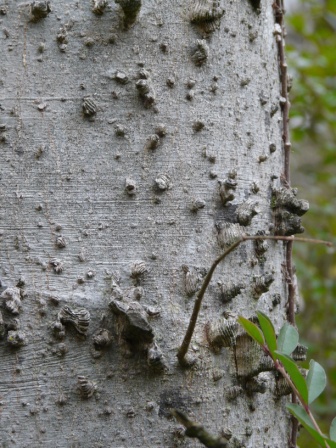
I’ve been using some salvaged wood to make repairs to the goat barn. One of the pieces seemed unusually light. I flipped it over and found a perfectly round hole on one side: the entranceway of a female Eastern carpenter bee, Xylocopa virginica.

The bee that left this hole used her mandibles to gnaw into the wood, then she slowly tunneled through the timber. I’ve seen these bees at work on the rafters of several of the small barns that we’ve built for animals and hay. On a quiet day in early summer you can hear the crunching of chitin on wood as the bees make their slow progress. Below the holes, small piles of sawdust accumulate.

I’ve seen many entrance holes, but never had the opportunity to see the extent of the tunnels inside. So I made a series of longitudinal cuts in my wood scrap, a 4×4 dissection of sorts. Inside, I found the tunnels extended about a foot away from the hole. One or two tunnels branched. This is an impressive hidden network, like a subway with just one exit. No wonder the piece of wood was so light.

The bees make these tunnels for their young. The female makes a ball of pollen and nectar, then lays an egg. All this is sealed into the tunnel with a slug of compressed sawdust. Once the passage is sealed, the mother leaves her offspring to their fates. These futures sometimes involve woodpecker beaks. The drilling of these hungry birds will finish what the bees started. The two species, bee and bird, are an anti-carpentry team. But I also think of these animals as supreme carpenters: they’ve been making homes from wood for millions of years and they spend their lives happily sprinkled with the sawdust of their labor. So they are both über- and anti-carpenters.

Away from wood, the bees do good work as pollinators. They are eager visitors to many species of flowering plant. Some farmers even erect pieces of wood to attract them into their orchards. I’m OK with a few at our place, but a year ago we had an invasion of battalions of barn-destroyers. So I relived my glory days of college squash-playing, dispatching them with a killer backhand from a dustpan. I felt bad, but not as bad as I would have had the barn needed rebuilding. These days we just have a few carpenter bees buzzing around and I leave them alone.

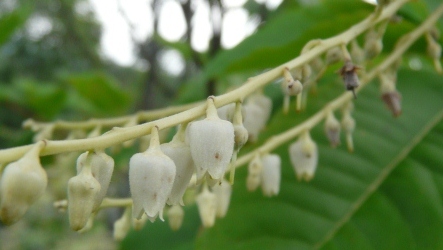
Sourwood in bloom

Most local trees bloom in the spring or early summer, but sourwood (Oxydendrum arboreum) waits until summer is well underway to grow its graceful clusters of small white flowers. These clusters arch out from the tips of twigs and, although each flower is quite small, the mass of flowers is visible from some distance. Bees love the nectar of this tree and in places where sourwood is plentiful “sourwood honey” is considered a fine complement to a slice of bread (I’m afraid that my bee-keeping knows no such temporal precision — whatever the bees gather over the course of the summer is what I get in the jar).

Sourwood is something of a botanical misfit. It grows as a small tree, yet its closest local relatives in the “Heath” family (Ericaceae) are all shrubs or tiny herbaceous flowers: mountain laurel, blueberry, azalea, wintergreen, and so forth. Like these kin, sourwood grows mostly on poor, acidic soils and relies on symbiotic fungi to help its roots find nutrients in these challenging conditions. Sourwood doesn’t quite fit with the “trees” either. Even when full grown, it is never as large as the oaks and hickories with which it grows; its trunk is seldom straight, usually leaning to one side; and, like its cousins the shrubs, it often sprouts more than one stem from the base.

The kinship to blueberries is evident in the flowers which are shaped like urns or bells. Unlike blueberries, sourwood fruits are, unfortunately, mere dry capsules.

Rejuvenating redwoods, dying oaks, The Grateful Dead, et al.

The last few posts have suffered from an excess of coherence and narrative continuity, so here are some true ramblings from Santa Cruz, CA (and for those who are still in awe of planetary motion, my last post also has some new Venus photos from a grad student that I met at the viewing at UCSC who kindly shared his images via email)…

Santa Cruz sits at the intersection of the cold ocean, the foggy redwood forests, and the blazing hot oak savannahs. Walking for thirty minutes in almost any direction will carry you into a new ecosystem. So variegation of microclimate is extreme.

San Francisco was built from lime and wood taken from this area, so almost all the forests are full of redwood trees growing in little clusters around huge, hundred-year-old stumps. The younger trees are still impressive: very very tall. There is almost no light in the understory, so even on a bright sunny noon, you gaze through the aromatic gloom. These trees drink water from the air. Even though their roots are dry, they get enough moisture from the near daily dousing in ocean fog to keep growing even in rainless months. How do we know this? The oxygen isotope ratios in fog differ from those in rain, so plant physiologists can read the isotopic “fingerprint” of oxygen in the trees, then deduce the source of water.

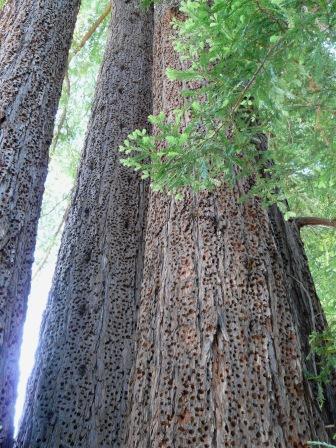
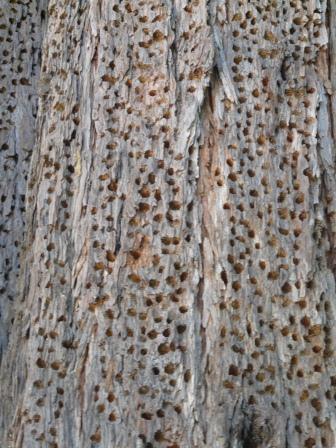
The redwood below has been adopted and turned into a granary by a family of acorn woodpeckers. Each hole is a storage place for an acorn. The family makes its nest in the tree then defends their nest, their stored food, and their honor from other woodpecker families, all of whom are thieves and cheats. Very much like Scotland, with less rain.

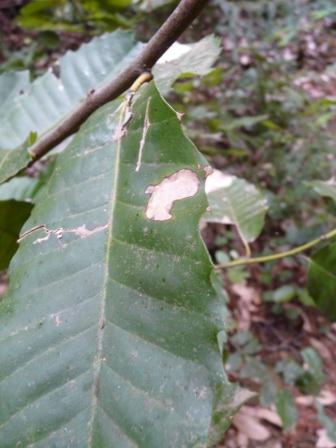
Oaks in California are being slammed by “sudden oak death,” a descriptive enough name for the disease (caused by an exotic species of protist, Phytophthora ramorum, the same genus that causes blight in potatoes, die-offs in peppers, and all kinds of destruction in many other tree species). The disease starts as lesions on leaves (these are tan oak leaves)…

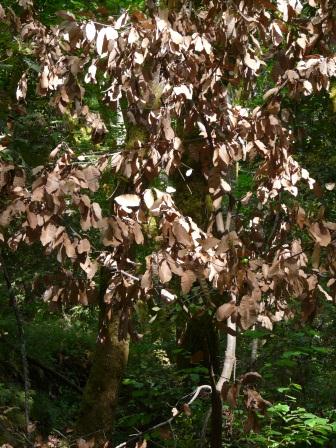
…then kills the whole tree in about a year. Most of the tan oaks in the understory seemed to have the disease. (And, yes, I thoroughly washed my shoes on my return to Tennessee).

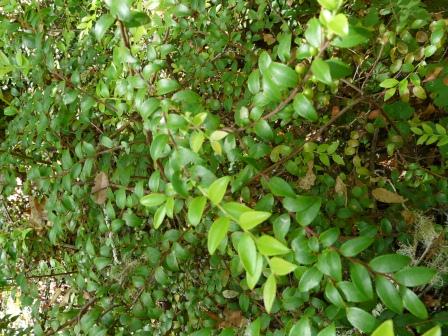
Other understory plants are doing much better. These are huckleberries, a close relative of the blueberry:

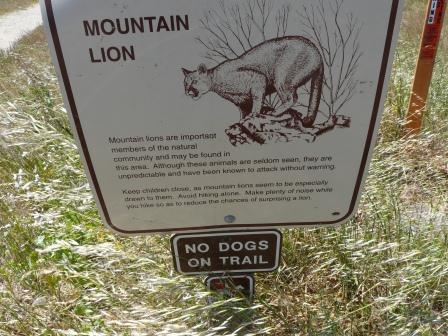
Mountain lions roam the woods and occasionally come into town. Warning signs are dotted over campus and the state parks. It is not clear whether the “no dogs” part of the sign is meant as a statement of a regulation or a summary of the outcome of past events:

The coast is continually raked by an incredible strong cold wind. Seabirds are abundant. These are Brandt’s cormorants:

Snails were common in the sandy coastal scrub. They were all, as far as I could tell, the invasive European immigrant, Cornu aspserum, the same species favored in France for eating:

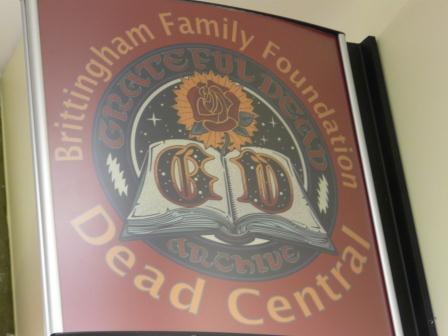
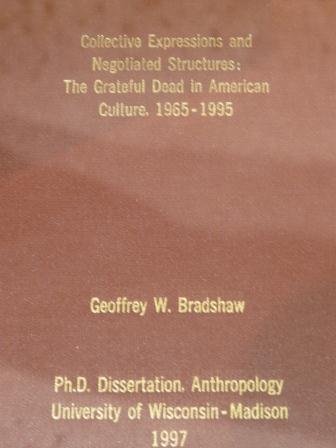
Back on campus, we briefly visited the University library and the Archives of the Grateful Dead, a carefully curated collection of posters, notes, letters, and so forth relating to the band’s long tenure. I was particularly taken by the Ph.D. theses. I know that several of the followers of this blog are Dead fans, so take note: the official opening is coming up at the end of June. There is a slight air of incongruence about an academic archive of Grateful Dead documents, but this strangeness, even dissonance, would have pleased Mr. Garcia, I think.

My visit to Santa Cruz was sponsored by the Department of Environmental Studies and initiated by the graduate students in the department who brought me in as their seminar speaker for this semester. Thank you. And special thank you to Leighton Reid and Rachel Brown who welcomed me and showed me around during my visit.

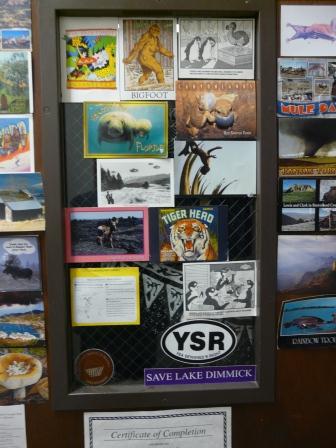
I’ll close with a shot of a door to a grad student office, chosen almost at random. Sewanee residents may remember those great students who protested the Lake Dimmick development, packing Convocation Hall and speaking with forceful clarity to the Regents. That spirit has now been carried to some far flung parts of the world.

“Under the spreading chestnut tree…” (via telescreen)

Hill Craddock and Tom Saielli visited Sewanee today with four hybrid chestnut trees to plant in our forest. Hill is in the Biology Department at UT Chattanooga and has worked for many years on American chestnut breeding and restoration; Tom is the Southern Regional Science Coordinator for the American Chestnut Foundation.

Photo credit for this photo and all others in this post: Buck Butler. Thank you, Buck!

Some backstory: the American chestnut (Castanea dentata) was formerly one of the dominant trees in our region, comprising half of all the trees in many forests. In some places the species grew in pure stands, a fact that is commemorated in many place names (Chestnut Ridge, Chestnut Hollow, etc). Chestnuts produced annual crops of tasty nuts and many animals depended on this massive burst of autumnal nutrition to make it through the year. In the late 1800s a fungus (Cryphonectria parasitica, an ascomycete) came into the U.S. on trees (of another chestnut species) imported from Japan. The fungus spread from the New York City area across the entire Eastern U.S., wiping out chestnuts as it went. From about 1900 to 1940, almost every tree was killed. The ecology of our forests was forever changed; other trees increased in abundance and many animal populations undoubtedly declined significantly due to the loss of the chestnut crop. These changes took place at the same time as the forest was being hit hard by unsustainable logging and grazing, so these were not happy decades for woodlands.

These days, the chestnut survives in the wild mostly as scattered small trees that grow for a few years, then get knocked back to their roots by the fungus. The fungus also infects scarlet oak, an unfortunate state of affairs because scarlet oak now acts as a continual reservoir of spore-producing fungus ready to attack chestnut saplings. A few large trees survive, either through luck or through the presence of a fungus-weakening virus that keeps the infection in check. But in the big ecological picture, the tree is functionally extinct.

All may not be lost. For many years now, scientists have been crossing the American chestnut (obtaining pollen and nuts from a few survivors) with the Chinese chestnut, a different species that is more resistant to the fungus. The resulting hybrids are indeed resistant to the fungus, but they have many characteristics of the Chinese parent that make them unsuitable for becoming true ecological “substitutes” for our lost Americans (e.g., their growth form is more bushy, they are more vulnerable to late freezes, etc). So, these hybrids (F1s, in biological lingo) are back-crossed to the American chestnuts for several generations (summarized here). These crosses produce plants that are nearly all American, with a few Chinese genes thrown in. The important step is then to pick out the offspring of these back-crosses that are truly disease resistant. This is where the trip to Sewanee comes in. Only by placing thousands of back-crossed seedlings in the forests, then testing them for disease resistance, can we ascertain which trees have inherited the right combination of genes.

So today we planted four seedlings in an area that had previously been cleared of planted pine. We hope in the future to establish a larger test area with hundreds of seedlings. The seedlings today were B3s — meaning that they are the result of three generations of back-crosses.

I’ll close with thanks to my colleagues Nate Wilson and Ken Smith who arranged for this visit and planting, and to Hill (in the green shirt above) and Tom for sharing their plants, their expertise, and their good cheer.

Trees in Oxford, MS

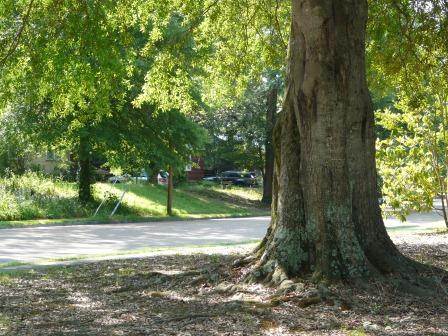
The number and stature of trees in Oxford, MS, is impressive. My stay was quite short, so my ramblings were brief, but it seemed to me that the sylvan nature of town extended well beyond the upscale neighborhoods. Urban trees and other forms of biodiversity are well-known to be associated with the more wealthy parts of towns (e.g., this and this study), so the presence of large trees in less affluent neighborhoods can be thought of as a measure of the “eco-justice” in communities: access to the practical and aesthetic benefits of nature.

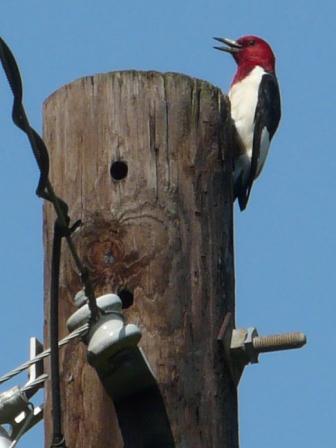
The large trees in the suburbs of Oxford attract a good diversity of bird species, including this red-headed woodpecker that was using the top of the power pole as a place to carry insects or seeds to jab with its beak.

The impressive tress in town contrast with much of the rural land in northern Mississippi where large plantations of loblolly pine dominate. These plantations are planted and cut like crops and, although they have more biodiversity than cotton fields, they generally host fewer species than native forests or residential areas (for my study of these differences on the Cumberland Plateau, see here).

Oxford’s wealth of trees didn’t “just happen.” The town has a tree board and a plan that not only seeks to preserve existing trees but also to expand plantings for the future. So, what lies behind the leafy charm of one of the most beautiful (and consequently one of the more prosperous) southern towns? Proactive urban planning, the work of loving the people and trees of the future.

To turn, turn will be our delight…

…’till by turning, turning we come ’round right.

This venerable cedar stands at the base of Shakerag Hollow, on the edge of an overgrown old pasture that has now turned to woodland. The tree’s original apex is pointing directly to the right and is almost rotted away. Decades ago another tree must have fallen on the main stem and bent the trunk down. Side branches then took over, growing straight up from what was formerly the side of the tree. The grain of the wood is contorted and twisted like old rope. Gnarly.

Bait

“’Hope’ is the thing with feathers,” so tells us Ms. Dickinson.

So, a bird feeder is a baiting station for hope. And why not invite wild, feathered dreams? Hope is also a classroom full of students eager to learn about feathers and other seemingly esoteric parts of the community of life.

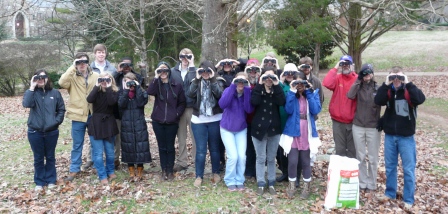
The 2012 Ornithology class, giving me some scrutiny. We'd just installed the feeder behind.

The feeder sits below the “moon tree” – a tree whose seed went to the moon (oh, curious journey), and is now back on Earth.

I imagine that no other tree on the planet is more relieved to have its roots worming through the soil of home.

The Hermitage…

…named by Andrew Jackson, 7th president of the United States, a man whose life did not manifest much affinity for the usual pursuits of a hermit. His original name for the house was “rural retreat,” so perhaps he always yearned for a little peace and quiet. The site is now not at all rural — Nashville’s growth has encompassed the area with urban and suburban development.

I visited The Hermitage with a group of faculty and staff from a variety of disciplines within the University. We discussed how we might involve our students in the ongoing study, preservation, and management of the site — internships, on-site classes, collaborations.

From an ecological perspective, sites like this provide “green” spaces within the more heavily urbanized surroundings. These areas can, depending on how they are managed, provide habitat for native species, “windows” of natural space in an otherwise human-dominated landscape. Just as important, they provide places where people can connect to the rest of the community of life, something that is not always possible in urban areas, particularly if those areas have not been planned with green spaces in mind. But there is a tension here: places that are preserved for historical reasons, like the Hermitage, are sometimes not open to the general public without a fee. So, unlike greenways, urban parks, and state natural areas, historical preservation sites are often off limits to many people. A management challenge is therefore how to maximize access while protecting the historical value of the site.

Slave quarters (formerly the early Jackson house), with an impressive understory of privet in the forest behind

Turkeys moved onto the site a few years ago and are now abundant, as are deer, groundhogs, and foxes.

Hackberry is the dominant tree in the forested areas. Its bark is characteristically "knobby" with corky projections

Hackberry

A few years ago, the Hermitage cleaned out this sink hole (>80 tons of garbage). Andrew Jackson's horse was reputed to lie at the bottom. The horse was never found, but when the wind settles down, the smell of the chemicals that were dumped down there wafts up. Humans have been dumping history into this hole for generations.

Jackson did not like to spend money unnecessarily. The columns on the front of the main house are wooden, painted with sand-encrusted paint to make them look like stone. The "marble" inside the house is cleverly painted wood. The "mahogany" doors are faux. Perhaps there is a reason why Jackson was the only president to pay off the national debt...
Music City, early 1800s. The family room.

Old Hickory subdivided -- a few steps down the road. The real estate market is not necessarily friendly to green space, although many studies have shown that open spaces not only increase people's quality of life, they improve "home values" as measured in dollars.

Mistletoe

A single mistletoe plant is growing near the top of an ash tree behind Shenanigans and Woody’s Bikes. Mistletoe is not common in Sewanee, although it can be quite abundant on the lower slopes of the coves.

American mistletoe, Phoradendron leucarpum (literally, the "white-seeded tree thief")

Recently, biologists have realized that mistletoe is a very important part of the ecology of forests. In fact, mistletoe has such a major effect on other species that it has been called a “keystone species,” one of the major determinants of a forest community’s vitality. How so? Mistletoe steals some of its host tree’s food and combines this with the food that it makes for itself through photosynthesis. This combination of a big trust fund (the tree) and a steady job (the mistletoe’s own leaves) allows the plant to live large, offering abundant nectar in the early spring and fat, nutritious fruit later in the year.

Bees love the nectar which comes earlier in the year than the nectar of most other flower species. Birds and many climbing mammals adore the fruit. The pulp of the fruit is sticky, ensuring that it will stick to branches after it has passed through the bird. More, the seed is often so gummy that it sticks to the birds’ feathers. Birds have to grab the seed, then wipe it off on a branch — a perfect way for the mistletoe seed to get placed exactly where it needs to be. So, this small plant is used by dozens of invertebrate and vertebrate animals. One butterfly, the great purple hairstreak, has gone so far as to become wholly dependent on the plant. Its caterpillars will eat nothing else.

In other parts of the world, including the western U.S., different mistletoe species provide a similar range of services. Some even provide favored nesting areas for many birds. A review of mistletoe biology a few years ago stated that, “…the widespread perception of mistletoes as destructive weeds needs to be challenged. Many landholders, managers, and even biologists regard mistletoes as invasive pests, damaging to individual trees and detrimental to forest health. [But] …mistletoes have a substantial positive role in many forests and woodlands, and should be given appropriate recognition.” (from: Watson, D. M.. 2001. Mistletoe — a keystone resource in forests and woodlands worldwide. Annu. Rev. Ecol. Syst. 32:219–49)

Of course, mistletoe has other roles in the ecology of our world. So, I’ll sit and do my end-of-semester grading under the thief, ever hopeful that songbirds will visit.

Lynn Margulis: an appreciation

Our experience of the world is mediated through stories. Stories (also called theories by those who need a patina of scientific respectability) tell us how the world came to be, how it works, and what its fundamental rules are. Once is a while, someone comes along who so fundamentally changes the nature of our guiding stories that our life experience is transformed. Lynn Margulis, who died two days ago, is such a person.

Margulis taught us the importance of symbiosis in biology — the union of two or more different species into a new form. Her views were dismissed, ridiculed, and ignored for years. Finally, some of her ideas prevailed, although she continued to receive sniper fire for her penchant for questioning dogma.

Now, thanks largely to her, we understand that every living species is, at some level, the result of symbiotic fusion and union: all animal, plant and fungal cells have ancient bacterial cooperators hidden within; trees are united to fungal helpers below-ground; the animals that build coral reefs cannot survival without algal partners; insects are partly nourished by symbiotic gut bacteria; and even DNA itself appears to jump among species, intertwining radically “different” species into new entities. These processes happen in every part of life’s delta, but are particularly powerful among Margulis’ favorite creatures, the so-called “microbes” (the true “99%”).

Our metaphors have to shift. The “tree” of life? No, life has too many cross-connections among distant branches. An unstable, flowing delta is a better image. Evolution as a capitalistic competition among individuals? No, there are as many unions as robber barons; self-interested cooperation is rife.

As a small homage to Margulis, here are some of my DNA sequence data from the mitochondria of land snails. These are the color-coded “letters” of the DNA alphabet found within the ancient bacteria that live inside every cell in a snail’s body. But this description is misleading: the bacterial cells truly don’t “live inside,” instead they have melted their bodies into the other, creating an individuality-destroying symbiosis. Thank you, Lynn Margulis.

Each row is the DNA from one individual. Each column is one position along the DNA stand. The different "letters," A, T, C, and G, are color-coded.

For more on Margulis’ life, see John Horgan’s blog entry at Scientific American. He has some nice insights. The NY Times has a shorter obituary.