Tag Archives: sewanee

Class exercise: Erasure poems from Kathleen Jamie’s “Findings”

This week I asked my students to create erasure poems from five chapters of Findings, Kathleen Jamie’s fabulous collection of essays on “the natural and unnatural world.” An erasure poem retains the words and word order of the original, and removes all but a small portion of the text. The task for the students, therefore, was to read the essay with close attention to the particularities of each word, while keeping an eye on how these words build into meanings and stories. The exercise is one more way of attending to a text, then using this attention to create new work. An inward movement, listening, then an outward gesture of response. We ended the class by reading the resulting poems aloud, with silence between readings. I found the readings particularly interesting and beautiful: hearing familiar and esteemed essays through the ears and minds of my students.

Click on the thumbnail images below to view a slideshow of the students’ work.

Flocks of locally-grown red junglefowl arrive in McClurg Hall

Thanks to the work of University of the South Executive Chef Rick Wright, along with his colleagues, local foods are gracing our dining hall. This year, the University will use about 20% of the food-purchasing budget in the local farm economy, a flow of $300,000. A few years ago, that number was zero. Next year, we’re on track for 30%.

This Sunday, fried chicken, along with squash from the University farm, was on the menu, a celebration of the fall harvest. Thank you Chef Rick Wright, Farm Manager Carolyn Hoagland, and the many staff, students, and administrators whose work is reorienting campus dining away from the outlet pipe of the industrial food system and toward Tennessee’s fields.

2015-11-08 chicken 007 2015-11-08 chicken 010 2015-11-08 chicken 011

Powerpoint begone! Welcome, scorpions.

Extreme makeover for the curriculum: we tossed out the lectures and replaced them with embodied experience. Students in Field Investigations in Biology (one half of our introductory biology course sequence) have for several years now been tromping the woods, measuring skulls, and poking around in the sewage treatment plant, experiencing ecology, evolution, and biological diversity through feet, noses, ears, and hands. Why not use the apps that came installed (free!) in our bodies. We’re not yet brains-in-jars.

One of the sites that we visit is near Sewanee’s “Piney Point.” Near the point is a sandstone outcrop, home to plants and animals with a taste for lichen-crusted pizza stones. The exposed rock blazes. Fence lizards bask, Cladonia lichen crinkles.

Limbs shed from drought-twisted pines provide cover for animals on the hottest days. To supplement this meager shade, we’ve lain a few small plywood boards at the site. The boards are class-lures. There is nothing like prepared spontaneity. Let’s lift the board: oh my, scorpions! Who knew?

2015-09-19 scorpionDuring last week’s class, Kirk Zigler, my colleague and fellow poker-under-boards, found not only solitary scorpions, but paragons of arachnid family values. I had to scuttle out there to see for myself.

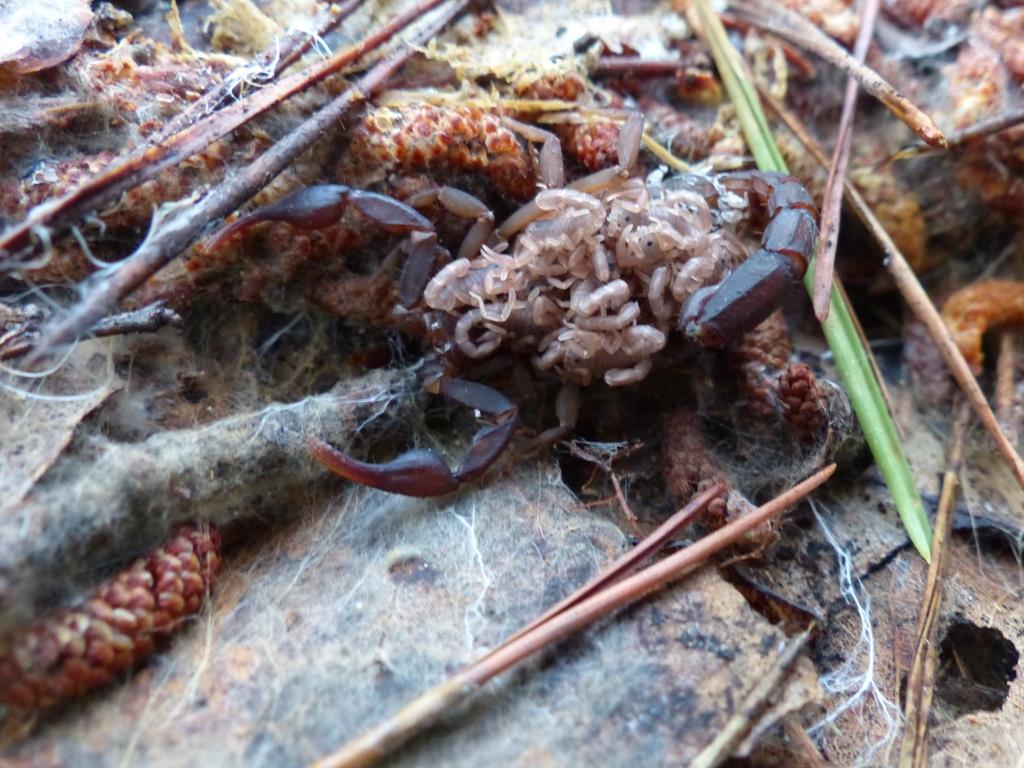
2015-09-19 scorpion with babies 011Scorpions jockeyed by their babies. The youngsters cluster on their mothers’ backs, finding refuge under the stinger. Each juvenile has its own curled, spiked tail. The overall effect is a jumble of gramigna pasta. The dish simmers with enough promise of spicy mouth-feel to deter even the more reckless eater.

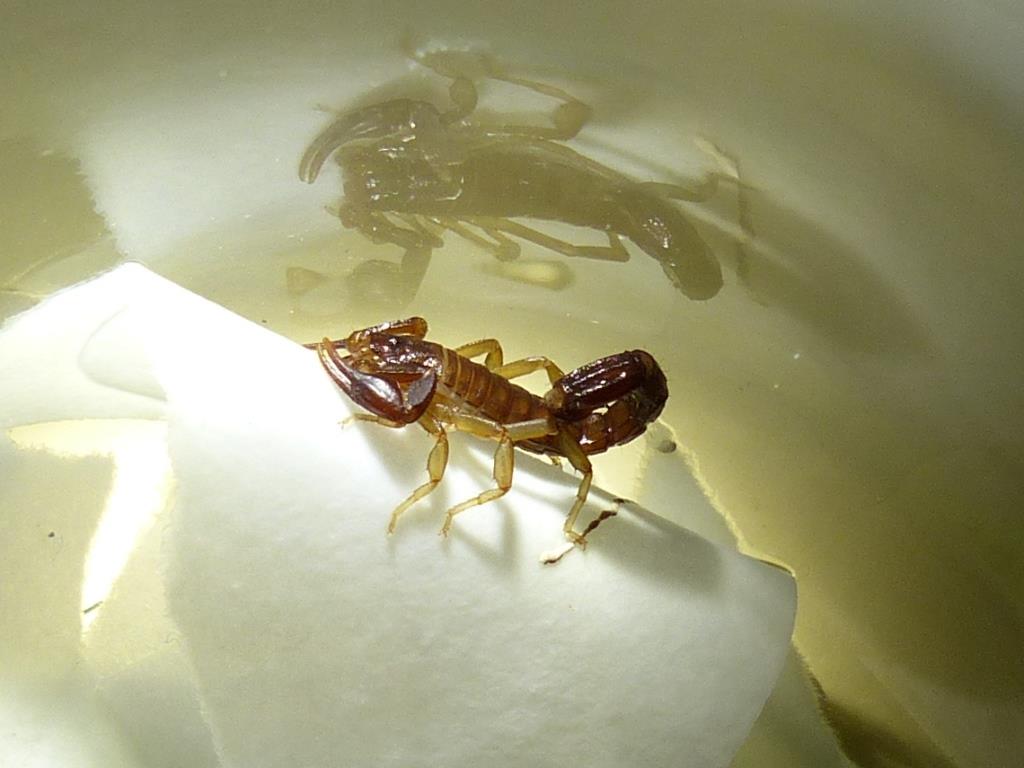
2015-09-19 scorpion with babies 017Where-ever exposed rock meets jumbles of downed wood, scorpions will thrive. If your house happens to sit next to such a site, expect guests. Lydia Boroughs saved one such creature for me to show-and-tell in class and then photograph.

Archno-Adonis mirrored by a flashlight’s glare:
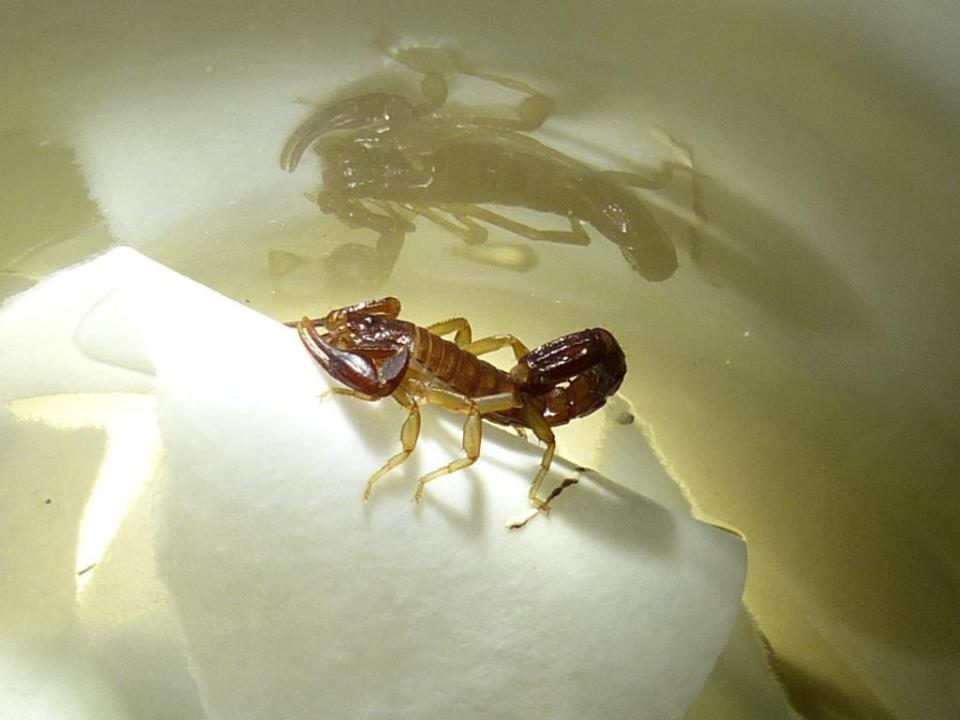
2015-09-04 scorpion 003The same scorpion, under ultra-violet “blacklight”:

2015-09-04 scorpion 022Ring-like molecules in scorpions’ exoskeletons snare the ultra-violet light, then throw it back as a blue-green glow. It’s unlikely that such a trick evolved just to amuse bulb-wielding primates. One explanation is that the glow lets scorpions receive and detect low levels of light, using their exoskeleton as another “eye.” When UV light levels are high,  scorpions hide, sitting out the bright day and sunset. Even when white light is absent, the animals detect and respond to ultraviolet.

This is a curious arrangement, but no stranger than the rest of the scorpions’ visual system. Scorpions have both median and lateral eyes. The median eye sits in the center of the “back” and forms images of high visual acuity. The lateral eyes vary considerably in number from species to species and are used to perceive subtle differences in light intensity at night, presumably letting scorpions orient as they forage at night and calibrate their daily clocks. The UV-gleamed exoskeleton shines into these lateral eyes, opening a new dimension of vision.

In searching for the latest information about scorpion eyes, I discovered that the most comprehensive study of their evolution and taxonomy was recently published by Stephanie Loria and Lorenzo Prendeini. Stephanie is a friend and former student now completing her PhD on scorpion biology at the American Museum of Natural History in Manhattan. Peering under cover-boards on Sewanee’s sandstone can be addictive… and lead to some interesting places.

 

Fireworks echo through cellulose and chitin

I recorded the Sewanee annual firework display at a lookout spot across a mountain cove from the detonations. Before the pyrotechnics, the katydids made my ears ring, but the explosions out-shouted even the combined acoustic power of tens of thousands of singing insects.

Here is the finale of the show:


(email subscribers, here is a link to the sound, or click on the page title to go to the site)

If you listen with earphones, you’ll hear the low-frequency roar of the fireworks rushing down through the mountain cove for five long seconds after the blast. From where I sat at the Proctor’s Hall rock, the echo ran from right to left, flowing down, like a dark bird launching from the cliffs to the fields below the cove.

Thank you to the Sewanee Volunteer Fire Department for their annual extravaganza of sound and light.


Log walkers

I’ve had an infrared-triggered camera set up in Shakerag Hollow for the last few months. The camera takes photos of animals as they climb along or walk around the fallen ash tree. The camera takes color pictures during the day, then at night uses an infrared flash that is invisible to animals.

The huge log is quite a highway. Squirrels are by far the most abundant creatures, but others also make appearances.


This slideshow requires JavaScript.

Pollinators, come get it

Shakerag Hollow continues its tumble through spring. The earliest blossoms are gone and fruits are fattening in their place. So goes the bloom of youth. The later flowers have now stepped forward and are waving for all they’re worth at the motley collection of pollinating bees, wasps, and flies. A few of my favorites:

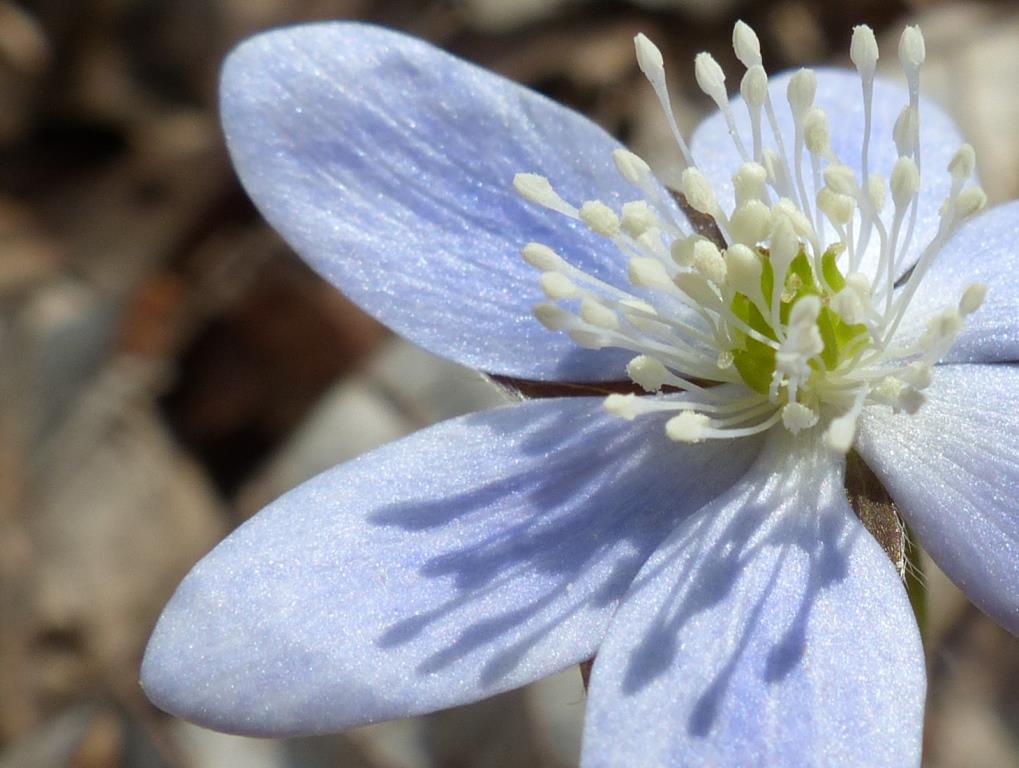
Hepatica. Most bloomed weeks ago; a few persist.

Hepatica. Most bloomed weeks ago; a few persist.

Larkspur. So violet it makes your eyes hurt.

Larkspur. So violet it makes your eyes hurt.

Wild geranium. A lighter shade of pale?

Wild geranium. Violet calmed.

Spotted Mandarin. Coolest name in the woods.

Spotted Mandarin. Most fabulous name in the woods.

Celandine poppy. The zenith.

Celandine poppy. The zenith. The nonpareil.

Late-blooming catchflies (and STDs?)

The south-facing sandstone cliffs of the Cumberland Plateau soak up heat all summer, then bathe the early winter forest in emitted warmth. Trees close to the cliffs keep their leaves for weeks after others have turned bare. Joseph Bordley and I took a walk along the cliffs yesterday to see what might be stirring. One of our finds were these round-leaved catchflies, Silene rotundifolia, growing out of cracks in the rock face. They’re still in bloom, although their pollinators (mostly hummingbirds) are long gone. A phenological time warp in the cliffs’ bubble of heat?

silenerotundifoliaThese plants might have caught more than flies. The anthers seem too fuzzy and purple for normal pollen. I’d welcome insight from botanists: does this look like normal Silene to you? If this is an infection, anther-smut fungus is the culprit.

silenerotundifolia1silenerotundifolia2The smut fungus infects cuts off the normal process of pollen production and converts the anthers to fungus spore factories. The spores are purple, hence the species name Microbotryum violaceum. The ovaries are also destroyed or damaged, so the plant is sterilized by the infection.

Microbotryum smut fungus is a sexually-transmitted disease, the gonorrhea of flowers. As bees, flies, or hummingbirds move among flowers they carry with them not just pollen, but unwanted fungal colonists. The pollinators’ promiscuous feeding habits makes them ideal transmitters of disease, poxed Don Juans that plants cannot turn away.

A study of herbarium records found that incidence of the fungus has increased over the last century in two closely related species, S. virginica and S. caroliniana. In Europe, the fungus seems to have spread northward after the last ice age, following its host plants as they expanded their range. Whether that is also true in North America is not known.

Apparently, the disease has not been found in S. rotundifolia, so I’m particularly keen to hear from readers who can comment on whether or not the anthers in the photos above are infected.

Bibliography:

Antonovics, Janis, Michael E. Hood, Peter H. Thrall, Joseph Y. Abrams, and G. Michael Duthie. 2003. “Herbarium Studies on the Distribution of Anther-Smut Fungus (Microbotryum Violaceum) and Silene Species (Caryophyllaceae) in the Eastern United States.” American Journal of Botany 90 (10) (October 1): 1522–1531. doi:10.3732/ajb.90.10.1522.
Vercken, Elodie, Michael C. Fontaine, Pierre Gladieux, Michael E. Hood, Odile Jonot, and Tatiana Giraud. 2010. “Glacial Refugia in Pathogens: European Genetic Structure of Anther Smut Pathogens on Silene Latifolia and Silene Dioica.” PLoS Pathog 6 (12) (December 16): e1001229. doi:10.1371/journal.ppat.1001229.


Invasion of the ladybugs. UN treaties violated.

An airborne invasion of ladybugs has turned Sewanee into a pointillist’s drunken joke. Our house has several thousand of them jostling on the southern wall, with a few hundred making their way through hidden cracks to the interior. As I type, they bombard the keyboard. Walking outside, I get them in my hair, down my shirt, into pockets.

2013-10-30 ladybugs 014

A plague of coleoptera? That seems to be the general opinion in town, with calls for  chemical weaponry not far behind. More on that later.

Who are these creatures? They are Harlequin ladybird beetles (Harmonia axyridis), also known as Asian ladybugs or multicolored lady beetles. They’re looking for shelter over the winter. Any crack will do. The more the merrier: they call to each other with chemical attractants, possibly because there is safety in numbers.

These insects were first brought from east Asia to America in an attempt to enlist them in our never-ending fight against aphids. So the legions of ladybugs banging against our walls are a testament to the foresight of the USDA and a witness to the prodigious numbers of aphids that, despite their new Asian foes, crowd like feedlot cows on twigs and flower stems.

If swarms of colored beetles were a rare occurrence, the military-industrial-wedding-complex would be charging big bucks for uplifting releases of these merry air-dancers. No such luck: these insects have crossed the cultural threshold that divides purty from plague. How to deal with them? Some companies make lures and traps, decoying the beetles with a mimic of their aggregation pheromones. I have no experience with these devices, but I suspect that they are only partly successful. Like a liquor store on the edge of a college town, you’ll grab some of the swarm, but many others will BYO and head straight to the party. Vacuums work well on smaller swarms and a mesh or nylon stocking placed inside the suction tube (trap it between tube sections) will keep the doomed beetles out of your bag. Or just wait and they’ll disperse or die on their own. Eventually.

But this is not just a story about Homo vacuumus. These beetles may quite literally have a silver lining. Their ecological success is partly due to their invulnerability to disease, a super-power conferred by their “hemolymph” (insect blood). The potency of this vital essence is easily confirmed: poke a beetle and see the defensive yellow ooze of blood emerge from chinks in their legs, staining your hand and releasing a powerful odor. Studies of the antimicrobial properties of the blood show that it contains a chemical, harmonine, that inhibits both TB and malaria. Knowing this, I pick the ladybugs out of my hair with new found respect and even a sense of hope that medical wonders may yet emerge from the entomological onslaught.

The weaponry story does not end here, though. These insects not only carry chemical defenses in their blood, they may also attack competitors with biological weapons. A microbe that lives peacefully on the harlequin ladybug appears to be lethal to native ladybugs. When these natives prey on the eggs of the harlequin ladybug, the microbe attacks and death follows.

In sum: we’re under attack from insects that are in violation of multiple international arms agreements. Enjoy the spectacle.

2013-10-30 ladybugs 015

Orchid seeds

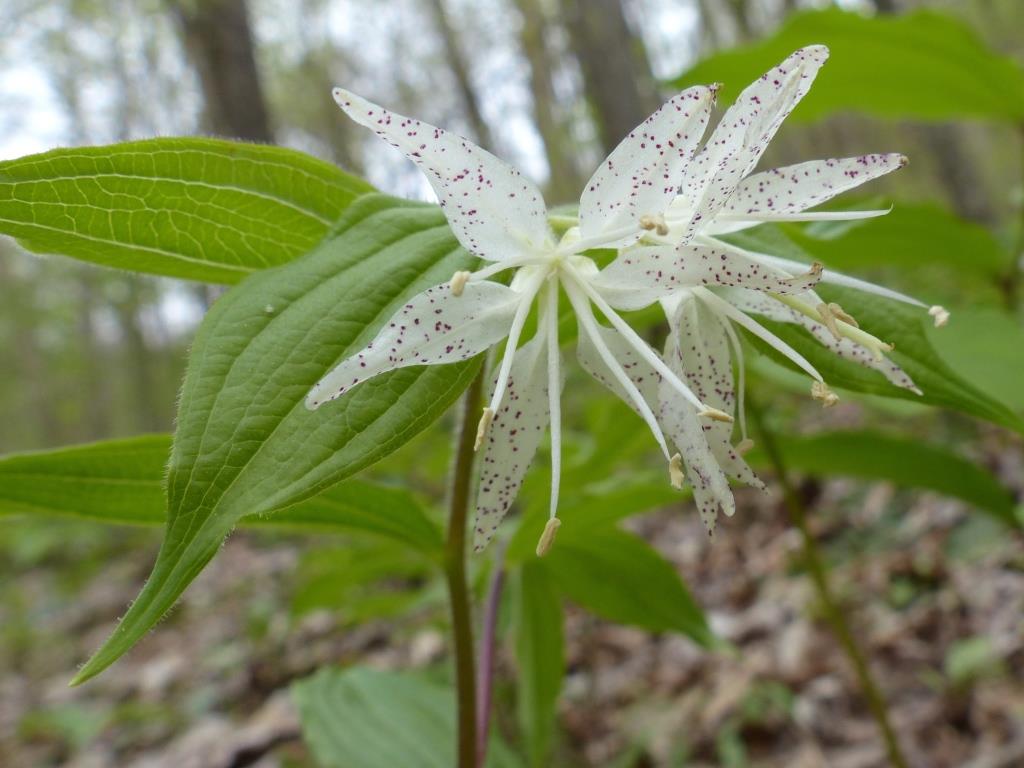
My ankle brushed against the dried flower stalk of a cranefly orchid and puff! a cloud of sandy dust billowed across the surrounding leaf litter. I got down on the ground for a closer look: the orchid’s fruit capsules were mature and starting to split apart.

Each capsule is roughly the size of a pinto bean. Inside are thousands of seeds. To the naked eye the massed seeds look like piles of very fine sawdust; with a squint we can make out the individual seeds. A camera lens and digital zoom lets us see a little closer.

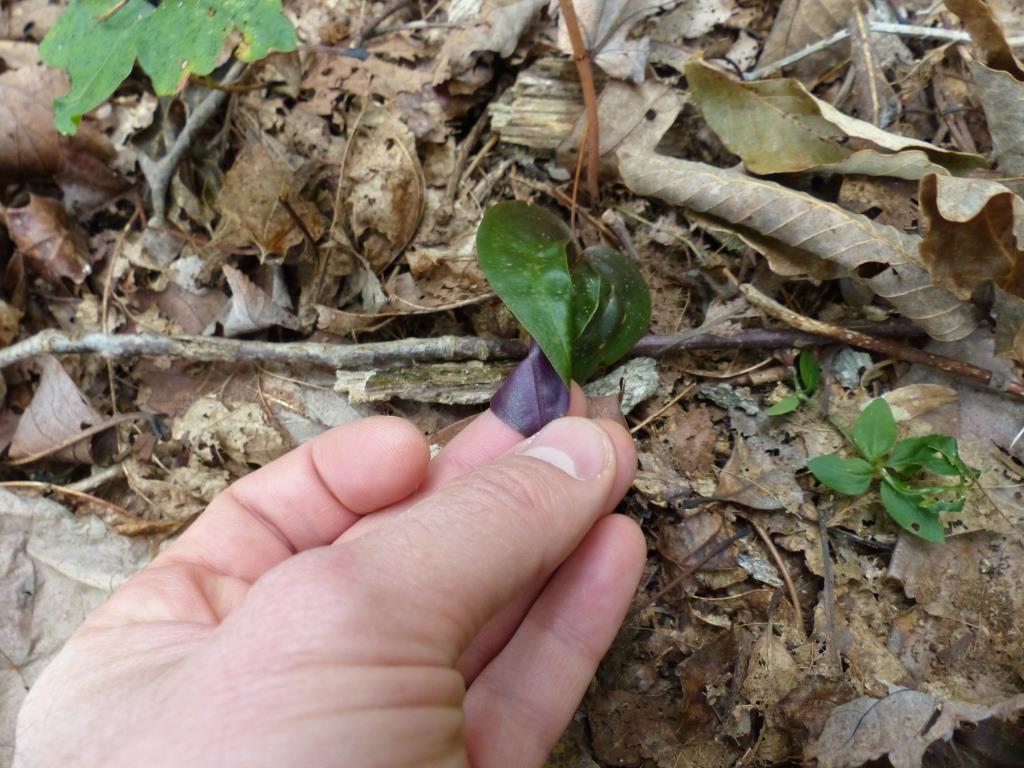
Cranefly orchid leaf with its distinctive purple underside. The leaf appears in fall then dies in the spring.

Cranefly orchid leaf with its distinctive purple underside. The leaf appears in autumn then dies back in the spring.

Cranefly orchid capsule, split open and shedding seeds.

Cranefly orchid capsule, split open and shedding seeds.

Thousands of seeds in one capsule.

Thousands of seeds in one capsule.

A tiny puff of air is all they need to take flight.

A tiny puff of air is all they need to take flight.

These seeds owe their existence to pollination by noctuid moths. The moths suffer the indignity of carrying orchid pollen on their eyes. The cranefly flower has a slight twist and the direction of this twist determines whether the left or the right eye of the moth receives the pollen.

The wind-blown seeds’ future depends on where they land. Successful growth requires (or is greatly helped by) the presence of decomposing wood, so this orchid is one of thousands of species in these forests that depend on old logs and fallen branches.

Regular readers of Ramble will be interested to know that this orchid’s only close relatives live in east Asia. It joins many other plant species in reminding us of the ancient connections between the forest of the southeastern US and those of eastern Asia.

The abundance of orchid seeds has impressed botanists for centuries. Here is Charles Darwin calculating that one plant could in a couple of generations of unchecked seed production “clothe with one uniform green carpet the entire surface of the land throughout the globe.”

“[seeds] are produced by orchids in vast profusion. Not that such profusion is anything to boast of; for the production of an almost infinite number of seeds or eggs, is undoubtedly a sign of lowness of organisation, … a poverty of contrivance, or a want of some fitting protection against other dangers. I was curious to estimate the number of seeds produced by some few Orchids; so I took a ripe capsule of Cephalanthera grandiflora, and arranged the seeds on a long ruled line as equably as I could in a narrow hillock; and then counted the seeds in an accurately measured length of one-tenth of an inch. In this way the contents of the capsule were estimated at 6020 seeds, and very few of these were bad; the four capsules borne by the same plant would have therefore contained 24,080 seeds. Estimating in the same manner the smaller seeds of Orchis maculata, I found the number nearly the same, viz., 6200; and, as I have often seen above thirty capsules on the same plant, the total amount would be 186,300. As this Orchid is perennial, and cannot in most places be increasing in number, one seed alone of this large number yields a mature plant once in every few years.

To give an idea what the above figures really mean, I will briefly show the possible rate of increase of O. maculata: an acre of land would hold 174,240 plants, each having a space of six inches square, and this would be just sufficient for their growth; so that, making the fair allowance of 400 bad seeds in each capsule, an acre would be thickly clothed by the progeny of a single plant. At the same rate of increase, the grandchildren would cover a space slightly exceeding the island of Anglesea; and the great grand-children of a single plant would nearly (in the ratio of 47 to 50) clothe with one uniform green carpet the entire surface of the land throughout the globe. But the number of seeds produced by one of our common British orchids is as nothing compared to that of some of the exotic kinds …  What checks the unlimited multiplication of the Orchideæ throughout the world is not known.”

(p. 277-279 in Darwin, C. R. 1877. The various contrivances by which orchids are fertilised by insects. London: John Murray. 2d edition, quote from the Darwin-Online archive.)

Emerging from the underworld

They’re back. Cicadas are crawling out of the hypogeal darkness. Summer must be coming, hidden somewhere behind the cold, rainy clouds.

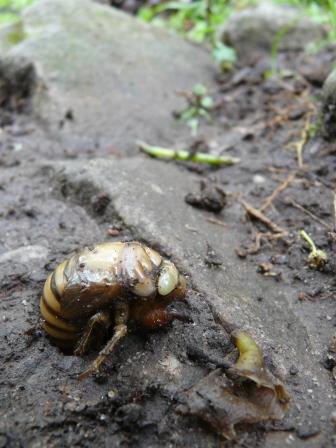
Cicada emerging 009 This pallid nymph was hauling itself out of a hole in the trail. The front legs are mole-like: sharp-edged shovels. After the insect’s molt, which usually happens shortly after emergence, the shovels will turn to grappling hooks, a more elongate form suited to clambering in trees. The molt will also equip the adult cicada with wings (wing buds are visible on the nymph’s back in the photo above).

Cicada emerging 013This is a so-called “annual” cicada, a name that belies the two or more years that the nymph has spent below ground. Although individual cicadas take more than one year to develop, there are multiple cohorts present in every location, so at least some of them emerge every year. This contrasts with the “peridocial” cicada species whose cohorts are synchronized, emerging every thirteen or seventeen years. Sewanee had one such emergence back in 2011. The New York region is due for an emergence this year, so we can expect some cicada media coverage in the coming weeks. (To find out whether or not you’re in the emergence area, see here for maps of the various “broods” of periodical cicada — the NY brood for 2013 is Brood II.)