After many inches of rain, the streams in Shakerag Hollow were roiling and roaring as I walked through the hollow just after dawn this morning. Many of these streams are completely dry for most of the year. All the diffuse, gentle energy of rain has been channeled into vigorous, pounding flow.
Author Archives: David George Haskell
Woods Reservoir Trip
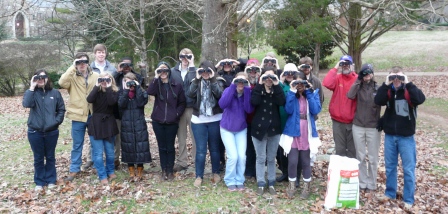
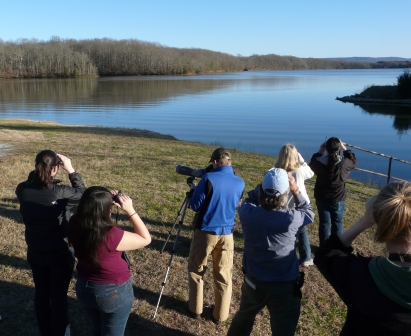
Yesterday, I took my Ornithology class to Woods Reservoir to look for ducks and other waterbirds. Many of these species overwinter here in the south before heading back north to breed in the boreal forest, the prairie-potholes, or the arctic. The weather was as warm and balmy as I’ve experienced in January and the duck count reflected this: we see fewer ducks during extended warm spells, presumably because they have not been pushed south by hard weather up north. However, we did see a good assortment, with the coots leading the count, as usual.
Many of the waterbirds that we saw are fish-eaters (loons, grebes, herons, mergansers). Unfortunately for them, Woods Reservoir is contaminated with PCBs and the fish bioacummulate these toxins and pass them up the food chain to the birds. The PCBs came from the Air Force’s Arnold Engineering Development Center (Woods Reservoir was built in 1952 to provide cooling water for the site). The Tennessee Department of Public Health has issued an advisory that recommends no human consumption of catfish caught from Woods Reservoir. They recommend that consumption of other fish species be limited to one fish per month. The birds (and the many fishermen at the lake) have evidently not heard this advice.
PCBs are found in the lake sediment and fish accumulate these pollutants in their bodies, especially in fat. Manufacture (but not use) of PCBs was banned in 1979, but the chemicals are very persistent, so linger in many ecosystems. PCBs were used at AEDC from approximately 1952 to 1990 and they are believed to have entered Woods Reservoir via streams draining contaminated soil at the site (2007 TDEC report).
Two non-duck highlights were a Bald Eagle and a Northern Harrier. The eagle gave us a great display, soaring in great ascending circles over the lake against the blue sky. Its slow, self-assured flight and eight-foot wing span embodied unfashionably grand qualities: majesty, imperialism, and hauteur. Bald Eagles may be ill-tempered, bad-breathed fish-scavengers, but they’re awesome nonetheless. The harrier flew across the lake with lazy wing beats as the sun set.
Chocolate in trouble?
Melt a square on your tongue and immediately you’re connected — to your own senses, but also to the other species and other people who made possible the experience. Your chocolate community includes: the cacao tree, the bacteria that fermented the pods to unlock the goodness inside, the tropical South American forests where the tree evolved, the midges and bats that pollinate the tree, the Olmec people of Mexico who domesticated the plant two or more thousand years ago, the soil and air of the farms in Africa, Asia, or South America where the atoms in the chocolate in your mouth last resided, the hundreds of people, living and dead, who developed and implemented modern preparation methods. Like the taste itself, this web is almost too rich to fully grasp.
But, all is not well in the world of chocolate. The latest issue of Scientific American (print only — the choc feature is not yet online) contains an article by scientists at Mars (yeah, yeah, Venus is next issue) detailing some of the challenges faced by the cacao tree. Domesticated cacao is not very genetically diverse, so disease is rampant. Some areas of Brazil have had their trees almost completely destroyed by fungi. Climate change and shifting socio-economic conditions are both projected to further threaten the crop.
The article suggests a number of ways of addressing these problems, mostly focused on genetics (the cacao genome was recently sequenced) and changed production practices (getting more fertilizer and fungicide into farmers’ hands). Some of these avenues seem sensible — finding new disease-resistant variants — but others have some hidden costs that the paper does not address. In particular, one of the proposed solutions to the problems of cacao is to “creat[e] large plantations…at higher altitude..in the full sun and irrigat[e] them with fertilizer-enriched water.” But, high elevation tropical forests are some of the richest places in the world for biodiversity and this diversity is almost entirely annihilated when forests are converted to monocultures of cacao (or to other crops like full-sun coffee or palm oil).
Interestingly, more traditional methods of cacao cultivation can, according to Smithsonian scientists Robert Rice and Russ Greenberg, support “a greater diversity of tropical forest organisms…than most other lowland tropical agricultural systems.” What makes the difference? These traditional farms grow cacao under a canopy of shade trees. Shade trees provide habitat for many other forest-dwelling species. According to Rice and Greenberg, cacao farms that “incorporate a high diversity of trees with animal dispersed and pollinated fruits and flowers, along with retaining epiphytes, lianas, and mistletoes, will support the greatest diversity.” Further, in places where native forest is entirely gone, shade-grown cacao (and shade-grown coffee) farms provide the only remaining habitat for many species.
Deforestation not only hurts the legions of other species that live in the tropics, but it destroys the wild relatives (and progenitors) of our domesticated crops. So, even from a purely agricultural perspective, loss of wild populations of cacao hinders our ability to find the new genetic variants needed to produce the chocolate of the future.
If loss of biodiversity doesn’t give reason enough to question large technified plantations, then socio-economic factors might. The recommendation to remove shade cover and to increase fertilizer use has, in some cases, not worked in the past: it provides, at best, a short term fix. At worse, it could replicate the coffee boom and bust that drove many farmers from their lands a few years ago.
Unlike coffee, there is no system of certification for “shade-grown” cacao. “Organic” chocolate is more likely to be shade-grown and responsibly produced, but this is an imperfect signal. So, information for responsible consumers is hard to come by.
Should we therefore stop eating chocolate? Ouch — I hear a chorus of wailing. Instead, perhaps, could we eat less chocolate, of higher agricultural and gastronomic quality? I’d say, yes. The problem of deforestation is driven largely by quantity — demand for chocolate is higher than ever. Moderation of our consumptive desires might be part of the answer.
The scientific name for cacao is Theobroma, “God food.” I vote that we treat it as such.
…sometimes the gap between the potential for transcendent sensory delight and our culture’s delivery of this potential leaves something to be desired.
Bait
“’Hope’ is the thing with feathers,” so tells us Ms. Dickinson.
So, a bird feeder is a baiting station for hope. And why not invite wild, feathered dreams? Hope is also a classroom full of students eager to learn about feathers and other seemingly esoteric parts of the community of life.
The feeder sits below the “moon tree” – a tree whose seed went to the moon (oh, curious journey), and is now back on Earth.
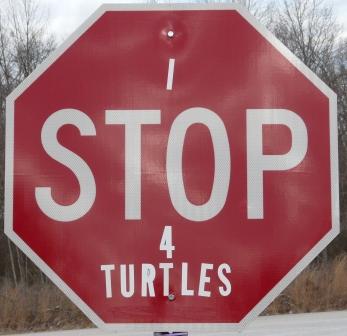
Sign bandit…
…of Highway 156, I salute you. They need all the help they can get.
Needle ice, springtails, and sunshine
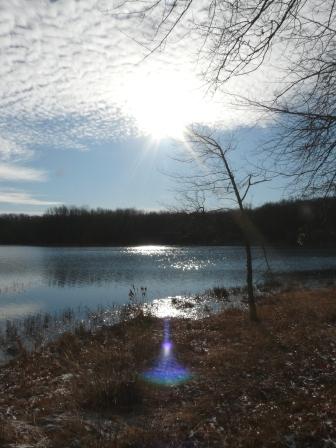
The temperature dipped into the teens last night, so my walk on the new trail to Lake Dimmick was an invigorating one. The trail is not officially open yet, but it runs from the perimeter trail (paved portion) out past the firing range, across JumpOff Rd, then skirts Lake Jackson to get to Lake Dimmick.
Ice needles were abundant on the sandy old road beds and in bare soil around the lake. These needles form when the air is freezing and the water in the soil is still unfrozen. As the aboveground water freezes in the chilly air, it wicks more water up from the soil. The pull of capillary action keeps the water moving upward, creating vertical columns of ice. Soil particles get carried up by the rising ice.
The edge of the lake was iced over, but springtails (Collembola) were clustered on the ice and in small pools where water had seeped up. These tiny arthropods (barely visible with the naked eye) use a spring-loaded catapult on their bellies to jump around on the water surface. Springtails feed mostly on decaying plant material and on the microbes that live in the soil. In some habitats, they are the most abundant animal by far, reaching densities of tens or hundreds of thousands per square meter. They are very vulnerable to desiccation, so they hang out either below the soil surface or close to (and on) water.
The sun came out, finally. It has been a full ten days since I last felt it on my face. Welcome back, friend.
The Hermitage…
…named by Andrew Jackson, 7th president of the United States, a man whose life did not manifest much affinity for the usual pursuits of a hermit. His original name for the house was “rural retreat,” so perhaps he always yearned for a little peace and quiet. The site is now not at all rural — Nashville’s growth has encompassed the area with urban and suburban development.
I visited The Hermitage with a group of faculty and staff from a variety of disciplines within the University. We discussed how we might involve our students in the ongoing study, preservation, and management of the site — internships, on-site classes, collaborations.
From an ecological perspective, sites like this provide “green” spaces within the more heavily urbanized surroundings. These areas can, depending on how they are managed, provide habitat for native species, “windows” of natural space in an otherwise human-dominated landscape. Just as important, they provide places where people can connect to the rest of the community of life, something that is not always possible in urban areas, particularly if those areas have not been planned with green spaces in mind. But there is a tension here: places that are preserved for historical reasons, like the Hermitage, are sometimes not open to the general public without a fee. So, unlike greenways, urban parks, and state natural areas, historical preservation sites are often off limits to many people. A management challenge is therefore how to maximize access while protecting the historical value of the site.

Slave quarters (formerly the early Jackson house), with an impressive understory of privet in the forest behind

Turkeys moved onto the site a few years ago and are now abundant, as are deer, groundhogs, and foxes.

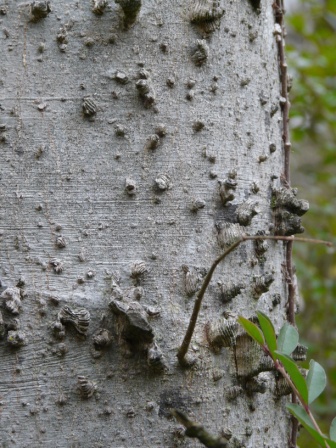
Hackberry is the dominant tree in the forested areas. Its bark is characteristically "knobby" with corky projections

A few years ago, the Hermitage cleaned out this sink hole (>80 tons of garbage). Andrew Jackson's horse was reputed to lie at the bottom. The horse was never found, but when the wind settles down, the smell of the chemicals that were dumped down there wafts up. Humans have been dumping history into this hole for generations.

Jackson did not like to spend money unnecessarily. The columns on the front of the main house are wooden, painted with sand-encrusted paint to make them look like stone. The "marble" inside the house is cleverly painted wood. The "mahogany" doors are faux. Perhaps there is a reason why Jackson was the only president to pay off the national debt...
Revival (no tent please)
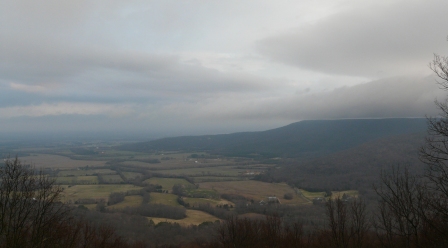
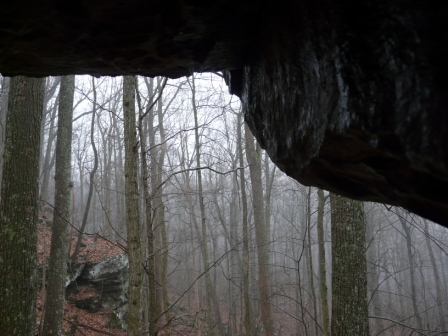
Air from the Gulf of Mexico has come for a visit, bringing warmth, rain, and ever-changing clouds. I took this shot yesterday morning before walking into Shakerag Hollow.

As wet air hits the slopes, it gets pushed up and cooled, making low-hanging clouds that rise and fall slowly, dipping us into and out of the fog.
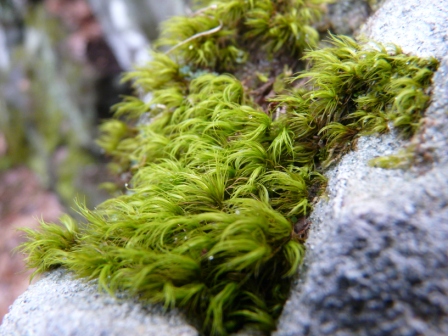
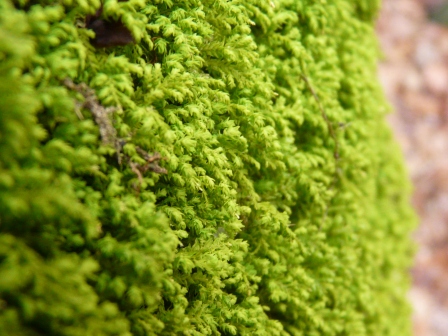
Mosses and lichens love this weather. No tree canopy interferes with their feeding (there is now more light on the ground than in mid-summer) and the gentle rains moisten, plump, and revive them.
They seem ignited, hungry for light. I could dive into their green: alive!
In the heavy rain, I briefly took shelter under a rock overhang.
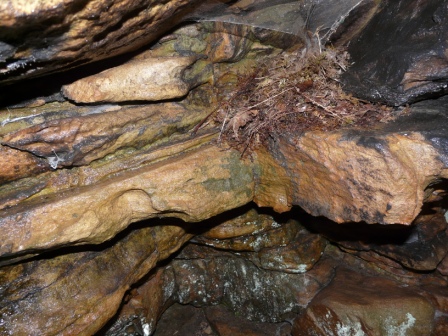
Another species had done the same last summer. This is the old nest of a phoebe, tucked into the back wall. It is lined with dried moss, perhaps plucked from the same clumps of moss that I had been admiring in the forest.
I enjoy a brief soaking in warm rain (is this January?), but Junebug says that the raindrops hurt her eyeballs…
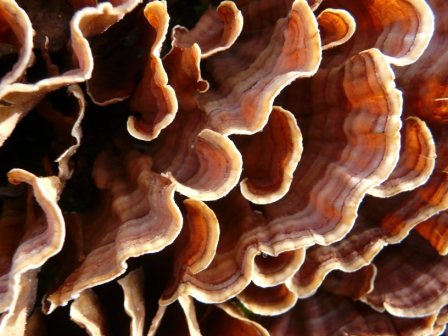
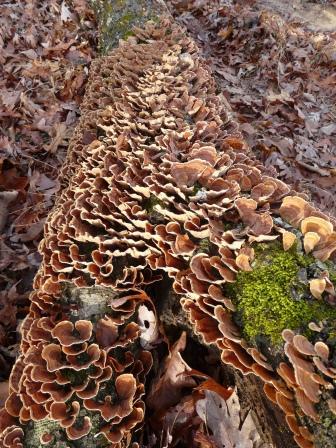
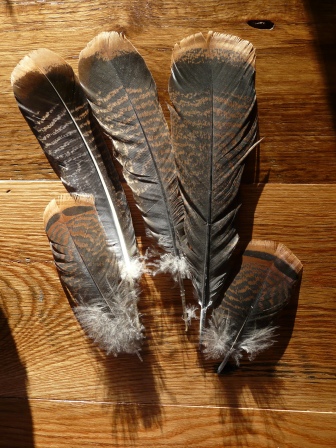
Turkey Tails
Cranefly orchid
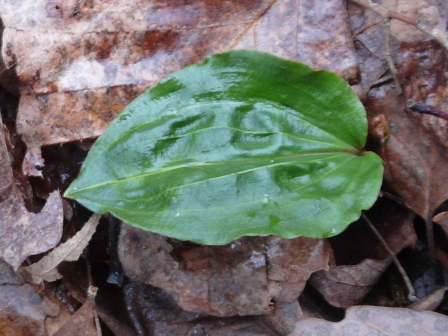
“Midway on our life’s journey, I found myself/In dark woods…lost.” The tangle of old logging roads and abandoned trails north of Kings’ Farm turned me around this morning, adding a half hour or more to my trek. Virgil did not appear. He never does. But, by getting lost, I did stumble on some great little plants: about a dozen cranefly orchids in the leaf litter on the side of an old trail.
Unlike most other woodland plants, cranefly orchids grow their leaves in the fall, keep them through the winter, then let them die in spring. Later, in midsummer, the spindly flower stalk emerges without any leaves, using belowground food stores to power its growth. So, this orchid’s life is powered by the weak winter sun.
The green, upper surface of the leaves is pleated, giving it a crinkled appearance. More striking, though, is the purple underside of the leaf. Sometimes this purple bleeds into the upper surface, especially later in winter.
This purple pigment is there to protect the leaf on cold days. When the photosynthetic machinery inside the leaf is iced-up, it can no longer absorb the energized electrons that sunlight knocks free from chlorophyll and other green pigments. The purple pigment soaks up these crazed electrons, keeping the leaf’s innards safe.