Author Archives: David George Haskell

Turtle tracks

Tracks left by young snapping turtle. Body length, about two inches. May 1st, Sewanee TN.

Tracks left by young snapping turtle. Body length: about two inches. May 1st, 2013, Sewanee TN. Habitat: puddle on gravel road between Alabama and Willie Six Avenues.

loggerhead crawl2

Tracks left by adult female loggerhead sea turtle. Body length: about forty inches. July 6th, 2012, St Catherine’s Island, GA. Habitat: large salty puddle between America and Africa.

Arboreal bear

Todd Crabtree, a naturalist extraordinaire and botanist at Tennessee’s Division of Natural Areas, sent me the following photos as a follow-up to my discussion of bear corn. Todd was leading a hike above Abrams Creek during the annual Smoky Mountain Wildflower Pilgrimage and saw this bear high in an ash tree. The photos are taken from a ridge looking down into the tree tops. The bear appeared to be nipping at the ash flowers.

BearInAshBearInAshCloseBearDescends

Photo Credits: Todd Crabtree, 2013.

Although this is a startling sight (how do the branches hold that weight?) studies of black bears report this kind of behavior across the species’ range. In some places, the bears’ hunger for tree flowers is a significant source of damage for many trees. In southeast Alaska, for example, bears like to climb cottonwoods, staying close to the trunk then breaking off branches to munch on catkins.

Omnivore defined.

Bird skeletons alight in the library

“…there was a noise, and behold a shaking, and the bones came together, bone to his bone”

This slideshow requires JavaScript.

This morning a small procession of bird skeletons made its way from the science building to the library: one last flight for the calcified remnants of wild lives that ended on windshields and picture windows in and around Sewanee. These skeletons are the result of the work of students in my Ornithology class, each of whom received a bird carcass at the beginning of the semester. The students have now cleaned and articulated the skeletons. Their work is on display within the belly of David Henderson’s Brief History of Aviation sculpture.

These unclothed cousins of ours reveal the relationship between unity and diversity in biology. The tension between these poles is what animates life: one theme, many variations.

Many thanks to Kevin Reynolds and the staff of duPont library for their fabulous help with this project and to David Henderson for letting my students use the remarkable space that he has created.

Bear Corn

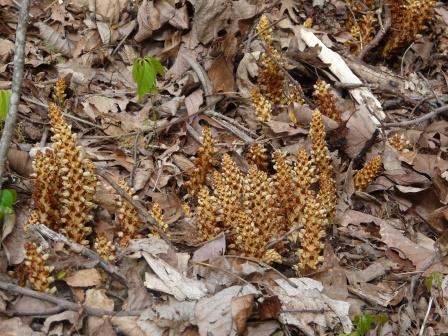
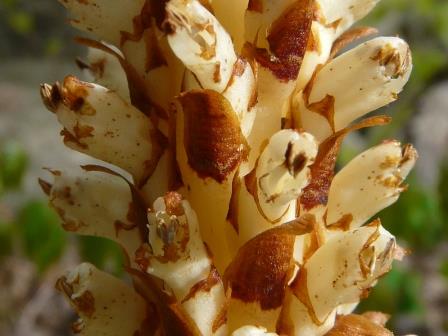
bearcornScaly, brown digits poke from the underworld, pointing skyward. They look slightly disturbing, like bloated pine cones or partly rotted corn cobs. These protrusions are the flowering parts of Conopholis americana, a plant that grows attached to the roots of oak trees. Conopholis has turned its back on its botanical inheritance: the plant has no chlorophyll. Instead it lives as a parasite, feeding on another species’ labor.

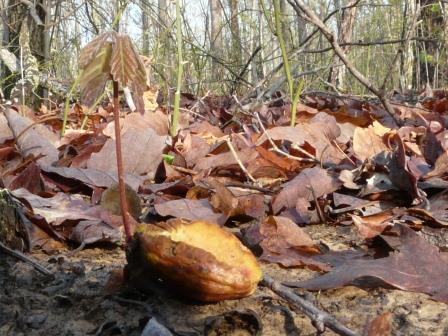
bearcorn3One of the common names for the plant is “bear corn,” an apt name for a plant that plays a surprisingly important role in the life of bears in eastern North America. Even though Conopholis is hardly an abundant species, the plant comprises ten to fifteen percent of the diet of bears in the Smoky and Shenandoah Mountains. When the total annual energy content of various botanical “bear foods” is added up, acorns top the list (67% of available energy) but amazingly Conopholis comes in second (16%). Although some websites and books claim that the bears eat the whole “cob,” biologists who have actually witnessed bears dining on the plant report that it is the little fruits that interest the bears, not the whole flowering stalk. I suspect, though, that the sample size for these observations is quite low…

bearcorn4The productivity of Conopholis in terms of energy provided per hectare is consistent from year to year, unlike blueberries and acorns whose fruitfulness can be highly variable. This, along with the early fruiting of the plant, make the species particularly important for wild bears. Lactating mother bears are said to be especially dependent on the plant.

So one way or another, oak forests nourish bears: bear corn in the late spring from parasites on roots, blueberries and other delights in the light summer shade of the oak understory, and acorns in the autumn. All this is evidence for the Ursic principle: the idea that the Universe as we know it seems wonderfully designed to bring about that supreme pinnacle of life, the bear. Black-robed bear philosophers rightly point out that an objective analysis of the data strongly supports the notion that the Universe’s parameters are improbably fine-tuned and that this fine-tuning has bear written all over it. Other thinkers, mostly grizzly bears, believe that these woods are just one of many realities. An infinite number of realities exist in this Multibearse, only some of which contain bear corn.

Sources:

  • Life History Studies of Conopholis americana (Orobanchaceae). Wm. Vance Baird and James L. Riopel. American Midland Naturalist , Vol. 116, No. 1 (Jul., 1986), pp. 140-151
  • Production of Important Black Bear Foods in the Southern Appalachians. Roger A. Powell and D. Erran Seaman. Bears: Their Biology and Management , Vol. 8, A Selection of Papers from the Eighth International Conference on Bear Research and Management, Victoria, British Columbia, Canada, February 1989 (1990), pp. 183-187
  • Seasonal Foods and Feeding Ecology of Black Bears in the Smoky Mountains. Larry E. Beeman and Michael R. Pelton. Bears: Their Biology and Management , Vol. 4, A Selection of Papers from the Fourth International Conference on Bear Research and Management, Kalispell, Montana, USA, February 1977 (1980), pp. 141-147
  • Energetic Production by Soft and Hard Mast Foods of American Black Bears in the Smoky Mountains. Robert M. Inman and Michael R. Pelton. Ursus , Vol. 13, (2002), pp. 57-68

Hatchling

chestnut oak seedlingA chestnut oak seedling emerges from the sloughed remains of winter. A mighty good sight.

Chestnut oaks (and their cousins in the “white oak” group) send down roots in the fall, racing against rodents. Once rooted, the seedling can survive the predatory munchings of mice and chipmunks. When temperatures warm in the spring, leafy shoots emerge: hopeful bids for a place in the canopy decades hence.

Red oaks have a different germination strategy. They load their acorns with bitter tannins. A bite on one of these poisoned seeds puckers your mouth; swallow one and your gut clenches. White oaks are sweeter to the palate. Thus defended, the red oak waits out winter inside its protective coat, poking out a root when winter is finally done.

Shoots rise, roots descend. The growing season is underway.

Serviceberry: preaching the gospel across the Appalachian Mountains

Serviceberry roared into flower this week, going from bud to bloom in a few hours, or so it seemed. From a distance these small trees present puffs of bright white in the dusky woods. Seen close, the flowers are indecently large and gaudy: this is no subtle, ground-hugging anemone flower. The serviceberry is famous all over eastern North America for announcing spring with a vigorous fanfare, usually at the head of the line, weeks before other trees and shrubs shake off their winter torpor.

serviceberry3

The species goes by many names, surely more names than any other understory tree. Here are the names that I’m aware of, no doubt I missed a few: serviceberry, sarvis, sarvisberry, shadbush, shadblow, juneberry, sugarplum, wild plum, Indian plum.

Etymology is clear for some of these names, but not for others. “Shad” refers to the shad fish (genus Alosa) of the northeast whose return from the oceans to their upriver spawning grounds coincides with the bloom of the “shadbush.” “Plums” refer to the fruits which are consumed with gusto by birds and small mammals and, depending on the variety of tree, by humans.

“Sarvis” is a mountain dialect variant of “service,” but the origins of these terms is not clear. Some claim a corruption of Sorbus, the scientific name of a related plant, the mountain ash. Others associate the name with church services: the return of traveling preachers as winter roads became passable or the use of the blooms as decorations for Sunday worship. I learned of another interpretation from Jay Leutz’s book Stand Up That Mountain. In the higher parts of the Appalachians, where winter freezes are deep and long, the tree blooms as soon as the ground thaws. This time marks the first opportunity to dig graves and hold funeral services for those who have died in winter and whose bodies await burial. On the Cumberland Plateau, at least in the years I’ve lived here, the ground is fit for burying many weeks ahead of serviceberry blooms. Different meanings are heard in different landscapes; our understanding of language molds itself to place.
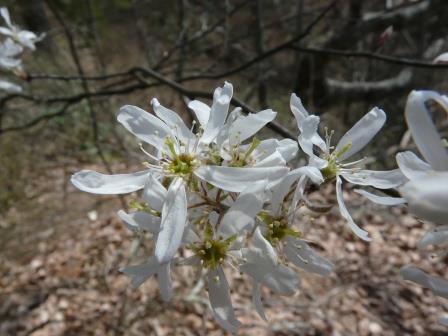
serviceberryServiceberry also offers us a curious parallel between nomenclature and biology. The genetics of this genus, Amelanchier, are particularly complicated. Dozens of forms exist. These forms hybridize, creating new variants and causing mental (and gastric) distress for any taxonomists who dream of order in the Natural Order. Some forms switch off sexual reproduction and set up small populations of asexual trees. These “microspecies” sometimes then switch back to sexual reproduction and interbreed again with other forms. In all, the genus is a hyperdiverse genetic tangle in which firm species do not exist.

This seems frustrating, but many biologists see the situation otherwise. Here, for example, is our friend Darwin in the second chapter of The Origin, discussing the serviceberry’s unruly relatives in the Rosaceae family:

I refer to those genera which have sometimes been called “protean” or “polymorphic,” in which the species present an inordinate amount of variation; and hardly two naturalists can agree which forms to rank as species and which as varieties…

Certainly no clear line of demarcation has as yet been drawn between species and sub-species…

Hence I believe a well-marked variety may be justly called an incipient species…

From these remarks it will be seen that I look at the term species, as one arbitrarily given for the sake of convenience to a set of individuals closely resembling each other, and that it does not essentially differ from the term variety, which is given to less distinct and more fluctuating forms.

For Darwin, these variable “species” and “varieties” were evidence for continuity in nature. Today’s species is yesterday’s variety. Life evolves; don’t expect tidiness.

We can only speculate what the traveling preachers of the 19th century might have thought of having their arrival heralded by an example of Darwinian mutability. I like to think that at least a few may have reached for the wild-plum wine.

Synchronized kidding

Cassia and Hazel made a bid for the new Olympic marathon event of kinda-but-not-exactly-synchronized-kidding, producing five kids in one night. They spread this excitement through the night, just to keep the audience stimulated. Four of the five followed regular diving protocol, splashing into the world headfirst; the fifth performed a flip, finishing with the flourish known as “ass backwards,” a sure way to get a lung full of water. You can see nighttime photos of the newborns on Sarah’s blog.

Jupiter oversaw the whole proceedings from his barn perch:

jupiterThe kids are now all dry and ready to go: (Nap/feed/play)*repeat.

This slideshow requires JavaScript.

Red maple: the burn begins, warblers drawn to the heat

winter_no_AprilGentle, domesticated plants are singing springtime songs, lifting gardens with flowers and newly emerged leaves, but the forest is wintry, especially in the uplands. Mountain slopes may glow with ephemeral wildflowers and buckeye saplings, but the rolling tabletop of the Cumberland Plateau seems little changed from January.

Red maple trees are the exception. Oaks and hickories have their buds clamped shut, but red maple blooms are out. From a distance these trees seem to stand in a shroud of carmine smoke. Each tiny bloom is  wine-red, standing like a small flame at the tip of a long, twiggy taper. Many of these flames have already matured and fallen, so my feet to move, for a few moments, through a dust of fallen embers as I pass below the trees.

Not to belabor a point, but these trees have rather variable sexual systems. Red maple flowers are usually either male or female, although a few blooms are both. Individual trees carry all male, all female, or mixed collections of flowers. On mixed trees, single branches will usually grow just male or female flowers. Richard Primack studied a small population of these trees and has written an interesting discussion of how the red maple breeding system fits within the diversity found within the whole Acer genus.

Click on images for captions and a slideshow.

The flowers scattered across our trails are almost all males. Once they have shed their air-borne pollen, their work is over and they become food for worms. (Brave Percy undoubtedly walked among them during his sojourn in Sewanee; the photos above are from a trail close to his haunt at Brinkwood.) The female flowers intercept floating pollen and will, over the coming months, grow the maple’s distinctive samaras or “helicopter fruits.”

Along with these emerging flowers come insects, scraping and sucking and chewing the newly emerged vegetation. And along with the insects: birds. Black-throated green warblers, just back from Central America, are congregating in the maples. I counted three of the warblers in one tree; all were steadily working from one flower to the next, pausing to hurl a short song to the forest, then getting back to work, beak to bloom.

A nature walk for the Supreme Court Justices: my op-ed in the NY Times

This morning the New York Times published my op-ed about nature and same-sex marriage.

Please follow the link above to read the article. What follows is an abbreviated list of links to documents that are relevant to the piece.

Supreme Court documents from docket. Specifically, I quote from: 12-144 Brief of Petitioners on the Merits.

Pope Benedict’s Christmas greetings to the Roman Curia

Roy Moore’s re-election and statements.

Language from the TN Bill that died in the State House this week.

Oscar Wilde trial quotes: here and here.

Japanese cherries: Two cultivars make up most of the Washington DC cherries, the Yoshino Cherry and the Kwanzan Cherry. Photos of bisexual flowers here and here and here.

Elms: The whole genus Ulmus, to which elms belong, is bisexual (e.g., page 369 in Flora of North America, Volume 3. 1997. Edited by the Flora of North America Editorial Committee. Oxford University Press).

Ginkgo: Peter Crane’s 2013 book, Ginkgo, Yale Univ Press discusses both the separation of male and female (page 53) and “spontaneous partial sexual switches” (pages 63-64).

Controversy in the medical literature about how human intersex: Blackless, Fausto-Sterling, and Sax.

Data on the frequency of homosexual bonds and sex in birds: MacFarlane.

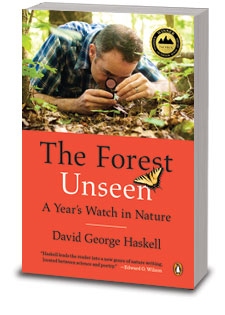
The Forest Unseen paperback edition; copies for course adoption available

paperback3DThe Penguin paperback edition of The Forest Unseen went on sale this week. Having read and enjoyed hundreds of books adorned with the smart little penguin, I’m very happy to see my book published under this imprint. All the other editions of the book — the hardcover, the various e-books — are still available. I’m hoping that this new edition will make the book available and attractive to new readers.

One such group of readers are students. The book is already in use in a few biology, environmental studies, literature, religion and philosophy classes, with great results so far. If you’re a teacher and would like an examination copy, Penguin has free copies available for “course-use consideration.” If you’re interested, please e-mail academic@penguin.com with your shipping address, course title and enrollment, and decision date. Please include “The Forest Unseen, ISBN: 978-0-14-312294-4” in the email. Penguin does not ship to P.O. boxes, so you’ll need to give a physical address. If you encounter any problems with the process (unlikely), just let me know and I’ll make sure that the books get where they need to go.

I’d be very grateful if you could spread the word to friends and colleagues who might be interested. (To make sharing easier here is the shortlink for this webpage: http://wp.me/pKjPz-19T)

To the many readers who have supported the book since its publication last year: Thank you! I’ve been bowled over by your generosity and enthusiasm.

Rambles will continue tomorrow. On the docket (literally): sex, nature and the Supreme Court, with a little help from the Grey Lady.