
One branch of the Trail of Tears runs past our house. Every year, hundreds of bikers break the silence in their commemorative ride.
One branch of the Trail of Tears runs past our house. Every year, hundreds of bikers break the silence in their commemorative ride.
I am on a quick visit to New York City. Amid the exultant noise of the city three areas of unusual quiet stand out:
The house sparrows seem content to go about their business without the chatter of their country cousins. These city birds know to save their breath, perhaps. Why compete?
Cabs with hybrid engines. It has been several years since I’ve been in the city, so the quiet of the cabs is disconcerting, but heartening. This is one more demonstration of the generality that cities are in many ways greener than the countryside. NYC performs particularly well in many energy-use rankings.
The “Permanent Mission of the Libyan Arab Jamahiriya to the United Nations.” My hotel is a couple of blocks away, so I wandered down there to see whether I could see any reflections of the day’s turmoil. The building is the only quiet place for many blocks. Only an idling NYPD vehicle parked in front breaks the stillness. Somehow the quiet seems more distressing than a noisy crowd.
This post is in answer to a query about John Muir from Eric Keen, a fellow saunterer of the finest kind. In 2008 I had the privilege of visiting Muir’s birthplace in Dunbar, Scotland, and found that the town fondly remembers its emigrant son:
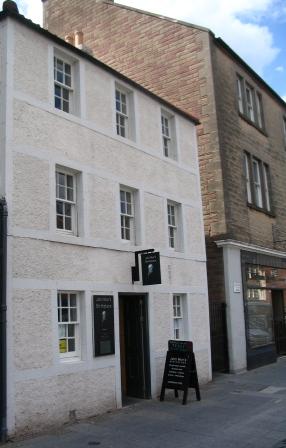
Muir's birthplace, now an interpretative center. In 1838, when Muir was born, the family quarters were cramped rooms behind a shop. The building has since been expanded and renovated.
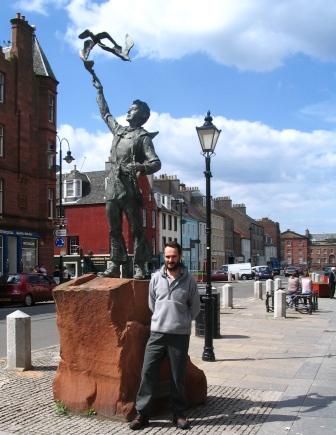
The town of Dunbar honors Muir with a sculpture of him as a boy, reaching up to gulls in flight. Pilgrims of dubious moral character loiter around the foot of the statue.
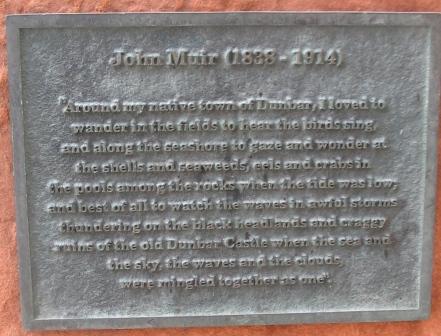
The statue's plaque quotes one of Muir's reminiscences about his childhood in Dunbar.
Humanity’s first successful attempt to clone a mammal from an adult cell stands on an illuminated rotating pedestal in the National Museum of Scotland. Her eyes gaze out quietly, as if at imagined pastures beyond the heads of museum visitors. All that advanced science finally comes to this: taxidermy.
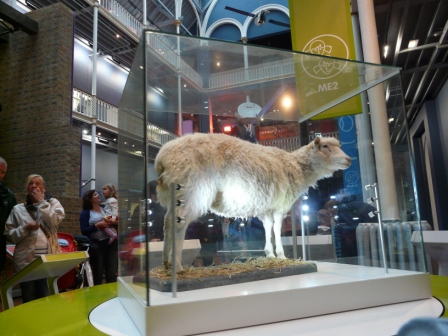
In the 1980s, when I was an undergraduate, I heard a lecture from one of the world’s best cell biologists. He explained why the details of mammalian cell biology and genetics would forever prevent us from cloning a mammal. A decade later, “Dolly” was born. The cell biologist was not a fool – he knew his stuff – but he underestimated our ability to penetrate what seem like solid barriers.
Housesteads fort was one of many along Hadrian’s wall, constructed about 1800 years ago.

The Romans built to last:
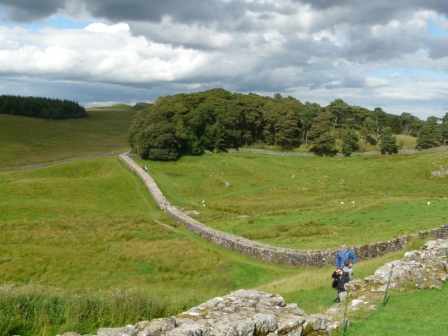
Large parts of Hadrian's Wall are still standing

Underfloor heating system in the commander's house.

Ventilation in the granary.

Fancy latrines.

All watched over by sheep.
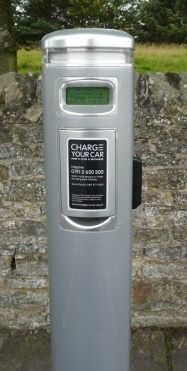
Remarkably, the Romans also thought to install places to charge electric vehicles.

...although arriving from 35,000 ft is proably a wee bit higher than the songwriter had in mind.
A dozen snail enthusiasts joined the American Malacological Society’s field trip to Powdermill, ably led by Tim Pearce, Head of the Carnegie Museum’s Section of Mollusks.
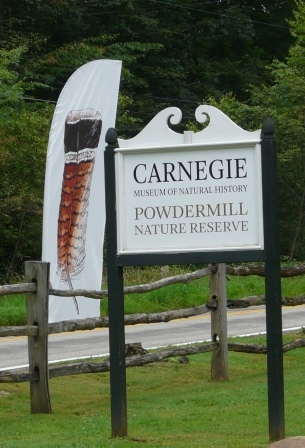
Xolotrema denotatum was one of the twenty five species that we found. I have been wanting to see this species for some time. We have its cousins, Xolotrema obstrictum and Xolotrema caroliniense, around Sewanee; both of these species have beautiful shells.
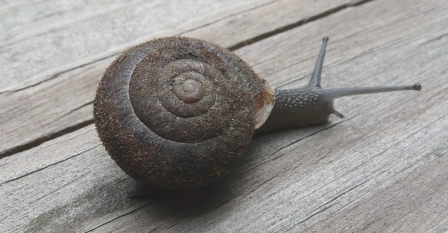
Xolotrema denotatum at Powdermill – note the very hairy covering to the shell. This is formed by the protein coating of the mineral shell.

Xolotrema denotatum seen from the side.

Xolotrema caroliniense shell from Sewanee

Xolotrema obstrictum shell from Sewanee.

A swarm of malacologists
I found these snail eggs hiding under a piece of fallen rotting wood on the forest floor:
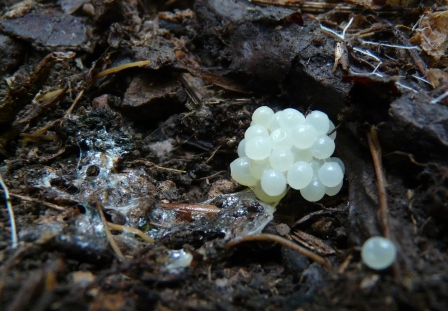
The whole cluster is about half an inch across. I’m guessing they are Mesodon or Mesomphix eggs.
Some spectacular fungi were growing under rotting bark.
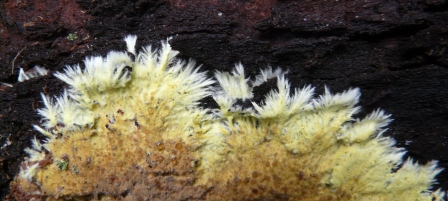
Advancing...
“Indian pipe” plants were poking up from the leaf litter.
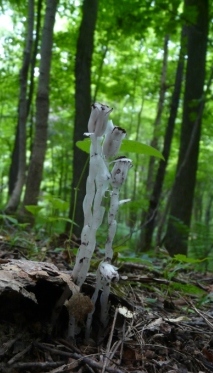
Monotropa uniflora, a parasite on fungi that live in symbiosis with tree roots. So, this plant parasitizes trees through an intermediary.

Although Monotropa is only four inches tall, it is a relative of blueberries and azaleas (in the plant Family Ericaceae). It has lost is chlorophyll, giving it another common name, the "Ghost plant."
You can see more photos from the trip at Aydin Örstan’s blog, The Snail’s Tales.
Life surges through cracks in the civilizing layers of concrete

Cell phone signal strength reaches heights unknown in the wilds of Tennessee

Public nudity, yet a chilly formality is somehow preserved
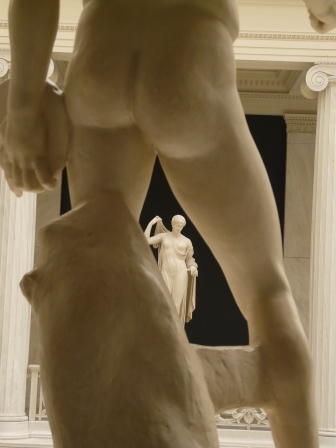
Robber barons turn socialist

Kingbirds sing from the treetops on the festival grounds.

Eastern kingbird, barely visible, centered in the O of ROO in the hand/globe sculpture. He sings without amplification.
The queen? Perhaps Alison Krauss who, with an inflection of a sung note, can send chills down the spines of thousands of listeners standing in the Tennessee afternoon sun.

Alison Krauss and Union Station. Approximate air temperature: sunny side up.
The royals preside over a Dominion of Dust.
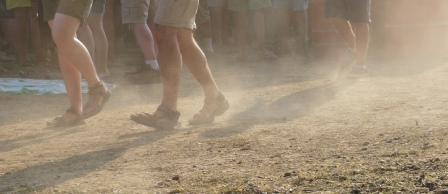
Quarter of a million feet on a few dozen acres.
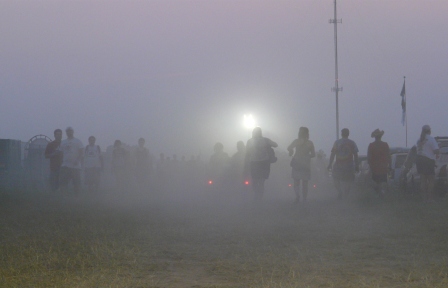
Nightfall.
tik tik bzzzzzz
I stepped out of my car into the vast field that is the Bonnaroo parking area and immediately heard the avian headliner for the day: a grasshopper sparrow singing from a post. This is not a common bird, so I knew immediately that I’d come to the right place for acoustic revelry. No doubt the bird wonders why eighty thousand people just showed up in his territory.
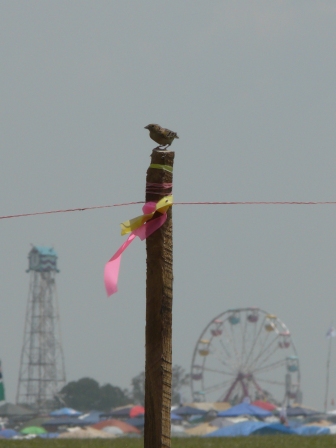
Grasshopper sparrow with Bonnaroo's firetower and Ferris wheel in the background.
 David George Haskell