Category Archives: Travels

Living Planet Report 2012

The World Wildlife Fund (with its partners the Zoological Society of London, the Global Footprint Network, and the European Space Agency) released its Living Planet Report yesterday, a reminder of the state of our home.

“We are living as if we have an extra planet at our disposal. We are using 50 per cent more resources than the Earth can provide, and unless we change course that number will grow very fast – by 2030, even two planets will not be enough.” [four planets if we all lived like residents of the USA]

“…the Living Planet Index continues to show around a 30 per cent global decline in biodiversity health since 1970”

“These analyses indicate that continuing with “business as usual” will have serious, and potentially catastrophic, consequences. In particular, continued increases in greenhouse gas emissions will irreversibly commit the world to a global average temperature rise of well over 2oC, which will severely disrupt the functioning of almost all global ecosystems and dramatically affect human development and well-being.”

Surely one response to these somber words must be sorrow at the wreckage we’ve left behind in our seemingly heedless passage through life.

When to the sessions of sweet silent thought/I summon up remembrance of things past,/…Then can I drown an eye, unused to flow,/For precious friends hid in death’s dateless night…/…And moan the expense of many a vanish’d sight…

Such a response is not an exercise in pointless self-flagellation. By taking in this knowledge – by not banishing it with distractions, medicating it with irony, or washing it away with psychological salves — we open ourselves to feel the consequence of our actions, to step up and offer a genuine mea maxima culpa, and to spur ourselves to reform (all the while knowing that the “offender’s sorrow lends but weak relief”).

One of the biggest challenges in moving toward a “sustainable” economy is the utter disconnection between our actions and knowledge of their consequences. Our materials and waste generally come from and go elsewhere, making us almost totally unable to comprehend what we’re doing. But the disconnect is also one of the emotions – we’re taught that sadness is a pathology that needs to be quickly erased (conveniently, the economy is happy to sell us aides in this quest), ignoring the possibility that melancholy might be a good and necessary thing sometimes. The WWF report, then, might be a way in which the world’s frayed connections can be brought to consciousness and as a consequence, felt.

Fair enough. But tears are not the only thing that the world calls from our eyes. How about a smiling twinkle? The world outside is not unremittingly dire (and the Sonnet walks us, maybe a little too smartly but hey he only had fourteen lines, from one part of memory to another, a sweeter place). Life’s great and fundamental characteristic is is irrepressibility, a quality that is probably the only reason we’re here after the “long strange trip” of the last four billion years. A very small offering of this Seussian gleam-in-the-eye:

This young downy woodpecker (lower bird on the pole) has been pursuing its parents around the neighborhood for the last day or so, as if attached by a springy leash. The youngster can fly, but only in a comedic blur of wings. The bird squalls continually for food which the tireless parents pick up from the bird feeder, then transfer a few feet to the young woodpecker’s mouth. These birds pursue their roles with vigor and seriousness of purpose, focused, as they should be, on the matter at hand: the goodness of a fat sunflower seed.

Hot-headed

A virus has delivered a special end-of-semester gift in the form of a cold and mild fever. I know this is a common experience among teachers: our immune systems carry us through to the moment that grades are due, then dump us over the cliff, their patience finally worn to nothing.

But the point here is not to whine about minor ailments or the rhythm of the semester, but to ask why fevers mess with our minds. High fevers bring on full blown hallucinations; milder versions create a restless cacophony of strange images and thoughts, seeming to rise up through the acidic vapors of the sinuses.

The neurobiological literature is, as far as I can tell, not clear about the causes of all this confusion. For major hallucinations, it seems that an imbalance between inhibition and excitation in the brain creates sensory illusions. In other words, some parts of the brain are shooting out way too many signals which, when combined with dulling of the parts of the brain that say “stop,” creates the neural mirages we call hallucinations.

For the milder confusion of a low fever, I suspect that mistiming plays a part. All our thoughts exist as relationships among nerves. These relationships depend critically on the timing of which nerves fire when. Even a simple thought, like an imagined object, is held in a network of neural firing patterns that shifts five times per second. So, thought is like music — it depends on relationships among dozens of players and the timing of those relationships determines the nature of the melody. When we heat up the brain with a fever, chemical reactions quicken slightly, throwing off the tempo.

Taking an aspirin is therefore like switching on the metronome. Click, click, click. Back to coherence.

Imaginings of avian reincarnation

At the end of the final exam in my Ornithology class, I ask the students, “If you could come back as a bird, which species would you choose and why?” No grades for this question… The diversity of answers is always interesting. This question can be taken in a number of ways: which bird most represents something about who you are, which bird most represents something about who you’d like to be, or which bird offers something to you now that you find compelling, amusing, or interesting?

I’ll list summaries of student answers below, then offer my own thoughts.

Student answers:

Wood thrush – for Thoreau

Oystercatcher

Blue-footed Boobies — because they are called blue-footed boobies; I’d choose the mate with the silliest foot-waving dance.

Arctic tern – they migrate between hemispheres; it is always summer for them.

Brown pelican – great life on the ocean

Owl – great songs; they are so quiet; come out in the evening, my favorite time of day.

Turkey vulture – they eat well and I could terrorize people with my unholy hissing sound.

A crane – to migrate and see the world; protected from hunters; I’d be tall and have few predators.

Peregrine falcon – amazing speed, control, and acute senses.

Whatever that bird was on the Life of Birds video that actually enjoyed sex.

Osprey – aerial and aquatic superiority, and a vision of the future…

Cedar waxwing – roll deep with a huge posse and get drunk off of berries while looking like a superhero/bandit.

Wood thrush – they make the most beautiful sound, magical, mysterious.

American crow – they do pretty well as a species (apart from West Nile virus); I like the idea of a family unit; fly high and fast.

Barred owl – I like owls, this species is the best looking. I’m not feisty enough to be a screech owl and I don’t have enough Rowan Williams in me to be a Great Horned Owl…

Common loon – I really like the song

Lyre bird – the ultimate song learner. Amazing feathers.

Spotted owl – neatest looking birds (soft and fluffy while also being murderous and cunning); I could stand in the way of deforestation in the NW, a beautiful place; no long migrations; people would be happy to see me; rad call.

Cedar waxwing – love their song and their appearance, especially the bar stripe through the eyes.

It heartens me to see how many of these answers refer to sound. Developing acoustic awareness is a big part of this class.

Here are my responses. I write the exam and the blog, so I get to bend the rules and choose three different species. A divided afterlife? Why not? I picked these three for the physical experience of the world that they would offer my body-jumping soul.

Wandering albatross – the purest experience of air possible, winging for hours without a flap of the wings, caught in the strength of the endless south polar winds; alone for months with ocean, salt, wind, and a gray horizon that never resolves into land. I can feel the streaming cold air in my nostrils already. A meditation.

Mousebird – a life tumbling in a flutter of sociable activity, my flockmates always close; we gorge on fruits and flower buds, then recline in the sun to let its warming rays toast our bellies, chattering all the while. Conviviality.

Winter wren – an unassuming bird, at home in the undergrowth, half bird half mammal. My song slices open the forest air and the moon pours out, splintered into a million pieces. My heart breaks at the beauty of the flowing air in my throat. An exaltation.

Of course, beyond these dreams, the task for today is to want to be who we are. As Oscar Wilde said, “Be yourself; everyone else is already taken.”

Pedaling a mile up

I’m in Denver for a conference, which means lots of time in chilled conference rooms, viewing the world through powerpoint slides. Great stuff, up to a point. Butt and brain give out after a while, so off comes the neck tag (a little frisson of excitement at liberation from group identity) and out the door I go…

I quickly found the Denver Bikes, a bike-sharing program that has bikes for check-out in racks across the central part of the city. Check-out privileges come in daily ($8), weekly ($20), monthly ($30), and yearly ($59) increments. Once you’ve registered at a kiosk (takes about a minute), you can check a bike out from any stand, then return it to any stand. The system is designed for short trips, so check-outs over 30 mins incur extra costs ($1 for an extra half hour, then $4 after that). The bikes themselves are tanks, seemingly indestructible, but surprisingly easy to ride.

Many streets in the city center have bike lanes and they seemed, in my few miles of pedaling, pretty well respected by cars and trucks.

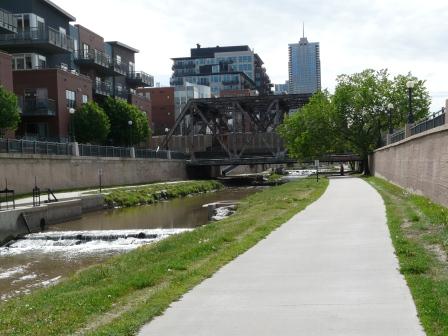
Even better, the city has several bike paths along waterways, so it is possible to go through the center of town and into outlying areas along bike-only paths that wind along running water. Hard to beat. (But stay out of the water — looks great, but bacterial counts are high.)

The best part: avoiding the Denver Boot, an enforcement device invented here in the 1940s by, of all people, a violinist. The boot shown below was put on a car right outside the window of the conference lunchroom. It was very kind of the local police to enliven our dining experience with a historical reenactment of traditional western vehicle wrangling:

[and this news added after I made the original post: bike-share is coming to Chattanooga…]

Rambling on the airwaves

I’ll be on the NPR show To The Best of Our Knowledge this weekend (April 28/29). The program is “Into the Woods,” and I’ll be talking about The Forest Unseen. Also scheduled for the show are Terry Tempest Williams, Stephen Sondheim, Marina Warner, and Stephen Long. I’m very grateful to be included in this line-up, to say the least.

Stations that carry the program and broadcast times are here. WPLN (Nashville) runs the show at 3pm on Sunday on its 1430 AM channel. WUTC (Chattanooga) runs at 12:00 (eastern time, 11am central) on Sunday on 88.1 FM. The show will also be available through podcasts, XM satellite, etc as detailed here.

Unlike previous interviews which have been live and over the phone, this interview was recorded last week in the WPLN studios in Nashville. The experience of sitting in a quiet studio, talking to people several states away, using a great mic and headphones was an unexpected treat for my senses. The studio was so quiet and the equipment so good that the world was stripped down to a nearly pure experience of sound. Just voices, hanging in a silvery space. It was almost enough to calm my nerves.

Paddling

For our last full lab of the semester, my ornithology class took canoes down to the Elk River. We put into the water where the Elk runs into Woods Reservoir.

Trip highlights include:

  • A great look at a Prothonotary Warbler. This warbler is unusual in that it nests inside old tree holes instead of making a twig or ground nest like most other warblers. It is found along waterways and lake edges.
  • Seeing a Great Blue Heron grab a big watersnake. The snake wrapped itself around the heron’s beak and neck like a whip around a post. The heron thrashed and leapt, perhaps feeling the sting of the snake’s bite, then the snake escaped. The heron kept probing in the water, but this snake was not about to come back.
  • Three Ospreys wheeling overhead, whistling loudly.
  • Two Black-crowned Night-herons, flying right over us, giving a great look at their head plumes and bright legs.
  • A mother goose on her eggs, flopped out with a “broken neck” — playing dead as a ploy to remain unmolested by these strange paddling primates.

(note: photo links above are not from this trip (I wish), but from Robert Royse, an outstanding bird photographer)

Trip lowlight: dozens of trotlines tied to branches overhanging the river. These are unattended fishing lines, mostly aimed at turtles, but anything that grabs at the large hooks on the lines gets snagged. Two years ago we found a heron that had died in a tangled trotline. Not so pretty, but 100% legal (as long as you don’t set more than 100 trotlines at a time…). This method of fishing is like deer-hunting by lashing shotguns to trees, then attaching tripwires to the triggers. You’ll get some deer, yes, but at what cost?

This slideshow requires JavaScript.

Nuclear power for Earth Week

At the CCJP Earth Week fair this weekend, Chris Lancaster had a great display of solar panels from the last decade. These panels are the best kind of nuclear power — harvesting energy from the nuclear fusion plant located at the center of the solar system. The risks associated with this nuclear power plant are outlined with admirable brevity here.

Chris’ display was a practical reminder that solar cell costs continue to decline, a trend that was discussed in this interesting blog post at Scientific American.

This slideshow requires JavaScript.

I threw in a slide of the oldest and the best panels of all.

The Forest Unseen, one month update. And an iris.

The Forest Unseen is celebrating its one month birthday. I’ve not used this blog to announce every tid-bit of news about the book’s first steps in the world, but here I’ll give a short overview and look forward to some upcoming events.

Upcoming lectures and signings:  In the next few weeks I’ll be in Knoxville, Nashville, Denver, Oxford, Pulaski, and Santa Cruz. Lauren Kirchner, writing in Capital New York, reviewed my lecture last month at the Explorer’s Club in NYC.

Reviews: the book’s website has a more complete listing, but two of the more detailed discussions are Hugh Raffles in the Wall Street Journal and Gina Webb in the Atlanta Journal and Constitution. Closer to home, Chapter 16, an organization devoted to Tennessee’s writers and readers, published a review by Michael Ray Taylor this week.

Other media: I’ll be on the NPR show, To the best of our knowledge the weekend of April 28/29. Frank Stasio from North Carolina Public Radio’s State of Things ran a nice long interview last week. Right after the book came out, the Gary Null show and Lewis Frumkes (show not yet archived) also did radio interviews. In addition to the book trailer, Penguin has uploaded some clips of me getting perhaps a little too excited about snails, soil, and hickory nuts.

If you’ve enjoyed the book and would like to spread the word, please tell your friends, put a review on your blog, or put some comments on Amazon. Thank you!

And now back to our regularly scheduled Ramblings:

This morning, I found some dwarf crested iris is in bloom in Shakerag Hollow. Unlike the tidy flowers of early spring, these blooms are frilly, complicated, and showy. They can get away with such extravagance because more insects are out now — in the bad weather of early spring, flowers have to be simple (with wide open petals) in order to maximize the chance that something will pollinate them. Bumblebees are the preferred pollinators of this iris species, I think, so their flowers exclude smaller bees and flies. The plants’ blade-like leaves slice up from below-ground rhizomes. Flowers and leaves are barely six inches tall. Cute.

Paddling with Carson and Byron

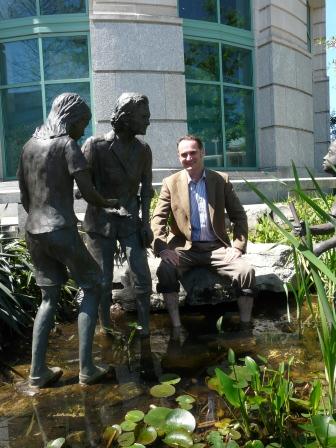
The entrance to the North Carolina Museum of Natural Sciences has a sculpture and native plant garden honoring the great writer Rachel Carson.

Carson is sculpted with her trousers rolled up, feet in a pond, showing two children the creatures in the water. Despite being dressed for oration instead of investigation, I decided to join her for a paddle. Stephen Garrett, a friend and former student who came to my talk was kind enough to take a photo or two. He was also kind enough not to say anything about my unsophisticated camera gear (he’s a pro, so I hesitated to hand over my little pixel-snatching machine).

cooooold

Child, Genius, and Grinnin' Fool.

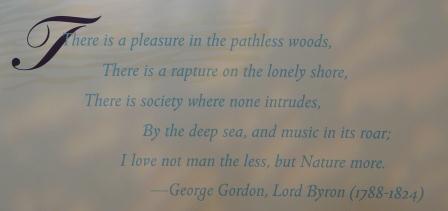
The Museum also had this nice quote painted in large print across one of its walls. In my experience, Lord Byron is not someone often featured in the halls of science or natural history museums. It is a pity that they left off the last four lines, “From these our interviews, in which I steal/From all I may be, or have been before,/To mingle with the Universe, and feel/What I can ne’er express, yet cannot all conceal.” ..stealing away from past and future, to the inexpressible present…nicely done.

“Lonely” the museum was not. There were an impressive number of people visiting its excellent exhibits. And, on April 20th, the museum will open a big new wing featuring “How Do We Know?” exhibits — e.g., “Dinosaurs taste like chicken — How do we know?” Good question. (I hear one answer from my Tennessee grilling friends: Yessir, but here in Tennessee our chickens taste a little better ‘n that, it’s in how you cook’em. Those Raleigh folks don’t know how its done.)

If you’re headed to Raleigh, I strongly recommend a visit (but not yet — the whole museum closes tomorrow to complete the last stages of construction).