Category Archives: Shakerag Hollow

Act I of Autumn

A vigorous belt of chilly rain passed over Sewanee this morning. In its wake, a Canada Warbler feeding on the shrubs in our garden. This is a bird of the boreal forest, found here only during migration. Cool rain, falling temperatures, a forecast for a week of low humidity and clear sunny skies, and the Bird from the North: these all speak of the season’s change.

The plants are ready. Many local species make use of the autumnal surge of birds to complete their pollination and seed dispersal. Cardinal flowers bloom along lake edges, beckoning hummingbirds with their crimson blooms. Dogwood and beautyberry offer brightly colored fruits to the passing thrushes, vireos and warblers. These birds feed on North American insects all summer, then become frugivorous on their tropical wintering grounds. They start the fruity feast right here, gobbling the fruits of our native shrubs and depositing the seeds a few hours later.

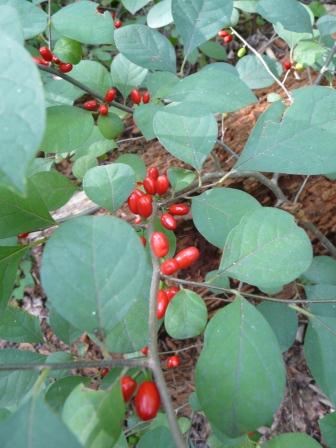
One of the most abundant of these fruiting shrubs is spicebush (Lindera benzoin), a species that is particularly common on the mountain slopes. This has been an incredible year for spicebush. I’ve never seen so many fruits. The warm spring must have suited them.

Like Christmas trees loaded with goodies, the plants will be stripped bare when the party gets going. For now, they sit in a quiet forest, waiting for the rambunctious guests to arrive. But unlike the treats on Christmas tree which make up just a small part of the festive food, these berries are the main meal for migrant birds. Now that dogwoods are nearly gone from our forests, killed by an invading fungus, spicebush is a lifeline for the feathered travelers.

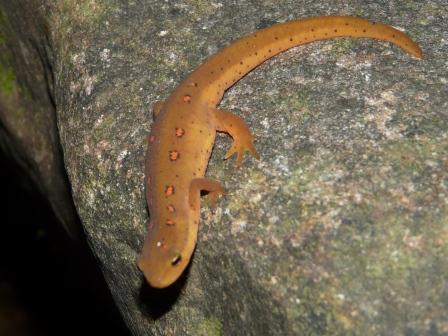
Red eft

We found this beauty in Shakerag Hollow today during our stream surveys: a red eft, the terrestrial form of a salamander that has no fewer than four life stages. The eggs (stage 1) hatch in lakes, then the larva (stage 2) fattens up in the lake before metamorphosing into an eft (stage 3) that leaves the water and wanders on land for several years before returning to a lake and transforming into an adult red-spotted newt (stage 4).

The eft stage is very unusual; no other salamanders in our region have such a stage. The advantages are clear: the eft can feed on the forest’s abundant small invertebrates and grow to adult size without having to compete with any adults. This is a common strategy among other animals, especially insects whose young specialize on different food sources than the parents (butterflies and caterpillars; maggots and flies; lake-dwelling larvae and flying dragonflies). But why should only the newt adopt such a strategy among salamanders? No-one knows, but I suspect that part of the reason lies in the species’ powerful defensive chemicals. All red-spotted newt life stages have neurotoxins in their skin and are therefore well protected from predators. It was therefore presumably not that hard for evolution to draw the eft out of water onto land. Indeed, unlike all other local salamanders, efts wander the woods in broad daylight. They are seemingly the most fearless of all the woodland creatures, with the possible exception of hornets and yellowjackets. Like these wasps, efts advertise their noxiousness with dramatic colors. This one was about only two or three inches long, but was sighted from several meters away.

“Eft” is from the Old English for “newt” or “small lizard.”

Pelting rain, then mist, more rain, and…salamanders

Intermittent downpours are not ideal weather for outdoor classes, unless your topic for the day is: salamanders!

So a hardy (and uncomplaining — YSR!) group of cyclists headed out in the rain, destination Shakerag Hollow. This is the first of many days of salamandering for my Advanced Ecology and Biodiversity class. We’ll be documenting the local fauna and comparing communities among streams with varying degrees of sedimentation.

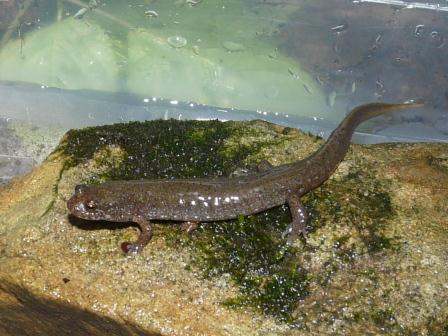
The focal stream for the day yielded many Spotted Dusky Salamanders, Desmognathus conanti. These stocky animals are fast movers: you need quick hands to catch them. They are about five inches long and hide under rocks, emerging at night and in downpours to feed on insects and other small prey.

Spotted Duskies stake out a tiny stretch of stream for their home range, so we made sure to put them back exactly where we found them.

In addition to salamanders, we found several crayfish, including this one, expertly captured and held by my colleague David Johnson, that has two babies attached to the underside of its tail. The females usually carry eggs in this position, but youngsters generally swim off on their own.

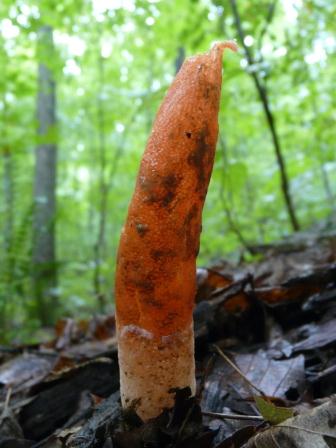
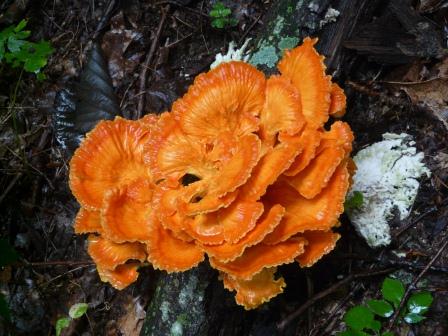
The woods were also full of fungi, including this stinkhorn……and a spectacular growth of what I think is “chicken-of-the-woods,” a species that is edible (to some; for others it causes considerable distress). This fungus was visible from about fifty meters away. It glowed through the mist of the forest. No, it burned. But salamander-like, we survived the fire.

The Forest Unseen — readings from the woods

I’ve posted some short readings from The Forest Unseen on the book’s website. I recorded these excerpts in the woods, sitting at the same small area of forest that is the book’s focus. Unlike studio recordings, these audio clips have plenty of background noise, especially cicadas. That seems fitting, given the book’s setting and subject matter. After all, one of the themes of the book is that the world’s “background noise” is worth hauling out of the background and into our field of attention.

I have one or two more audio files in process…so I’ll post more next week.

Shakerag Hollow: damage from construction continues

I visited Shakerag Hollow this afternoon to make some sound recordings. A good thunderstorm blew in, giving us another inch or so of rain. Unfortunately, on my walk out, the intermittent stream near Green’s View was running the color of milky coffee. I walked up to the construction site and found water pouring off the bare ground, hitting a construction fence, then running underneath, and into the woods. The fence added about 30 seconds to the water’s travel time, so it would be technically incorrect to say that the barrier did nothing. Just next to nothing, in my opinion.

Disturbed by this sight, I diverted my return walk to look at the larger drainages. On one, the retention walls and sodding did seem to have slowed the rate of soil loss. The water running off was dirty, but not completely opaque as it has been. But on the largest drainage, water ran right through the rock walls, across the small ponds, and straight out into the stream leading into Shakerag.

So the streams of Shakerag Hollow, and the waterways into which these streams flow, continue to be severely impacted by the golf course construction that I discussed in a previous post.

Looking from the edge of the construction into the woods. This flows directly into the stream near Green’s View.

The main flow from the golf course leads to a series of waterfalls.

Water running under and through rock walls.

Muddy retention pit. Water flows directly out of this pit into the stream.

This water runs into the woods and a stream, slowed slightly by having to go under the construction fence.

Earthstar

Indulge me by letting me start with a short quote from The Forest Unseen:

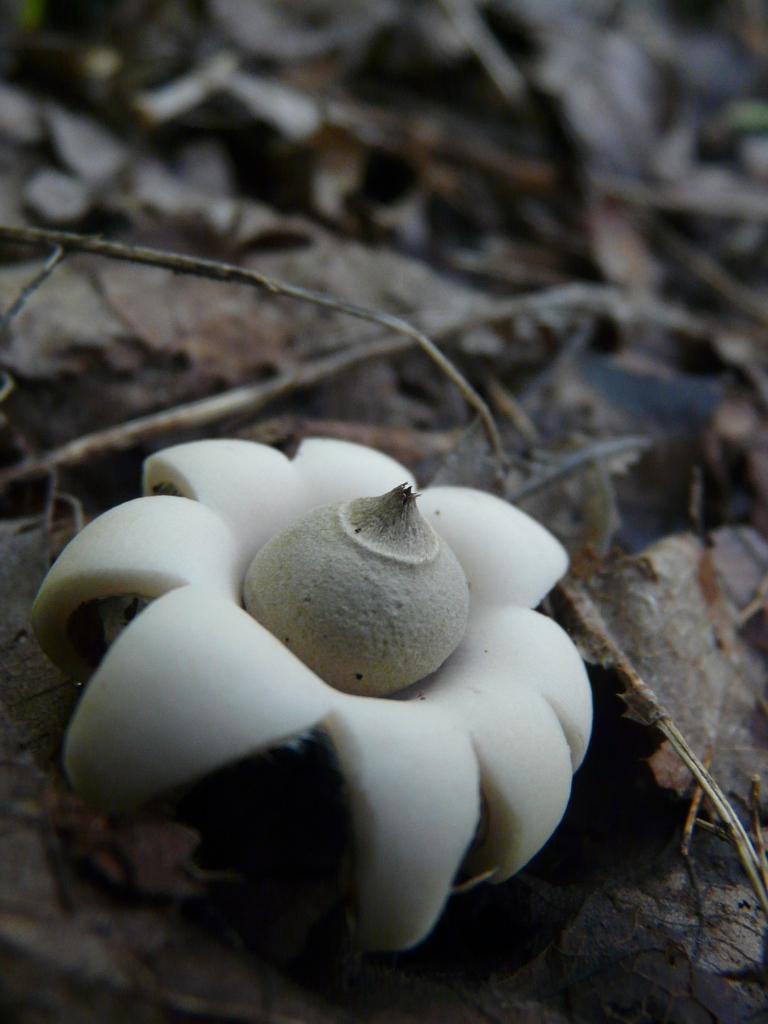
August 8th — Earthstar. Summer’s heat has coaxed another flush of fungi from the mandala’s core. Orange confetti covers twigs and litter. Striated bracket fungi jut from downed branches. A jellylike orange waxy cap and three types of brown gilled mushroom poke from crevices in the leaf litter. The most arresting member of this death bouquet is the earthstar lodged between rafts of leaves. Its leathery outer coat has peeled back in six segments, each segment folded out like a flower’s petal. At the center of this brown star sits a partly deflated ball with a black orifice at its peak.”

And, several years later, right on cue in early August, here are the earthstars in Shakerag Hollow. They must be the most gorgeous fungi ever. The one pictured above is Geastrum saccatum. It is about the size of a quarter.

My essay in The Forest Unseen rambles off in the direction of golf balls. Here I’ll keep my eye on the fungus.

Earthstars belong to the Gasteromycetes (“stomach fungi”), a motley collection of mushrooms that hold their spores in a stomach-like sac. Other members of the group of puffballs, stinkhorns, and bird’s nest fungi. Unlike the gilled mushrooms, bracket fungi, and others that forcibly eject spores using microscopic catapults, Gasteromycetes take an entirely passive approach to dispersing their spores. They hope for a raindrop, or the step of a beetle, or a prod from a falling twig to puff their spores into the air.

The evolution of these Gasteromycete fungi reveals some interesting evolutionary processes. Once the “stomach-like” form evolves, there is no turning back. Although “normal” gilled mushrooms have evolved earthstar or puffball-like structures at least four times, there are no known evolutionary transitions in the other direction. Why? The catapult mechanism is so complicated that it is very unlikely to re-evolve once it has been lost. After the catapult genes have been discarded, only a very long stretch of time and some lucky mutations could bring them back.

The loss of forcibly discharged spores has unexpected consequences. It turns out that having a passive spore dispersal mechanism makes a species more likely to split into new species. Exactly why this should be so is not clear. Perhaps their spores do not travel as far, so allow populations to become isolated from each other, leading to reduced gene exchange and then speciation? Regardless of the mechanism, the Gasteromycete fungi have been speciating more rapidly than their gilled relatives.

So the future belongs to the earthstars. Especially those that can figure out how to eat golf balls.

____

For those interested in digging deeper, the relevant articles in the scientific literature are listed below.

Hibbett, D. S., E. M. Pine, E. Langer, G. Langer, and M. J. Donoghue. 1997. Evolution of gilled mushrooms and puffballs inferred from ribosomal DNA sequences. Proceedings of the National Academy of Sciences, USA 94: 12002–6.

Wilson, A. W., Binder, M. and Hibbett, D. S. (2011), Effects of gasteroid fruiting body morphology on diversification rates in three independent clades of fungi estimated using binary state speciation and extinction analysis. Evolution, 65: 1305–1322. doi: 10.1111/j.1558-5646.2010.01214.x

Shakerag Hollow: update

Thank you to the University President, John McCardell, for making this statement: “We will solve this issue in a way that is not only exemplary, but permanent.” Kudos also to Jon Evans, my colleague in Biology and Assistant Provost for Environmental Stewardship and Sustainability, who first found the problem and took immediate action both in the field and in the administrative workings of the University. We are lucky to have leadership that understands the importance of Shakerag Hollow and that cares enough not only to remedy the present situation, but to look to the future and make permanent changes in University policy.

For the full text of the University’s initial statement, see here.

Regrettably, there is not word yet on whether we’ll maximize the educational potential of this debacle by making public the video and a full report. I’m sure more information will be forthcoming as the University takes its next steps.

Sad times in Shakerag Hollow

The drought has broken here in Sewanee, welcome news for most of us. But rain brings life only to healthy soil. Moonscapes and other bare-earthed areas are quickly scoured away. The rain’s clear blessing turns to choking brown sludge. This, regrettably, is what appears to have happened in a couple of the streams that feed off the golf course construction site into Shakerag Hollow.

The vigorous bulldozing and earth-moving that has raised huge clouds of dust into the air above Sewanee all summer has left large swaths of soil uncovered. A modest rain storm (not hard enough to flood my garage — my informal metric of severity) turned these areas to gullied mud pits. The water that ran off the construction site ran dark as chocolate milk.

The little barriers that were erected were totally inadequate for the job. They ran cross-ways to the streams’ flow and were quickly breached. Boards placed in rivers do not cause the water to stop; fabric placed across a torrent of muddy water has about as much effect.

I’m deeply saddened by this turn of events. Numbed, in fact. Downstream is the forest that E. O. Wilson has lauded as one of the South’s most spectacular. When he received his honorary degree here, he said: “This morning I was able to visit Shakerag Hollow…It is a cathedral of nature, more valuable for the history it preserves, millions of years, than any building.  It’s irreplaceable…I’m reminded of my friend John Sawhill, the late director of the Nature Conservancy. He said that society is defined not just by what it creates, but by what it refuses to destroy.”

This is not just the opinion of an out-of-town biologist. Several years ago, hundreds of members of the Sewanee community joined in the largest grassroots environmental fund-raising effort to that date, raising over $150,000 to protect the north slope of Shakerag.

So, the golf course debacle raises serious questions about how and why we got into this mess. But I am confident that the leadership that we have at the University will step up and respond to this in a way that not only corrects the problem (as much as is possible, one cannot unbury the streams and call back the stream creatures choked by the erosion), but looks to the future to make sure that we have a zero tolerance policy for this kind of destruction.

Some suggested steps that would help to increase confidence that we are indeed headed in that positive direction:

1. Make public the video of the failure of the “erosion control” mechanisms. This is an incredible opportunity to let this event not only change Sewanee’s policies, but to spread the educational message beyond the gates of the University’s land. Releasing the video will also go a long way to convincing people that we take seriously our responsibility as educators: facing the facts with complete transparency.

2. A public report about how we got to this sad place. What do the architects, contractors, and overseers have to say about this? What will be learned? The Sewanee website states that the project “will be in the capable hands of Hanse Golf Course Design, Inc. Founder and President Gil Hanse, whose reputation for artistry, craftsmanship, and personal attention earned him Golf magazine’s 2009 Architect of the Year Award.” Further, the new design will include “environmentally sustainable features that will both enhance the challenges of the course and preserve the delicate ecosystem of the Cumberland Plateau.” This, therefore, is another opportunity for reflection and education.

3. A new policy and set of enforcement mechanisms to ensure that we don’t repeat this tragedy. Every major project over the last couple of decades has resulted in erosion problems (some major, some minor): the Fowler Center, The Chapel of the Apostles, McClurg Hall, the airport expansion, Spencer Hall, and Snowden Hall. Community members, faculty, staff, and students have in each case asked for better safeguards. Evidently, we’re not there yet. But we could be. We have a strong group of leaders at the University who have a commitment to environmental responsibility. We should support them in their efforts to move forward.

I posted a short message on Facebook earlier today about my sadness. The response has been overwhelming both on Facebook and on email. Most people are just stunned or want more facts (information that I hope the University will provide). But there is also a lot of anger. Anger is understandable, but it is destructive in its own way: a mental flow of muddy water that smothers all in its path. Instead of anger, let’s face the facts, mourn, offer mea culpas where needed, fix what we can, then get on with doing the right thing. Pulling that off would be a lesson worth learning.

[Addendum added one day later: the University’s initial statement regarding this problem is here. “We will solve this issue in a way that is not only exemplary, but permanent,” said McCardell.]

[this is a personal blog, opinions here are my own]
Reflections on The Forest Unseen

The Sewanee Magazine’s summer issue includes an article in which I offer some thoughts about my book, The Forest Unseen, and its relation to science, contemplation, and teaching. I’m delighted with the article’s layout and I’m particularly honored to have my photos of Shakerag Hollow featured alongside those of my friend and former student Stephen L. Garrett.

Thank you to Buck Butler for inviting and editing this essay. I’ve posted a pdf of the piece on Issuu.

Thoreau went to the woods to suck out all the marrow of life. I, too, wanted to learn what the woods had to teach, but my teeth are weaker, so I worried at the gristle, gradually gnawing my way into Sewanee’s bones…