Category Archives: Shakerag Hollow

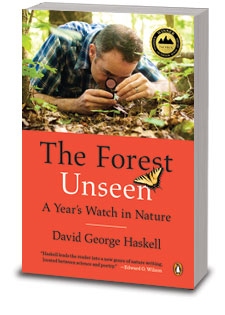
The Forest Unseen paperback edition; copies for course adoption available

paperback3DThe Penguin paperback edition of The Forest Unseen went on sale this week. Having read and enjoyed hundreds of books adorned with the smart little penguin, I’m very happy to see my book published under this imprint. All the other editions of the book — the hardcover, the various e-books — are still available. I’m hoping that this new edition will make the book available and attractive to new readers.

One such group of readers are students. The book is already in use in a few biology, environmental studies, literature, religion and philosophy classes, with great results so far. If you’re a teacher and would like an examination copy, Penguin has free copies available for “course-use consideration.” If you’re interested, please e-mail academic@penguin.com with your shipping address, course title and enrollment, and decision date. Please include “The Forest Unseen, ISBN: 978-0-14-312294-4” in the email. Penguin does not ship to P.O. boxes, so you’ll need to give a physical address. If you encounter any problems with the process (unlikely), just let me know and I’ll make sure that the books get where they need to go.

I’d be very grateful if you could spread the word to friends and colleagues who might be interested. (To make sharing easier here is the shortlink for this webpage: http://wp.me/pKjPz-19T)

To the many readers who have supported the book since its publication last year: Thank you! I’ve been bowled over by your generosity and enthusiasm.

Rambles will continue tomorrow. On the docket (literally): sex, nature and the Supreme Court, with a little help from the Grey Lady.

Dead wood, ashes.

One of Shakerag Hollow’s giant trees has fallen. An ash that until last week held its arms in the highest reaches of the canopy now sprawls across the forest floor, its body utterly torn. I’ll go back soon and “measure” things (how tall? what weight of wood came slamming down?), but for now: just awe.

I did not see the fall, but came by soon after. The trunk was … indescribable. Some grand words are needed, for barely imaginable violence had been at work. Rent asunder!? The whole wide trunk was twisted and split open, lengthways, in several long gashes. Other trees, themselves no mere saplings, were smashed into the ground. Large boulders were shifted as roots reared and cracked. The air was infused with the odor of fresh-split wood. An overtone of bitterness, like cut oak, but mostly a sweet smell, almost honeyed.

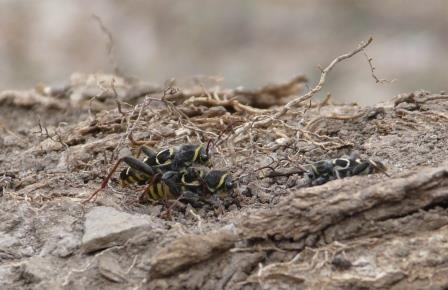
I found the tree in the morning and returned in later in the day for another look. As I stepped closer in the warm afternoon, I hesitated then held back. There were wasp-like creatures, big ones, swarming over one of the thick exposed roots. These insects were scurrying, flickering their wings, crawling over each other. A frenzy.

Black with bold yellow stripes. Buzzing as they flew. Had the tree fall unearthed a buried wasp nest?

Neoclytus caprea

But something was not quite right about these wasps. I moved forward slowly and saw their fat hind legs, too beefy for a wasp. Crickets? No. Then the wing cases, striped in black and yellow: beetles! Wasp-mimicking beetles of some kind. I moved to the side of the tree and saw hundreds of them, racing up and down the bark. They were on no other trees nearby. Half of the beetles were copulating; the other half seemed intent on colliding with the mating pairs. Even though I now knew that they were harmless, their waspy nature made me cautious. Even their short curved antennae were creepily hymenopteran in style (oh yes, those hymenoptera have style).

Who were they? To identify them, I spent some time in the online funhouse known as the Photographic Atlas of the Cerambycidae of the World. This is an amazing site devoted to a single family of beetles, the so-called longhorns (although many of them do not have long antennae). The family contains twenty thousand species, an impressive number when we remember that there are fewer than six thousand mammal species. Some of these cerambid beetles run afoul of humans when they bore into trees and wood that we’d rather they stayed out of. A few of them are “invasive exotics,” killing off native plants. But the beetles in Shakerag were natives: Banded Ash Borers (Neoclytus caprea (Say) 1824). They have an interesting life history, finding recently downed ash and oak trees, then laying their eggs in the bark. The larvae then chew on the wood below the bark, emerging next spring to start the hunt for a newly downed tree.

So I was not the only creature in Shakerag following my nose to the smell of ripped up wood. How many huge ash trees have fallen lately? Not many. Every banded borer within miles must have been at this party. Those flickering antennae are surely tuned to the chemical particularities of newly opened ash wood.

The beetles were one of the very first arrivals in the tree’s new existence. When a large tree falls, its ecological life still stretches out into the future. Perhaps half of the animals (and many more of the fungi) that the tree will nurture during its existence arrive after the tree has fallen. The ecological vitality of a forest can be judged by how may large trees are lying around, feeding beetles, hiding salamanders, growing fungi.

To paraphrase Mr. Faulkner, “Dead wood is never past, it’s not even dead.”

ash

Shakerag Hollow snow

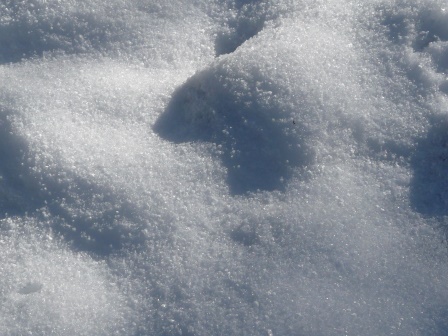
Winter seemed to be slipping quietly out of the door, but evidently it still has business here. The forest floor is transformed.

SnowComp1

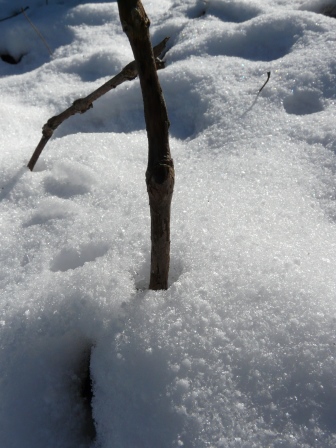
Where-ever dark objects protrude, they soak the sun’s weak heat. Gradually the surrounding snow sublimates, leaving sleeves of empty space around twigs and leaves.

SnowComp7The nascent growth of spring wildflowers is checked. Buds and furled leaves endure, listening for the click of the door.

This slideshow requires JavaScript.

Fog happens, and the woods rise into it.

The overlook at Green’s View offered an interesting prospect this morning. The hundred mile view was shortened by the enveloping cloud to less than one hundred feet.

fogThe fog penetrated the forest, hazing and graying views through the trees.

fog2The smell was deliciously tenebrous, seeping into the dim air from the darkness of the soil. Shrews and moles must inhale the same rich earthiness as they burrow.

Although we imagine springtime coming from elsewhere, a warm breeze blowing birds and warmth from the tropics, in reality most of the year’s new life rises from the musty earth, surging through layers of decay.

The first significant signs of this life have now appeared in Shakerag Hollow. Harbinger-of-spring (also called salt-and-pepper plant, Erigenia bulbosa, a carrot relative with an edible tuber) has raised hundreds of tiny blooms over the mountainside, each one standing barely taller than the upper surface of the leaf litter.

harbinger of spring1

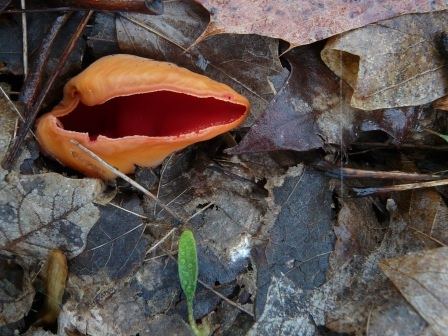
harbinger of springFungi are also poking through, spreading their spores from colored cups.

cup1cuo2And the animal world is alive. Hairy woodpeckers call, perhaps starting their  breeding season. Orange centipedes lumber across the litter, seeking prey into which to sink their poisoned fangs. Spiders, although withdrawn in their hiding places, have their presence revealed by the foggy air. Every web is a bright cloud of droplets. In some places, funnel-web spiders had strewn the forest floor with dozens of newly constructed traps.

funnelLeaves of toothwort, spring beauty, bloodroot and trillium were unfurling, but their flowers were not yet emerged. Soon, though, the smouldering wet soil will blaze.

Beech

The woods are mostly bare and gray, but American beech still shines. The trees, especially the young trees, retain their coppery leaves until spring. Beech is the bright ornament of the dark woods, gold leaf flecking the gloom.

winter beech

The leaves are exposed to all of winter’s assaults and many of them abrade away until all that is left is translucent paper, etched with veins.

beechtrans

Other trees weather more slowly. Perhaps they grow in slightly more sheltered areas or have a genetic propensity for toughness. Their leaves keep the full, metaled color of autumn.

beech copper

Botanists are fond of classically derived English neologisms to describe their plants and the scientists have not let us down here. Unfallen leaves are “marcescent” (from the Latin, marcesco, wither).

But nomenclature is easier than explanation. Why might trees be marcescent? One idea is that a fuzz of leaves might protect nutritious buds from browsing animals like deer. Having watched goat lips strip shrubbery, I initially found this explanation unlikely. Browsers are adept at taking what they like and leaving the rest. Goats work around tiny thorns with ease. A few crisped leaves would be unlikely to keep deer away from beech buds. But my skepticism should be tempered by actual experiments. I know of no such experiment in North America, but a study of beech, hornbeam, and oak in Denmark did find that marcescence had a protective effect for beech and hornbeam, but not for oak. Apparently, the lower nutritional content of the leaves compared to buds and twigs acted as a deterrent for deer. The fact that marcescence is most common in young, short trees and on the lower branches of older trees is another piece of evidence in favor of this hypothesis.

On the other hand, retained leaves may act as cues for ovipositing insects in the spring. Or so it appears for gall-forming cynipid wasps infecting one species of California oak. This tree species lives in a very different environment, but galls are also common in Sewanee’s forests.

Another idea is that the retained leaves subtly change the micro-climate around buds. There is experimental evidence for such an effect in Andean plants with rosettes of marcesent leaves. It is possible (although no-one has checked, that I know of) that the ice and snow that gathers on marcescent leaves might act as a buffer, protecting buds from the more extreme winds and temperatures of winter.

I encourage you to seek out beech on your woodland walks. The species is found all over eastern North America. On the southern Cumberland Plateau it has an odd distribution. Puckette, Priestley, Kuers and Hay’s excellent 1996 guide to Sewanee’s trees states that beech is found “almost exclusively in the bottomlands and the neighboring lower slopes of coves.” I’d add that the species also likes (strangely) dry ridges and the streamside habitat of the eroding bluff. It may be that the semi-domesticated hogs that ran through these forests for decades have caused the species to have a more patchy distribution than it otherwise would have done. Beech nuts were favorite food for hogs and in the late 1800s and early 1900s it is likely that almost no young beeches germinated across large parts of the mountain. The species’ present-day distribution is therefore hard to interpret.

Look closely and you’ll see another interesting feature: needle-like buds. Unlike the rotund buds of oak, ash, and maple, beech has stilettos on the ends of its twigs. They are quite remarkably elongate.

beech budbeech bud2I am not the first person to marvel at this species. I have heard that Native Americans in these parts viewed groves of beech as sacred places. One such grove, in Champion Cove, has come up repeatedly in conversations over the years. A destination, perhaps, for a pilgrimage next year.

Fifty Shades of Grey: Woodland Edition

Sitting in the woods with my class last week, I was struck by how grays had come to dominate. The light environment is transformed. Of course, a “fifty shades” wisecrack had to work its way into my impromptu lesson on the visual aesthetics of the forest. The witticism turned into a small project for my walks of the last week: pay attention and find these shades. So here they are, fifty photographs of variations on the theme.

Gray is the most egalitarian of hues. Indeed, its essence is that is not a single color. Instead, gray gives us a muted echo of all the light spectrum, a moody version of white. Contrast this with the bias of other pigments — reds, blues, yellows — that reflect just a tiny slice of the light available to them.

Gray is an unassuming mirror of the world and a quiet companion for its more assertive kin. It absorbs metaphors with ease, having combined light and dark: ash, silver, lead, pepper. A suitable tone, then, for winter reflections.

Happy Solstice, fellow ramblers.

This slideshow requires JavaScript.

Stream bows

I came across some unexpected sights on my morning walk in Shakerag Hollow. Water was snaking its way through the tangle of rocks and leaf piles that form the boundaries of the little streams on the mountain slope. As the water flowed, the barriers in its way created little falls which emptied into eddies in pools below. All this tumbling motion stirred up air bubbles that turned in slow circles on surface of the pools.

I watched this gentle gyration for some time before my eye caught what was happening below. The bubbles acted as lenses, refracting the sunlight that was coming in at a low angle through the trees. The streambed was covered in underwater stars, each one gliding behind a bubble.

As the light angled through the bubbles, its constituent wavelengths were teased out. Seen close, the stars were edged with prismatic color. Rain can bow the light, even when the rain is old and earth-bound (or, if we look forward, so young that it has not yet risen to the sky). Bubbles were not the only objects drifting on the water’s surface. Leaves and the shells of hickory nuts floated past.

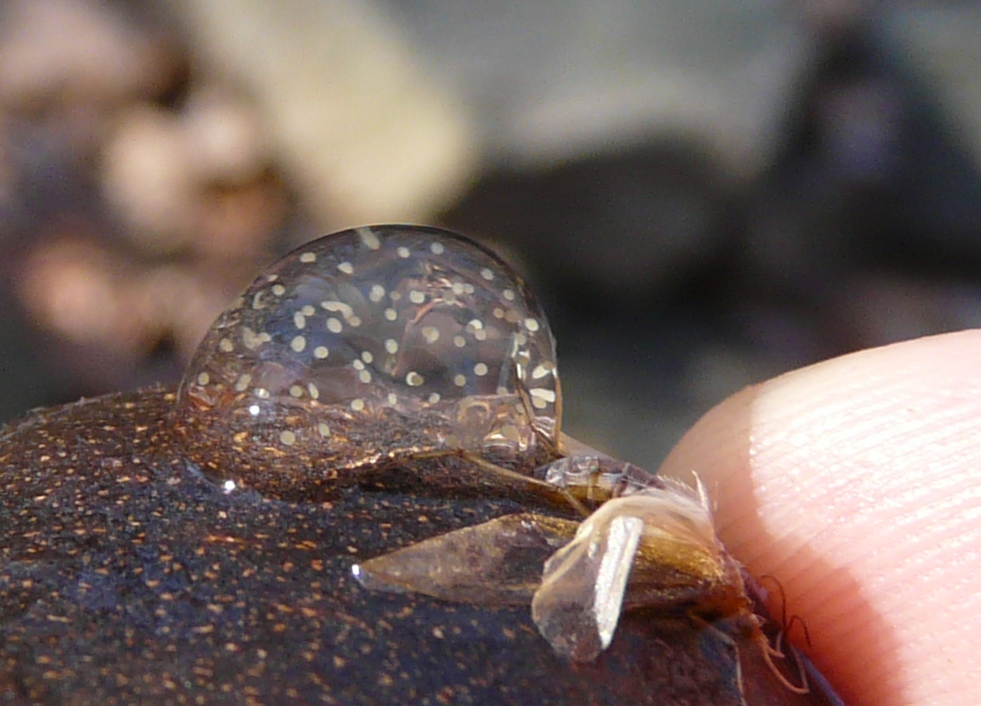
One such hickory shell had some passengers, a dying caddisfly and a cluster of minute eggs encased within a blob of jelly.

I’m guessing that the eggs were deposited by an aquatic snail. (I’d be happy to be corrected or further enlightened about this guess —  I have found no adult snails in this stream which makes me suspect that I’m mistaken. Addendum: these are caddisfly eggs. Thank you David Johnson and Dave McLain for clarifing.) The caddisfly probably flew here from downstream to lay eggs in the water. The adults of many stream insects have an instinct to move upstream when they are ready to breed, counteracting the inevitable downstream flow of aquatic larvae and nymphs.

I took particular pleasure in seeing these two rafters. This is the stream that a few months ago was choked with silt from erosion on the golf course construction site. I took the eggs and the recolonizing caddisfly as signs that, although the stream is still severely impacted by sediment, some aquatic animals have persisted here and others are returning. Soon, I hope, young caddisflies and snails will join the bubbles and stars swimming and crawling in the stream’s waters.

Herp fest continues

Herpetological wonders continue to unfold. The Cumberland Plateau and the Southern Appalachians are among the most diverse places in North America (and the world) for amphibians and, to a lesser extent, reptiles. The last few weeks have not disappointed in encounters with this group.

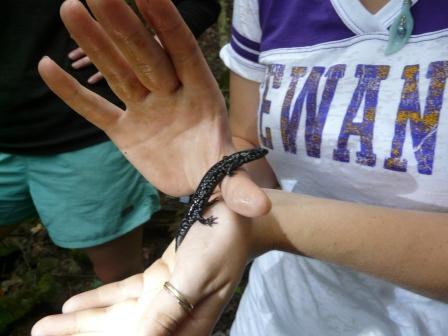
We found this Seal Salamander during my Advanced Ecology/Biodiversity lab last week. The animal was in a creek in Shakerag Hollow. It was about five inches long. Seal salamanders spend most of their time in water, but will wander on land to feed, especially on wet nights.

Unlike its close relatives, the Seal Salamander has tough cornified toe tips, possibly to help it climb vegetation during its terrestrial forays. You can see the blackened tips through the ziplock bag.

This Slimy salamander was under a rock in the same creek. This species is usually found away from water, under logs or rocks, so this individual may have just been passing through. Slimy salamanders lay their eggs in moist places on land and their young never dip their feet in water. Young Seal Salamanders, on the other hand, are aquatic and have feathery gills.

I found this Marbled Salamander during Intro Biology class. It was hiding under a log in a dried up vernal pool. In a normal year, the salamander would wait for several more months before the pool filled up. This week’s phenomenal rains mean that the pools are now overbrimming. We’ll see whether or not the water stays. If so, this will be the earliest filling of these ephemeral wetlands that I know of in recent years.

Scott Summers, a freshman at Sewanee, found this spectacular Red Salamander last week under a log near Morgan’s Steep. Great find!

A Pickerel Frog in Shakerag Hollow. Note the squarish spots on the back. The similar Leopard Frog has rounder spots that are more randomly scattered over the back.

A Green Frog snuggled underwater with an acorn. Also in Shakerag Hollow. Note the nice clear water — thankfully, not all streams have been impacted by silt runoff into the hollow.

And from an entirely different habitat, located just a stone’s throw away from the vernal pool: a fence lizard enjoying the baking sun on a sandstone outcrop near Piney Point. These outcrops are incredibly dry and blazing hot. Fence lizards love the heat.

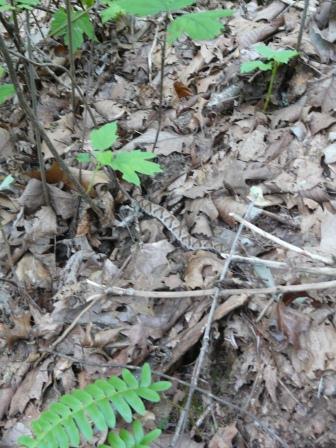
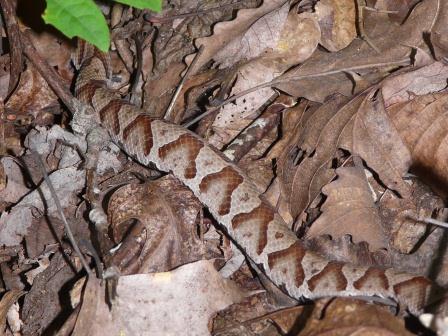
In closing, a frission of danger. This Timber Rattlesnake was on the trail in the northern Smoky Mountains where I was botanizing with the TN Native Plant Society last weekend. The botanists stopped briefly to admire the snake’s freshly molted shine, then returned their attention to petioles, leaf margins, and floral structure. The snake had thirteen rattles, so it has molted thirteen times. They molt two or three times a year, so this one is relatively young. They live up to twenty years.

Horror from within

The rains have brought all kinds of strangeness to the woods. As we wrapped up our surveys of stream salamanders, a cry went up: nematomorph! (Yes, this is an advanced class; in Introductory Biology the cry would have been, OMG-gross…) Lying on the stream bed was half of a Narceus millipede with a long white worm writhing its way out of the broken body. The millipede’s front legs were still grasping feebly at the ground. It had dragged itself several feet to this spot, leaving its other half discarded on the wet rocks.

This individual was not alone. Barely ten minutes later we found another, this time with both halves still encasing the emerging parasite.

I’m fairly confident that the students’ identification of the cause of this distress was correct: a nematomorph worm emerging from its host. However, the light color of the worm makes me a little suspicious that a mermithid nematode might also be the culprit. My search of the scientific literature revealed nothing about either of these worms in this particular host, so we may have stumbled into new corner of the vast wonderland of pain that is animal parasitism. We’ll likely head back down into Shakerag Hollow to see if we can find more worms to bring back to the lab.

Nematomorphs appear in the first chapter of The Forest Unseen as examples of one extreme of the continuum between cooperation and conflict. The worms eat their hosts from the inside out, with no regard for the comfort of the suffering victim. The vital organs are left in place to allow the host to continue feeding (the food goes mostly to the inner pirate, of course). At last the parasite directs its hollowed-out victim to water. There the worm breaks free, discards its dying carrier and squirms away to look for a mate.

After one of my recent public lectures, someone recently asked me for an example of what I meant by the “weight of the world’s pain” (what a blessed life the questioner must have led). This species could surely serve as an answer.

Some visceral fears are tapped when we observe the emergence from within of a life-robbing villain. I think these fears may, in part, be rooted in our species’ long history with parasites, some of which do indeed emerge through our flesh, others merely use existing exit orifices. Either way, we recoil in horror. Movie-makers titillate these deep-seated fears when they show slick-bodied monsters sliding out of our skin. And Freud et al‘s ideas of the unconscious are so successful because of our pre-existing and, ahem, unconscious fear of what might be hidden within us (oh delicious infolding circularity). Psychoanalysis entices because it promises to draw out the appalling inner worm, a cleansing that is surely the deep desire of all animals.