Category Archives: Plants

Pipevines

This humble vine is at the center of a evolutionary tangle of butterflies:
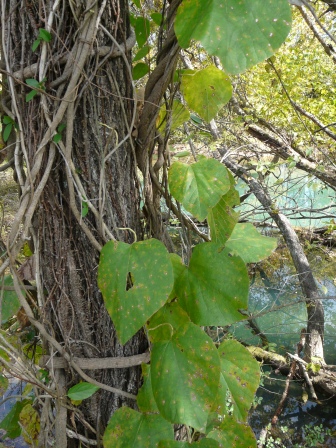
Woolly Pipevine, aka Dutchman's Pipe, Aristolochia tomentosa.

The vine makes poisonous defensive compounds which keep away most chewing insects. But pipevine swallowtails have evolved the ability to not only eat the pipevine, but to sequester its nasty chemicals, taking on a protective mantle. The poisons are stored by caterpillars when they feed on the vine and the chemicals are retained in the bodies of adult butterflies. The butterflies advertise their distastefulness with distinctive blue and black colors. Few birds or other predators are interested in attacking this species.
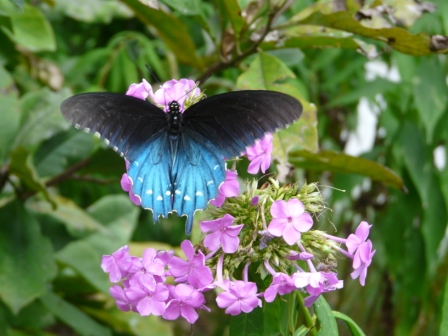
Pipevine swallowtail (photographed earlier this summer, as were all the butterflies that follow)

This bad-tasting butterfly carries a gaggle of other species in its wake. These others lack the defensive chemicals, but mimic the blue and black colors, gaining protection through false advertising.  This kind of mimicry is called Batesian mimicry, after Henry Walter Bates, a Victorian naturalist who first described the phenomenon in the rainforests of South America.

Mimic 1: Spicebush swallowtail

Mimic 2: Red-spotted purple

Mimic 3: Female tiger swallowtail (males are yellow and black). The females can also be yellow and black; the proportion of mimetic forms increases in areas with more pipevine swallowtails.

Humans also use the chemicals in pipevine as a herbal medicine, but the severe toxicity of the aristolochic acids in the plant make this risky medicine, at best.

White heath aster

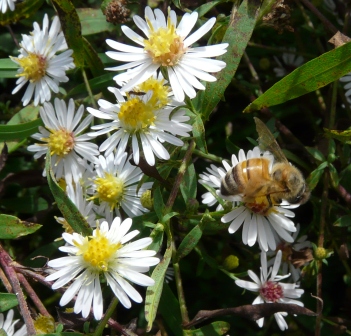
White heath aster, Aster pilosus, is now in full bloom. Each plant stands about four feet tall and has hundreds of small blooms. The plant grows from a perennial root.

Honeybees adore this species. Most other flowers have gone to seed or died back completely, so the abundant nectar and pollen draws dozens of bees to each cluster of flowers.

Pollen basket, the "corbicula", of a honeybee, packed full of aster pollen. The basket consists of a flattened area on the hind leg surrounded by long stiff hairs. The pollen will be used to feed young bees in the hive.

Jewelweed

The last hummingbirds of the season are feeding in the jewelweed patch behind Stirling’s Coffee House.

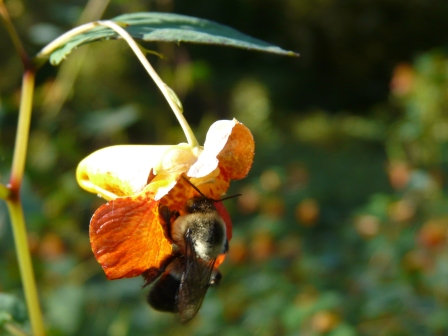
Jewelweed flowers offer nectar to the hummingbirds from a nectar spur at the end of a cone-shaped flower. The hummingbirds have to insert their beaks all the way in to reach the nectar and in doing so they receive a dab of pollen on their foreheads. Many of the hummingbirds in the patch have heads that are completely coated in pollen.

Jewelweed, Impatiens capensis, with nectar spur visible on the far right

The last thing a hummingbird sees before it sinks its beak into the flower. The pollen dusters are at the top of the flower.

Not all spurs are the same shape. Some are curled, others are straight. It turns out the the more curvy spurs result in better pollen transfer to the hummingbirds, probably because the birds have to reach down further to get the nectar.

Compare this piglet-tailed spur to the one above.

The degree of curvature is heritable, so this is a feature that can evolve through natural selection. Why, then, don’t all flowers have the same degree of curl? No-one knows, but the diversity of pollinators that visit jewelweed may favor a diverse set of nectar spur designs.

Bumblebee visiting the same jewelweed patch.

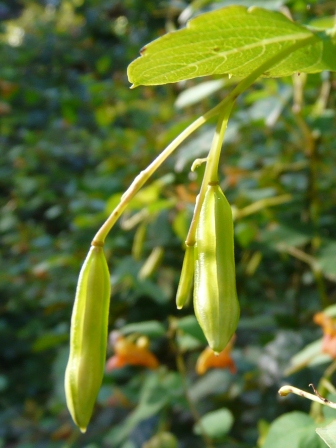
Jewelweed is also called-touch-me-not: a gentle pinch to the bottom of the seed capsule will cause the seeds to explode outwards, shooting several feet away. Gram for gram, the energy stored in these seed pods exceeds that of steel in springs.

Waiting to explode...

As an extra bonus today, the jewelweed patch also hosted a beautiful red phase screech owl. The scolding wrens gave away its location in the shrubs.

Clubmoss

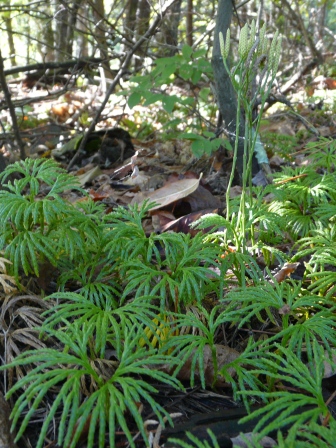
Clubmoss with its spore-bearing "clubs" and branching, green stems

A colony of the clubmoss Lycopodium digitatum lives on the bank of the Lake Cheston overflow. This species is sometimes called running-cedar or fan ground-pine, although it is neither a cedar nor a pine. Rather, it belongs to an ancient group of plants, the Lycopods, that date back more than 400 million years, making them the most ancient of living vascular plants.

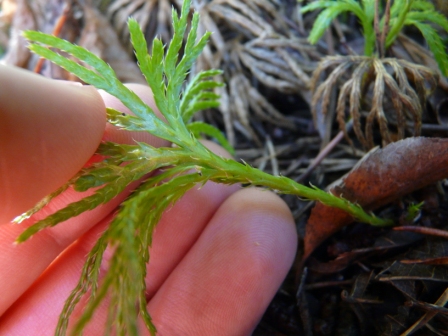
Like other Lycopods, this species has small, scale-like leaves that emerge from the stem. Unlike the leaves of flowering plants, these "mircophyll" leaves are supplied by a simple, unbranched vein.

This Lycopodium is a diminished shadow of its ancestors. Three hundred million years ago, another Lycopsid, Lepidodendron, grew in vast forests all across our region (and well beyond, where-ever the Carboniferous coal forests grew). Lepidodendron also had scale-like leaves, restricted to the tips of it long bifurcating branches. These plants grew up to 30m high and their remains form part of the coal deposits that we now use to power our economy. Unless you’re on green power, the light coming from the image of the tiny clubmoss on this post is likely fueled, in part, by these ancient relatives: their stored photosynthetic energy flickers one more time.

Goldenrod pollen

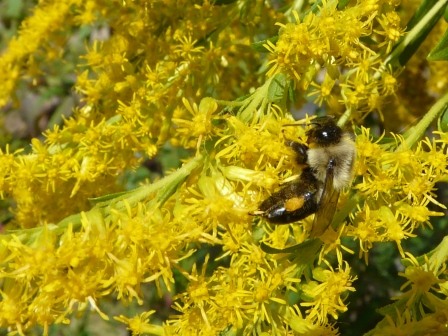
Goldenrods (Solidago sp.) are in full bloom, giving insects a welcome bonanza of pollen.

A bumblebee packs pollen into "baskets" on its hind legs. The baskets are made from long hairs.

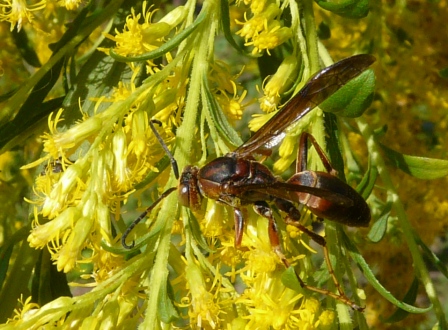
Paper wasps (genus Polistes) also love the flowers. Some studies of goldenrod ecology suggest that these wasps may be the main pollinators of goldenrod. These wasps are normally very flighty, but on goldenrod they seem to settle down to the serious business of investigating every floret on the flower stalk.

Cardinal flowers

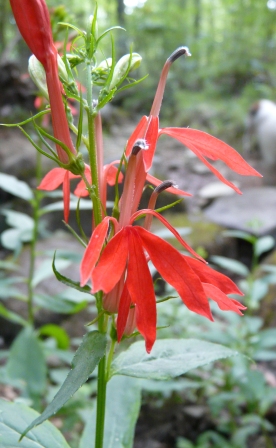
Lobelia cardinalis, the cardinal flower, is in bloom along stream banks. This species uses hummingbirds as its main pollinator and the flowers have all the classic characteristics of a bird-pollinated plant: bright red flowers, nectar buried at the base of a long tube, pollen delivered to the top of the bird’s head from curved anthers, and no scent. Swallowtail butterflies are one of the few insects whose tongues are long enough to reach into the nectar. But butterflies hang low on the flower and pick up no pollen. They are nectar thieves.

The timing of the cardinal flowers’ bloom is no accident. All the hummingbirds from Canada and the north-eastern U.S. are starting to move through our region on their way to the tropics.

Xolotrema denotatum and others at the Powdermill Nature Center

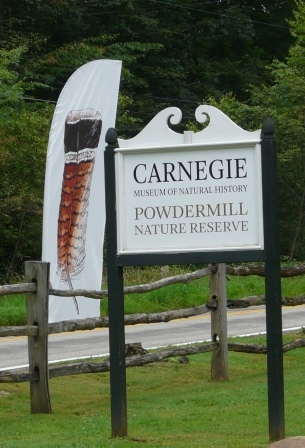
A dozen snail enthusiasts joined the American Malacological Society’s field trip to Powdermill, ably led by Tim Pearce, Head of the Carnegie Museum’s Section of Mollusks.

Xolotrema denotatum was one of the twenty five species that we found. I have been wanting to see this species for some time. We have its cousins, Xolotrema obstrictum and Xolotrema caroliniense, around Sewanee; both of these species have beautiful shells.

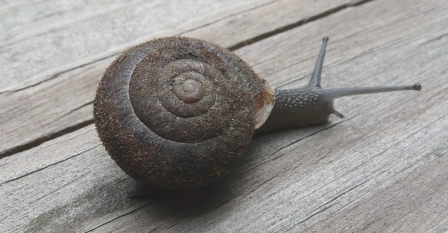
Xolotrema denotatum at Powdermill – note the very hairy covering to the shell. This is formed by the protein coating of the mineral shell.

Xolotrema denotatum seen from the side.

Xolotrema caroliniense shell from Sewanee

Xolotrema obstrictum shell from Sewanee.

A swarm of malacologists

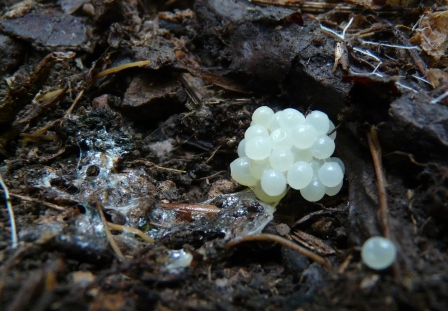
I found these snail eggs hiding under a piece of fallen rotting wood on the forest floor:

The whole cluster is about half an inch across. I’m guessing they are Mesodon or Mesomphix eggs.

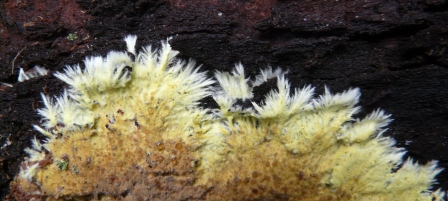
Some spectacular fungi were growing under rotting bark.

Advancing...

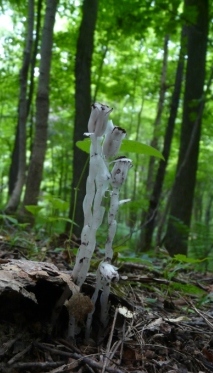
“Indian pipe” plants were poking up from the leaf litter.

Monotropa uniflora, a parasite on fungi that live in symbiosis with tree roots. So, this plant parasitizes trees through an intermediary.

Although Monotropa is only four inches tall, it is a relative of blueberries and azaleas (in the plant Family Ericaceae). It has lost is chlorophyll, giving it another common name, the "Ghost plant."

You can see more photos from the trip at Aydin Örstan’s blog, The Snail’s Tales.

Bellflowers

The thick canopy of leaves is casting deep shade in Shakerag Hollow. Two hours after sunrise it is still dark enough to cause katydids to continue their nighttime songs.

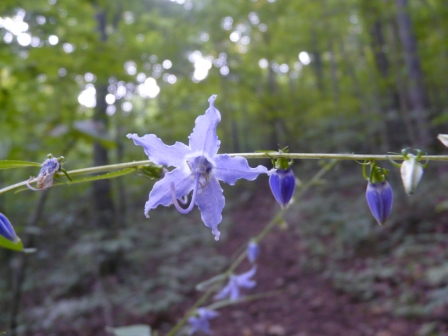
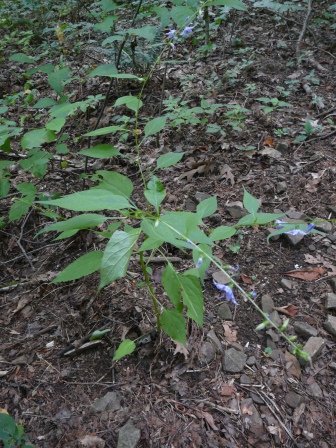
Remarkably, American bellflowers (Campanulastrum americanum) choose this time of year to flower, a strategy that ensures they have few competitors for pollination but little sunlight. They hold their thumbnail-sized blooms on long, bendy stalks above rough, tapered leaves.