Category Archives: Archosaurs

Act I of Autumn

A vigorous belt of chilly rain passed over Sewanee this morning. In its wake, a Canada Warbler feeding on the shrubs in our garden. This is a bird of the boreal forest, found here only during migration. Cool rain, falling temperatures, a forecast for a week of low humidity and clear sunny skies, and the Bird from the North: these all speak of the season’s change.

The plants are ready. Many local species make use of the autumnal surge of birds to complete their pollination and seed dispersal. Cardinal flowers bloom along lake edges, beckoning hummingbirds with their crimson blooms. Dogwood and beautyberry offer brightly colored fruits to the passing thrushes, vireos and warblers. These birds feed on North American insects all summer, then become frugivorous on their tropical wintering grounds. They start the fruity feast right here, gobbling the fruits of our native shrubs and depositing the seeds a few hours later.

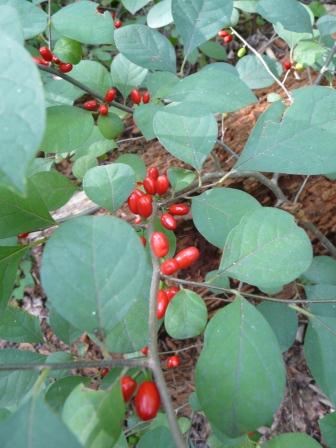
One of the most abundant of these fruiting shrubs is spicebush (Lindera benzoin), a species that is particularly common on the mountain slopes. This has been an incredible year for spicebush. I’ve never seen so many fruits. The warm spring must have suited them.

Like Christmas trees loaded with goodies, the plants will be stripped bare when the party gets going. For now, they sit in a quiet forest, waiting for the rambunctious guests to arrive. But unlike the treats on Christmas tree which make up just a small part of the festive food, these berries are the main meal for migrant birds. Now that dogwoods are nearly gone from our forests, killed by an invading fungus, spicebush is a lifeline for the feathered travelers.

Amazonia bound

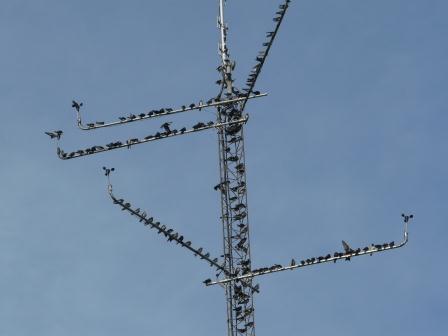
Sewanee got pounded with rain yesterday. A hard day for birds that feed on aerial insects. Late in the afternoon, the skies cleared and dozens of purple martins swarmed the radio antenna pole near Lake Cheston. They circled in noisy groups, feeding then swirling in to roost.

Many of these birds are likely migrants from the north, winging their way across Tennessee on the first leg of a long journey to their Amazonian wintering grounds.

In the eastern U. S., martins are almost entirely dependent on humans for nest cavities, a dependence that goes back to the days of Native American agriculturalists who erected poles with hollow gourds for the birds. Martins chase away crows, so this was a mutualistic arrangement. The birds got homes; the humans got protection for their corn crop.

In 1831, John James Audubon noted: “Almost every country tavern has a martin box on the upper part of its sign-board; and I have observed that the handsomer the box, the better does the inn generally prove to be.”

I think Lake Cheston could use a handsome box. Perhaps a class project for the spring?

Tracking migration: a window into the lives of wood thrushes

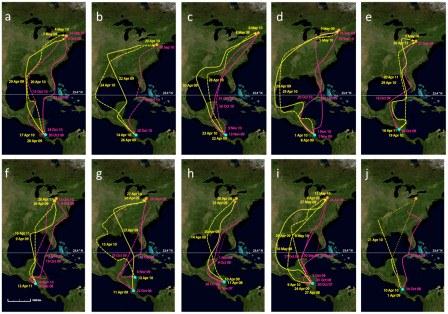
This image comes from a remarkable new paper about the migration of wood thrushes. A team of ornithologists led by Calandra Stanley and Maggie MacPherson from Bridget Stutchbury’s lab at York University in Toronto have used  tiny “light-level geolocators” to track the individual migration routes of wood thrushes. Geolocators use the daily cycle of sunlight and darkness, referenced to the time of day and date, to calculate where in the world they are. Sunrise and sunset vary consistently according to longitude (sun rises earlier in North Carolina than it does in Tennessee) and latitude (day length is longer in New York than in Belize in summer, but shorter in winter — except on the equinox when the machines get confused). Geolocators are not as accurate as GPS but they have the great advantage of being very small and lightweight. GPS needs a big, heavy antenna — there is no way that a songbird could carry even the smallest GPS unit.

The image above shows the path of one wood thrush over two years as it moves between its wintering area in Belize and its breeding grounds in Pennsylvania. The particularities of the route taken bring the map alive. The details change each year. In the fall of 2009, the bird came south over Florida and Cuba, but took the direct route across the Gulf of Mexico the next year. The map makes clear that migration is not an abstraction, but a yearly marvel.

This bird winged across Tennessee twice. That makes my heart leap — I may have heard this bird in Sewanee’s woods — but it also gives me chills. I have a freezer full of thrushes that hit windows and cars. (The dead birds are for use in the anatomy labs in my ornithology class.) We’ve thrown so many hurdles in the way of these migrating birds. To see the migration path is therefore not just to marvel, but to imagine the dangers.

A composite of the maps of multiple individuals shows the diversity of migratory paths within the species. Some birds hug the Mexican coast, some come through the Florida peninsula, and others take the dare-devil ocean crossing.

Joanna Foster’s article at the NYTimes Green blog does a great job of putting this study into the larger context of climate change and habitat loss. The important finding of this study was that the date of departure for spring migration barely varied from year to year. Individual birds, in other words, were consistent in when they left Belize. This is surprising — you’d expect them to be more sensitive to local conditions like the weather or their body condition. In the words of the authors, this lack of variability “may limit the ability of individuals to adjust migration schedules in response to climate change.” As my previous post of thrushes described, these birds have been declining for decades, so this is not good news.

Images here are from the paper: Stanley CQ, MacPherson M, Fraser KC, McKinnon EA, Stutchbury BJM (2012) Repeat Tracking of Individual Songbirds Reveals Consistent Migration Timing but Flexibility in Route. PLoS ONE 7(7): e40688. doi:10.1371/journal.pone.0040688 [Creative Commons]

For another mind-blowing set of maps from geolocators, see the Arctic Tern Migration Project website and click on “maps.”

Sargassum

The seaward beaches on St Catherine’s Island are littered with big clumps of sargassum, a type of seaweed normally found only far offshore. The tropical depression that blasted the island a week ago carried the sargassum toward the land and dumped it in untidy skeins in the wrack line. Some even got carried up into the marshes behind the beach.

Sargassum is incredibly important to the ocean’s ecology. It grows in vast floating mats in the warm tropical currents of the Gulf Stream and beyond, even giving its name to the gyre that sits at the center of the Atlantic, the Sargasso Sea. The mats of algae serve as a breeding ground for eels, the nursery of young sea turtles, the home for legions of fish, and the feeding ground for tropical seabirds. Several years ago I took a boat ride out to the edge of this strange sea-within-a-sea (it has no land borders, being surrounded by other bodies of water and ocean currents). The water and air were torrid; the abundance of sea life was phenomenal, especially the graceful terns that plucked fish from the startlingly blue water.

Algae were not the only creatures trapped and hurled to shore by the storm. This young frigatebird was lying on the wrack on the island’s easternmost point. Frigatebirds are the real pirates of the Caribbean, making their living by robbing gulls and terns of their hard-won prey. This young bird must have been blown out of its tropical home and perished on the Georgia shore, turned to acrid-smelling jerky in the sun’s blaze.

Magnificent Frigatebird (Fregata magnificens)

“So little cause for carolings / Of such ecstatic sound / Was written on terrestrial things”

Now that the summer season is wearing on, the thrushes are singing at dusk. More than any other songbird, their voices seem to rise as the sun sets. There is something irredeemably sad in the fluting of a thrush as the western horizon sweeps up and takes away the light.

We’ve heard Thoreau’s springtime rapture over the same song; Hardy’s refrain takes over as days shorten, with Hughes’ black silent waters lapping close.

But “irredeemable” must be a lie. Hardy kindles his hope and even Hughes bends to be blent in the prayer. And the thrush remains beautifully inscrutable in his otherness.

Goslings and caterpillar

Continuing with the theme of cute animals, I was in Chattanooga today and took time out for a bike ride along the Riverwalk. Young animals from two very different parts of the tree of life caught my attention.

This mixed brood of Canada goose goslings was making its way upstream along the Tennessee River. There are at least two families, possibly three, in this “crèche.” Mixing families like this is common in waterfowl, although less so among Canada geese. There is safety in numbers, so these goslings benefit from each other’s presence.

This pipevine swallowtail caterpillar was crossing the concrete path. Although it looks fearsome, it is harmless to handle. But any would-be predator foolish enough to try to eat the caterpillar will soon regret its decision. These caterpillars feed on poisonous pipevine plants and sequester the toxins in their bodies. The toxins then get passed to the adult butterfly. The adult tastes so nasty that half a dozen other species of butterfly mimic the butterfly’s blue and black colors, gaining protection through deception. Predators generally leave these mimics alone for fear of biting into a pipevine swallowtail. The photo below is from last summer — note the remarkable iridescent blue. Although I frequently encounter the adults I have never before seen the caterpillar. So a close encounter with this bristly rubbery beast made my day. I put it back in the vegetation, away from the walkway.

Trees in Oxford, MS

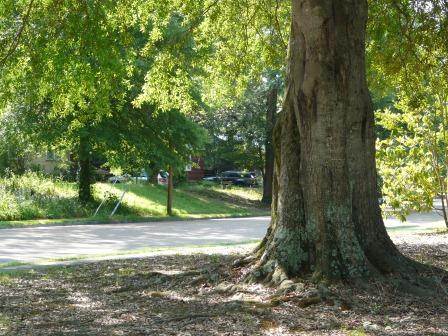
The number and stature of trees in Oxford, MS, is impressive. My stay was quite short, so my ramblings were brief, but it seemed to me that the sylvan nature of town extended well beyond the upscale neighborhoods. Urban trees and other forms of biodiversity are well-known to be associated with the more wealthy parts of towns (e.g., this and this study), so the presence of large trees in less affluent neighborhoods can be thought of as a measure of the “eco-justice” in communities: access to the practical and aesthetic benefits of nature.

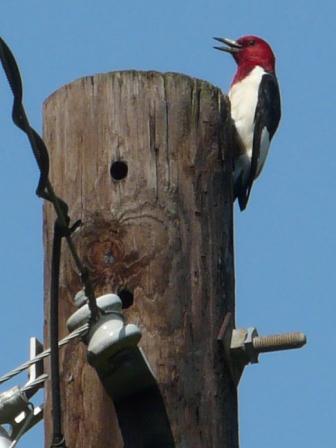
The large trees in the suburbs of Oxford attract a good diversity of bird species, including this red-headed woodpecker that was using the top of the power pole as a place to carry insects or seeds to jab with its beak.

The impressive tress in town contrast with much of the rural land in northern Mississippi where large plantations of loblolly pine dominate. These plantations are planted and cut like crops and, although they have more biodiversity than cotton fields, they generally host fewer species than native forests or residential areas (for my study of these differences on the Cumberland Plateau, see here).

Oxford’s wealth of trees didn’t “just happen.” The town has a tree board and a plan that not only seeks to preserve existing trees but also to expand plantings for the future. So, what lies behind the leafy charm of one of the most beautiful (and consequently one of the more prosperous) southern towns? Proactive urban planning, the work of loving the people and trees of the future.

Imaginings of avian reincarnation

At the end of the final exam in my Ornithology class, I ask the students, “If you could come back as a bird, which species would you choose and why?” No grades for this question… The diversity of answers is always interesting. This question can be taken in a number of ways: which bird most represents something about who you are, which bird most represents something about who you’d like to be, or which bird offers something to you now that you find compelling, amusing, or interesting?

I’ll list summaries of student answers below, then offer my own thoughts.

Student answers:

Wood thrush – for Thoreau

Oystercatcher

Blue-footed Boobies — because they are called blue-footed boobies; I’d choose the mate with the silliest foot-waving dance.

Arctic tern – they migrate between hemispheres; it is always summer for them.

Brown pelican – great life on the ocean

Owl – great songs; they are so quiet; come out in the evening, my favorite time of day.

Turkey vulture – they eat well and I could terrorize people with my unholy hissing sound.

A crane – to migrate and see the world; protected from hunters; I’d be tall and have few predators.

Peregrine falcon – amazing speed, control, and acute senses.

Whatever that bird was on the Life of Birds video that actually enjoyed sex.

Osprey – aerial and aquatic superiority, and a vision of the future…

Cedar waxwing – roll deep with a huge posse and get drunk off of berries while looking like a superhero/bandit.

Wood thrush – they make the most beautiful sound, magical, mysterious.

American crow – they do pretty well as a species (apart from West Nile virus); I like the idea of a family unit; fly high and fast.

Barred owl – I like owls, this species is the best looking. I’m not feisty enough to be a screech owl and I don’t have enough Rowan Williams in me to be a Great Horned Owl…

Common loon – I really like the song

Lyre bird – the ultimate song learner. Amazing feathers.

Spotted owl – neatest looking birds (soft and fluffy while also being murderous and cunning); I could stand in the way of deforestation in the NW, a beautiful place; no long migrations; people would be happy to see me; rad call.

Cedar waxwing – love their song and their appearance, especially the bar stripe through the eyes.

It heartens me to see how many of these answers refer to sound. Developing acoustic awareness is a big part of this class.

Here are my responses. I write the exam and the blog, so I get to bend the rules and choose three different species. A divided afterlife? Why not? I picked these three for the physical experience of the world that they would offer my body-jumping soul.

Wandering albatross – the purest experience of air possible, winging for hours without a flap of the wings, caught in the strength of the endless south polar winds; alone for months with ocean, salt, wind, and a gray horizon that never resolves into land. I can feel the streaming cold air in my nostrils already. A meditation.

Mousebird – a life tumbling in a flutter of sociable activity, my flockmates always close; we gorge on fruits and flower buds, then recline in the sun to let its warming rays toast our bellies, chattering all the while. Conviviality.

Winter wren – an unassuming bird, at home in the undergrowth, half bird half mammal. My song slices open the forest air and the moon pours out, splintered into a million pieces. My heart breaks at the beauty of the flowing air in my throat. An exaltation.

Of course, beyond these dreams, the task for today is to want to be who we are. As Oscar Wilde said, “Be yourself; everyone else is already taken.”
Paddling

For our last full lab of the semester, my ornithology class took canoes down to the Elk River. We put into the water where the Elk runs into Woods Reservoir.

Trip highlights include:

  • A great look at a Prothonotary Warbler. This warbler is unusual in that it nests inside old tree holes instead of making a twig or ground nest like most other warblers. It is found along waterways and lake edges.
  • Seeing a Great Blue Heron grab a big watersnake. The snake wrapped itself around the heron’s beak and neck like a whip around a post. The heron thrashed and leapt, perhaps feeling the sting of the snake’s bite, then the snake escaped. The heron kept probing in the water, but this snake was not about to come back.
  • Three Ospreys wheeling overhead, whistling loudly.
  • Two Black-crowned Night-herons, flying right over us, giving a great look at their head plumes and bright legs.
  • A mother goose on her eggs, flopped out with a “broken neck” — playing dead as a ploy to remain unmolested by these strange paddling primates.

(note: photo links above are not from this trip (I wish), but from Robert Royse, an outstanding bird photographer)

Trip lowlight: dozens of trotlines tied to branches overhanging the river. These are unattended fishing lines, mostly aimed at turtles, but anything that grabs at the large hooks on the lines gets snagged. Two years ago we found a heron that had died in a tangled trotline. Not so pretty, but 100% legal (as long as you don’t set more than 100 trotlines at a time…). This method of fishing is like deer-hunting by lashing shotguns to trees, then attaching tripwires to the triggers. You’ll get some deer, yes, but at what cost?

This slideshow requires JavaScript.

Here is a bird in whose strain the story is told

I heard the first wood thrush this morning, singing in the thickets along Willie Six Rd. By the time I got my class out there, the bird was silent. Next year, I’ll reschedule this class to begin at 7am instead of 8am, for the whole darn semester. More in tune with reality, I think.

The wood thrush sings with pure notes, unadorned by harmonics, slightly offsetting the tones from the two sides of its throat. The result is gorgeous. Thoreau, as usual, had something to say about this:

“The wood thrush’s is no opera music; it is not so much the composition as the strain, the tone, — cool bars of melody from the atmospheres of everlasting morning or evening. It is the quality of the sound, not the sequence. In the peawai’s [Eastern wood-pewee] note there is some sultriness, but in the thrush’s, though heard at noon, there is the liquid coolness of things that are just drawn from the bottom of springs. The thrush alone declares the immortal wealth and vigor that is in the forest. Here is a bird in whose strain the story is told, though Nature waited for the science of aesthetics to discover it to man. Whenever a man hears it, he is young, and Nature is in her spring. Whenever he hears it, it is a new world and a free country, and the gates of heaven are not shut against him.” (from Thoreau’s Journals, July 5th, 1852)

The gates of heaven are not closed, agreed. But they are swinging shut, quite fast. Wood thrushes are in decline, the victims of fragmented forests, air-borne mercury from our coal plants, and lost wintering habitat. I culled the following graph from the Breeding Bird Survey. It shows an index of wood thrush abundance over the last forty years. In my lifetime, the species appears to have halved its abundance.

But, given a chance, these birds can bounce back. Indeed, it is likely that in many regions they were a lot less common in Thoreau’s day (the late 19th century was a time of massive deforestation) than they are now.

If you want a taste of heaven for yourself, The Music of Nature site has some nice footage and sound. But computer speakers and pixels are wan memories of reality. In the words of another bewhiskered New England word- and nature-lover, “You shall no longer take things at second or third hand, nor look through the eyes of the dead, nor feed on the spectres in books;/You shall not look through my eyes either, nor take things from me:/You shall listen to all sides, and filter them from yourself.”