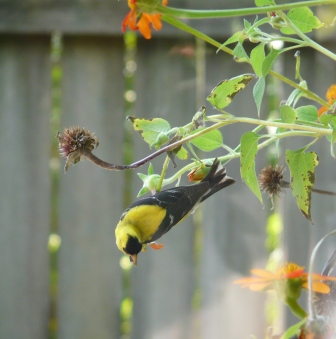
They love the dry seedheads...
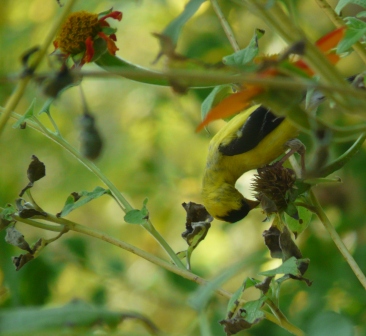
...and twist their heads and bodies to get the best angle to pry out the oily black seeds.
They love the dry seedheads...
...and twist their heads and bodies to get the best angle to pry out the oily black seeds.
I am on a quick visit to New York City. Amid the exultant noise of the city three areas of unusual quiet stand out:
The house sparrows seem content to go about their business without the chatter of their country cousins. These city birds know to save their breath, perhaps. Why compete?
Cabs with hybrid engines. It has been several years since I’ve been in the city, so the quiet of the cabs is disconcerting, but heartening. This is one more demonstration of the generality that cities are in many ways greener than the countryside. NYC performs particularly well in many energy-use rankings.
The “Permanent Mission of the Libyan Arab Jamahiriya to the United Nations.” My hotel is a couple of blocks away, so I wandered down there to see whether I could see any reflections of the day’s turmoil. The building is the only quiet place for many blocks. Only an idling NYPD vehicle parked in front breaks the stillness. Somehow the quiet seems more distressing than a noisy crowd.
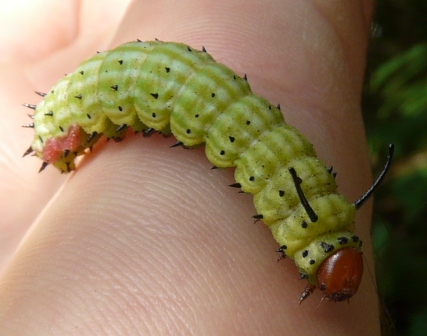
Dryocampa rubicunda
This caterpillar was racing across our driveway, heaving its body along in lurches. It is a “green-striped mapleworm.” It looks big and fat enough to pupate. After the animal emerges from the pupal stage, it will be a “rosy maple moth,” one of the more striking of our local moth species. Here in Tennessee, this species goes through several generations each year, so the moth will likely lay eggs in September and get one more generation completed before the winter. The pupae of the year’s last generation overwinter in the soil and emerge as moths in the spring.
Hickory nuts are not quite ripe in Shakerag Hollow, but the squirrels have started in on them already. You can locate hickory trees by the gnawing, scraping sounds coming from the canopy. Below, the ground is strewn with discarded nuts and fragments of shell.
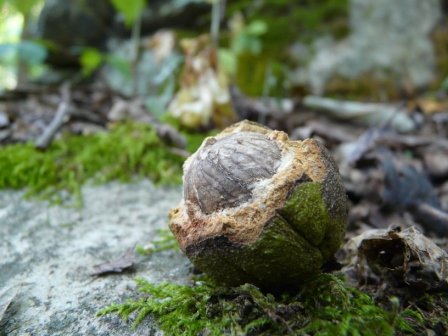
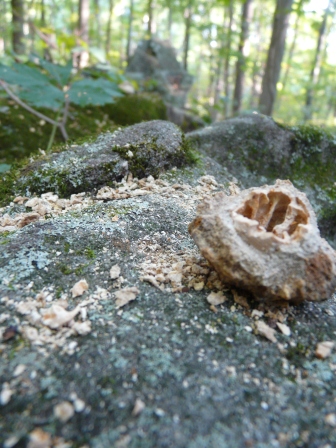
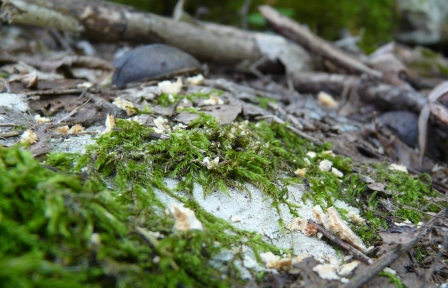 Shagbark hickory has the sweetest nuts (pignut hickory, above, and other species have more bitter flesh) and the ground below these trees looks like a woodshop floor, covered with sawdust. These squirrels have impressively tough and persistent teeth.
Our Seminole squash vines have dozens of flowers, each of which is stuffed full of bumblebees (or, as Darwin called them, humble bees).
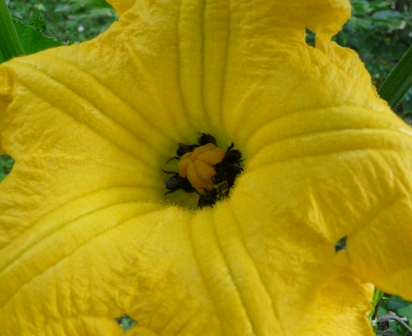
Seminole squash flower
The bees cram their heads under the central column (the pistil that gathers pollen from incoming bees), lapping at the nectar that oozes below. Occasionally a bee will break away and fly to another flower, but mostly they keep their heads buried in the flower, moving only to push themselves deeper into the nectar.

Seminole squash flower with bumblebees
The photographs above are of female flowers. Interestingly, the male flowers are a little smaller and, although they attract bumblebees, they don’t seem to elicit from the bees the same adoration and abundance.

Male Seminole squash flower
According to RAFT (Renewing America’s Food Traditions), this variety of squash is one of America’s ten most endangered native foods. This breed of squash was originally cultivated by Native Americans in and around the Everglades by girdling trees and letting the vines grow up the dead limbs. This gave the plant its other common name, “hanging pumpkin,” for the arboreal fruits. We’ve grown this variety for two years now. Its vines and leaves are enormous and they tend to smother all other plants in their path as they grow outward. They are phenomenally productive and seem to have no problems with disease. And, evidently, the bumblebees love them.
This post is in answer to a query about John Muir from Eric Keen, a fellow saunterer of the finest kind. In 2008 I had the privilege of visiting Muir’s birthplace in Dunbar, Scotland, and found that the town fondly remembers its emigrant son:
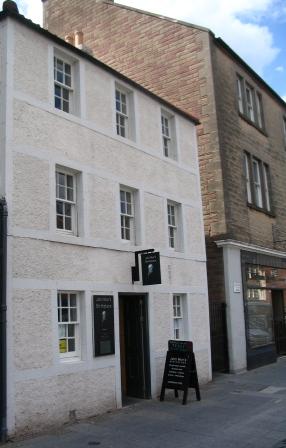
Muir's birthplace, now an interpretative center. In 1838, when Muir was born, the family quarters were cramped rooms behind a shop. The building has since been expanded and renovated.
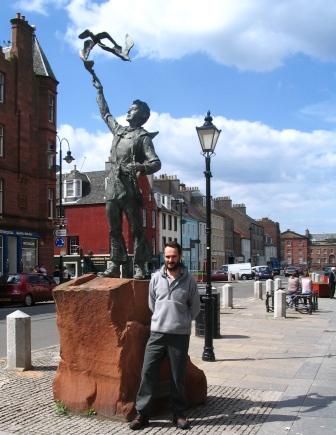
The town of Dunbar honors Muir with a sculpture of him as a boy, reaching up to gulls in flight. Pilgrims of dubious moral character loiter around the foot of the statue.
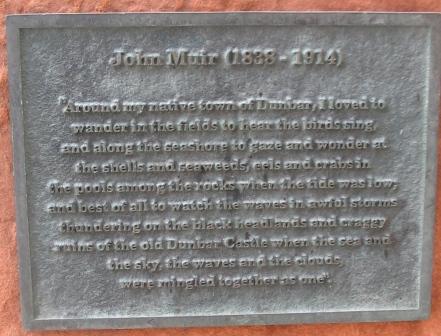
The statue's plaque quotes one of Muir's reminiscences about his childhood in Dunbar.
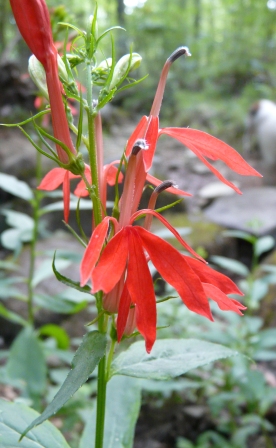
Lobelia cardinalis, the cardinal flower, is in bloom along stream banks. This species uses hummingbirds as its main pollinator and the flowers have all the classic characteristics of a bird-pollinated plant: bright red flowers, nectar buried at the base of a long tube, pollen delivered to the top of the bird’s head from curved anthers, and no scent. Swallowtail butterflies are one of the few insects whose tongues are long enough to reach into the nectar. But butterflies hang low on the flower and pick up no pollen. They are nectar thieves.
The timing of the cardinal flowers’ bloom is no accident. All the hummingbirds from Canada and the north-eastern U.S. are starting to move through our region on their way to the tropics.
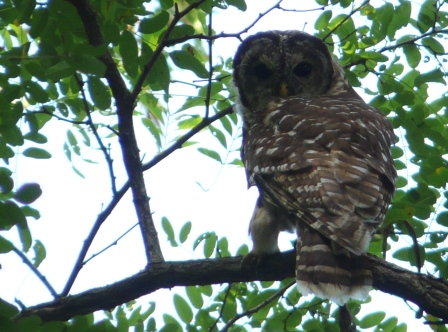
This Barred Owl flew in alarm as we walked past its perch in the dry oak woods south of Tennessee Ave. It perched high on a branch and watched.
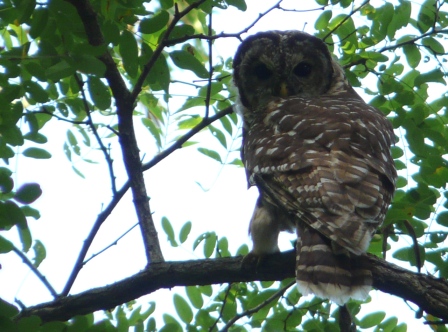
Close inspection of its head revealed a halo of downy feathers around its face. This is a youngster, born earlier this summer. It is likely that the parents are still feeding it as it learns to hunt on its own.
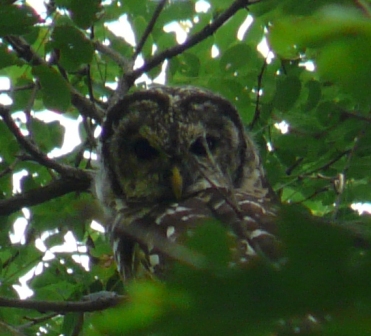
An hour before dawn, the owl sat outside our window and gave its soft whinny.
Several species of cricket call in the background.
 David George Haskell