Author Archives: David George Haskell

Celandine Poppies

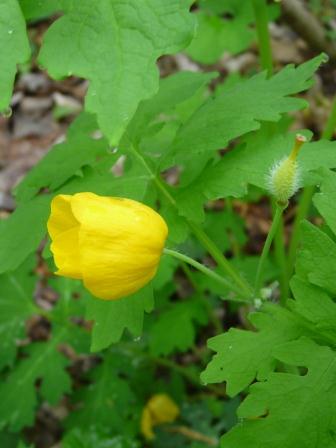
On my return to Sewanee, I made a trip down Shakerag Hollow to see whether I had missed the blooms of my favorite spring flowers, celandine poppies (Stylophorum diphyllum). These are short-lived flowers, easily damaged by rain, a fragility that somehow makes them all the more compelling.

Most had set seed already, with hairy pods hanging below the leaves.

But a few flowers remained. This is one of the few yellow-flowered species in the spring (in this patch of woods, they are the only one).

Ants play an important part in the life history of this species. The small fruits that fall from the pods have large ant-attracting food packages, elaiosomes, attached to them. The ants drag off the fruits, eat the attractant, then discard the fruit. In this way, the poppy seeds are “planted” in the good fertile soil of an ant waste heap. Thank you, ants.


Inching into the future

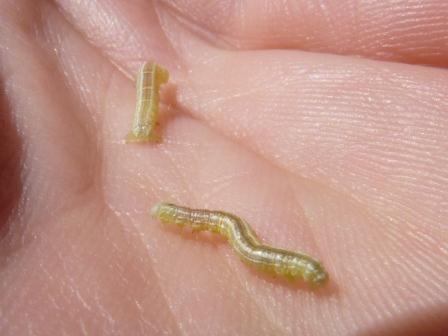
I’m visiting the University of Richmond where, just like Sewanee, spring is in full force and many weeks early. In addition to great people and beautiful buildings, the campus is populated by millions of inchworm caterpillars. Just walking between buildings results in the acquisition of half a dozen hitch-hikers, each one hanging by a silk thread from above, presumably drfiting down to new feeding areas or places to pupate. These caterpillars belong to the Geometrid moths, a family of brown moths named for the looping walking habit of the caterpillars — they appear to “measure, metron, the Earth,Geo,” as they walk along.

These seemingly insignificant creatures are one of the hinges on which our changing world swings.

The caterpillars come out when the oaks and other trees first unfurl their leaves. The young leaves have not yet had time to accumulate toxins to deter the inchworms, so the little caterpillars feast quickly, then their numbers dwindle.

Migrant birds time their arrival to catch the burst of caterpillars (food!). But, lately, the caterpillars are emerging so early that by the time the migrant birds arrive, the party is over. In Europe, this mistiming is so severe that it has caused significant population declines in some birds.

How or whether these dissonant changes in tempo will resolve is unclear.

The High Line

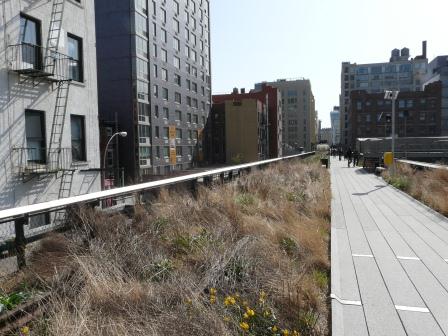
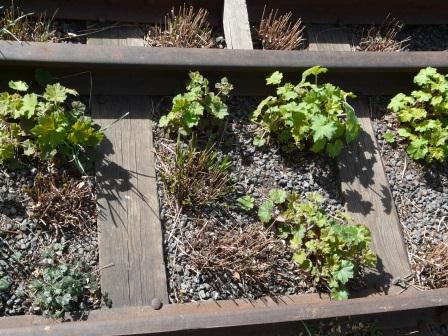
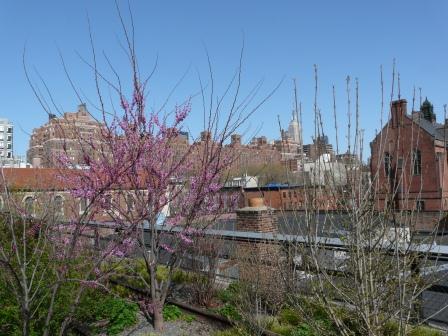
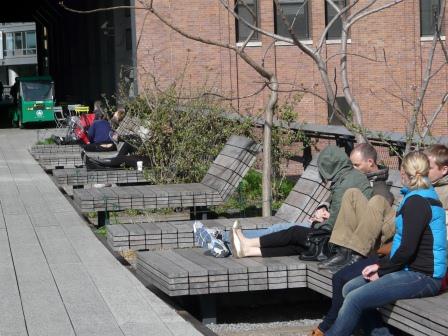
During my trip to New York, I made a visit to the High Line, surely one of the more interesting urban parks in the world. The park swings through West Chelsea and neighboring areas of the city, running along a disused elevated train line. The old tracks are still in place, forming the backdrop to varied plantings of native and ornamental plants. A wide walkway runs the length of the park, liberally scattered with benches and overlooks. I’d read about the park many times and was eager to visit.


The elevation of the park gives a feeling of both separation (walking above the streets) and connection (seeing roofs and buildings up close). As a New Yorker friend told me, “now you know what it feels like to be a pigeon.”

Ornithological insight is not the only fruit of this remarkable project. What was a derelict and ugly piece of infrastructure has become a thing of beauty. The affinity that people feel for the park is reflected in the many nearby ads for real estate. The creators of the park have created desirable habitat for Homo sapiens, it seems.

The unspoken rules among walkers on the High Line are more congenial than those of the world below. This is a place where ambling is OK — a verb that gets trampled in the surrounding streets.

Puget Sound

After my talks in Seattle, Olympia, and Tacoma, I spent Saturday in Tacoma with my friend Peter Wimberger. We were in graduate school together back in the early 1990s and we have a shared affinity for natural history, helping our students see the world through the eyes of evolutionary biology, and eating salmon. He was kind enough to take me on a tour of some good bird-watching spots on Puget Sound.

A different world from the forests of Tennessee.

Douglas firs, western cedars, Pacific yews. Ever Green. Tree trunks thicker than any that have grown in most eastern forests for hundreds of years. There is no “ground,” no litter layer; instead, moss, moss, moss, as if a bryophyte blizzard had passed through, leaving drifts everywhere.

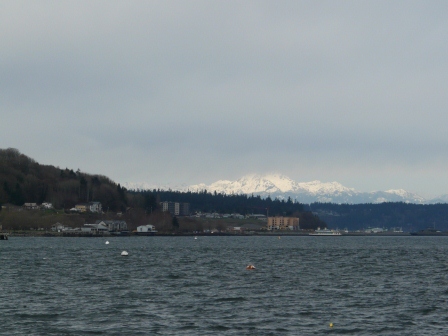
And on the water: murrelets, goldeneyes, harlequin ducks, scoters, loons, red-necked grebes. These are birds of cool rocky coasts, of Alaskan inlets, of moutain lakes, of streams running out from mountain glaciers. Look up from the water, and there are the snowy mountains rising behind wooded slopes and coast-hugging cities.
We conducted our bird-watching through binoculars and a scope, out of range of my modest, weak-lensed camera. But, a few ducks were bobbing close to shore. These Barrow’s goldeneyes were close to the dock. I’d never seen this species before. It is distinguished from its cousin, the common goldeneye, by the bright orange beak of the female and the crescent-shaped white patch on the male’s head. They winter on the coasts, but move inland to mountain lakes to breed, building nests in holes in dead trees. They feed by flipping their compact bodies forward and diving under the surface with a little splash. They swim down to grab mussels and other invertebrates from the rocky bottom. Their eyes are, indeed, golden — just visible in this photo.

Next stop, Newark, NJ…

Poultry Art installation

During my brief visit to Olympia, I stayed at Fertile Ground, a beautiful b&b right next to the public library where I gave my talk. Fertile Ground also serves as a hub for urban ag, art, and community building.

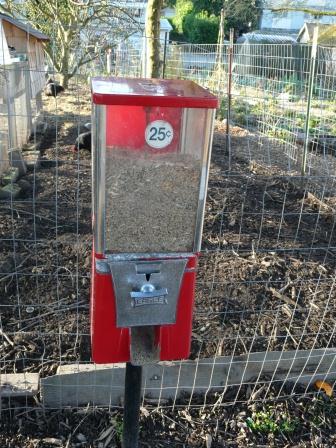
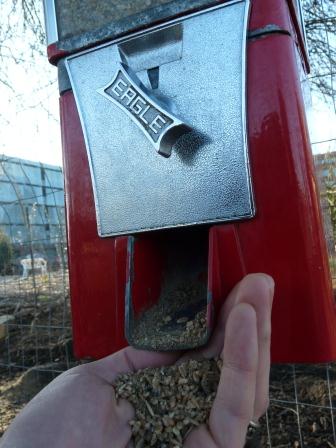
A small chicken pen sits next to the sidewalk, with hens scratching away within sight of the multistory office buildings and parking lots near downtown. The stroke of genius, though, is the chicken feed dispenser, right there on the sidewalk. Put in your quarter, turn the dial, and get a handful of feed to throw to the hens.

 There is something very rewarding about getting a handful of grain for your quarter, then tossing it to the hens (who know very well what is coming when someone approaches the dispenser). Like Vegas slot-machines, but the payoff is three hens in a row — winner!

I talked to Gail at Fertile Ground about this project of hers. Apparently, local kids love to put in their change and feed the birds. For me, this was the crowning achievement of the project: kids using quarters to get bird seed instead of sugary gumballs; kids playing Happy Birds (feathery real!) instead of Angry Birds (pixely fake!); and kids able to get a smile during their walk home.

Ocean

The Pike Place market in Seattle is piled high with seafood, especially seafood from the Pacific. The smell and the look of it make me mighty hungry, like a bear that needs to fatten up on the flesh of salmon. Part of the hunger is for the sea itself, I think. After all, we came from the sea and every cell in our bodies carries the salty water inside, an ionic memory of our ancestry.

So, do we, also, go well with butter and lemon?

Fishes are not the only ocean creatures on display. Invertebrates, especially my friends the molluscs, were also abundantly displayed, some pre-cooked (crabs), some just plain ol’ dead (squid, octopus), and others awaiting the future tucked into their shells (clams).

This slideshow requires JavaScript.

The abundance on display in the fish market belies the state of our oceans. The seas are thinner, diminished. Large predatory fish are down 80% compared to the days before industrial fishing. We take so much from the oceans that we’ve become an evolutionary force, changing the genetic code of fishes. Massive “by-catch” of seabirds threatens the survival of a large fraction of these species. The red snappers in the slideshow above are a good example — many of their populations are a disaster of bad management. These days, much “red snapper” in stores is actually some other species, mislabeled as snapper, thus hiding the truth from us hungry bears.

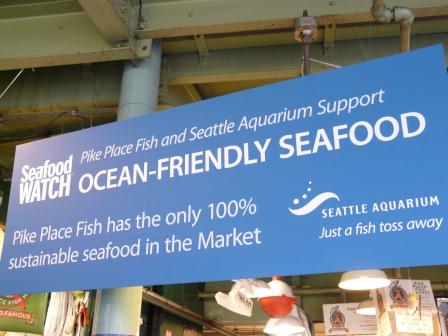
To be fair to the Pike Place folks, much of their seafood comes from Alaska, where fisheries are generally well-managed. And, more and more people care, leading to the following sign over one stall. Hope is the thing with feathers fins.

Kidding #1

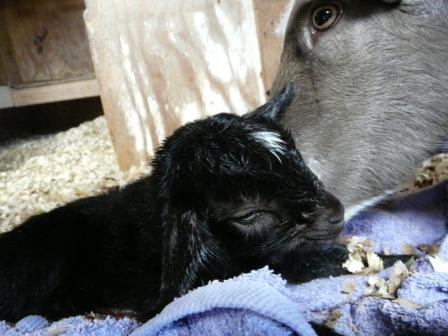
Hazel had her baby this afternoon, the first of the year for the goat herd. Sarah has named the kid Foxglove.

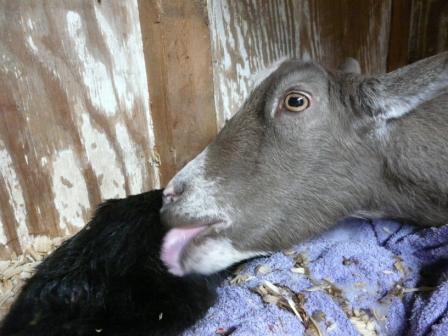
The first thing Hazel did was, like all new goat mothers, to subject Foxglove to a frenzy of licking. This licking dries the kid, stimulates her to get up, and lets the mother know the smell and taste of her youngster. No licking, no bonding. Sarah’s blog has some good video.

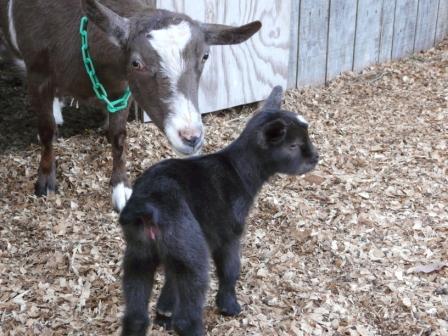
Within a few hours, Foxglove was up and about, even trying a few little leaps. She looks to be a strong, sassy one.

Across the path, the two young boys crowded at the fence to see the new arrival. Pretty much anything excites these little guys, so a new herd member about blew their rambunctious minds.

Spuds for St Patrick’s day

The soil temperature is above fifty and dandelions are blooming, so it is time to get potatoes in the ground. I got four rows planted this morning with sprouted seed potatoes from the Farmer’s Coop. “Seed potatoes” are misnamed, they are not seeds but tubers certified to be disease-free and therefore good for replanting. Raising potatoes from actual seeds is almost never done.

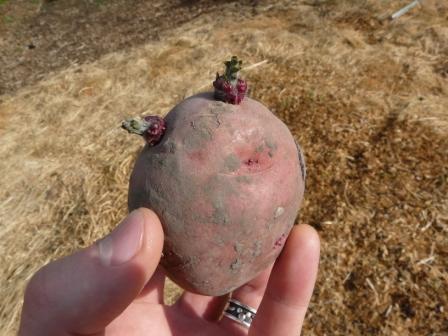
Sprouted potato. When left in the light for a week or two, the potato breaks its dormancy and sprouts little shoots from "eyes." The potato is a swollen stem; the "eyes" are the nodes, like the buds on the side of a tree branch.

Eye-to-eye with a sprouted eye. Baby leaves are visible atop an expanding mass of tissue that will ultimately form the stems and roots of the new plant.

The date came to me as I planted: St Patrick’s Day. Of course, the Irish potato famine also came to mind, a disaster made possible by the combined forces of a genetically uniform potato crop (only one clone, the Lumper potato, was grown, making the crop very vulnerable), an attack by Phytophthora infestans (a water mold), and the policies of the British government.

Phytophthora is still a major pest of many crops worldwide. It caused the massive tomato die-off in the eastern U. S. in 2009. Its disease potential increased recently as new strains arrived in North America and Europe, allowing the species to engage in sexual reproduction (previously it had been breeding only asexually) and thus create new genetic combinations with which to attack its hosts.

The Forest Unseen

March 15th: an auspicious day for killing dictators, aligning planets, and publishing books.

The Forest Unseen hits the streets today (and wiggles its words through wires in e-books).

A couple of quotes from some fellow writers seem well-suited to the moment:

Franz Wright’s poem, Publication Date, starts, “One of the few pleasures of writing/is the thought of one’s book in the hands of a kind-hearted/intelligent person somewhere. I can’t remember what the/others are right now.” Indeed.

Regina Spektor sings, “No, this is how it works/You peer inside yourself/You take the things you like/And try to love the things you took/And then you take that love you made/And stick it into some/Someone else’s heart/Pumping someone else’s blood.” (from On The Radio). Love? Blood? Isn’t this a book about science? Indeed. Bloody, loving science.

I’m honored that my words are in bookstores, in the pixels of the ether-world, in people’s hands, and perhaps even energizing some ventricles. If you’re interested in learning more, the book’s website has photos, a video, reviews (some new ones out this week and more on the way), and information about upcoming lectures and signings.

Next week, I’ll head out for several weeks of lectures, so this blog will be Rambling further afield than Shakerag Hollow, starting with the Pacific North-West next week. I hope to learn some interesting natural history and meet some fellow rambling Homo sapiens along the way.

Another great sign for the Ides of March: this morning, the first Tree Swallow showed up at Lake Cheston.

Shakerag Hollow: spring ephemeral wildflowers

Our campus emptied out this afternoon as spring break began. After a few hours of cleaning the lab, answering emails, and pushing papers from one place to another I finally cracked (or woke up) and set out for the woods to enjoy some reality.

This slideshow requires JavaScript.

Spring ephemeral wildflowers covered the forest floor. In the richer areas, each palm-sized patch of forest had a dozen blooms crowded together. There are few places in the world that rival the profusion of blooms in this north-facing Appalachian cove (and the snails, insects and salamanders that ply the leaf litter below the flowers are equally diverse).

These “ephemeral” wildflowers are hurrying through their flowering and photosynthesizing in the short weeks that remain before the tree canopy steals all their light. But the plants don’t disappear for the rest of the year. Instead, most of them persist underground in roots and swollen stems. So, the “ephemerals” appear to be short-lived, but are in fact many years old, perhaps as old as many of the trees that loom over them.

No canopy = a great opportunity