Author Archives: David George Haskell

Living Planet Report 2012

The World Wildlife Fund (with its partners the Zoological Society of London, the Global Footprint Network, and the European Space Agency) released its Living Planet Report yesterday, a reminder of the state of our home.

“We are living as if we have an extra planet at our disposal. We are using 50 per cent more resources than the Earth can provide, and unless we change course that number will grow very fast – by 2030, even two planets will not be enough.” [four planets if we all lived like residents of the USA]

“…the Living Planet Index continues to show around a 30 per cent global decline in biodiversity health since 1970”

“These analyses indicate that continuing with “business as usual” will have serious, and potentially catastrophic, consequences. In particular, continued increases in greenhouse gas emissions will irreversibly commit the world to a global average temperature rise of well over 2oC, which will severely disrupt the functioning of almost all global ecosystems and dramatically affect human development and well-being.”

Surely one response to these somber words must be sorrow at the wreckage we’ve left behind in our seemingly heedless passage through life.

When to the sessions of sweet silent thought/I summon up remembrance of things past,/…Then can I drown an eye, unused to flow,/For precious friends hid in death’s dateless night…/…And moan the expense of many a vanish’d sight…

Such a response is not an exercise in pointless self-flagellation. By taking in this knowledge – by not banishing it with distractions, medicating it with irony, or washing it away with psychological salves — we open ourselves to feel the consequence of our actions, to step up and offer a genuine mea maxima culpa, and to spur ourselves to reform (all the while knowing that the “offender’s sorrow lends but weak relief”).

One of the biggest challenges in moving toward a “sustainable” economy is the utter disconnection between our actions and knowledge of their consequences. Our materials and waste generally come from and go elsewhere, making us almost totally unable to comprehend what we’re doing. But the disconnect is also one of the emotions – we’re taught that sadness is a pathology that needs to be quickly erased (conveniently, the economy is happy to sell us aides in this quest), ignoring the possibility that melancholy might be a good and necessary thing sometimes. The WWF report, then, might be a way in which the world’s frayed connections can be brought to consciousness and as a consequence, felt.

Fair enough. But tears are not the only thing that the world calls from our eyes. How about a smiling twinkle? The world outside is not unremittingly dire (and the Sonnet walks us, maybe a little too smartly but hey he only had fourteen lines, from one part of memory to another, a sweeter place). Life’s great and fundamental characteristic is is irrepressibility, a quality that is probably the only reason we’re here after the “long strange trip” of the last four billion years. A very small offering of this Seussian gleam-in-the-eye:

This young downy woodpecker (lower bird on the pole) has been pursuing its parents around the neighborhood for the last day or so, as if attached by a springy leash. The youngster can fly, but only in a comedic blur of wings. The bird squalls continually for food which the tireless parents pick up from the bird feeder, then transfer a few feet to the young woodpecker’s mouth. These birds pursue their roles with vigor and seriousness of purpose, focused, as they should be, on the matter at hand: the goodness of a fat sunflower seed.
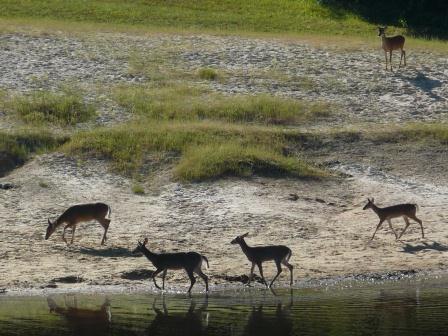
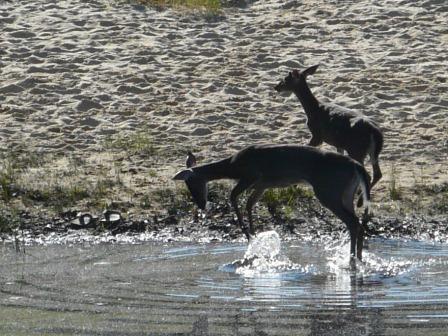
Strolling on the beach

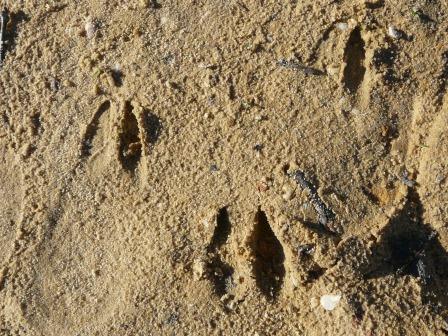
Two days ago these white-tailed deer sauntered out of the woods near Lake Cheston and walked the length of the beach, stopping occasionally to drink from the shallow water. They skipped off after a couple of minutes, leaving some crisp tracks in the sand.

There is nothing quite like the sight of ungulates ambling in the dawn light to take you back to the good old days.

Red fox kits

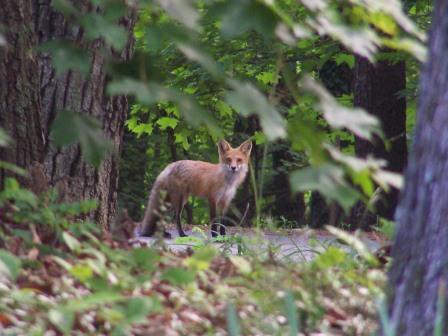
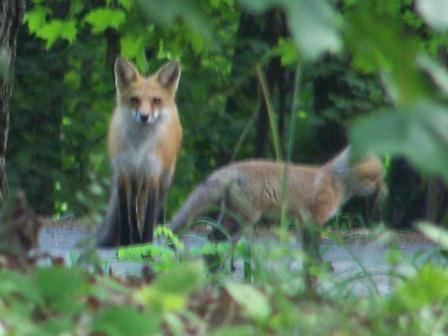
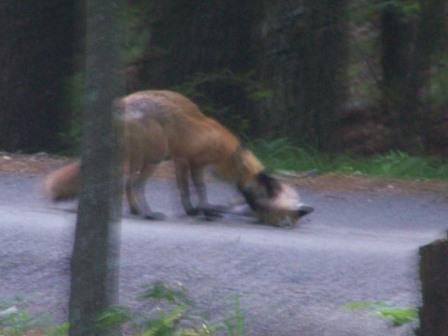
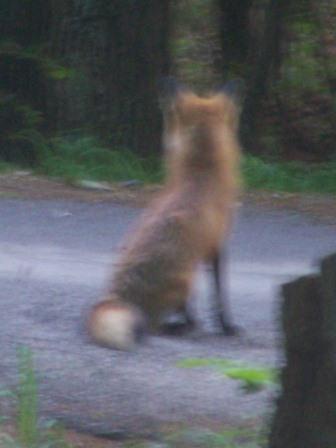
Jeff Heitzenrater sent me these photographs of a red fox mother and her kits (Vulpes vulpes). The foxes had little fear of humans and played openly even as Jeff approached with the camera. They were denning near his house, but have now grown up and moved on. The family group will stay together until late summer or autumn. At first I thought that this must be a gray fox — the tip of the tail seems to be dark, a distinguishing characteristic of the gray fox (red foxes have white tips). But the actual tail tip is hidden in the photos. The shape of the face (narrow muzzle, with large ears), the dark legs, the white wash that extends up the belly to the throat, and the bushiness of the tail all indicate that this is a red fox. If blog viewers have other ideas, please don’t hold back on correcting me in the comments section. In Sewanee, gray foxes are more common (they are woodland creatures) but red foxes do occur here and are fairly common in the valley. The red fox is the most widely distributed canid in the world, occurring on five continents. [update added later: Jeff has now sent me another photo (last one below) that clearly shows the white tail tip]

Hot-headed

A virus has delivered a special end-of-semester gift in the form of a cold and mild fever. I know this is a common experience among teachers: our immune systems carry us through to the moment that grades are due, then dump us over the cliff, their patience finally worn to nothing.

But the point here is not to whine about minor ailments or the rhythm of the semester, but to ask why fevers mess with our minds. High fevers bring on full blown hallucinations; milder versions create a restless cacophony of strange images and thoughts, seeming to rise up through the acidic vapors of the sinuses.

The neurobiological literature is, as far as I can tell, not clear about the causes of all this confusion. For major hallucinations, it seems that an imbalance between inhibition and excitation in the brain creates sensory illusions. In other words, some parts of the brain are shooting out way too many signals which, when combined with dulling of the parts of the brain that say “stop,” creates the neural mirages we call hallucinations.

For the milder confusion of a low fever, I suspect that mistiming plays a part. All our thoughts exist as relationships among nerves. These relationships depend critically on the timing of which nerves fire when. Even a simple thought, like an imagined object, is held in a network of neural firing patterns that shifts five times per second. So, thought is like music — it depends on relationships among dozens of players and the timing of those relationships determines the nature of the melody. When we heat up the brain with a fever, chemical reactions quicken slightly, throwing off the tempo.

Taking an aspirin is therefore like switching on the metronome. Click, click, click. Back to coherence.

Banded Hairstreak butterfly

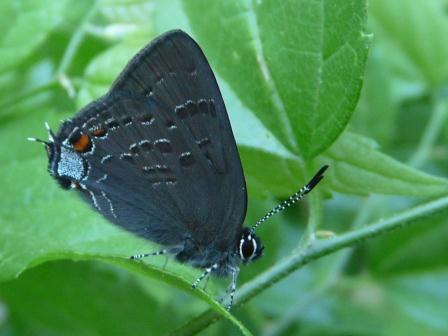
This freshly emerged Banded Hairstreak (Satyrium calanus) was perched on a hackberry leaf outside my back door. Butterfly colors come from tiny scales that cover the wings. As these scales gradually wear away, so does the vibrancy of the insects’ colors. Only butterflies that have newly emerged from their chrysalis look so tidy and fresh. The stripey antennae on this hairstreak add some panache.

This species has just one generation per year. Adults mate in early summer, then lay their eggs on oak and hickory twigs, placing the eggs near the twigs’ buds. The eggs remain dormant until the next spring, when the caterpillars emerge and eat the fresh greens sprouting from the trees’ buds. So, the individual in the photograph is nearly a year old, having spent most of last year as an egg.


Mountain laurel pummels bees

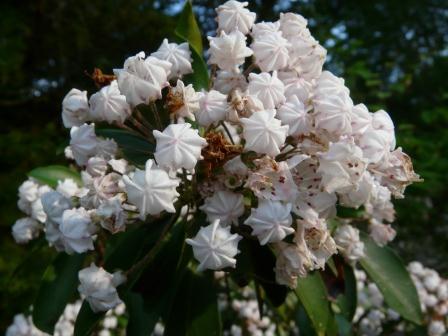
Mountain Laurel (Kalmia latifolia) is in bloom on the dry ridges and steep slopes around Sewanee.

Its closed blooms look like piped icing:

And open to reveal purple and pink within:

The center of each flower has a pollen-receiving pad, the stigma, surrounded by ten filaments that curve out from the center. At each filament’s tip is an anther, a little purple pouch of pollen. These anthers are lodged inside pockets at the edge of the flower. The filament elongates as it grows and pushes against this pocket. When a bee lands on the flower, the anther is jostled out of its pocket and the tension in the filament causes the anther to spring upward, slapping the bee with a dusting of pollen. You can mimic this action by prodding the anthers with a small twig. The pollen shoots out for several inches. Very amusing, I find. If no bee or human comes along, the anthers will eventually rise up and dust the stigma with pollen, ensuring fertilization.

Imaginings of avian reincarnation

At the end of the final exam in my Ornithology class, I ask the students, “If you could come back as a bird, which species would you choose and why?” No grades for this question… The diversity of answers is always interesting. This question can be taken in a number of ways: which bird most represents something about who you are, which bird most represents something about who you’d like to be, or which bird offers something to you now that you find compelling, amusing, or interesting?

I’ll list summaries of student answers below, then offer my own thoughts.

Student answers:

Wood thrush – for Thoreau

Oystercatcher

Blue-footed Boobies — because they are called blue-footed boobies; I’d choose the mate with the silliest foot-waving dance.

Arctic tern – they migrate between hemispheres; it is always summer for them.

Brown pelican – great life on the ocean

Owl – great songs; they are so quiet; come out in the evening, my favorite time of day.

Turkey vulture – they eat well and I could terrorize people with my unholy hissing sound.

A crane – to migrate and see the world; protected from hunters; I’d be tall and have few predators.

Peregrine falcon – amazing speed, control, and acute senses.

Whatever that bird was on the Life of Birds video that actually enjoyed sex.

Osprey – aerial and aquatic superiority, and a vision of the future…

Cedar waxwing – roll deep with a huge posse and get drunk off of berries while looking like a superhero/bandit.

Wood thrush – they make the most beautiful sound, magical, mysterious.

American crow – they do pretty well as a species (apart from West Nile virus); I like the idea of a family unit; fly high and fast.

Barred owl – I like owls, this species is the best looking. I’m not feisty enough to be a screech owl and I don’t have enough Rowan Williams in me to be a Great Horned Owl…

Common loon – I really like the song

Lyre bird – the ultimate song learner. Amazing feathers.

Spotted owl – neatest looking birds (soft and fluffy while also being murderous and cunning); I could stand in the way of deforestation in the NW, a beautiful place; no long migrations; people would be happy to see me; rad call.

Cedar waxwing – love their song and their appearance, especially the bar stripe through the eyes.

It heartens me to see how many of these answers refer to sound. Developing acoustic awareness is a big part of this class.

Here are my responses. I write the exam and the blog, so I get to bend the rules and choose three different species. A divided afterlife? Why not? I picked these three for the physical experience of the world that they would offer my body-jumping soul.

Wandering albatross – the purest experience of air possible, winging for hours without a flap of the wings, caught in the strength of the endless south polar winds; alone for months with ocean, salt, wind, and a gray horizon that never resolves into land. I can feel the streaming cold air in my nostrils already. A meditation.

Mousebird – a life tumbling in a flutter of sociable activity, my flockmates always close; we gorge on fruits and flower buds, then recline in the sun to let its warming rays toast our bellies, chattering all the while. Conviviality.

Winter wren – an unassuming bird, at home in the undergrowth, half bird half mammal. My song slices open the forest air and the moon pours out, splintered into a million pieces. My heart breaks at the beauty of the flowing air in my throat. An exaltation.

Of course, beyond these dreams, the task for today is to want to be who we are. As Oscar Wilde said, “Be yourself; everyone else is already taken.”

Skullcap and Catchfly

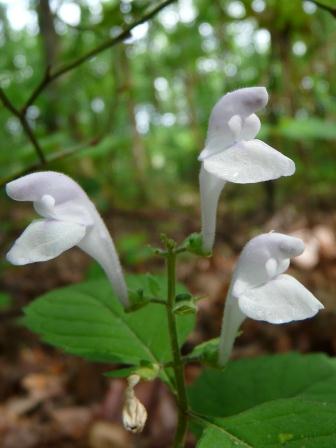
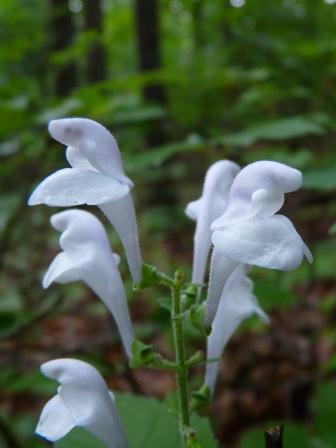
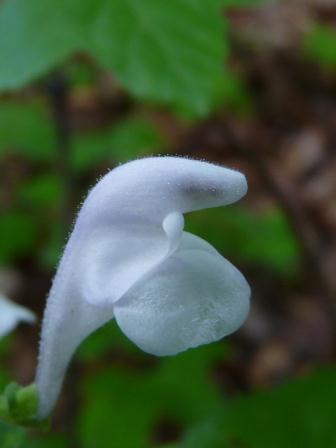
I ran into a small cluster of Showy Skullcap, Scutellaria pseudoserrata, on the trail that winds through a dry upland oak forest in Sewanee (for local readers: the perimeter trail, north of the memorial cross). This wildflower grows about a foot fall and has pearly-purple flowers at the top of a slender stem. It was the only herbaceous plant in bloom under the forest canopy. The dry upland woods don’t support the profusion of flowers found in the moist coves, so the these skullcap flowers are visually striking in the otherwise green understory.

The tube leading from the lip of the flower down to the nectar the flower’s base is very long, excluding all but the longest-tongued bees and moths. Keeping the nectar relatively inaccessible saves the plant from giving nectar to insects that are poor pollinators (e.g., ants), but it also means that in many years no pollination takes place at all. In the closely related large-flowered skullcap (S. montana), a study by Mitchell Cruzan from the University of Tennessee reported that “several hundred hours of observation over four seasons suggest that these pollinators may be rare or lacking.” Most flowers either produce no seeds, or self-pollinate. This seems like a dreadfully slow way of propagating the species, but these plants are perennial, coming back year after year, so they don’t have to spew thousands of seeds into the world each year to pass along their genetic legacy. A more open flower might attract more insects, but the costs of such a flower design (wasted nectar and visits from insects that will not visit another skullcap) may outweigh the benefits. Or, an undocumented decline in the local moth and bee populations has left this species high and dry. No way to know for sure.

[Thanks to Mary Priestley and Jon Evans for helping me sort out the difference between pseudoserrata and montana. The latter is found just to our east and has leaves with velvety short hairs all over its upper surface. The species is listed as “threatened” by the USFWS.]

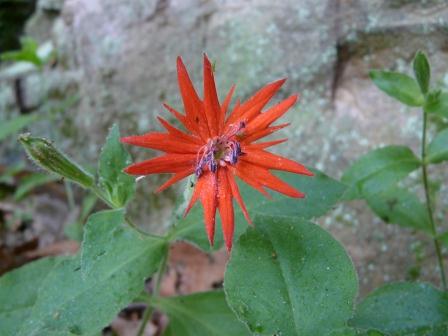
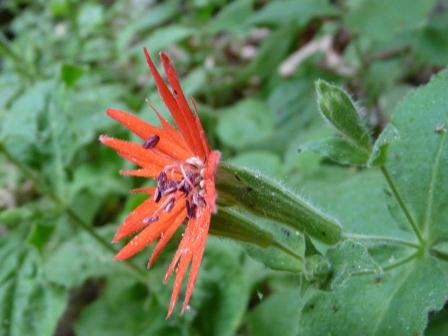
Further along the trail, out of the woods in a tumble of rocks on the cliff edge, I found another showy flower, the Roundleaf Catchfly, Silene rotundifolia. This species’ leaves and petals are covered with sticky secretions that snare wandering insects, keeping them away from the flowers’ nectar. This stickiness also catches crud and dust, giving the plant an untidy, unwashed appearance. My Horn et al. wildflower book (an excellent guide in almost every way) tells me that “flying insects” are the pollinators, but I doubt that. The bright red flowers, splayed open and pointing skyward, strongly suggest that hummingbirds are what the plant seeks. A quick search on the web confirmed this suspicion, at least for the look-alike Silene virginica.

Back to 6th grade

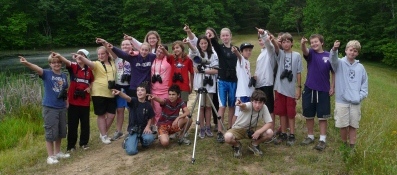
I started the day with an early morning visit to the Saint Andrew’s Sewanee 6th grade campout. Despite the early hour, the energy level was high. The birds were also active: in just a few minutes of quiet listening we heard nearly ten different species, right from the campground. We took a stroll around the lake and into the woods to find some more.

Pointing at a displaying red-winged blackbird. So what if we’re not all pointing in the same direction?

Thank you to Cindy Potter for the invitation to join the group, and to Cindy, Doug Burns, and Reid Fisher who camp out with the students. For many students, this is their first experience of camping. I was glad to learn that the whip-poor-wills had serenaded the campers over night.

Pedaling a mile up

I’m in Denver for a conference, which means lots of time in chilled conference rooms, viewing the world through powerpoint slides. Great stuff, up to a point. Butt and brain give out after a while, so off comes the neck tag (a little frisson of excitement at liberation from group identity) and out the door I go…

I quickly found the Denver Bikes, a bike-sharing program that has bikes for check-out in racks across the central part of the city. Check-out privileges come in daily ($8), weekly ($20), monthly ($30), and yearly ($59) increments. Once you’ve registered at a kiosk (takes about a minute), you can check a bike out from any stand, then return it to any stand. The system is designed for short trips, so check-outs over 30 mins incur extra costs ($1 for an extra half hour, then $4 after that). The bikes themselves are tanks, seemingly indestructible, but surprisingly easy to ride.

Many streets in the city center have bike lanes and they seemed, in my few miles of pedaling, pretty well respected by cars and trucks.

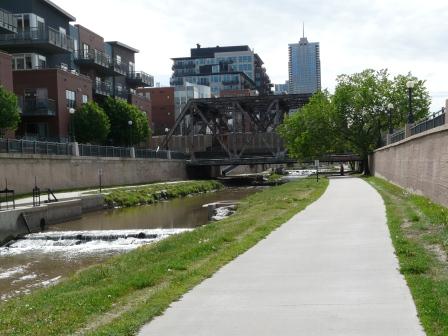
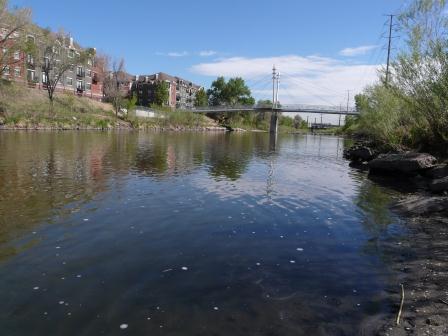
Even better, the city has several bike paths along waterways, so it is possible to go through the center of town and into outlying areas along bike-only paths that wind along running water. Hard to beat. (But stay out of the water — looks great, but bacterial counts are high.)

The best part: avoiding the Denver Boot, an enforcement device invented here in the 1940s by, of all people, a violinist. The boot shown below was put on a car right outside the window of the conference lunchroom. It was very kind of the local police to enliven our dining experience with a historical reenactment of traditional western vehicle wrangling:

[and this news added after I made the original post: bike-share is coming to Chattanooga…]