Author Archives: David George Haskell

Ringneck snake

I found this ringneck snake (Diadophis punctatus) under a piece of firewood from the pile in our driveway. The snake either came as a free bonus with the wood or it colonized the new hiding place in the last couple of days. Either way, the wood is stacked, so the snake is roaming the garden. It is probably joining many others of its kind. This species can, in the right conditions, live at very high densities (hundreds per acre).

I held the snake for just a minute or two, and in that time it demonstrated its two favorite methods of defense. First it writhed around, flashing its bright underbelly at me, then it oozed nasty-smelling saliva from its mouth. Despite a thorough scrubbing, my hands still smell musky. If severely provoked, the snake will bite, but I merely handled it for a photo, then released it, stopping well short of this level of torment. The bite is not dangerous to humans.

Ringnecks are mostly active at night when they hunt for small salamanders, insects, slugs, and any other animal that can fit down their gullet. They, in turn, are preyed on by larger snakes, raccoons, and, occasionally, birds. I’d guess, from the smell, that they taste pretty bad. I usually encounter them under rocks and logs. The contrast between their smooth dark backs and bright bellies makes them one of the more visually appealing (I was going to say…striking…but we’ll leave that word for the copperheads) snakes in our area.

Range maps for the species indicate that this is a “northern” ringneck. But the color patterns are ambiguous. The animal has a complete neck ring (a characteristic of the northern subspecies, D. p. edwardsii), but the belly is patterned (a characteristic of the southern subspecies, D. p. punctatus). Some recent molecular work suggests that this “species” — the ringneck snake whose range covers much of North America — may in fact be a complex of multiple undescribed species. In addition, some of these undescribed species seem restricted to particular habitat types, suggesting ecological as well as evolutionary diversity within the group. So taxonomic revision is coming, I suspect.

Carpentry

I’ve been using some salvaged wood to make repairs to the goat barn. One of the pieces seemed unusually light. I flipped it over and found a perfectly round hole on one side: the entranceway of a female Eastern carpenter bee, Xylocopa virginica.

The bee that left this hole used her mandibles to gnaw into the wood, then she slowly tunneled through the timber. I’ve seen these bees at work on the rafters of several of the small barns that we’ve built for animals and hay. On a quiet day in early summer you can hear the crunching of chitin on wood as the bees make their slow progress. Below the holes, small piles of sawdust accumulate.

I’ve seen many entrance holes, but never had the opportunity to see the extent of the tunnels inside. So I made a series of longitudinal cuts in my wood scrap, a 4×4 dissection of sorts. Inside, I found the tunnels extended about a foot away from the hole. One or two tunnels branched. This is an impressive hidden network, like a subway with just one exit. No wonder the piece of wood was so light.

The bees make these tunnels for their young. The female makes a ball of pollen and nectar, then lays an egg. All this is sealed into the tunnel with a slug of compressed sawdust. Once the passage is sealed, the mother leaves her offspring to their fates. These futures sometimes involve woodpecker beaks. The drilling of these hungry birds will finish what the bees started. The two species, bee and bird, are an anti-carpentry team. But I also think of these animals as supreme carpenters: they’ve been making homes from wood for millions of years and they spend their lives happily sprinkled with the sawdust of their labor. So they are both über- and anti-carpenters.

Away from wood, the bees do good work as pollinators. They are eager visitors to many species of flowering plant. Some farmers even erect pieces of wood to attract them into their orchards. I’m OK with a few at our place, but a year ago we had an invasion of battalions of barn-destroyers. So I relived my glory days of college squash-playing, dispatching them with a killer backhand from a dustpan. I felt bad, but not as bad as I would have had the barn needed rebuilding. These days we just have a few carpenter bees buzzing around and I leave them alone.

The Forest Unseen — readings from the woods

I’ve posted some short readings from The Forest Unseen on the book’s website. I recorded these excerpts in the woods, sitting at the same small area of forest that is the book’s focus. Unlike studio recordings, these audio clips have plenty of background noise, especially cicadas. That seems fitting, given the book’s setting and subject matter. After all, one of the themes of the book is that the world’s “background noise” is worth hauling out of the background and into our field of attention.

I have one or two more audio files in process…so I’ll post more next week.

Shakerag Hollow: damage from construction continues

I visited Shakerag Hollow this afternoon to make some sound recordings. A good thunderstorm blew in, giving us another inch or so of rain. Unfortunately, on my walk out, the intermittent stream near Green’s View was running the color of milky coffee. I walked up to the construction site and found water pouring off the bare ground, hitting a construction fence, then running underneath, and into the woods. The fence added about 30 seconds to the water’s travel time, so it would be technically incorrect to say that the barrier did nothing. Just next to nothing, in my opinion.

Disturbed by this sight, I diverted my return walk to look at the larger drainages. On one, the retention walls and sodding did seem to have slowed the rate of soil loss. The water running off was dirty, but not completely opaque as it has been. But on the largest drainage, water ran right through the rock walls, across the small ponds, and straight out into the stream leading into Shakerag.

So the streams of Shakerag Hollow, and the waterways into which these streams flow, continue to be severely impacted by the golf course construction that I discussed in a previous post.

Looking from the edge of the construction into the woods. This flows directly into the stream near Green’s View.

The main flow from the golf course leads to a series of waterfalls.

Water running under and through rock walls.

Muddy retention pit. Water flows directly out of this pit into the stream.

This water runs into the woods and a stream, slowed slightly by having to go under the construction fence.

“…somewhere about the middle of the month when suddenly there’s a foretaste of fall”

This morning, my friend Bill Keener sent me the following words from Faulkner. They relate directly to the bodily experience of the past few days, so I though I would share them here.

The quote comes from a 1957 question-and-answer session in an American Fiction class at the University of Virginia. You can hear digital audio clips of portions of the session here.

Question: “You spoke of titles before, Mr. Faulkner. I’d like to ask you about the origin of Light in August.”

Faulkner’s answer: “Oh, that was—in August in Mississippi there’s a few days somewhere about the middle of the month when suddenly there’s a foretaste of fall, it’s cool, there’s a lambence, a luminous quality to the light, as though it came not from just today but from back in the old classic times. It might have fauns and satyrs and the gods and — from Greece, from Olympus in it somewhere.  It lasts just for a day or two, then its gone, but every year in August that occurs in my country, and that’s  all that title meant, it was just to me a pleasant evocative title because it reminded me of that time, of a luminosity older than our Christian civilization…that light older than ours.”

If this seems an overblown response to a cool day in August, remember that Faulkner lived in Mississippi, without AC. For months, life was lived under a sheen of sweat. Any exertion, even in the relative cool of morning, would soak a shirt. At night, lying immobile in bed, tiny rivulets pool in the hollows of collarbones. And the light? A haze of water drawn into air. So when these August days come, the texture of life is transformed. The heat-fogged light snaps into clarity. The simple pleasure of working outside all day and barely breaking a sweat takes on a mythic quality — the body is transported, abruptly, to another world.

Earthstar

Indulge me by letting me start with a short quote from The Forest Unseen:

August 8th — Earthstar. Summer’s heat has coaxed another flush of fungi from the mandala’s core. Orange confetti covers twigs and litter. Striated bracket fungi jut from downed branches. A jellylike orange waxy cap and three types of brown gilled mushroom poke from crevices in the leaf litter. The most arresting member of this death bouquet is the earthstar lodged between rafts of leaves. Its leathery outer coat has peeled back in six segments, each segment folded out like a flower’s petal. At the center of this brown star sits a partly deflated ball with a black orifice at its peak.”

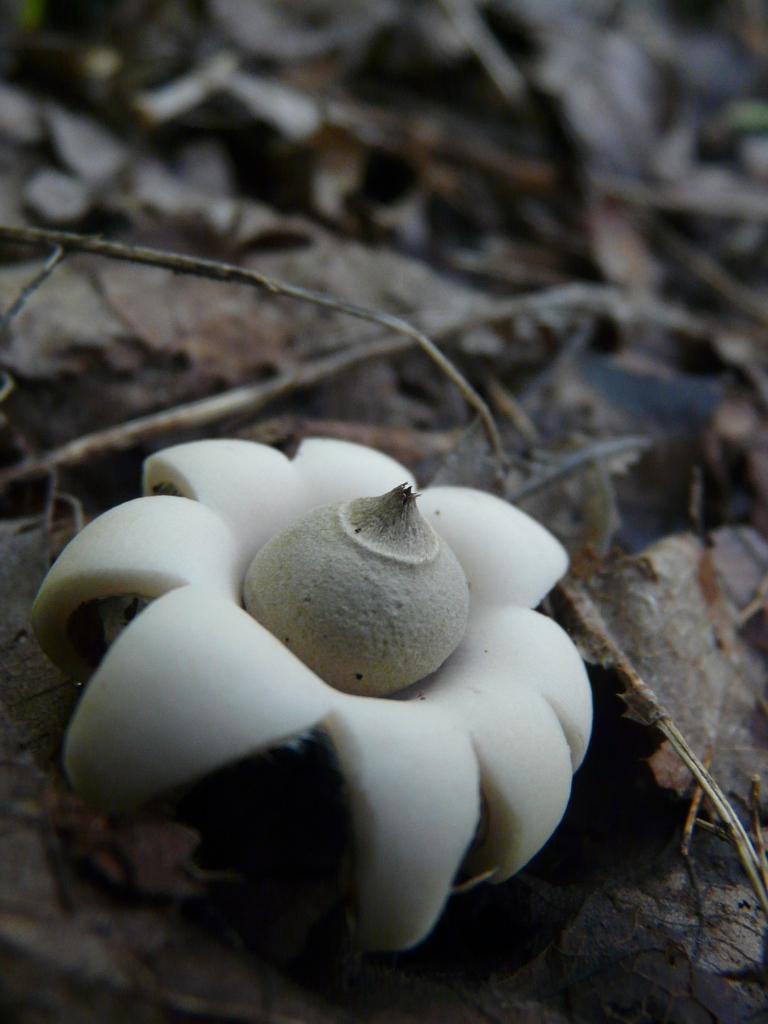
And, several years later, right on cue in early August, here are the earthstars in Shakerag Hollow. They must be the most gorgeous fungi ever. The one pictured above is Geastrum saccatum. It is about the size of a quarter.

My essay in The Forest Unseen rambles off in the direction of golf balls. Here I’ll keep my eye on the fungus.

Earthstars belong to the Gasteromycetes (“stomach fungi”), a motley collection of mushrooms that hold their spores in a stomach-like sac. Other members of the group of puffballs, stinkhorns, and bird’s nest fungi. Unlike the gilled mushrooms, bracket fungi, and others that forcibly eject spores using microscopic catapults, Gasteromycetes take an entirely passive approach to dispersing their spores. They hope for a raindrop, or the step of a beetle, or a prod from a falling twig to puff their spores into the air.

The evolution of these Gasteromycete fungi reveals some interesting evolutionary processes. Once the “stomach-like” form evolves, there is no turning back. Although “normal” gilled mushrooms have evolved earthstar or puffball-like structures at least four times, there are no known evolutionary transitions in the other direction. Why? The catapult mechanism is so complicated that it is very unlikely to re-evolve once it has been lost. After the catapult genes have been discarded, only a very long stretch of time and some lucky mutations could bring them back.

The loss of forcibly discharged spores has unexpected consequences. It turns out that having a passive spore dispersal mechanism makes a species more likely to split into new species. Exactly why this should be so is not clear. Perhaps their spores do not travel as far, so allow populations to become isolated from each other, leading to reduced gene exchange and then speciation? Regardless of the mechanism, the Gasteromycete fungi have been speciating more rapidly than their gilled relatives.

So the future belongs to the earthstars. Especially those that can figure out how to eat golf balls.

____

For those interested in digging deeper, the relevant articles in the scientific literature are listed below.

Hibbett, D. S., E. M. Pine, E. Langer, G. Langer, and M. J. Donoghue. 1997. Evolution of gilled mushrooms and puffballs inferred from ribosomal DNA sequences. Proceedings of the National Academy of Sciences, USA 94: 12002–6.

Wilson, A. W., Binder, M. and Hibbett, D. S. (2011), Effects of gasteroid fruiting body morphology on diversification rates in three independent clades of fungi estimated using binary state speciation and extinction analysis. Evolution, 65: 1305–1322. doi: 10.1111/j.1558-5646.2010.01214.x

Amazonia bound

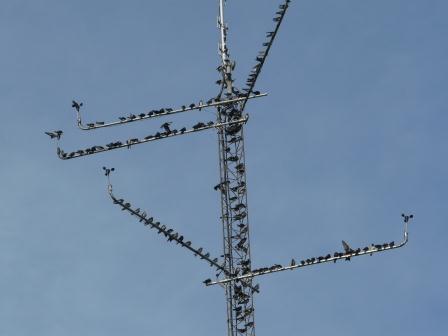
Sewanee got pounded with rain yesterday. A hard day for birds that feed on aerial insects. Late in the afternoon, the skies cleared and dozens of purple martins swarmed the radio antenna pole near Lake Cheston. They circled in noisy groups, feeding then swirling in to roost.

Many of these birds are likely migrants from the north, winging their way across Tennessee on the first leg of a long journey to their Amazonian wintering grounds.

In the eastern U. S., martins are almost entirely dependent on humans for nest cavities, a dependence that goes back to the days of Native American agriculturalists who erected poles with hollow gourds for the birds. Martins chase away crows, so this was a mutualistic arrangement. The birds got homes; the humans got protection for their corn crop.

In 1831, John James Audubon noted: “Almost every country tavern has a martin box on the upper part of its sign-board; and I have observed that the handsomer the box, the better does the inn generally prove to be.”

I think Lake Cheston could use a handsome box. Perhaps a class project for the spring?

One more smutty webpage

These are healthy corn tassels, ready to shed their pollen:

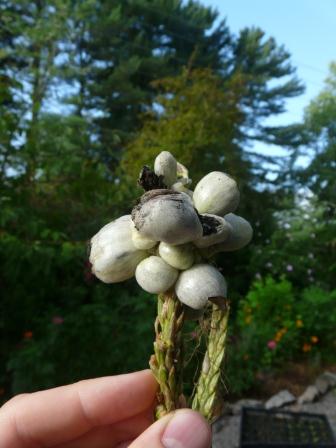
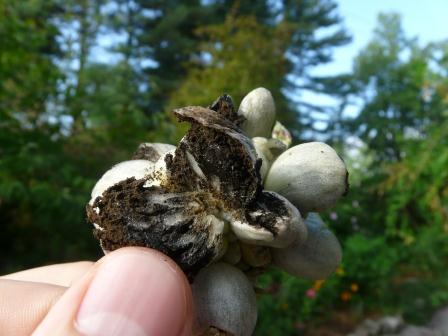
And these are tassels that have been infected by a fungus, the “corn smut” (Ustilago maydis; formerly U. zeae):

Smut spores overwinter in the soil, then as the weather warms they blow up onto corn plants and infect leaves, tassels, and ears. Like corn itself, smut is native to Mexico and thrives when the weather is hot and dry in early summer. This Mexican weather came to Tennessee in June, so we’ve had a good crop of fungal growth this year.

The fungus causes grotesque swellings on the corn. These pustules eventually burst and disgorge clouds of dark spores. The whole process is interesting to watch: the civilized, elegant growth of a plant hijacked by an ugly, destructive mob. Depending on your mood, this discord is either disturbing (the world’s order is threatened) or profoundly hopeful (the world’s order is indeed threatened).

Fungal infections are usually unmitigated bad news for gardeners, but this one has a surprising silver lining. The fungus causes uncontrolled growth and swelling of cells in the corn plant, cells that then get filled with…mushroom. In Central America and Mexico, smut is considered a delicacy, called “huitlacoche,” and farmers can get a higher price for infected ears. I was unfortunately not aware of the gastronomic possibilities when I culled the smut from our corn patch. Next year, perhaps?

The word “smut” obviously has another meaning. The etymological common origins here are straightforward: lewd smut and fungal smut are both “dirty.” The Online Etymology Dictionary (one of my favorite websites…a celebration of the anastomosing evolutionary trees of language) traces the word to pre-1500s West Germanic, smutt-, “to make dirty,” through the 1400s where smutten meant “to debase or defile,” then to the 1660s when the word meant both “black mark or stain” and “indecent or obscene language.” There is a botanical irony here, of course. The smut fungus is “defiling” one of the more overtly sexual plants under cultivation, one that sheds its pollen to the air and lets both male and female parts hang exposed (at eye-level, no less; I blush to gaze at a field of corn). But only when these parts become darkened with unbidden strands of fungal desire do they count as smut. Order is indeed threatened.

Snake

While walking down the garden path, I was stopped by the sight of a black rat snake, its body woven loosely through the low weedy plants. The snake was a youngster, too young to have the heft and scratched hide of a mature adult, but too old to be striped and worm-like. It was about two feet long and was basking in the weak heat of an overcast noon. The snake was entirely still, but its whole being said: alive.

Light hit the snake’s scales and melted. Black. Somehow, an earthy deity had lifted its head from the ground and breathed life into graphite. I’ve never been so captivated by a snake’s quiet presence.

In my admiration and greed, I wanted to catch and remember this beauty. So I walked to the house for my camera. Of course, the snake was gone on my return, leaving a wavy line of pressed vegetation as a mark of its passing.

So far this year, I have not seen the big old rat snake that used to patrol our garden. Even the strong snaky smell around the apple trees has dissipated. This newcomer may have wandered into a deceased old-timer’s empty domain. To stay, I hope.

Cicada killer

Stop and listen. Every tree is occupied by buzzing cicadas. Their vigor of their acoustic attack builds through the day, then dies away after dark, giving way to katydids.

We’re not the only species to tune into this sound. Cuckoos, blue jays, and other large-billed birds will grab cicadas when they can. But the champion hunter is the cicada killer, Sphecius speciosus, a large wasp that flies up into the trees in search of its prey.
The wasp grasps a cicada then tries to jab its stinger into the weak spots on the cicada’s exoskeleton. The cicada reacts violently — fighting for its life — buzzing its wings, writhing, and rolling. Often the tussling pair fall to the ground as they struggle. The cicada tries to break free while the wasp lances with the sharp stinger on the end of the abdomen. Spear and armor clash, then resolution comes. If the cicada can free itself, it takes wing and zooms away. The wasp does not follow, having no hope of recapture. But if the wasp’s poison finds its mark, the cicada falls into a deep sleep. This is no fairytale, no prince comes to waken the sleeper; instead, the mother wasp carries her prey to an underground tunnel where she buries it, alive but paralyzed, with a wasp egg. The larval wasp will fuel its growth by consuming the cicada.

Cicada killers have been active these last several weeks. They prefer to build their tunnels in well-drained sand, so the upper portion of the Lake Cheston “beach” has numerous holes, as do other sandy areas in town.

Cicada killer with paralyzed cicada. The wasp was dragging her prey across the sand toward a burrow.

The wasp is almost as long as my thumb. They look fearsome, but don’t attack humans unless molested. Unlike yellowjackets and bees, cicada killers don’t defend their nests from intruders and can be observed at close range.

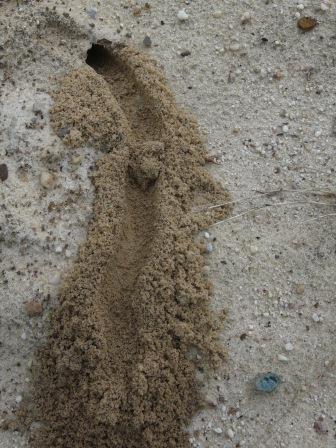
Entrance to nest burrow. The cicada pictured above was laid to “rest” here.

Cicadas are big insects and the wasps often struggle to carry them. I was swimming in Lake Cheston a few days ago when a low-flying creature — I thought at first a hummingbird — flew across the water, losing altitude as it went. When it reached the lake’s center, the flier hit the water’s surface, dropped its excess baggage and shot away. I swam out to retrieve the cargo: a cicada bobbing on the water. Back on shore, Junebug (the dog, not the insect), wanted a look. Lacking a burrow and an egg, we left the cicada to its unfortunate fate.