Tag Archives: sewanee

Bird skeletons alight in the library

“…there was a noise, and behold a shaking, and the bones came together, bone to his bone”

This slideshow requires JavaScript.

This morning a small procession of bird skeletons made its way from the science building to the library: one last flight for the calcified remnants of wild lives that ended on windshields and picture windows in and around Sewanee. These skeletons are the result of the work of students in my Ornithology class, each of whom received a bird carcass at the beginning of the semester. The students have now cleaned and articulated the skeletons. Their work is on display within the belly of David Henderson’s Brief History of Aviation sculpture.

These unclothed cousins of ours reveal the relationship between unity and diversity in biology. The tension between these poles is what animates life: one theme, many variations.

Many thanks to Kevin Reynolds and the staff of duPont library for their fabulous help with this project and to David Henderson for letting my students use the remarkable space that he has created.

Red maple: the burn begins, warblers drawn to the heat

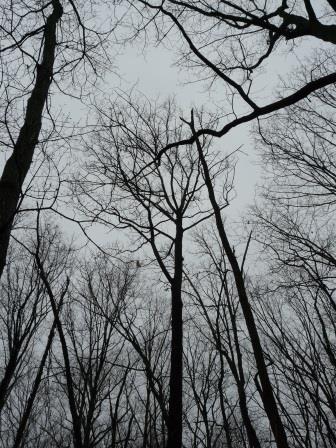
winter_no_AprilGentle, domesticated plants are singing springtime songs, lifting gardens with flowers and newly emerged leaves, but the forest is wintry, especially in the uplands. Mountain slopes may glow with ephemeral wildflowers and buckeye saplings, but the rolling tabletop of the Cumberland Plateau seems little changed from January.

Red maple trees are the exception. Oaks and hickories have their buds clamped shut, but red maple blooms are out. From a distance these trees seem to stand in a shroud of carmine smoke. Each tiny bloom is  wine-red, standing like a small flame at the tip of a long, twiggy taper. Many of these flames have already matured and fallen, so my feet to move, for a few moments, through a dust of fallen embers as I pass below the trees.

Not to belabor a point, but these trees have rather variable sexual systems. Red maple flowers are usually either male or female, although a few blooms are both. Individual trees carry all male, all female, or mixed collections of flowers. On mixed trees, single branches will usually grow just male or female flowers. Richard Primack studied a small population of these trees and has written an interesting discussion of how the red maple breeding system fits within the diversity found within the whole Acer genus.

Click on images for captions and a slideshow.

The flowers scattered across our trails are almost all males. Once they have shed their air-borne pollen, their work is over and they become food for worms. (Brave Percy undoubtedly walked among them during his sojourn in Sewanee; the photos above are from a trail close to his haunt at Brinkwood.) The female flowers intercept floating pollen and will, over the coming months, grow the maple’s distinctive samaras or “helicopter fruits.”

Along with these emerging flowers come insects, scraping and sucking and chewing the newly emerged vegetation. And along with the insects: birds. Black-throated green warblers, just back from Central America, are congregating in the maples. I counted three of the warblers in one tree; all were steadily working from one flower to the next, pausing to hurl a short song to the forest, then getting back to work, beak to bloom.

Dead wood, ashes.

One of Shakerag Hollow’s giant trees has fallen. An ash that until last week held its arms in the highest reaches of the canopy now sprawls across the forest floor, its body utterly torn. I’ll go back soon and “measure” things (how tall? what weight of wood came slamming down?), but for now: just awe.

I did not see the fall, but came by soon after. The trunk was … indescribable. Some grand words are needed, for barely imaginable violence had been at work. Rent asunder!? The whole wide trunk was twisted and split open, lengthways, in several long gashes. Other trees, themselves no mere saplings, were smashed into the ground. Large boulders were shifted as roots reared and cracked. The air was infused with the odor of fresh-split wood. An overtone of bitterness, like cut oak, but mostly a sweet smell, almost honeyed.

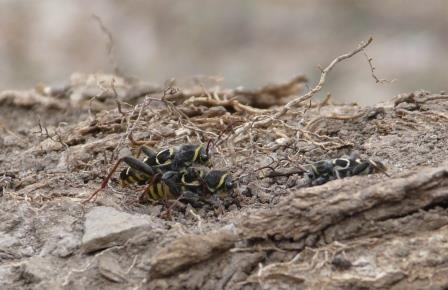
I found the tree in the morning and returned in later in the day for another look. As I stepped closer in the warm afternoon, I hesitated then held back. There were wasp-like creatures, big ones, swarming over one of the thick exposed roots. These insects were scurrying, flickering their wings, crawling over each other. A frenzy.

Black with bold yellow stripes. Buzzing as they flew. Had the tree fall unearthed a buried wasp nest?

Neoclytus caprea

But something was not quite right about these wasps. I moved forward slowly and saw their fat hind legs, too beefy for a wasp. Crickets? No. Then the wing cases, striped in black and yellow: beetles! Wasp-mimicking beetles of some kind. I moved to the side of the tree and saw hundreds of them, racing up and down the bark. They were on no other trees nearby. Half of the beetles were copulating; the other half seemed intent on colliding with the mating pairs. Even though I now knew that they were harmless, their waspy nature made me cautious. Even their short curved antennae were creepily hymenopteran in style (oh yes, those hymenoptera have style).

Who were they? To identify them, I spent some time in the online funhouse known as the Photographic Atlas of the Cerambycidae of the World. This is an amazing site devoted to a single family of beetles, the so-called longhorns (although many of them do not have long antennae). The family contains twenty thousand species, an impressive number when we remember that there are fewer than six thousand mammal species. Some of these cerambid beetles run afoul of humans when they bore into trees and wood that we’d rather they stayed out of. A few of them are “invasive exotics,” killing off native plants. But the beetles in Shakerag were natives: Banded Ash Borers (Neoclytus caprea (Say) 1824). They have an interesting life history, finding recently downed ash and oak trees, then laying their eggs in the bark. The larvae then chew on the wood below the bark, emerging next spring to start the hunt for a newly downed tree.

So I was not the only creature in Shakerag following my nose to the smell of ripped up wood. How many huge ash trees have fallen lately? Not many. Every banded borer within miles must have been at this party. Those flickering antennae are surely tuned to the chemical particularities of newly opened ash wood.

The beetles were one of the very first arrivals in the tree’s new existence. When a large tree falls, its ecological life still stretches out into the future. Perhaps half of the animals (and many more of the fungi) that the tree will nurture during its existence arrive after the tree has fallen. The ecological vitality of a forest can be judged by how may large trees are lying around, feeding beetles, hiding salamanders, growing fungi.

To paraphrase Mr. Faulkner, “Dead wood is never past, it’s not even dead.”

ash

Migration

As we slide down the slope behind the equinox, animals have accelerated their autumnal movements. My backyard now consistently hosts several migrant bird species each day. In the last week: rose-breasted grosbeaks, magnolia warblers, Tennessee warblers, American redstarts, gray catbirds, chestnut-sided warblers, warbling vireos, and a summer tanager. Unlike the songsters of spring, these mostly silent birds can be hard to detect. A flicker of foliage reveals their presence, then a glimpse of their plumage as they prance through the concealing twigs. Grosbeaks are an exception to this crypsis. Although they can be hard to see, their sharp tweek call, given repeatedly through the day, gives them away. The sound is just like that of a sneaker squeaking on a gym floor. Listen for it, then look up.

Last night, as I left the Biology picnic on campus, another migrant bird making a spectacular display over the old building that houses the fire station. About two hundred chimney swifts were scything the air in a tight, fast vortex. They swirled around the brick chimney that protrudes from the station’s roof. One by one, they folded their wings and dropped in. Like hot cinders carried up by the wind, these birds seemed to ignite the dead dusky air with their coordinated vitality. A little tornado of life. The swifts are on their way south to the Amazon where they’ll feast on tropical gnats all winter. I suspect that they are speeding on their way as I write: this morning’s cold rain squalls mean there will be few flying insects in Sewanee today. Time for swifts to get out of here.

Birds are not the only migrant animals making their way through our skies. This week has seen an impressive number of monarch butterflies winging across the treetops. It seems impossible that so slow and delicate a flyer could make it all the way to Mexico, but that is where they are all headed, to a few small patches of dense fir forest in the highlands. The monarchs gather there in the tens of millions to rest in the cool but unfrozen woods. Remarkably, these autumnal migrants are the grandchildren of the butterflies that left Mexico this spring. Somehow their genes guide them to precisely the right location.

One for the road: a monarch loading up on thistle biofuel earlier this week near Lake Dimmick.

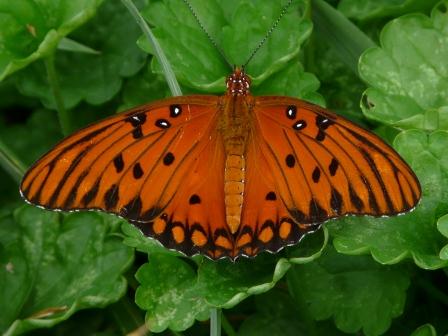
Another migrant butterfly, less celebrated than the monarch, is the gulf fritillary. This species breeds all over the southeastern U. S., but overwinters only in the deep south. Unlike the fluttery monarchs, these butterflies scull their way across the air with seemingly powerful and directed wingbeats. In Florida, where adults linger all winter, huge flocks of them will sometimes stream over fields and scrubby areas. A river of bright amber.

Gulf fritillary. Photo taken earlier in the year.

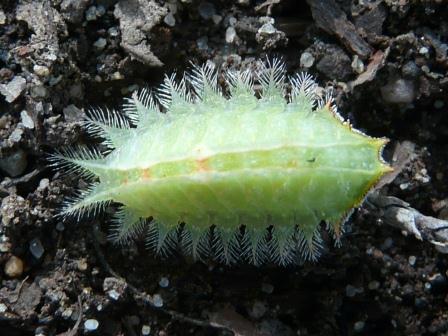
Crowned Slug Moth, Isa textula

I came across this tiny (1.5 cm long) but handsome caterpillar on my walk to Piney Point this morning. It was lying immobile in the trail, under a white oak. Wagner’s Caterpillars of Eastern North America (what a great book!) notes that these caterpillars “may be active very late in the season, sometimes dropping down with autumn rains and winds.” After photographing the animal, I placed it on an adjacent oak sapling.

Murphy, Lill and Epstein’s study in the Journal of the Lepidopterists’ Society has some interesting background information on these caterpillars. They belong to the Limacodidae family, the so-called “slug caterpillar moths,” a group named for their strange offspring. All the species in the family have caterpillars that look like gummy worms going through a punk adolescence. Studs and spiky hair adorn colorful pudgy bodies. They can deliver quite a sting, as I noted a few weeks ago in my post about the saddleback, a different species in this family.

Murphy et al. confirm Wagner’s statement about the lateness of the species. This species is one of the season’s last active caterpillars, and are “frequently found feeding on leaves in the midst of turning color in late October, right up until leaf drop.”

Once they have finished growing, the caterpillars find a safe nook, then make a cocoon in which they enter a state of suspended animation (known as “diapause” in the zoological world). In the spring they make a pupa within the winter cocoon, then transform into an adult moth.