Category Archives: Water

Ocean

The Pike Place market in Seattle is piled high with seafood, especially seafood from the Pacific. The smell and the look of it make me mighty hungry, like a bear that needs to fatten up on the flesh of salmon. Part of the hunger is for the sea itself, I think. After all, we came from the sea and every cell in our bodies carries the salty water inside, an ionic memory of our ancestry.

So, do we, also, go well with butter and lemon?

Fishes are not the only ocean creatures on display. Invertebrates, especially my friends the molluscs, were also abundantly displayed, some pre-cooked (crabs), some just plain ol’ dead (squid, octopus), and others awaiting the future tucked into their shells (clams).

This slideshow requires JavaScript.

The abundance on display in the fish market belies the state of our oceans. The seas are thinner, diminished. Large predatory fish are down 80% compared to the days before industrial fishing. We take so much from the oceans that we’ve become an evolutionary force, changing the genetic code of fishes. Massive “by-catch” of seabirds threatens the survival of a large fraction of these species. The red snappers in the slideshow above are a good example — many of their populations are a disaster of bad management. These days, much “red snapper” in stores is actually some other species, mislabeled as snapper, thus hiding the truth from us hungry bears.

To be fair to the Pike Place folks, much of their seafood comes from Alaska, where fisheries are generally well-managed. And, more and more people care, leading to the following sign over one stall. Hope is the thing with feathers fins.

Toad song

Click below to hear…

…the sweet trill of amorous American toads (Anaxyrus americanus). Half a dozen males have been chorusing in the small pond at our house for the last week or so. For a warty ol’ amphibian, they sure make a nice sound. The recording has several individuals calling, some sweeter than others. Female toads, I’m told, prefer males that can produce low-pitched trills over many hours. I’m not that fussy. Any trill will do: the song of these toads is one of my favorite sounds. Winter is done. The acoustic world expands.

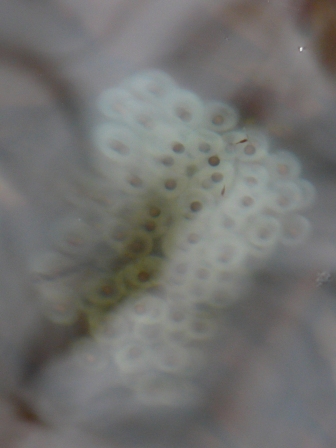
Last night, the male toads were joined by a couple of females. Amplexus ensued and now the pond is festooned with long strings of eggs.

I’m pretty sure the female in the photo above is the same one that has been here the last several years – she’s a rich chestnut color, quite unlike most local toads. She is also about twice as big as the males, a dream-mate because size correlates with egg number, and egg number correlates with numbers of toadlings, and toadlings are what natural selection cares about, and dreams are made by brains, and brains are made by natural selection. Happy slumbers.

The eggs are neatly lined up in jelly strands. Usually these strands are coiled, but they straighten out when pulled out of the water for a photo. The eggs hatch in about a week (depending on temperature) and the tadpoles graze on algae underwater for a couple of months before emerging onto land.

The future.

Microsafari: Bear hunting

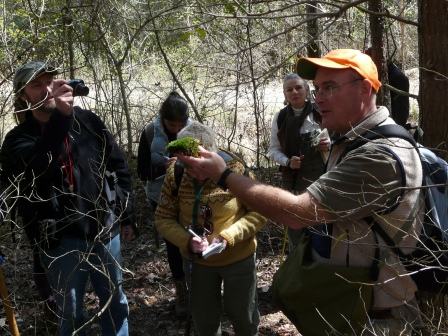
I spent much of Saturday on a trip organized by the Sewanee Herbarium, led by Paul Davison from the University of North Alabama. In addition to being a botanical expert, Paul is a master of finding the “wee beasties” (a phrase used by the pioneering microscopist Van Leeuwenhoek) that surround us: the micro-world of single-celled protists and tiny animals, all existing just beyond the limits of our vision. But, with some simple equipment and a hand lens or microscope, this world opens up for us. About 24 people came on the trip, a good mix of Sewanee biology students and faculty, along with community members.

Paul Davsion discussing the "pin cushion" moss, Leucobryum.

Curious structures growing in the Leucobryum moss: undescribed in the North American literature, apparently. Perhaps micro-male mosses growing within the larger female parts of the plant (the Archegonia, for lovers of botanico-jargon).

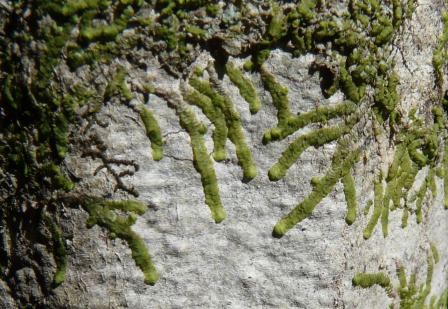
Leafy liverworts creeping across tree trunks.

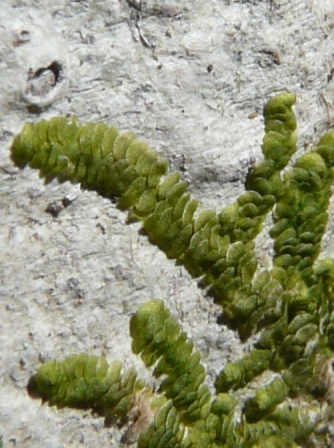
Seen close, the alternating scale-like flaps (not true leaves) of the liverwort are visible.

After a foray into Lost Cove, we returned to the lab to pull open the door to another world (amazingly, also the same world) by looking at critters under microscopes. We found legions of algal cells, whizzing crustacea, lumbering protists, and gliding flatworms.

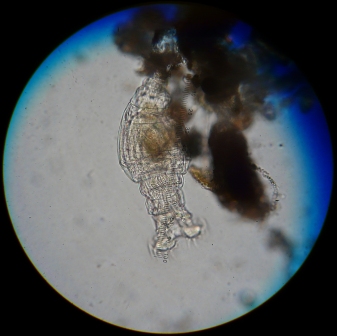
By holding my camera up to the microscope lens, I snapped a few shots of a couple of my favorites.

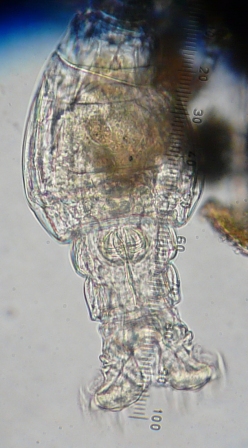
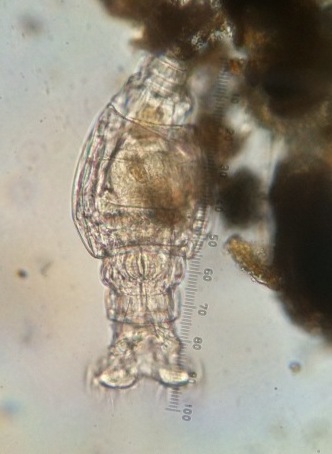
A rotifer, or "wheel animal". Its head is pointing down and its rear end is clasping some dead plant material (aka crud). the two Mickey Mouse ears are ciliated (cilia = hairs that stir the water) feeding devices, moving food into the mouth.

A close look at this shot shows the grinding pharynx that pulverizes food as it moves through the gut (look for the round structure to the left of the "60" mark).

Commercial break: go buy Apple products. Chris Waldrup sent me this photo that he took through the scope with his iPhone. Pretty darn good. Yes, I want one.

Now for the bear: this is a tardigrade, also called "waterbear" or "moss piglet" (with some crud to the left and below -- the waterbear is at the top). It was indeed living in some moss. They have eight little legs and amble along like bears. This one is stranded on its back with its front legs pointing to the left and its hose-like mouth just visible. Don't let the rolly-poly cuteness fool you: these are the toughest animals in the world, able to enter suspended animation and survive the deepest cold imaginable, vacuums, radiation blasts, utter dryness for years, and exposure to temperatures above the boiling point of water.

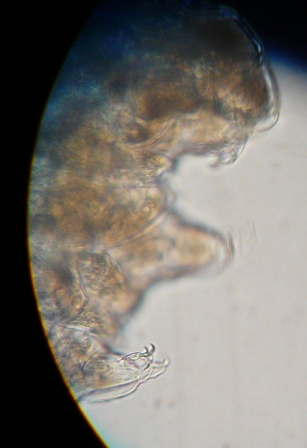
Tardigrade feet, equipped with claws for clinging to their mossy homes. They'll still be hanging on when Homo sapiens has turned to a layer of dust in the geological column. So far, tardigrades have been around for 600 million years. Modern humans, less than one tenth of one percent of that.

Thank you, Paul Davison, for leading the hunt. Thank you also to Jon Evans and Mary Priestley for organizing the event.

Cute larvae. Adults are a different story.

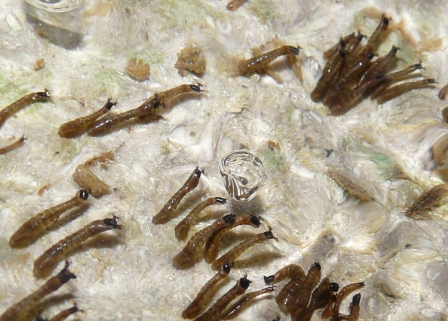
Looking down on this fast-flowing stream in Shakerag Hollow we see wavy lines on the submerged rocks. Moss? Algae? No, ...

...these are clusters of blackfly larvae (Fanily Simuliidae). Each larva is attached to the rock with claspers on its rear end; silky threads provide additional anchorage. They prefer the fastest flowing parts of the stream, so these attachments are strong.

With a flash photo, we can see the larvae leaning with the current. They thrive in the oxygenated water of unpolluted streams.

Two fan-like feeding appendages crown each animal. The fans are used to sieve bacteria, algae, and small pieces of plant material from the flowing water. In good conditions, every few seconds the fans sweep food into the animal's mouth.

After a few weeks, the larvae pupate underwater (still attached to the rock in flowing water), then emerge as the infamous flying adults. Males feed on nectar, but females want blood. Unlike the swarms that emerge in northern states, blackflies are seldom numerous here.

Ephemeral pond

On Saturday morning, I visited the large ephemeral pond at the end of Brakefield Road. This pond, like all ephemeral ponds or “vernal pools,” fills with water in the early winter, stays wet through the spring, then dries up completely in either summer or early fall. The peculiar hydrology keeps fish out – they obviously can’t survive the dry spells – and creates an incredibly rich community of animals that thrive in the absence of fish predation. The abundance and diversity of salamanders and crustaceans in these pools is unrivalled; many of these species live nowhere else.

Although February has just started, spotted salamanders (Ambystoma maculatum) have already visited the pond, mated, and laid their eggs. The adults of this species lives underground in the surrounding forest and emerge only for a few nights in the spring. After breeding in the ponds, they burrow back down into the leaf litter and disappear from view for another year. This year’s breeding season got going very early. In most years, mating doesn’t happen until late February or early March.

Spotted salamander egg mass seen through the wind-stirred light on the pond surface

I returned later, at night under a misty, drizzly moon, to see whether any salamanders were still in the pond.
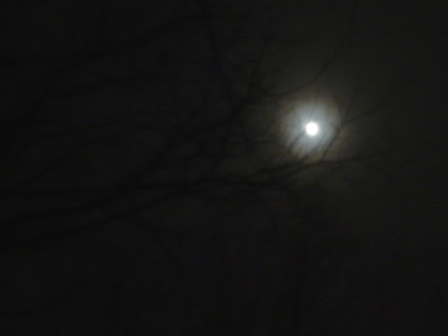
Despite a thorough search, I couldn’t find any adult spotted salamanders, but I found dozens of egg masses attached to submerged twigs, especially in the center of the pond where the water was deepest (thigh-high: deeper than I expected). Illuminated with a flashlight these masses are quite stunning. The little embryos are visible within.

When these spotted salamander eggs hatch, they’ll feed on the diverse set of small crustaceans and larval insects that swarm through the pond’s water. Their cousins, the larvae of marbled salamanders (Ambystoma opacum), hatched in the early winter and have a head start on growth (I posted about a female marbled salamander guarding her eggs in this same pond last fall). This sets the stage for some inter-species struggles: the smaller larvae make good meals.

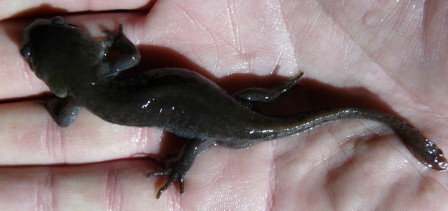
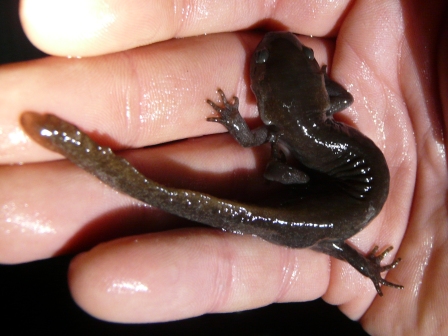
At the shallow end of the pond, I found a few mole salamanders (Ambystoma talpoideum). In our region, this species is found only at ephemeral ponds. Like spotted salamanders, they lay egg masses attached to small twigs in the pond, although the mole salamander has a smaller cluster of eggs (fewer than one hundred, rather than up to two hundred as in spotteds). The adult is also smaller, about half the length of the spotted.

Ephemeral ponds are in trouble – they have no legal protection in most states. The federal Supreme Court SWANCC decision removed Clean Water Act protections from these and other “isolated wetlands”) and these small pools tend not to get protected when residential development, tree plantations, or other habitat modifications happen in a forest. A few states have adopted their own protections, but Tennessee is not one of them, to my knowledge (and I’d be oh so happy to be corrected on that point if some recent legislative action has taken place).

Salamanders were not the only creatures on the move.

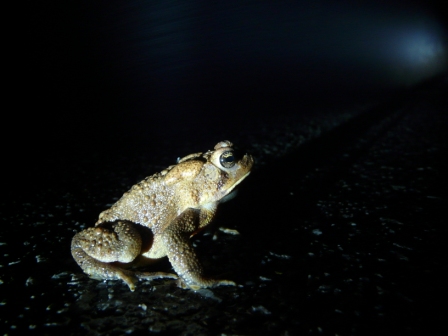
Toads were sitting on the paved roads in town.

I suspect that the toads were hunting stranded earthworms, which were everywhere.

Turning the flashlight around for a moment, another wet-skinned night wanderer was seen in the rain.

In closing, I’ll record a new life goal: to get some waders that don’t leak. The gallon or two of water that oozed into my boots was cold, cold. On the other hand: the feeling of icy water around my toes; the utter silence of the woods except for the patter of water drops in the dark pool; the spicy smell of wet leaves on the forest floor mingling with the slightly sulphurous odor of the black, sodden leaves on the pond margins; the feel of rain on my face. These things bring me back to my senses. Reframing: leaky boots are a doorway into experience. A new product line idea for LaCrosse boots?

The sign of a Saturday night well spent: wringing out your socks.

Merlin!

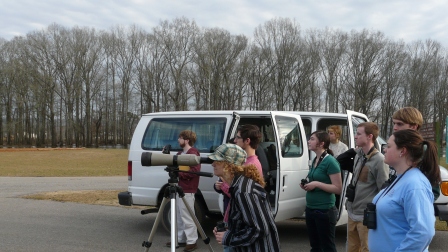
This lonesome old tree by the waterline has a special visitor perched at its top: a merlin visiting from Northern Canada. Merlins (Falco columbarius) are small falcons that breed in the boreal forest. They are uncommon winter visitors to our region. We found the bird at the end of our class visit to Crow Creek Wildlife Refuge near Stevenson, AL.

Merlin, condensed to about 2 pixels. Great views through the scope, though.
Merlins are spectacular little birds. They sit and wait for an unsuspecting songbird to fly past, then they explode into rapid flight and chase down the prey, catching it in midair. They are the fighter jets of the bird world: fast, maneuverable, and uncompromisingly fierce. “…no falsifying dream/Between my hooked head and hooked feet”.

Scoping

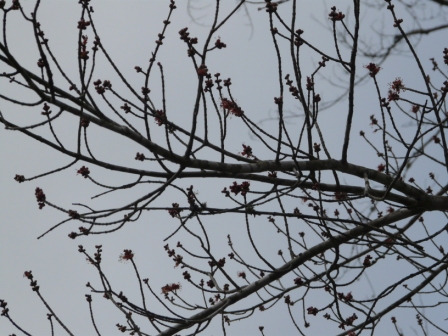
The warm weather turned up some other unusual phenomena: great-blue herons standing over their big stick nests, maples in bloom, and chorus frogs singing. This is a very peculiar January — prolonged warm weather has unlocked all kinds of activity that in normal years would not happen for another month.

Red maple flowers...on Jan 31st

In summer, the water in the Crow Creek Refuge is carpeted with the large round leaves of American Lotus (Nelumbo lutea; also called Water Chinquapin). Now, the plants are invisible (their stems are underwater in the mud) except for the strange seed receptacles that litter the shoreline like organic showerheads.

Seeds fit inside the holes on the top surface.

We also found a rare specimen of Florus plasticus washed up on shore.

The pollinator of this flower is unknown, but it probably requires a battery.

Limestone foray

I rambled halfway down the mountain to visit some caves this morning. The Cumberland Plateau is a layer-cake of rock: the top layer is sandstone, the bottom is limestone. Sandstone does not dissolve in water, but limestone does. Over millions of years, this dissolution of rock by water has gouged holes in the lower reaches of the mountainside, creating an impressive network of caves.

From the outside, looking in.

From the inside, looking out.

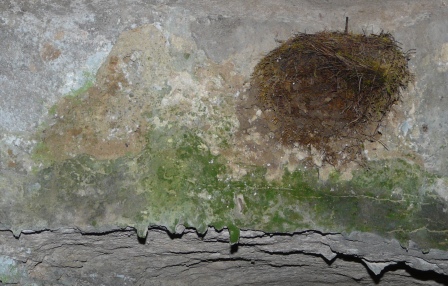
A phoebe nest on the inner wall of the cave, about fifty feet back from the entrance. These nestlings were raised in near darkness. Their first flight out into the world must have been a revelation.

"Solomon's Temple" cave entrance. No Ark of the Covenant here, just limestone-adapted spleenwort ferns.

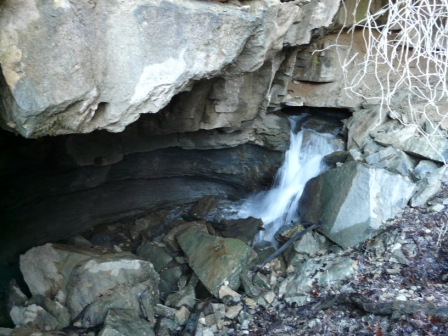
An underground stream surfaces briefly at the base of the cliffs. Inside the cave, this stream roars away at the bottom of large pits. I was by myself, so I did not scramble into the cave to see them again -- rule number one of caving is 'don't go inside dangerous caves alone'.

Multiple layers of eroding and fractured rock: another reason for caution.

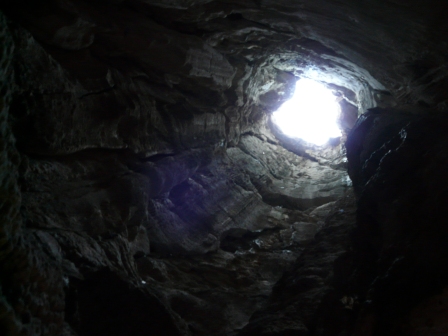
My favorite spot around these caves. This is a vertical tube, about twelve feet wide, running straight down from a hole on the forest floor, emerging far below in a pile of debris on the side of the cliff face.

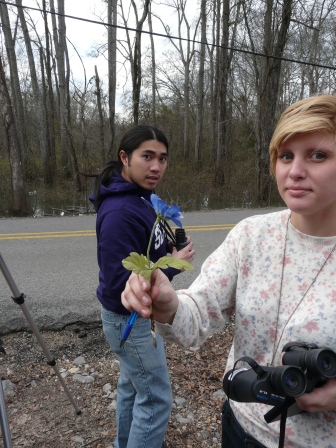
Just below the cliffs and caves, I found the first wildflower of the the year, “pepper-and-salt” or “harbinger-of-spring”, Erigenia bulbosa. It seems a little early to be harbinging the spring — we’ve got plenty of winter to go yet — but it is good to be reminded that spring will come. These little flowers belong to the carrot family and their tuberous root is supposedly edible. I’d rather leave them rooted and feed on the hope they offer.

Woods Reservoir Trip

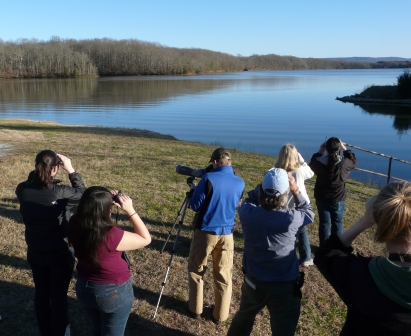
Yesterday, I took my Ornithology class to Woods Reservoir to look for ducks and other waterbirds. Many of these species overwinter here in the south before heading back north to breed in the boreal forest, the prairie-potholes, or the arctic. The weather was as warm and balmy as I’ve experienced in January and the duck count reflected this: we see fewer ducks during extended warm spells, presumably because they have not been pushed south by hard weather up north. However, we did see a good assortment, with the coots leading the count, as usual.

Many of the waterbirds that we saw are fish-eaters (loons, grebes, herons, mergansers). Unfortunately for them, Woods Reservoir is contaminated with PCBs and the fish bioacummulate these toxins and pass them up the food chain to the birds. The PCBs came from the Air Force’s Arnold Engineering Development Center (Woods Reservoir was built in 1952 to provide cooling water for the site). The Tennessee Department of Public Health has issued an advisory that recommends no human consumption of catfish caught from Woods Reservoir. They recommend that consumption of other fish species be limited to one fish per month. The birds (and the many fishermen at the lake) have evidently not heard this advice.

PCBs are found in the lake sediment and fish accumulate these pollutants in their bodies, especially in fat. Manufacture (but not use) of PCBs was banned in 1979, but the chemicals are very persistent, so linger in many ecosystems. PCBs were used at AEDC from approximately 1952 to 1990 and they are believed to have entered Woods Reservoir via streams draining contaminated soil at the site (2007 TDEC report).

Two non-duck highlights were a Bald Eagle and a Northern Harrier. The eagle gave us a great display, soaring in great ascending circles over the lake against the blue sky. Its slow, self-assured flight and eight-foot wing span embodied unfashionably grand qualities: majesty, imperialism, and hauteur. Bald Eagles may be ill-tempered, bad-breathed fish-scavengers, but they’re awesome nonetheless. The harrier flew across the lake with lazy wing beats as the sun set.

Needle ice, springtails, and sunshine

The temperature dipped into the teens last night, so my walk on the new trail to Lake Dimmick was an invigorating one. The trail is not officially open yet, but it runs from the perimeter trail (paved portion) out past the firing range, across JumpOff Rd, then skirts Lake Jackson to get to Lake Dimmick.

Ice needles were abundant on the sandy old road beds and in bare soil around the lake. These needles form when the air is freezing and the water in the soil is still unfrozen. As the aboveground water freezes in the chilly air, it wicks more water up from the soil. The pull of capillary action keeps the water moving upward, creating vertical columns of ice. Soil particles get carried up by the rising ice.

A miniature forest of ice needles

Each column of ice is about six inches tall

The edge of the lake was iced over, but springtails (Collembola) were clustered on the ice and in small pools where water had seeped up. These tiny arthropods (barely visible with the naked eye) use a spring-loaded catapult on their bellies to jump around on the water surface. Springtails feed mostly on decaying plant material and on the microbes that live in the soil. In some habitats, they are the most abundant animal by far, reaching densities of tens or hundreds of thousands per square meter. They are very vulnerable to desiccation, so they hang out either below the soil surface or close to (and on) water.

The sun came out, finally. It has been a full ten days since I last felt it on my face. Welcome back, friend.