Category Archives: Water

Shakerag Hollow: damage from construction continues

I visited Shakerag Hollow this afternoon to make some sound recordings. A good thunderstorm blew in, giving us another inch or so of rain. Unfortunately, on my walk out, the intermittent stream near Green’s View was running the color of milky coffee. I walked up to the construction site and found water pouring off the bare ground, hitting a construction fence, then running underneath, and into the woods. The fence added about 30 seconds to the water’s travel time, so it would be technically incorrect to say that the barrier did nothing. Just next to nothing, in my opinion.

Disturbed by this sight, I diverted my return walk to look at the larger drainages. On one, the retention walls and sodding did seem to have slowed the rate of soil loss. The water running off was dirty, but not completely opaque as it has been. But on the largest drainage, water ran right through the rock walls, across the small ponds, and straight out into the stream leading into Shakerag.

So the streams of Shakerag Hollow, and the waterways into which these streams flow, continue to be severely impacted by the golf course construction that I discussed in a previous post.

Looking from the edge of the construction into the woods. This flows directly into the stream near Green’s View.

The main flow from the golf course leads to a series of waterfalls.

Water running under and through rock walls.

Muddy retention pit. Water flows directly out of this pit into the stream.

This water runs into the woods and a stream, slowed slightly by having to go under the construction fence.

“…somewhere about the middle of the month when suddenly there’s a foretaste of fall”

This morning, my friend Bill Keener sent me the following words from Faulkner. They relate directly to the bodily experience of the past few days, so I though I would share them here.

The quote comes from a 1957 question-and-answer session in an American Fiction class at the University of Virginia. You can hear digital audio clips of portions of the session here.

Question: “You spoke of titles before, Mr. Faulkner. I’d like to ask you about the origin of Light in August.”

Faulkner’s answer: “Oh, that was—in August in Mississippi there’s a few days somewhere about the middle of the month when suddenly there’s a foretaste of fall, it’s cool, there’s a lambence, a luminous quality to the light, as though it came not from just today but from back in the old classic times. It might have fauns and satyrs and the gods and — from Greece, from Olympus in it somewhere.  It lasts just for a day or two, then its gone, but every year in August that occurs in my country, and that’s  all that title meant, it was just to me a pleasant evocative title because it reminded me of that time, of a luminosity older than our Christian civilization…that light older than ours.”

If this seems an overblown response to a cool day in August, remember that Faulkner lived in Mississippi, without AC. For months, life was lived under a sheen of sweat. Any exertion, even in the relative cool of morning, would soak a shirt. At night, lying immobile in bed, tiny rivulets pool in the hollows of collarbones. And the light? A haze of water drawn into air. So when these August days come, the texture of life is transformed. The heat-fogged light snaps into clarity. The simple pleasure of working outside all day and barely breaking a sweat takes on a mythic quality — the body is transported, abruptly, to another world.

Cicada killer

Stop and listen. Every tree is occupied by buzzing cicadas. Their vigor of their acoustic attack builds through the day, then dies away after dark, giving way to katydids.

We’re not the only species to tune into this sound. Cuckoos, blue jays, and other large-billed birds will grab cicadas when they can. But the champion hunter is the cicada killer, Sphecius speciosus, a large wasp that flies up into the trees in search of its prey.
The wasp grasps a cicada then tries to jab its stinger into the weak spots on the cicada’s exoskeleton. The cicada reacts violently — fighting for its life — buzzing its wings, writhing, and rolling. Often the tussling pair fall to the ground as they struggle. The cicada tries to break free while the wasp lances with the sharp stinger on the end of the abdomen. Spear and armor clash, then resolution comes. If the cicada can free itself, it takes wing and zooms away. The wasp does not follow, having no hope of recapture. But if the wasp’s poison finds its mark, the cicada falls into a deep sleep. This is no fairytale, no prince comes to waken the sleeper; instead, the mother wasp carries her prey to an underground tunnel where she buries it, alive but paralyzed, with a wasp egg. The larval wasp will fuel its growth by consuming the cicada.

Cicada killers have been active these last several weeks. They prefer to build their tunnels in well-drained sand, so the upper portion of the Lake Cheston “beach” has numerous holes, as do other sandy areas in town.

Cicada killer with paralyzed cicada. The wasp was dragging her prey across the sand toward a burrow.

The wasp is almost as long as my thumb. They look fearsome, but don’t attack humans unless molested. Unlike yellowjackets and bees, cicada killers don’t defend their nests from intruders and can be observed at close range.

Entrance to nest burrow. The cicada pictured above was laid to “rest” here.

Cicadas are big insects and the wasps often struggle to carry them. I was swimming in Lake Cheston a few days ago when a low-flying creature — I thought at first a hummingbird — flew across the water, losing altitude as it went. When it reached the lake’s center, the flier hit the water’s surface, dropped its excess baggage and shot away. I swam out to retrieve the cargo: a cicada bobbing on the water. Back on shore, Junebug (the dog, not the insect), wanted a look. Lacking a burrow and an egg, we left the cicada to its unfortunate fate.

Goodbye loggerhead sea turtle hatchlings…see you in the year 2042

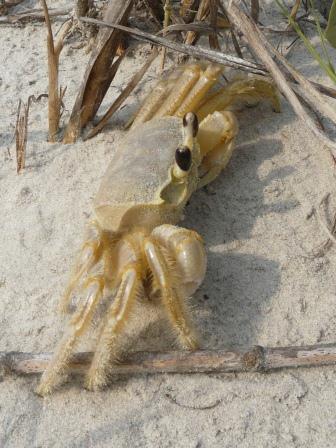
Two nights ago, Gale Bishop has his colleagues at the St Catherine’s Island Sea Turtle Conservation Program were kind enough to invite the Sewanee Island Ecology Program crew along on the year’s first release of baby turtles. These little hatchlings all came from the same nest, a nest that was dug out by hand (not flipper) to save it from a predatory ghost crab that had started to munch its way through the clutch. The crab got three; one hundred and fourteen were released.

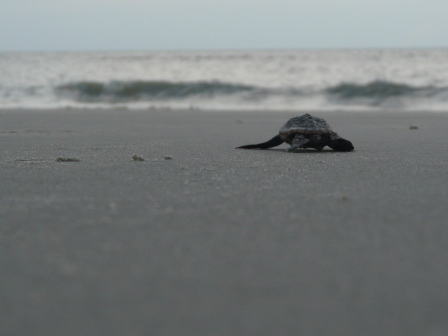
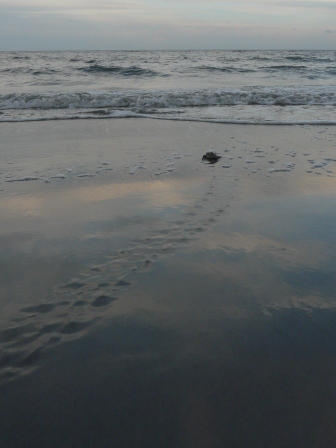
The turtles were kept through the day in a cooler (to keep them at the temperature of their sandy nest deep in a dune), then taken to the beach at sunset. This timing mimics the natural rhythm of hatching: the youngsters emerge at night when they are a little safer from the heat of the sun and from beach-hunting predators. They dig their way out of the nesting burrow high on the beach, then crawl down the sand (they all know which way to go) into the breaking surf. Once in the water, the turtles swim away, surfacing for gulps of air, then head out to the open ocean.

Many of these young turtles will follow the Atlantic gyre, passing Iceland, then Northern Europe, then Portugal, the Azores, finally ending up in the Sargasso Sea where they will live until they reach sexual maturity in about thirty years. Some will avoid the swirl of the Atlantic and swim directly to the Sargasso Sea. The “long and perilous journey” cliché applies here: one in a thousand will survive to breed. When mature, the females come back to shore to lay their eggs; the males never again set foot on land.

So if I’m lucky enough to reach my seventies, I’ll make a return trip to this island. If the hatchlings survive natural predators, legions of fishing boats (up to thirty massive shrimp trawlers at a time off this beach alone), and an ocean filled with tangling, choking garbage, I’ll greet again the turtles that we released onto the beach today. What will the beach be like in thirty years? It is presently eroding at two meters per year, a rate that will accelerate in a world with warmer, stormier, higher seas. But I hope some sand will still be here to greet the mothers as they crawl ashore.

Letting these youngsters go was an emotionally charged occasion. Turtles are ancient creatures, one hundred and forty million years on this OceanEarth, older than the flowering plants, older than most dinosaurs and mammals, and older than Homo rapaciens which has been around for a mere turtle’s blink, two hundred thousand years. Yet in the short time that humans have been here, we’ve pushed all sea turtle species to the edge of extinction. The vulnerability of the little hatchlings and the long long odds that each one faces, odds worsened considerably by the gutted state of the oceans, is profoundly sad. But the vigor and determination of the little turtles is an incarnation of hope, optimism scribed in turtle flesh: damn the odds, I’m headed down this beach with flippers whirring, then I’m taking to the dark ocean with gusto to swim into my fate. All this produces a powerful combination of feelings and thoughts in the watching bipeds. Several of us had tight throats and drops of ocean water in our eyes as we watched the turtles leave.

The photos below include a few from earlier in the week to illustrate the nesting process, then some of the release.

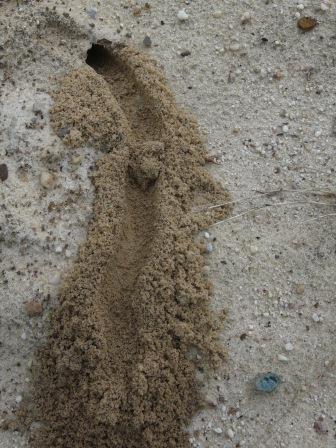
Tracks left in the sand by a mature female ascending the beach to lay her eggs. They do this at night when heat and predators are less of a problem.

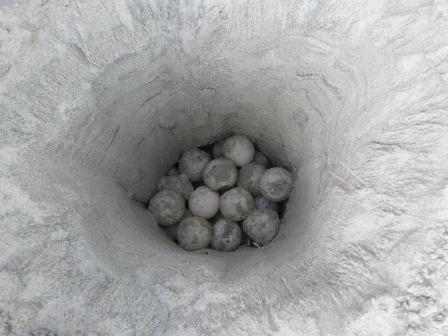
Loggerhead turtle nest. This one is being moved upshore to keep it out of the drowning high tides.

The nest chamber is dug by the female with her back flippers.

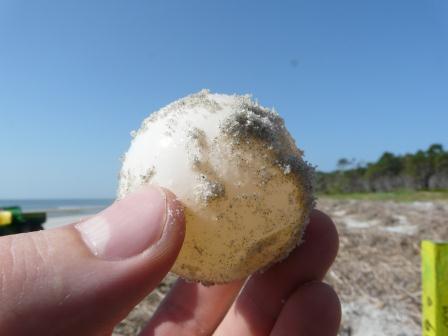
Loggerhead sea turtle egg. Unlike many reptilian eggs, sea turtles egg shells are partly calcified, giving them the feel of a bird egg.

Ghost crab — they live in deep burrows and love to eat turtle eggs.

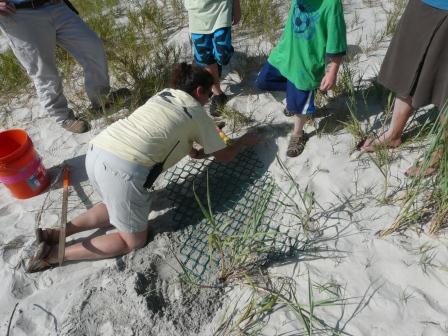
The new nest site is protected with a wire mesh. This keeps raccoons and feral pigs from digging up the eggs.

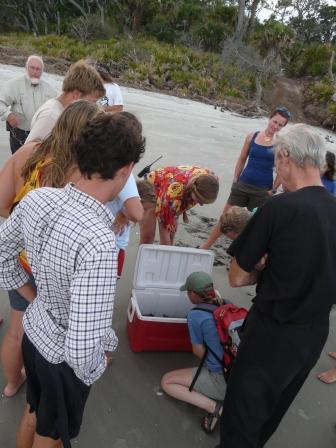
The cooler of turtles arrives…

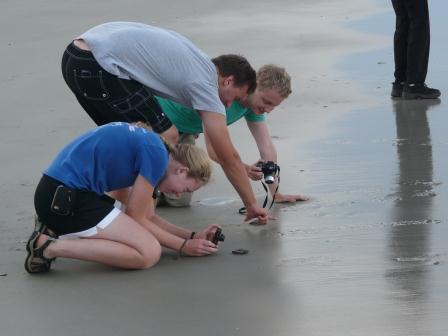
…and is admired.

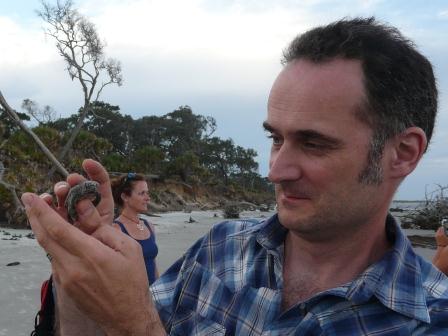
Loggerhead-to-head

The following photographs are from the release of the turtles onto the beach. The hatchlings propel themselves down the beach on their flippers, then get caught up in the breaking waves.

Sargassum

The seaward beaches on St Catherine’s Island are littered with big clumps of sargassum, a type of seaweed normally found only far offshore. The tropical depression that blasted the island a week ago carried the sargassum toward the land and dumped it in untidy skeins in the wrack line. Some even got carried up into the marshes behind the beach.

Sargassum is incredibly important to the ocean’s ecology. It grows in vast floating mats in the warm tropical currents of the Gulf Stream and beyond, even giving its name to the gyre that sits at the center of the Atlantic, the Sargasso Sea. The mats of algae serve as a breeding ground for eels, the nursery of young sea turtles, the home for legions of fish, and the feeding ground for tropical seabirds. Several years ago I took a boat ride out to the edge of this strange sea-within-a-sea (it has no land borders, being surrounded by other bodies of water and ocean currents). The water and air were torrid; the abundance of sea life was phenomenal, especially the graceful terns that plucked fish from the startlingly blue water.

Algae were not the only creatures trapped and hurled to shore by the storm. This young frigatebird was lying on the wrack on the island’s easternmost point. Frigatebirds are the real pirates of the Caribbean, making their living by robbing gulls and terns of their hard-won prey. This young bird must have been blown out of its tropical home and perished on the Georgia shore, turned to acrid-smelling jerky in the sun’s blaze.

Magnificent Frigatebird (Fregata magnificens)

Rejuvenating redwoods, dying oaks, The Grateful Dead, et al.

The last few posts have suffered from an excess of coherence and narrative continuity, so here are some true ramblings from Santa Cruz, CA (and for those who are still in awe of planetary motion, my last post also has some new Venus photos from a grad student that I met at the viewing at UCSC who kindly shared his images via email)…

Santa Cruz sits at the intersection of the cold ocean, the foggy redwood forests, and the blazing hot oak savannahs. Walking for thirty minutes in almost any direction will carry you into a new ecosystem. So variegation of microclimate is extreme.

San Francisco was built from lime and wood taken from this area, so almost all the forests are full of redwood trees growing in little clusters around huge, hundred-year-old stumps. The younger trees are still impressive: very very tall. There is almost no light in the understory, so even on a bright sunny noon, you gaze through the aromatic gloom. These trees drink water from the air. Even though their roots are dry, they get enough moisture from the near daily dousing in ocean fog to keep growing even in rainless months. How do we know this? The oxygen isotope ratios in fog differ from those in rain, so plant physiologists can read the isotopic “fingerprint” of oxygen in the trees, then deduce the source of water.

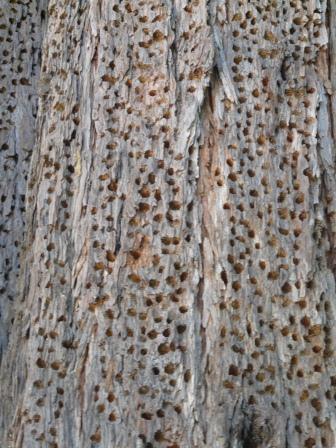
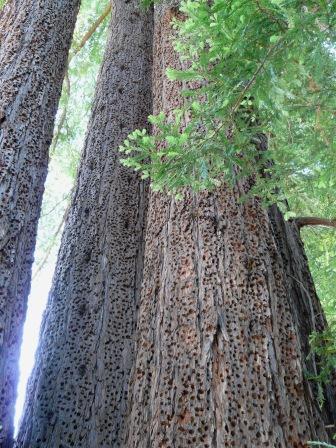
The redwood below has been adopted and turned into a granary by a family of acorn woodpeckers. Each hole is a storage place for an acorn. The family makes its nest in the tree then defends their nest, their stored food, and their honor from other woodpecker families, all of whom are thieves and cheats. Very much like Scotland, with less rain.
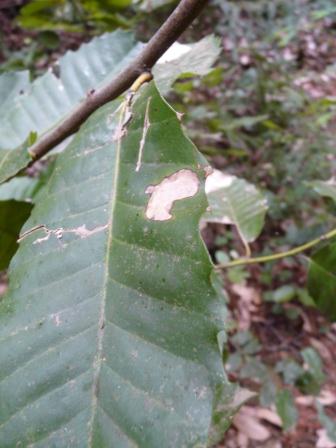
Oaks in California are being slammed by “sudden oak death,” a descriptive enough name for the disease (caused by an exotic species of protist, Phytophthora ramorum, the same genus that causes blight in potatoes, die-offs in peppers, and all kinds of destruction in many other tree species). The disease starts as lesions on leaves (these are tan oak leaves)…
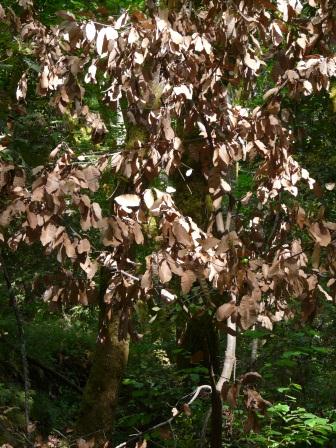
…then kills the whole tree in about a year. Most of the tan oaks in the understory seemed to have the disease. (And, yes, I thoroughly washed my shoes on my return to Tennessee).
Other understory plants are doing much better. These are huckleberries, a close relative of the blueberry:

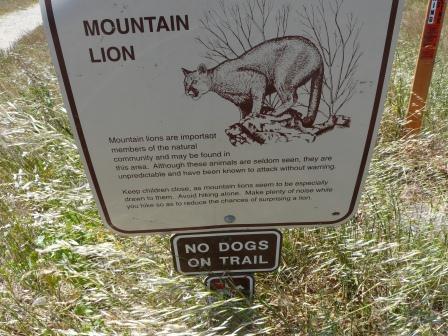
Mountain lions roam the woods and occasionally come into town. Warning signs are dotted over campus and the state parks. It is not clear whether the “no dogs” part of the sign is meant as a statement of a regulation or a summary of the outcome of past events:
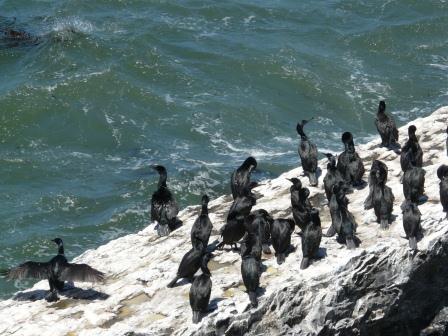
The coast is continually raked by an incredible strong cold wind. Seabirds are abundant. These are Brandt’s cormorants:
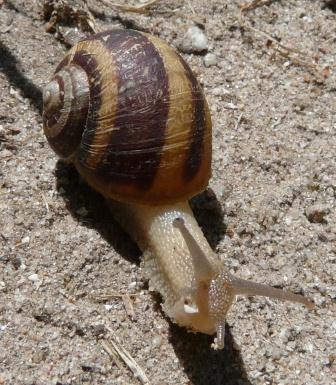
Snails were common in the sandy coastal scrub. They were all, as far as I could tell, the invasive European immigrant, Cornu aspserum, the same species favored in France for eating:
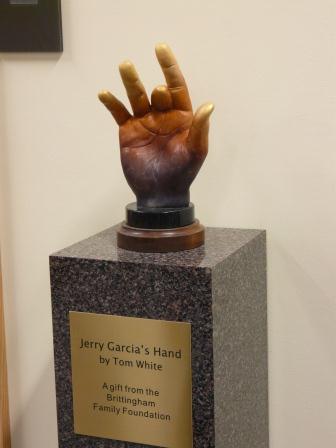
Back on campus, we briefly visited the University library and the Archives of the Grateful Dead, a carefully curated collection of posters, notes, letters, and so forth relating to the band’s long tenure. I was particularly taken by the Ph.D. theses. I know that several of the followers of this blog are Dead fans, so take note: the official opening is coming up at the end of June. There is a slight air of incongruence about an academic archive of Grateful Dead documents, but this strangeness, even dissonance, would have pleased Mr. Garcia, I think.

My visit to Santa Cruz was sponsored by the Department of Environmental Studies and initiated by the graduate students in the department who brought me in as their seminar speaker for this semester. Thank you. And special thank you to Leighton Reid and Rachel Brown who welcomed me and showed me around during my visit.

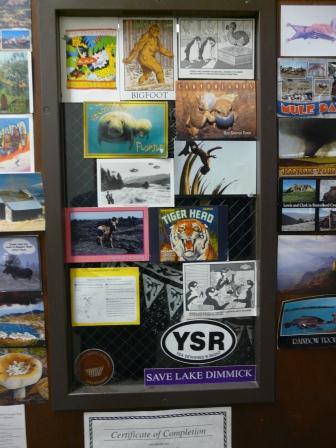
I’ll close with a shot of a door to a grad student office, chosen almost at random. Sewanee residents may remember those great students who protested the Lake Dimmick development, packing Convocation Hall and speaking with forceful clarity to the Regents. That spirit has now been carried to some far flung parts of the world.
Goslings and caterpillar

Continuing with the theme of cute animals, I was in Chattanooga today and took time out for a bike ride along the Riverwalk. Young animals from two very different parts of the tree of life caught my attention.

This mixed brood of Canada goose goslings was making its way upstream along the Tennessee River. There are at least two families, possibly three, in this “crèche.” Mixing families like this is common in waterfowl, although less so among Canada geese. There is safety in numbers, so these goslings benefit from each other’s presence.

This pipevine swallowtail caterpillar was crossing the concrete path. Although it looks fearsome, it is harmless to handle. But any would-be predator foolish enough to try to eat the caterpillar will soon regret its decision. These caterpillars feed on poisonous pipevine plants and sequester the toxins in their bodies. The toxins then get passed to the adult butterfly. The adult tastes so nasty that half a dozen other species of butterfly mimic the butterfly’s blue and black colors, gaining protection through deception. Predators generally leave these mimics alone for fear of biting into a pipevine swallowtail. The photo below is from last summer — note the remarkable iridescent blue. Although I frequently encounter the adults I have never before seen the caterpillar. So a close encounter with this bristly rubbery beast made my day. I put it back in the vegetation, away from the walkway.

Paddling

For our last full lab of the semester, my ornithology class took canoes down to the Elk River. We put into the water where the Elk runs into Woods Reservoir.

Trip highlights include:

  • A great look at a Prothonotary Warbler. This warbler is unusual in that it nests inside old tree holes instead of making a twig or ground nest like most other warblers. It is found along waterways and lake edges.
  • Seeing a Great Blue Heron grab a big watersnake. The snake wrapped itself around the heron’s beak and neck like a whip around a post. The heron thrashed and leapt, perhaps feeling the sting of the snake’s bite, then the snake escaped. The heron kept probing in the water, but this snake was not about to come back.
  • Three Ospreys wheeling overhead, whistling loudly.
  • Two Black-crowned Night-herons, flying right over us, giving a great look at their head plumes and bright legs.
  • A mother goose on her eggs, flopped out with a “broken neck” — playing dead as a ploy to remain unmolested by these strange paddling primates.

(note: photo links above are not from this trip (I wish), but from Robert Royse, an outstanding bird photographer)

Trip lowlight: dozens of trotlines tied to branches overhanging the river. These are unattended fishing lines, mostly aimed at turtles, but anything that grabs at the large hooks on the lines gets snagged. Two years ago we found a heron that had died in a tangled trotline. Not so pretty, but 100% legal (as long as you don’t set more than 100 trotlines at a time…). This method of fishing is like deer-hunting by lashing shotguns to trees, then attaching tripwires to the triggers. You’ll get some deer, yes, but at what cost?

This slideshow requires JavaScript.

Paddling with Carson and Byron

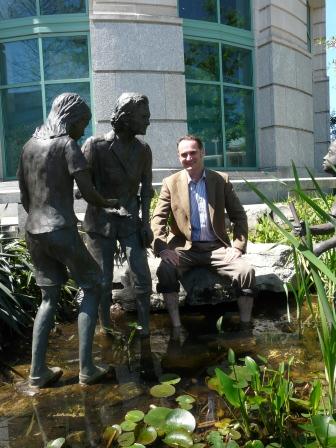
The entrance to the North Carolina Museum of Natural Sciences has a sculpture and native plant garden honoring the great writer Rachel Carson.

Carson is sculpted with her trousers rolled up, feet in a pond, showing two children the creatures in the water. Despite being dressed for oration instead of investigation, I decided to join her for a paddle. Stephen Garrett, a friend and former student who came to my talk was kind enough to take a photo or two. He was also kind enough not to say anything about my unsophisticated camera gear (he’s a pro, so I hesitated to hand over my little pixel-snatching machine).

cooooold

Child, Genius, and Grinnin' Fool.

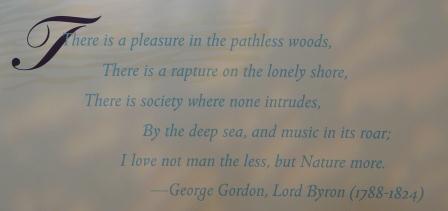
The Museum also had this nice quote painted in large print across one of its walls. In my experience, Lord Byron is not someone often featured in the halls of science or natural history museums. It is a pity that they left off the last four lines, “From these our interviews, in which I steal/From all I may be, or have been before,/To mingle with the Universe, and feel/What I can ne’er express, yet cannot all conceal.” ..stealing away from past and future, to the inexpressible present…nicely done.

“Lonely” the museum was not. There were an impressive number of people visiting its excellent exhibits. And, on April 20th, the museum will open a big new wing featuring “How Do We Know?” exhibits — e.g., “Dinosaurs taste like chicken — How do we know?” Good question. (I hear one answer from my Tennessee grilling friends: Yessir, but here in Tennessee our chickens taste a little better ‘n that, it’s in how you cook’em. Those Raleigh folks don’t know how its done.)

If you’re headed to Raleigh, I strongly recommend a visit (but not yet — the whole museum closes tomorrow to complete the last stages of construction).

Puget Sound

After my talks in Seattle, Olympia, and Tacoma, I spent Saturday in Tacoma with my friend Peter Wimberger. We were in graduate school together back in the early 1990s and we have a shared affinity for natural history, helping our students see the world through the eyes of evolutionary biology, and eating salmon. He was kind enough to take me on a tour of some good bird-watching spots on Puget Sound.

A different world from the forests of Tennessee.

Douglas firs, western cedars, Pacific yews. Ever Green. Tree trunks thicker than any that have grown in most eastern forests for hundreds of years. There is no “ground,” no litter layer; instead, moss, moss, moss, as if a bryophyte blizzard had passed through, leaving drifts everywhere.

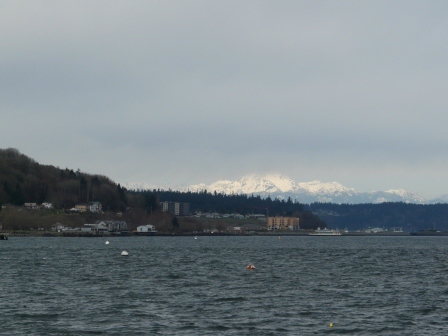
And on the water: murrelets, goldeneyes, harlequin ducks, scoters, loons, red-necked grebes. These are birds of cool rocky coasts, of Alaskan inlets, of moutain lakes, of streams running out from mountain glaciers. Look up from the water, and there are the snowy mountains rising behind wooded slopes and coast-hugging cities.

We conducted our bird-watching through binoculars and a scope, out of range of my modest, weak-lensed camera. But, a few ducks were bobbing close to shore. These Barrow’s goldeneyes were close to the dock. I’d never seen this species before. It is distinguished from its cousin, the common goldeneye, by the bright orange beak of the female and the crescent-shaped white patch on the male’s head. They winter on the coasts, but move inland to mountain lakes to breed, building nests in holes in dead trees. They feed by flipping their compact bodies forward and diving under the surface with a little splash. They swim down to grab mussels and other invertebrates from the rocky bottom. Their eyes are, indeed, golden — just visible in this photo.

Next stop, Newark, NJ…