Category Archives: Trees

Arboreal bear

Todd Crabtree, a naturalist extraordinaire and botanist at Tennessee’s Division of Natural Areas, sent me the following photos as a follow-up to my discussion of bear corn. Todd was leading a hike above Abrams Creek during the annual Smoky Mountain Wildflower Pilgrimage and saw this bear high in an ash tree. The photos are taken from a ridge looking down into the tree tops. The bear appeared to be nipping at the ash flowers.

BearInAshBearInAshCloseBearDescends

Photo Credits: Todd Crabtree, 2013.

Although this is a startling sight (how do the branches hold that weight?) studies of black bears report this kind of behavior across the species’ range. In some places, the bears’ hunger for tree flowers is a significant source of damage for many trees. In southeast Alaska, for example, bears like to climb cottonwoods, staying close to the trunk then breaking off branches to munch on catkins.

Omnivore defined.

Hatchling

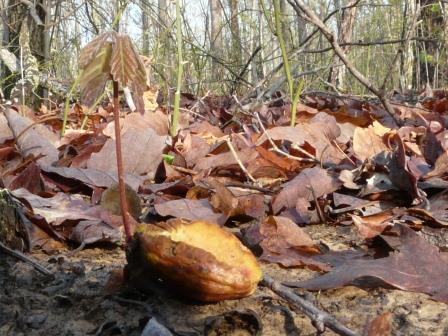
chestnut oak seedlingA chestnut oak seedling emerges from the sloughed remains of winter. A mighty good sight.

Chestnut oaks (and their cousins in the “white oak” group) send down roots in the fall, racing against rodents. Once rooted, the seedling can survive the predatory munchings of mice and chipmunks. When temperatures warm in the spring, leafy shoots emerge: hopeful bids for a place in the canopy decades hence.

Red oaks have a different germination strategy. They load their acorns with bitter tannins. A bite on one of these poisoned seeds puckers your mouth; swallow one and your gut clenches. White oaks are sweeter to the palate. Thus defended, the red oak waits out winter inside its protective coat, poking out a root when winter is finally done.

Shoots rise, roots descend. The growing season is underway.

Serviceberry: preaching the gospel across the Appalachian Mountains

Serviceberry roared into flower this week, going from bud to bloom in a few hours, or so it seemed. From a distance these small trees present puffs of bright white in the dusky woods. Seen close, the flowers are indecently large and gaudy: this is no subtle, ground-hugging anemone flower. The serviceberry is famous all over eastern North America for announcing spring with a vigorous fanfare, usually at the head of the line, weeks before other trees and shrubs shake off their winter torpor.

serviceberry3

The species goes by many names, surely more names than any other understory tree. Here are the names that I’m aware of, no doubt I missed a few: serviceberry, sarvis, sarvisberry, shadbush, shadblow, juneberry, sugarplum, wild plum, Indian plum.

Etymology is clear for some of these names, but not for others. “Shad” refers to the shad fish (genus Alosa) of the northeast whose return from the oceans to their upriver spawning grounds coincides with the bloom of the “shadbush.” “Plums” refer to the fruits which are consumed with gusto by birds and small mammals and, depending on the variety of tree, by humans.

“Sarvis” is a mountain dialect variant of “service,” but the origins of these terms is not clear. Some claim a corruption of Sorbus, the scientific name of a related plant, the mountain ash. Others associate the name with church services: the return of traveling preachers as winter roads became passable or the use of the blooms as decorations for Sunday worship. I learned of another interpretation from Jay Leutz’s book Stand Up That Mountain. In the higher parts of the Appalachians, where winter freezes are deep and long, the tree blooms as soon as the ground thaws. This time marks the first opportunity to dig graves and hold funeral services for those who have died in winter and whose bodies await burial. On the Cumberland Plateau, at least in the years I’ve lived here, the ground is fit for burying many weeks ahead of serviceberry blooms. Different meanings are heard in different landscapes; our understanding of language molds itself to place.
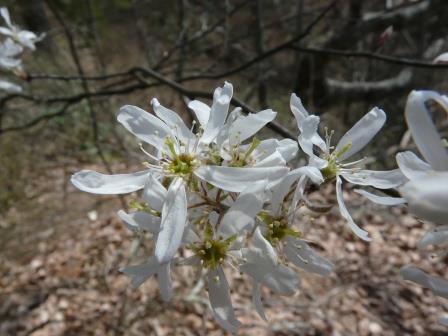
serviceberryServiceberry also offers us a curious parallel between nomenclature and biology. The genetics of this genus, Amelanchier, are particularly complicated. Dozens of forms exist. These forms hybridize, creating new variants and causing mental (and gastric) distress for any taxonomists who dream of order in the Natural Order. Some forms switch off sexual reproduction and set up small populations of asexual trees. These “microspecies” sometimes then switch back to sexual reproduction and interbreed again with other forms. In all, the genus is a hyperdiverse genetic tangle in which firm species do not exist.

This seems frustrating, but many biologists see the situation otherwise. Here, for example, is our friend Darwin in the second chapter of The Origin, discussing the serviceberry’s unruly relatives in the Rosaceae family:

I refer to those genera which have sometimes been called “protean” or “polymorphic,” in which the species present an inordinate amount of variation; and hardly two naturalists can agree which forms to rank as species and which as varieties…

Certainly no clear line of demarcation has as yet been drawn between species and sub-species…

Hence I believe a well-marked variety may be justly called an incipient species…

From these remarks it will be seen that I look at the term species, as one arbitrarily given for the sake of convenience to a set of individuals closely resembling each other, and that it does not essentially differ from the term variety, which is given to less distinct and more fluctuating forms.

For Darwin, these variable “species” and “varieties” were evidence for continuity in nature. Today’s species is yesterday’s variety. Life evolves; don’t expect tidiness.

We can only speculate what the traveling preachers of the 19th century might have thought of having their arrival heralded by an example of Darwinian mutability. I like to think that at least a few may have reached for the wild-plum wine.

Red maple: the burn begins, warblers drawn to the heat

winter_no_AprilGentle, domesticated plants are singing springtime songs, lifting gardens with flowers and newly emerged leaves, but the forest is wintry, especially in the uplands. Mountain slopes may glow with ephemeral wildflowers and buckeye saplings, but the rolling tabletop of the Cumberland Plateau seems little changed from January.

Red maple trees are the exception. Oaks and hickories have their buds clamped shut, but red maple blooms are out. From a distance these trees seem to stand in a shroud of carmine smoke. Each tiny bloom is  wine-red, standing like a small flame at the tip of a long, twiggy taper. Many of these flames have already matured and fallen, so my feet to move, for a few moments, through a dust of fallen embers as I pass below the trees.

Not to belabor a point, but these trees have rather variable sexual systems. Red maple flowers are usually either male or female, although a few blooms are both. Individual trees carry all male, all female, or mixed collections of flowers. On mixed trees, single branches will usually grow just male or female flowers. Richard Primack studied a small population of these trees and has written an interesting discussion of how the red maple breeding system fits within the diversity found within the whole Acer genus.

Click on images for captions and a slideshow.

The flowers scattered across our trails are almost all males. Once they have shed their air-borne pollen, their work is over and they become food for worms. (Brave Percy undoubtedly walked among them during his sojourn in Sewanee; the photos above are from a trail close to his haunt at Brinkwood.) The female flowers intercept floating pollen and will, over the coming months, grow the maple’s distinctive samaras or “helicopter fruits.”

Along with these emerging flowers come insects, scraping and sucking and chewing the newly emerged vegetation. And along with the insects: birds. Black-throated green warblers, just back from Central America, are congregating in the maples. I counted three of the warblers in one tree; all were steadily working from one flower to the next, pausing to hurl a short song to the forest, then getting back to work, beak to bloom.

Dead wood, ashes.

One of Shakerag Hollow’s giant trees has fallen. An ash that until last week held its arms in the highest reaches of the canopy now sprawls across the forest floor, its body utterly torn. I’ll go back soon and “measure” things (how tall? what weight of wood came slamming down?), but for now: just awe.

I did not see the fall, but came by soon after. The trunk was … indescribable. Some grand words are needed, for barely imaginable violence had been at work. Rent asunder!? The whole wide trunk was twisted and split open, lengthways, in several long gashes. Other trees, themselves no mere saplings, were smashed into the ground. Large boulders were shifted as roots reared and cracked. The air was infused with the odor of fresh-split wood. An overtone of bitterness, like cut oak, but mostly a sweet smell, almost honeyed.

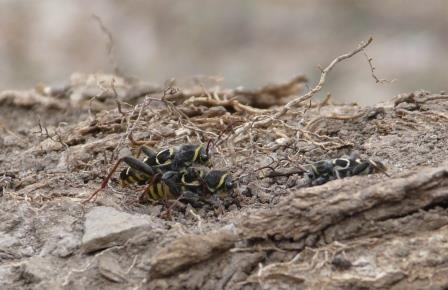
I found the tree in the morning and returned in later in the day for another look. As I stepped closer in the warm afternoon, I hesitated then held back. There were wasp-like creatures, big ones, swarming over one of the thick exposed roots. These insects were scurrying, flickering their wings, crawling over each other. A frenzy.

Black with bold yellow stripes. Buzzing as they flew. Had the tree fall unearthed a buried wasp nest?

Neoclytus caprea

But something was not quite right about these wasps. I moved forward slowly and saw their fat hind legs, too beefy for a wasp. Crickets? No. Then the wing cases, striped in black and yellow: beetles! Wasp-mimicking beetles of some kind. I moved to the side of the tree and saw hundreds of them, racing up and down the bark. They were on no other trees nearby. Half of the beetles were copulating; the other half seemed intent on colliding with the mating pairs. Even though I now knew that they were harmless, their waspy nature made me cautious. Even their short curved antennae were creepily hymenopteran in style (oh yes, those hymenoptera have style).

Who were they? To identify them, I spent some time in the online funhouse known as the Photographic Atlas of the Cerambycidae of the World. This is an amazing site devoted to a single family of beetles, the so-called longhorns (although many of them do not have long antennae). The family contains twenty thousand species, an impressive number when we remember that there are fewer than six thousand mammal species. Some of these cerambid beetles run afoul of humans when they bore into trees and wood that we’d rather they stayed out of. A few of them are “invasive exotics,” killing off native plants. But the beetles in Shakerag were natives: Banded Ash Borers (Neoclytus caprea (Say) 1824). They have an interesting life history, finding recently downed ash and oak trees, then laying their eggs in the bark. The larvae then chew on the wood below the bark, emerging next spring to start the hunt for a newly downed tree.

So I was not the only creature in Shakerag following my nose to the smell of ripped up wood. How many huge ash trees have fallen lately? Not many. Every banded borer within miles must have been at this party. Those flickering antennae are surely tuned to the chemical particularities of newly opened ash wood.

The beetles were one of the very first arrivals in the tree’s new existence. When a large tree falls, its ecological life still stretches out into the future. Perhaps half of the animals (and many more of the fungi) that the tree will nurture during its existence arrive after the tree has fallen. The ecological vitality of a forest can be judged by how may large trees are lying around, feeding beetles, hiding salamanders, growing fungi.

To paraphrase Mr. Faulkner, “Dead wood is never past, it’s not even dead.”

ash

Fog happens, and the woods rise into it.

The overlook at Green’s View offered an interesting prospect this morning. The hundred mile view was shortened by the enveloping cloud to less than one hundred feet.

fogThe fog penetrated the forest, hazing and graying views through the trees.

fog2The smell was deliciously tenebrous, seeping into the dim air from the darkness of the soil. Shrews and moles must inhale the same rich earthiness as they burrow.

Although we imagine springtime coming from elsewhere, a warm breeze blowing birds and warmth from the tropics, in reality most of the year’s new life rises from the musty earth, surging through layers of decay.

The first significant signs of this life have now appeared in Shakerag Hollow. Harbinger-of-spring (also called salt-and-pepper plant, Erigenia bulbosa, a carrot relative with an edible tuber) has raised hundreds of tiny blooms over the mountainside, each one standing barely taller than the upper surface of the leaf litter.

harbinger of spring1

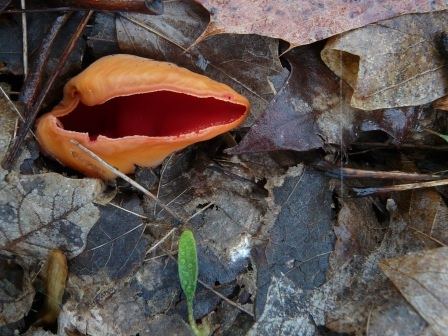
harbinger of springFungi are also poking through, spreading their spores from colored cups.

cup1cuo2And the animal world is alive. Hairy woodpeckers call, perhaps starting their  breeding season. Orange centipedes lumber across the litter, seeking prey into which to sink their poisoned fangs. Spiders, although withdrawn in their hiding places, have their presence revealed by the foggy air. Every web is a bright cloud of droplets. In some places, funnel-web spiders had strewn the forest floor with dozens of newly constructed traps.

funnelLeaves of toothwort, spring beauty, bloodroot and trillium were unfurling, but their flowers were not yet emerged. Soon, though, the smouldering wet soil will blaze.

Shelf fungus as a rain shelter for woodpeckers?

Older black locust trees in our region are often rotten on the inside. Fungi worm through the tree trunks, digesting their cores. When these fungi are mature enough to reproduce, they sends filaments (hyphae) to break through the tree bark. The exposed hyphae grow into “shelves” on the trees’ trunks. These shelves are comprised of the remains of thick-walled dead hyphae, intermingled with thin-walled living strands. The “wooden” feel of the shelves comes from the walls of the dead cells; the spores are made by living hyphae. “Wooden” is not quite accurate: fungi cell walls are strengthened not with the stuff of wood, cellulose, but with chitin, a molecule that also finds use in the exoskeletons of insects. The shelves are tough enough to persist for many years.

Rotten trees provide habitat for many animals. Much of this utility is mediated through the work of woodpeckers. In excavating a fresh nesting hole each year, woodpeckers leave a trail of convenient roosting and nesting sites for other species, most obviously many bird species (titmice, chickadees, great-crested flycatchers, wood ducks, owls, etc), some mammals (flying squirrels), and bees (feral honey bees love big hollow trees). Most woodpeckers will only attack trees that are partly rotten, so it is the combination of bird and fungus that produces this real estate boon in the forest.

Woodpeckers and fungi may also have more short-lived associations. My friend Joseph Bordley pointed out to me that the tree bark under shelf fungi is often scratched up. This seems to be particularly true for shelves of Phellinus robiniae on locust trees. I found one such example this weekend on the trail to Bridal Veils falls near Sewanee. As the photos below demonstrate, the distressed bark sits directly below the shelf. Are woodpeckers using shelves as shelters in the rain? Despite keeping my eye on locust trees for many years now, I’ve yet to see any birds under shelves in rain or shine. I’d be interested to hear whether anyone has any other relevant observations. Might animals be gnawing the wood to slurp mushroom spores? Is there some other reason for the mysterious scratchings?

wpumbrella

wpumbrella2

Beech

The woods are mostly bare and gray, but American beech still shines. The trees, especially the young trees, retain their coppery leaves until spring. Beech is the bright ornament of the dark woods, gold leaf flecking the gloom.

winter beech

The leaves are exposed to all of winter’s assaults and many of them abrade away until all that is left is translucent paper, etched with veins.

beechtrans

Other trees weather more slowly. Perhaps they grow in slightly more sheltered areas or have a genetic propensity for toughness. Their leaves keep the full, metaled color of autumn.

beech copper

Botanists are fond of classically derived English neologisms to describe their plants and the scientists have not let us down here. Unfallen leaves are “marcescent” (from the Latin, marcesco, wither).

But nomenclature is easier than explanation. Why might trees be marcescent? One idea is that a fuzz of leaves might protect nutritious buds from browsing animals like deer. Having watched goat lips strip shrubbery, I initially found this explanation unlikely. Browsers are adept at taking what they like and leaving the rest. Goats work around tiny thorns with ease. A few crisped leaves would be unlikely to keep deer away from beech buds. But my skepticism should be tempered by actual experiments. I know of no such experiment in North America, but a study of beech, hornbeam, and oak in Denmark did find that marcescence had a protective effect for beech and hornbeam, but not for oak. Apparently, the lower nutritional content of the leaves compared to buds and twigs acted as a deterrent for deer. The fact that marcescence is most common in young, short trees and on the lower branches of older trees is another piece of evidence in favor of this hypothesis.

On the other hand, retained leaves may act as cues for ovipositing insects in the spring. Or so it appears for gall-forming cynipid wasps infecting one species of California oak. This tree species lives in a very different environment, but galls are also common in Sewanee’s forests.

Another idea is that the retained leaves subtly change the micro-climate around buds. There is experimental evidence for such an effect in Andean plants with rosettes of marcesent leaves. It is possible (although no-one has checked, that I know of) that the ice and snow that gathers on marcescent leaves might act as a buffer, protecting buds from the more extreme winds and temperatures of winter.

I encourage you to seek out beech on your woodland walks. The species is found all over eastern North America. On the southern Cumberland Plateau it has an odd distribution. Puckette, Priestley, Kuers and Hay’s excellent 1996 guide to Sewanee’s trees states that beech is found “almost exclusively in the bottomlands and the neighboring lower slopes of coves.” I’d add that the species also likes (strangely) dry ridges and the streamside habitat of the eroding bluff. It may be that the semi-domesticated hogs that ran through these forests for decades have caused the species to have a more patchy distribution than it otherwise would have done. Beech nuts were favorite food for hogs and in the late 1800s and early 1900s it is likely that almost no young beeches germinated across large parts of the mountain. The species’ present-day distribution is therefore hard to interpret.

Look closely and you’ll see another interesting feature: needle-like buds. Unlike the rotund buds of oak, ash, and maple, beech has stilettos on the ends of its twigs. They are quite remarkably elongate.

beech budbeech bud2I am not the first person to marvel at this species. I have heard that Native Americans in these parts viewed groves of beech as sacred places. One such grove, in Champion Cove, has come up repeatedly in conversations over the years. A destination, perhaps, for a pilgrimage next year.

Fifty Shades of Grey: Woodland Edition

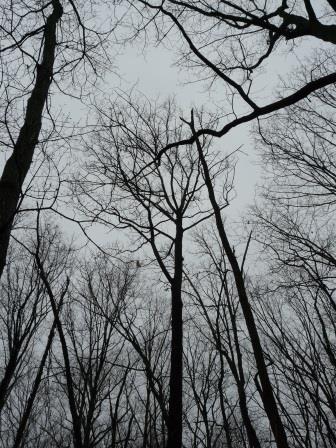
Sitting in the woods with my class last week, I was struck by how grays had come to dominate. The light environment is transformed. Of course, a “fifty shades” wisecrack had to work its way into my impromptu lesson on the visual aesthetics of the forest. The witticism turned into a small project for my walks of the last week: pay attention and find these shades. So here they are, fifty photographs of variations on the theme.

Gray is the most egalitarian of hues. Indeed, its essence is that is not a single color. Instead, gray gives us a muted echo of all the light spectrum, a moody version of white. Contrast this with the bias of other pigments — reds, blues, yellows — that reflect just a tiny slice of the light available to them.

Gray is an unassuming mirror of the world and a quiet companion for its more assertive kin. It absorbs metaphors with ease, having combined light and dark: ash, silver, lead, pepper. A suitable tone, then, for winter reflections.

Happy Solstice, fellow ramblers.

This slideshow requires JavaScript.

Forest on Whidbey Island, Washington

An empire of moss and broadsword ferns. Douglas fir trees bend the sea wind. Reams of gold leaf — bigleaf maple — drop through thickets of hemlock and cedar.

Kinglets hammer the forest’s ceiling with sharp brads of sound. Then they drop, working the ferns. Ten of them, right here: hazed wings and stone-bright eyes. Sulfur headstripes; bright, they slice open the heavy green drapes.

Wads of old leaf caught in maple tree crotches, rotted mats lodged inside sprays of alder twigs. Seedlings take root there, above our heads. The soil’s upper boundary is fogged. In walking, we worm through soil passages, burrows of air.

This slideshow requires JavaScript.