Category Archives: Travels

Goodbye loggerhead sea turtle hatchlings…see you in the year 2042

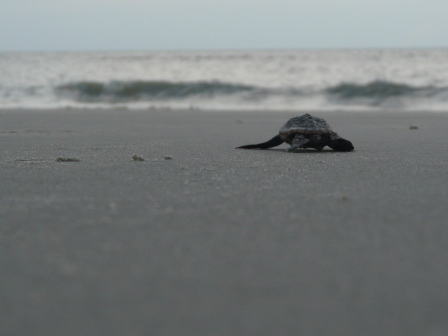
Two nights ago, Gale Bishop has his colleagues at the St Catherine’s Island Sea Turtle Conservation Program were kind enough to invite the Sewanee Island Ecology Program crew along on the year’s first release of baby turtles. These little hatchlings all came from the same nest, a nest that was dug out by hand (not flipper) to save it from a predatory ghost crab that had started to munch its way through the clutch. The crab got three; one hundred and fourteen were released.

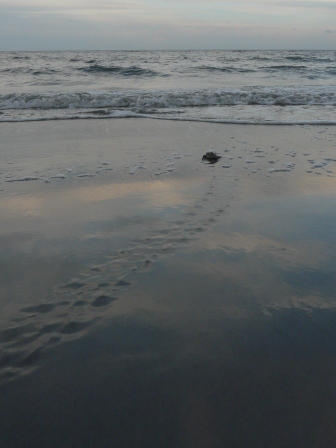
The turtles were kept through the day in a cooler (to keep them at the temperature of their sandy nest deep in a dune), then taken to the beach at sunset. This timing mimics the natural rhythm of hatching: the youngsters emerge at night when they are a little safer from the heat of the sun and from beach-hunting predators. They dig their way out of the nesting burrow high on the beach, then crawl down the sand (they all know which way to go) into the breaking surf. Once in the water, the turtles swim away, surfacing for gulps of air, then head out to the open ocean.

Many of these young turtles will follow the Atlantic gyre, passing Iceland, then Northern Europe, then Portugal, the Azores, finally ending up in the Sargasso Sea where they will live until they reach sexual maturity in about thirty years. Some will avoid the swirl of the Atlantic and swim directly to the Sargasso Sea. The “long and perilous journey” cliché applies here: one in a thousand will survive to breed. When mature, the females come back to shore to lay their eggs; the males never again set foot on land.

So if I’m lucky enough to reach my seventies, I’ll make a return trip to this island. If the hatchlings survive natural predators, legions of fishing boats (up to thirty massive shrimp trawlers at a time off this beach alone), and an ocean filled with tangling, choking garbage, I’ll greet again the turtles that we released onto the beach today. What will the beach be like in thirty years? It is presently eroding at two meters per year, a rate that will accelerate in a world with warmer, stormier, higher seas. But I hope some sand will still be here to greet the mothers as they crawl ashore.

Letting these youngsters go was an emotionally charged occasion. Turtles are ancient creatures, one hundred and forty million years on this OceanEarth, older than the flowering plants, older than most dinosaurs and mammals, and older than Homo rapaciens which has been around for a mere turtle’s blink, two hundred thousand years. Yet in the short time that humans have been here, we’ve pushed all sea turtle species to the edge of extinction. The vulnerability of the little hatchlings and the long long odds that each one faces, odds worsened considerably by the gutted state of the oceans, is profoundly sad. But the vigor and determination of the little turtles is an incarnation of hope, optimism scribed in turtle flesh: damn the odds, I’m headed down this beach with flippers whirring, then I’m taking to the dark ocean with gusto to swim into my fate. All this produces a powerful combination of feelings and thoughts in the watching bipeds. Several of us had tight throats and drops of ocean water in our eyes as we watched the turtles leave.

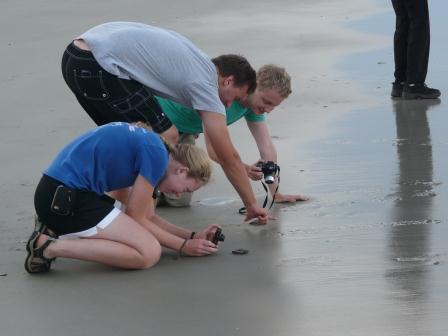
The photos below include a few from earlier in the week to illustrate the nesting process, then some of the release.

Tracks left in the sand by a mature female ascending the beach to lay her eggs. They do this at night when heat and predators are less of a problem.

Loggerhead turtle nest. This one is being moved upshore to keep it out of the drowning high tides.
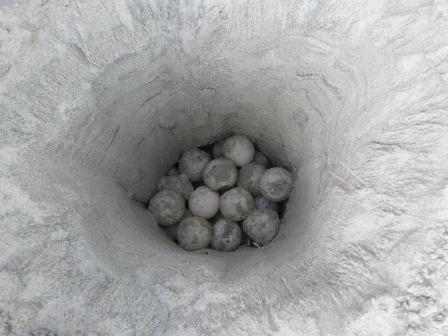
The nest chamber is dug by the female with her back flippers.
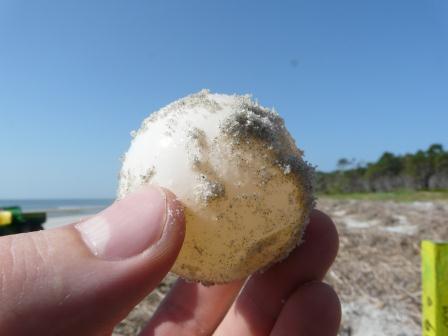
Loggerhead sea turtle egg. Unlike many reptilian eggs, sea turtles egg shells are partly calcified, giving them the feel of a bird egg.
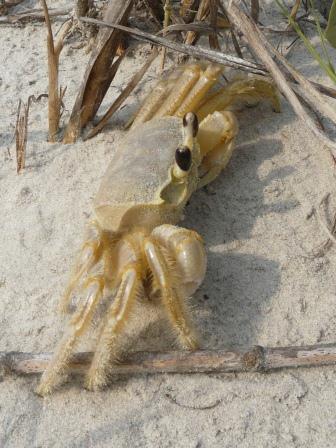
Ghost crab — they live in deep burrows and love to eat turtle eggs.
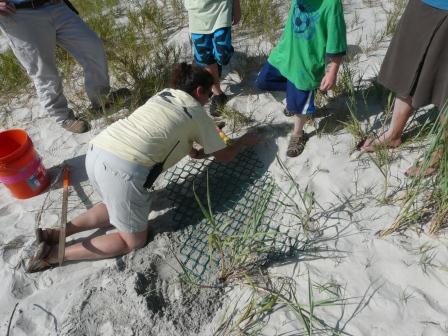
The new nest site is protected with a wire mesh. This keeps raccoons and feral pigs from digging up the eggs.

The cooler of turtles arrives…
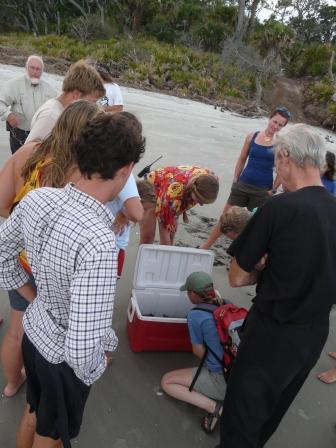
…and is admired.
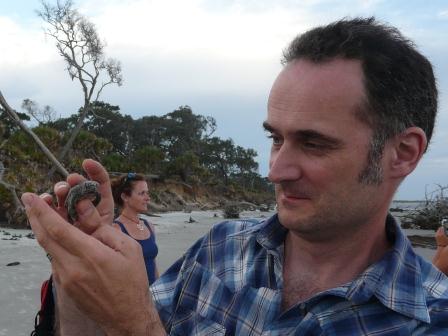
Loggerhead-to-head

The following photographs are from the release of the turtles onto the beach. The hatchlings propel themselves down the beach on their flippers, then get caught up in the breaking waves.

Ring-tailed lemurs

A small population of ring-tailed lemurs lives on the north end of St Catherine’s Island. The animals are descendents of a handful of ancestors that originally lived in the Bronx Zoo and Duke University. The lemurs are free-ranging but receive daily dietary supplements (fruit and “primate biscuit”) and regular veterinary attention. They have been on the island since 1985.

The lemurs’ social behavior is very similar to that found in the wild — they live in matriarchal groups that keep to a home territory. The matriarch and her daughters are usually the dominant animals within the group. Social rank is therefore determined by kinship (and, secondarily, by reproduction — not having babies knocks down a female’s rank). Males are subordinate to females. They live with the group for their first few months, then disperse and try to join other groups.
The lemurs on St Catherine’s are not “tame” (no touching allowed) but they seem to have no fear of humans, frequently approaching very close. This opens the door to interesting studies of their lives and primatologists travel here from across the world to observe the lemurs’ behavior. Most of the animals have individually colored radio-collars. These chunky necklaces appear to cause them no discomfort and allow researchers to track each animal.
This slideshow requires JavaScript.

Clapper Rail

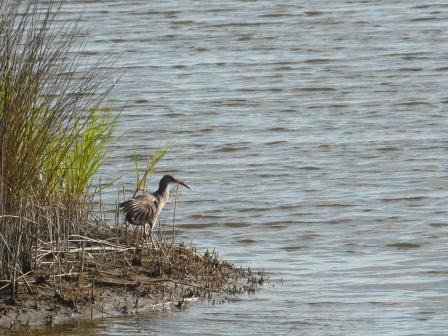
The salt marshes of the Atlantic coast are home to a variety of bird species that specialize on this harsh but productive habitat. One such denizen of the marshes is the clapper rail (Rallus longirostris). This bird is related to the cranes, but is the size of a small chicken. It spends its entire life squeezing through the densely packed vegetation in the marsh, poking around in its hunt for crabs and other mud-loving morsels. Its body is flattened side-to-side (thin as a rail) to assist this movement.

The rail’s song is a chugging, choking, coughing splutter. The Cornell bird site has a recording, but it doesn’t capture the attack and volume of the song. I took a group of students out in canoes yesterday to search for the rails and was impressed to hear the songs echo down the tidal creeks that we were traveling. The low walls of salt marsh vegetation along these creek act like the walls of a canyon and the songs ricochet as they shoot along.

Clapper rails normally keep themselves hidden, but this evening I saw one preening and singing on an exposed mud bank. The photo below show the bird’s impressive beak, a tool used to catch and dismember crabs.

Clapper rails live along the coasts on both sides of North and South America, wherever salt marshes grow. These birds can be quite common in good habitat, but because salt marshes have decreased in extent over the last hundred years, they are not nearly as abundant as they used to be. Despite the best efforts of the legislature in North Carolina (who just passed a law more or less forbidding the sea to rise or, more precisely, asking scientists to stick their heads ostrich-like deep into the eroding sands), the ongoing and accelerating upward creep of the ocean will gnaw away at the rails’ home (and ours — see NASAs interesting animation on this topic).

Sargassum

The seaward beaches on St Catherine’s Island are littered with big clumps of sargassum, a type of seaweed normally found only far offshore. The tropical depression that blasted the island a week ago carried the sargassum toward the land and dumped it in untidy skeins in the wrack line. Some even got carried up into the marshes behind the beach.

Sargassum is incredibly important to the ocean’s ecology. It grows in vast floating mats in the warm tropical currents of the Gulf Stream and beyond, even giving its name to the gyre that sits at the center of the Atlantic, the Sargasso Sea. The mats of algae serve as a breeding ground for eels, the nursery of young sea turtles, the home for legions of fish, and the feeding ground for tropical seabirds. Several years ago I took a boat ride out to the edge of this strange sea-within-a-sea (it has no land borders, being surrounded by other bodies of water and ocean currents). The water and air were torrid; the abundance of sea life was phenomenal, especially the graceful terns that plucked fish from the startlingly blue water.

Algae were not the only creatures trapped and hurled to shore by the storm. This young frigatebird was lying on the wrack on the island’s easternmost point. Frigatebirds are the real pirates of the Caribbean, making their living by robbing gulls and terns of their hard-won prey. This young bird must have been blown out of its tropical home and perished on the Georgia shore, turned to acrid-smelling jerky in the sun’s blaze.

Magnificent Frigatebird (Fregata magnificens)

Gopher tortoises on St Catherine’s Island, GA

I’m spending ten or so days teaching on St Catherine’s Island, a coastal barrier island south of Savannah, GA. The island is swarming with interesting creatures; I’ll highlight just one in this post, with more to follow.

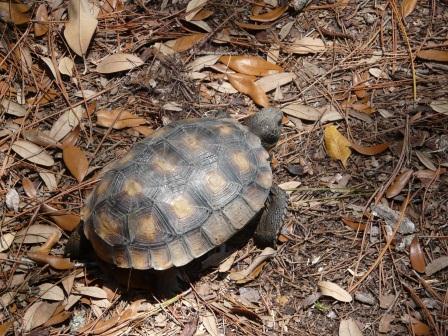
The gopher tortoise (Gopherus polyphemus) is the only “true tortoise” (Family Testudinidae) in eastern North America (the other shelled critters here are all turtles of one kind or another, even the terrestrial box turtle whose kinship is much closer to pond turtles than it is to tortoises). Gopher tortoises dig very long burrows in which they spend most of their time. Some burrows are four or five feet deep and twenty feet long. These subterranean homes help the animals escape the worst of the heat and the cold. They also provide a safe space when fires roar through the open piney forests that is the preferred habitat of the species. These fires help to maintain the savannah-like structure of the forest, but they are obviously also dangerous to resident animals.

The population of gopher tortoises on St Catherine’s came from the mainland. They were moved here when a commercial development destroyed their habitat. Since then, the tortoises here have thrived and bred. They live in a large pasture that is maintained as an open savannah. From the surface, all that is visible are the sand piles around the entrance to each burrow. It is seriously hot here at the moment, so the animals usually stay below in the cool.

Gopher tortoise burrow with apron of sand. The females lay their eggs in this apron.

The hole is tortoise-shaped…

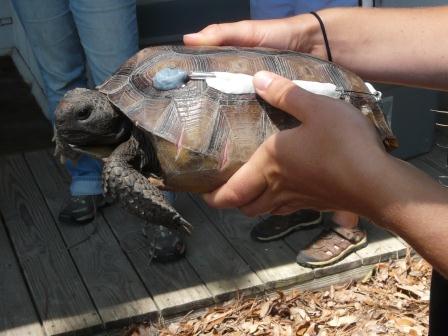
Bess Harris, a graduate student at the University of Georgia, is on the island studying the tortoises. She kindly took some time out of her afternoon to talk about her work and show us some of the animals that she was fitting with radio-transmitters.

This one is eight years old. She/he has many more decades of life to come, hopefully.

The tortoises were surprisingly fast (Aesop never saw a gopher tortoise, it seems) and had to be grabbed and retrieved as they paddled away.

Radio transmitter.

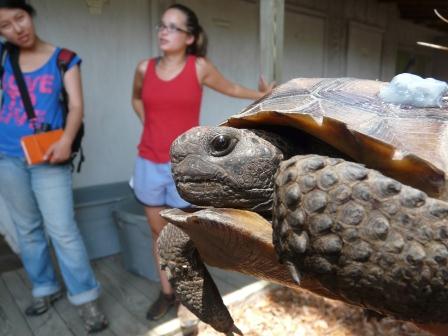
The front legs are flattened: great shovels.

Not only flattened, but strong. A full grown tortoise (about 20 lbs) can out-pull a human hand. This one is only half grown and inflicted no bruises.

Beautiful patterns in the keratin shell.

Making a #hash of things…yes, here we go

Last week, 350.org launched a twitterstorm to increase the profile of their campaign to end subsidies for fossil fuels. The storm was timed to coincide with the Rio+20 meetings. What’s a twitterstorm? A tempest of tweets, all with the same message, all sent at about the same time. The storm makes a tidal surge, hopefully breaching the dunes on the shores of the internet.

So what? Isn’t this less than a tempest in a teacup? After all, twitter is just thought, mere ether (miasma, some would say), with no physical substance; no tea, no cup. Perhaps. But the history of humanity (and the experience of our everyday lives) is surely a testament to the power of that ether to come to ground and change the world (how did that long-buried CO2 get burned up in the first place?). In the big scheme of things, one twitterstorm is a tiny gust, but the wind from this storm even pushed briefly into the normally airtight halls of power in DC.

The campaign’s launch persuaded me to sign up, dipping my toe (inexpertly, I’m sure) into the stream of @s, #s, RTs, and other obtuse ciphers of this clipped form of speech. I have a not-so-hidden agenda, a plan that has been brewing in various incoherent ways for a year now: to gather a cadre of naturalists to sing “nature” into the twitmosphere while digging deeper into the particularities of our places. The exact form of the idea is still composting, but some mature humus of thought will hopefully emerge soon. For now, I’m tweeting one natural history observation per day: a notable sighting, a sensory impression, or an interesting ecological interaction. With just 140 characters to play with, the right voice is not self-evident, so I’m goofing around. For now, I’m tweeting pretty much into the void, like praying to a non-existent god, or speaking a poem into air with no-one to hear. I’d be delighted to have this void populated by a few ears. So I invite you to take a look (you don’t have to be on Twitter to check it out) or to join me.

Unlike this blog, which I’ve tried to keep fairly clear of politics, I’m also retweeting a little information from ongoing environmental activist campaigns. In the very short time that I’ve been signed up, I’ve been pleasantly surprised at what a great tool Twitter is for keeping on top of what is happening in DC where, for better or worse, the fates of real storms in our atmosphere and biosphere are being decided.

I’m interested to see where, if anywhere, this little experiment goes. In my limited experience, the intersection between the sets (naturalists), (academics), and (twitter) is very, very small. My hunch is that this need not be the case: there is some creative potential to be played with in that space.

The usual critique of twitter, that it is just trivial chatter and therefore worthless, seems off the mark. Trivial chatter is part of our inheritance as ultra-social primates, a kind of linguistic grooming. Now that we don’t have fleas to pick off each other (or so I hope), social media fill the void. From ectoparasites to smartphones; our opposable thumbs come in handy once again.

Upcoming events: The Forest Unseen

This weekend and next week I have several book readings and lectures in east and middle Tennessee. If you live close by, I hope that you’ll consider attending. All are welcome. Please email me (dhaskell@sewanee.edu) if you have questions.

Chattanooga, TN: Artifact, 6-9pm, Saturday June 23rd, 2012. Hand-made Book Fair. In the words of the organizers: “It will be weird, it will be awesome, there will be useful handmade books on sale starting at 10 bucks! There will be a reading! There will be two readings! BYO refreshments, though we will have a short supply of wine at first.” I’ll do a short reading, as will Aubrey Lenahan. 1080 Duncan Ave, Chattanooga, TN. The folks at Artifact have designed a great poster which you can view on their website. Free and open to the public.

Nashville, TN: Sigourney Cheek Literary Garden, Cheekwood, 1200 Forrest Park Drive, Nashville, Tennessee. 3pm, Sunday, June 24th, 2012. I’ll give a reading and talk about the context for the book. There is no additional charge for the event but the usual Cheekwood admission price applies ($12 for adults; discounts for students, retired, etc).

Sewanee, TN: Sewanee School of Letters. Gailor Auditorium, Gailor Hall, University of the South. 4:30pm, Wednesday, 27th June, 2012. I’m speaking as part of the Guest Lectures series. Free and open to the public.

Monteagle, TN: Monteagle Assembly lecture. 11am, Thursday, 28th June, 2012. In Warren Chapel. The Assembly was “established in 1882 as a Chautauqua, a place where our members and guests gather in the summer for fellowship and for spiritual and intellectual growth.” If you’re coming from outside the Assembly, allow some extra time to get through the gates, parking, find the lecture, etc. One of the Assembly’s charms is its forest-like labyrinthine layout. I believe that this lecture is free and open to the public.

And, for a break from “What do you read, my lord? / Words, words, words,” David Coe and I are leading the annual butterfly census (our 15th year, I think) on Saturday June 30th. We leave from the Lake Cheston Pavilion in Sewanee at 9am, then the TN Ave Memorial Cross at 1pm. This is part of the continent-wide annual NABA survey, so our data is combined with data from hundreds of other surveys to give a large-scale and long-term view of butterfly populations.

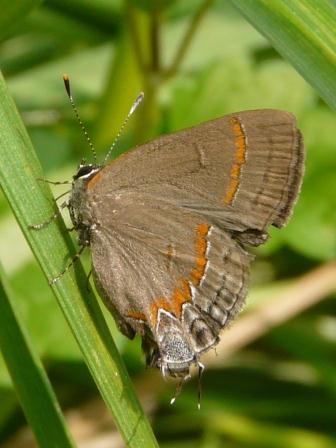
As a sampler, here is a red-banded hairstreak that I photographed last April:

Rejuvenating redwoods, dying oaks, The Grateful Dead, et al.

The last few posts have suffered from an excess of coherence and narrative continuity, so here are some true ramblings from Santa Cruz, CA (and for those who are still in awe of planetary motion, my last post also has some new Venus photos from a grad student that I met at the viewing at UCSC who kindly shared his images via email)…

Santa Cruz sits at the intersection of the cold ocean, the foggy redwood forests, and the blazing hot oak savannahs. Walking for thirty minutes in almost any direction will carry you into a new ecosystem. So variegation of microclimate is extreme.

San Francisco was built from lime and wood taken from this area, so almost all the forests are full of redwood trees growing in little clusters around huge, hundred-year-old stumps. The younger trees are still impressive: very very tall. There is almost no light in the understory, so even on a bright sunny noon, you gaze through the aromatic gloom. These trees drink water from the air. Even though their roots are dry, they get enough moisture from the near daily dousing in ocean fog to keep growing even in rainless months. How do we know this? The oxygen isotope ratios in fog differ from those in rain, so plant physiologists can read the isotopic “fingerprint” of oxygen in the trees, then deduce the source of water.

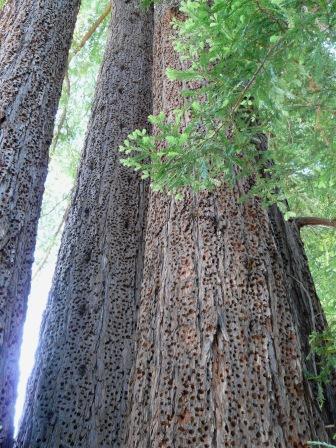
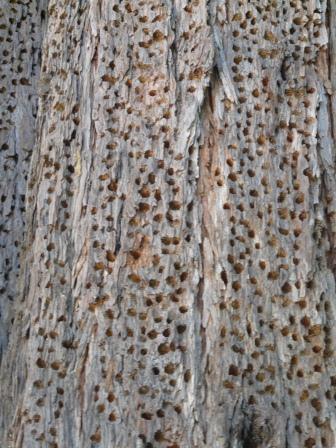
The redwood below has been adopted and turned into a granary by a family of acorn woodpeckers. Each hole is a storage place for an acorn. The family makes its nest in the tree then defends their nest, their stored food, and their honor from other woodpecker families, all of whom are thieves and cheats. Very much like Scotland, with less rain.

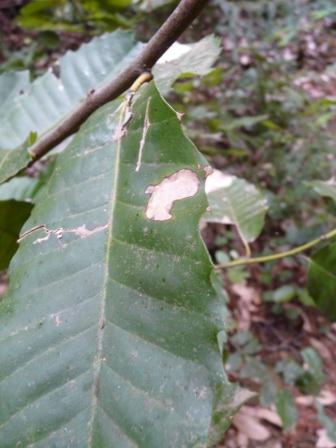
Oaks in California are being slammed by “sudden oak death,” a descriptive enough name for the disease (caused by an exotic species of protist, Phytophthora ramorum, the same genus that causes blight in potatoes, die-offs in peppers, and all kinds of destruction in many other tree species). The disease starts as lesions on leaves (these are tan oak leaves)…

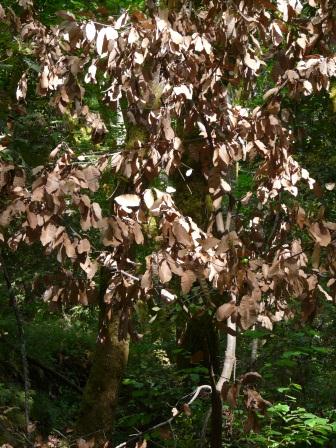
…then kills the whole tree in about a year. Most of the tan oaks in the understory seemed to have the disease. (And, yes, I thoroughly washed my shoes on my return to Tennessee).

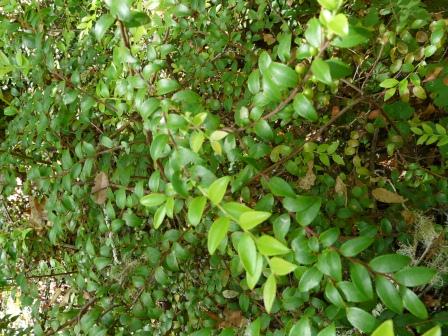
Other understory plants are doing much better. These are huckleberries, a close relative of the blueberry:

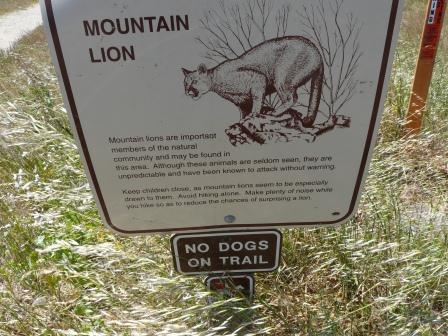
Mountain lions roam the woods and occasionally come into town. Warning signs are dotted over campus and the state parks. It is not clear whether the “no dogs” part of the sign is meant as a statement of a regulation or a summary of the outcome of past events:

The coast is continually raked by an incredible strong cold wind. Seabirds are abundant. These are Brandt’s cormorants:

Snails were common in the sandy coastal scrub. They were all, as far as I could tell, the invasive European immigrant, Cornu aspserum, the same species favored in France for eating:

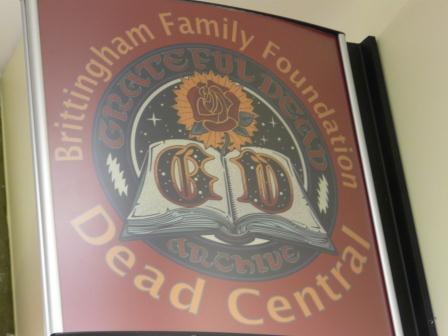
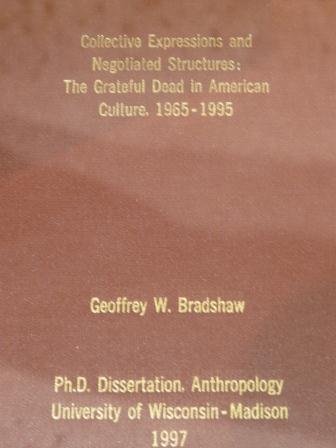
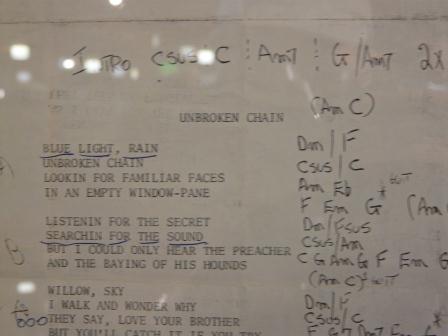
Back on campus, we briefly visited the University library and the Archives of the Grateful Dead, a carefully curated collection of posters, notes, letters, and so forth relating to the band’s long tenure. I was particularly taken by the Ph.D. theses. I know that several of the followers of this blog are Dead fans, so take note: the official opening is coming up at the end of June. There is a slight air of incongruence about an academic archive of Grateful Dead documents, but this strangeness, even dissonance, would have pleased Mr. Garcia, I think.

My visit to Santa Cruz was sponsored by the Department of Environmental Studies and initiated by the graduate students in the department who brought me in as their seminar speaker for this semester. Thank you. And special thank you to Leighton Reid and Rachel Brown who welcomed me and showed me around during my visit.

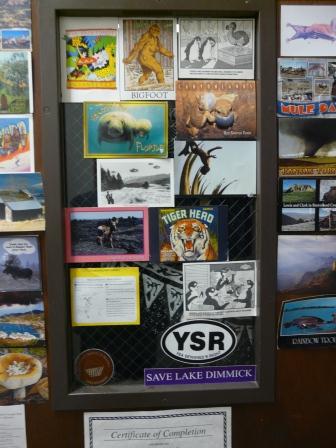
I’ll close with a shot of a door to a grad student office, chosen almost at random. Sewanee residents may remember those great students who protested the Lake Dimmick development, packing Convocation Hall and speaking with forceful clarity to the Regents. That spirit has now been carried to some far flung parts of the world.

Mass (viewing of) transit

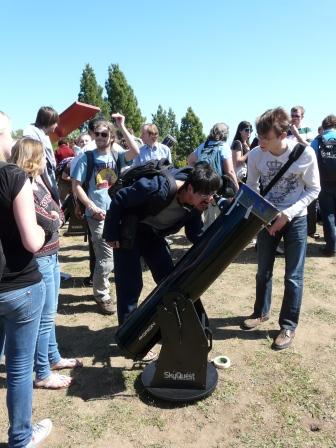
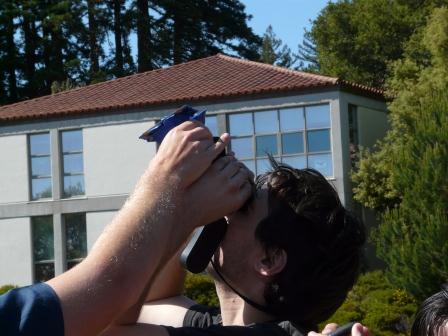
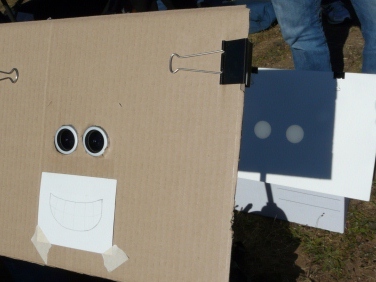
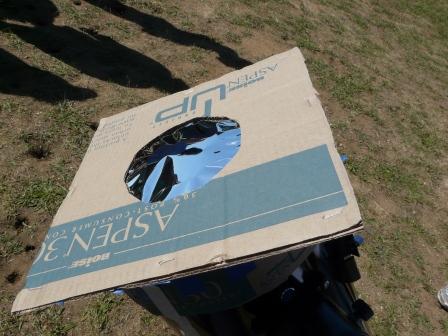
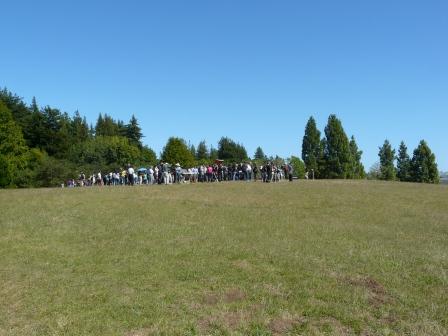
The astronomers at UC Santa Cruz set up a motley army of observational devices on a small knoll on the edge of campus. A hundred or so people squinted through eyepieces, metal tubes, silvery sunglasses with paper frames, kiddie binoculars strapped to paper flipcharts, and heavily shielded cameras. All gazed up.

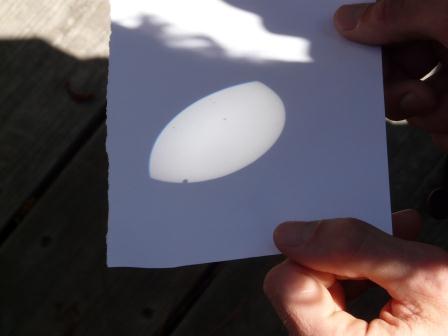
And there was Venus, an inscrutable black disc pimpling the bright sun. I expected that she’d hurl herself across the sky, but she took her time, lingering for hours as she scribed her twisted route. Most surprising of all was the frequency with which the knobs on the telescopes had to be tweaked to reorient the lens. We live on a surface of a planet that is spinning terribly fast. This was a disorienting realization, a jarring yank out of the complacency of my pathetically small day-to-day “world” and into the enormous reality of the chunk of flying space rock that we live on. I felt that I ought really to hold onto something to keep my feet steady as my eyes watched a gyrating Venus from the window of this bullet-train earth. Instead, I pulled myself together and snapped some photos.

The transit’s start:

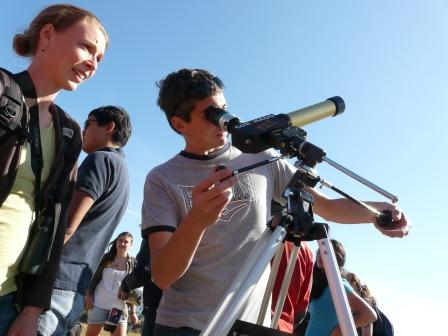
Various viewing devices:

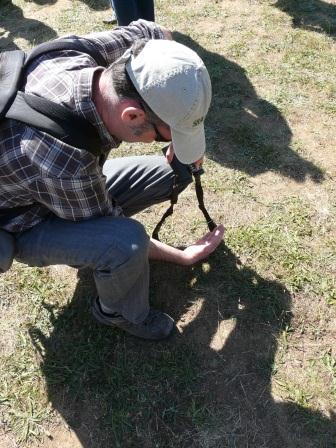
I’m focusing the hot image onto my tender palm using binoculars:

This scope was incredible. The filters in the scope filtered out everything except the 656.28 nm wavelength (see here for the cool background — this is the wavelength created by one type of electron change in Hydrogen). The roiling surface of the sun was visible; flares and loops of light arched from the sun’s edge:

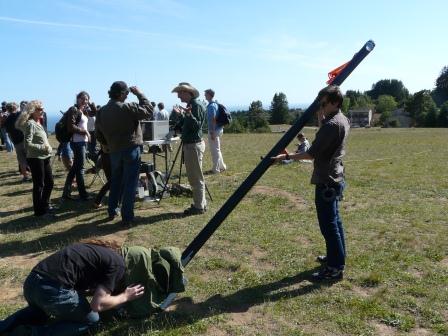
Place your head inside the box at the end of the long tube and observe the image formed by the pinhole:

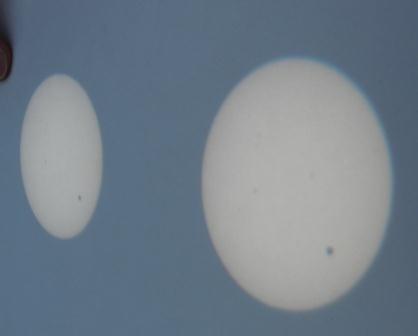
Out of their usual context, binoculars are weird. These photons have traveled together all the way from the sun to this spot on Earth, only to be split apart at the last moment. Venus and her twin:

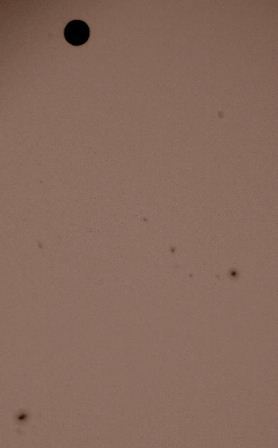
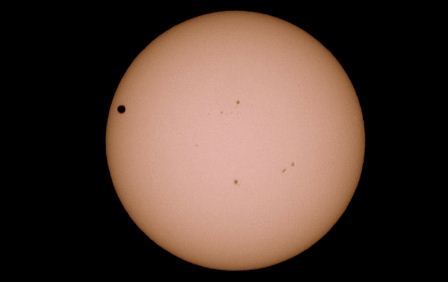
The following photos come from UCSC grad student Tuguldur Sukhbold who was taking photos through his shielded camera. I asked whether he would mind sharing the results and he was kind enough to send me these (with sunspots also visible):