Category Archives: Shakerag Hollow

Mayapple fruit

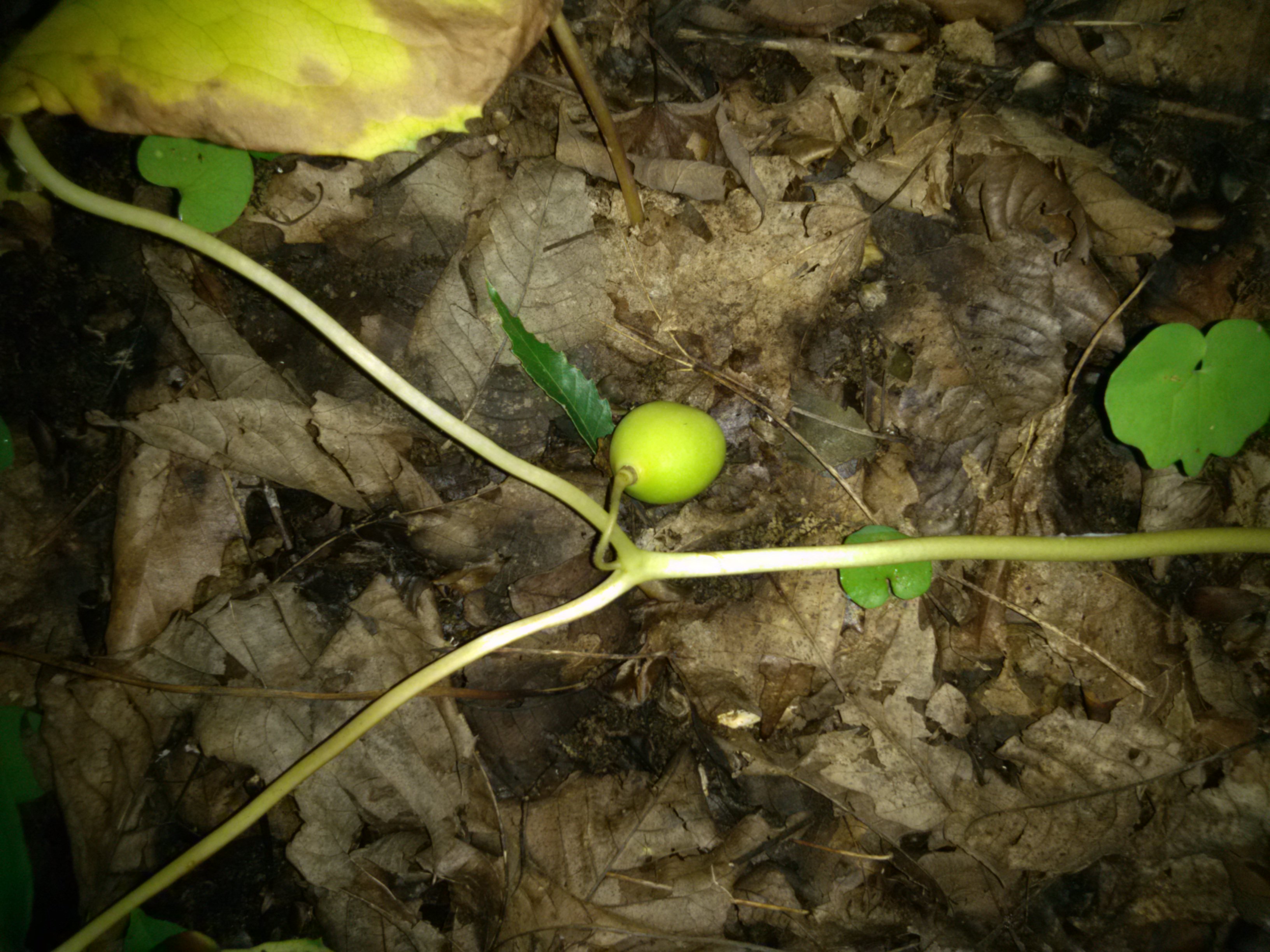
On a recent walk in Shakerag Hollow I ran across this mayapple (Podophyllum peltatum) plant lying prostrate on the ground, its fruit resting on the leaf litter surface. This is box turtle food. Turtles love the fruits and serve as seed dispersers for the plant. The fruit is the size of a small lemon.

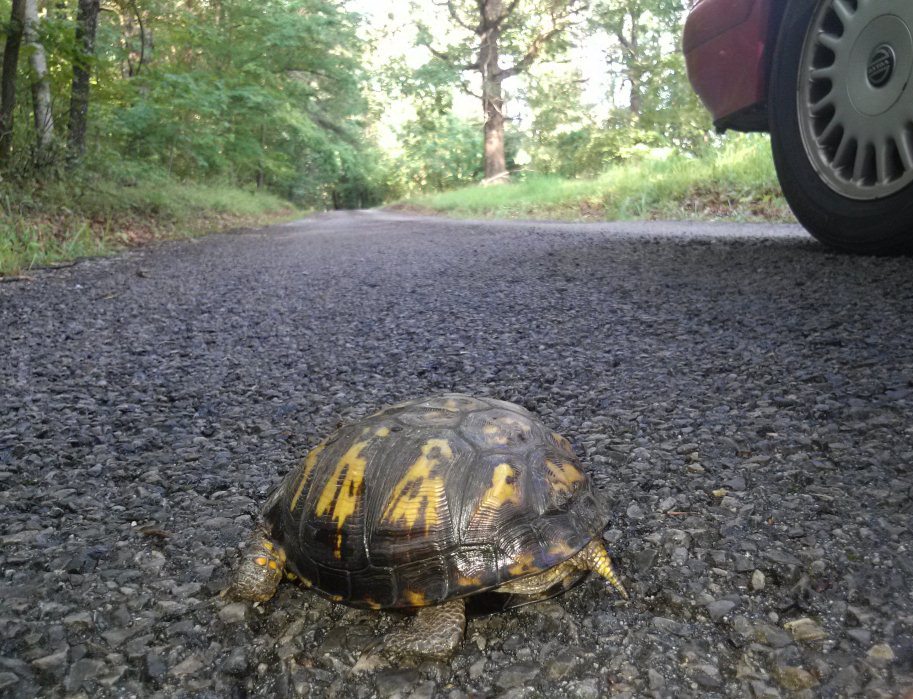
Mayapple contains chemicals that are used in anti-cancer drugs, so our health depends, in small part, on the ecological services provided by box turtles. One more reason to drive carefully? I moved this fellow (red eyes, domed plastron = a male) out of the way last week…

The Forest Unseen, one month update. And an iris.

The Forest Unseen is celebrating its one month birthday. I’ve not used this blog to announce every tid-bit of news about the book’s first steps in the world, but here I’ll give a short overview and look forward to some upcoming events.

Upcoming lectures and signings:  In the next few weeks I’ll be in Knoxville, Nashville, Denver, Oxford, Pulaski, and Santa Cruz. Lauren Kirchner, writing in Capital New York, reviewed my lecture last month at the Explorer’s Club in NYC.

Reviews: the book’s website has a more complete listing, but two of the more detailed discussions are Hugh Raffles in the Wall Street Journal and Gina Webb in the Atlanta Journal and Constitution. Closer to home, Chapter 16, an organization devoted to Tennessee’s writers and readers, published a review by Michael Ray Taylor this week.

Other media: I’ll be on the NPR show, To the best of our knowledge the weekend of April 28/29. Frank Stasio from North Carolina Public Radio’s State of Things ran a nice long interview last week. Right after the book came out, the Gary Null show and Lewis Frumkes (show not yet archived) also did radio interviews. In addition to the book trailer, Penguin has uploaded some clips of me getting perhaps a little too excited about snails, soil, and hickory nuts.

If you’ve enjoyed the book and would like to spread the word, please tell your friends, put a review on your blog, or put some comments on Amazon. Thank you!

And now back to our regularly scheduled Ramblings:

This morning, I found some dwarf crested iris is in bloom in Shakerag Hollow. Unlike the tidy flowers of early spring, these blooms are frilly, complicated, and showy. They can get away with such extravagance because more insects are out now — in the bad weather of early spring, flowers have to be simple (with wide open petals) in order to maximize the chance that something will pollinate them. Bumblebees are the preferred pollinators of this iris species, I think, so their flowers exclude smaller bees and flies. The plants’ blade-like leaves slice up from below-ground rhizomes. Flowers and leaves are barely six inches tall. Cute.

Inky cap

I made a quick visit to Shakerag Hollow this morning and found the biggest Inky Cap mushroom that I’ve ever seen (genus Coprinus, probably — but see here for identification complications). It stood about a foot tall, growing right next to the trail.

Inky Caps are named for the dripping black goo that edges their caps. Like other mushrooms, spores are produced under the cap. Unlike other mushrooms, the cap liquifies after the spores have been released. Spores mature first on the outer edge of the cap, so the cap shrinks as the spores are released. This keeps the edge of the cap adjacent to the mature spores, letting them catch the best air currents. Liquefaction through self-digestion is somewhat horrifying but also strangely beautiful process (Salvador Dali, anyone?).

Celandine Poppies

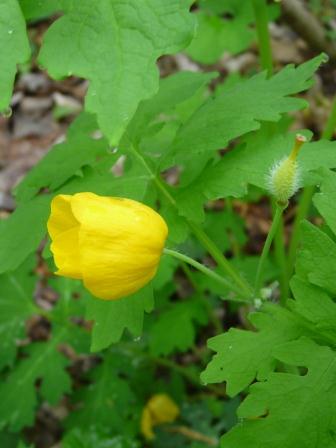
On my return to Sewanee, I made a trip down Shakerag Hollow to see whether I had missed the blooms of my favorite spring flowers, celandine poppies (Stylophorum diphyllum). These are short-lived flowers, easily damaged by rain, a fragility that somehow makes them all the more compelling.

Most had set seed already, with hairy pods hanging below the leaves.

But a few flowers remained. This is one of the few yellow-flowered species in the spring (in this patch of woods, they are the only one).

Ants play an important part in the life history of this species. The small fruits that fall from the pods have large ant-attracting food packages, elaiosomes, attached to them. The ants drag off the fruits, eat the attractant, then discard the fruit. In this way, the poppy seeds are “planted” in the good fertile soil of an ant waste heap. Thank you, ants.


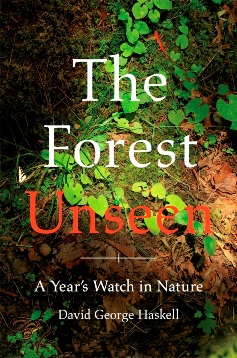
The Forest Unseen

March 15th: an auspicious day for killing dictators, aligning planets, and publishing books.

The Forest Unseen hits the streets today (and wiggles its words through wires in e-books).
A couple of quotes from some fellow writers seem well-suited to the moment:

Franz Wright’s poem, Publication Date, starts, “One of the few pleasures of writing/is the thought of one’s book in the hands of a kind-hearted/intelligent person somewhere. I can’t remember what the/others are right now.” Indeed.

Regina Spektor sings, “No, this is how it works/You peer inside yourself/You take the things you like/And try to love the things you took/And then you take that love you made/And stick it into some/Someone else’s heart/Pumping someone else’s blood.” (from On The Radio). Love? Blood? Isn’t this a book about science? Indeed. Bloody, loving science.

I’m honored that my words are in bookstores, in the pixels of the ether-world, in people’s hands, and perhaps even energizing some ventricles. If you’re interested in learning more, the book’s website has photos, a video, reviews (some new ones out this week and more on the way), and information about upcoming lectures and signings.

Next week, I’ll head out for several weeks of lectures, so this blog will be Rambling further afield than Shakerag Hollow, starting with the Pacific North-West next week. I hope to learn some interesting natural history and meet some fellow rambling Homo sapiens along the way.

Another great sign for the Ides of March: this morning, the first Tree Swallow showed up at Lake Cheston.

Shakerag Hollow: spring ephemeral wildflowers

Our campus emptied out this afternoon as spring break began. After a few hours of cleaning the lab, answering emails, and pushing papers from one place to another I finally cracked (or woke up) and set out for the woods to enjoy some reality.

This slideshow requires JavaScript.

Spring ephemeral wildflowers covered the forest floor. In the richer areas, each palm-sized patch of forest had a dozen blooms crowded together. There are few places in the world that rival the profusion of blooms in this north-facing Appalachian cove (and the snails, insects and salamanders that ply the leaf litter below the flowers are equally diverse).

These “ephemeral” wildflowers are hurrying through their flowering and photosynthesizing in the short weeks that remain before the tree canopy steals all their light. But the plants don’t disappear for the rest of the year. Instead, most of them persist underground in roots and swollen stems. So, the “ephemerals” appear to be short-lived, but are in fact many years old, perhaps as old as many of the trees that loom over them.

No canopy = a great opportunity

To turn, turn will be our delight…

…’till by turning, turning we come ’round right.

This venerable cedar stands at the base of Shakerag Hollow, on the edge of an overgrown old pasture that has now turned to woodland. The tree’s original apex is pointing directly to the right and is almost rotted away. Decades ago another tree must have fallen on the main stem and bent the trunk down. Side branches then took over, growing straight up from what was formerly the side of the tree. The grain of the wood is contorted and twisted like old rope. Gnarly.

Some early stirrings in Shakerag Hollow

After work yesterday I headed down into Shakerag Hollow to see what was stirring at the end of the warm afternoon. It was a pleasure to walk with just a shirt on my back — discarding the wintry weight and confining clutter of jackets and gloves and fleeces and hats. Ah!

Scarlet cup fungi (Sarcoscypha sp.were fruiting in one or two places on the side of the trail. They feed on decaying plant matter and grow their striking red “cups” throughout the year, but especially in cooler months. Spores are produced from the inner surface of the cup. These blow away (or are carried on mouse feet) to colonize more dead vegetation, of which there is no shortage on the forest floor. The scarlet cup is a favorite of mine –saturated with color at a time of year when the rest of the forest is mostly muted.

Bloodroot plants were poking up their flowers. Most were still tightly closed, but one or two had cracked open a little. The deeply incised leaves are held clasped against the stem, only relaxing into an open posture when the flower is mature or dead.

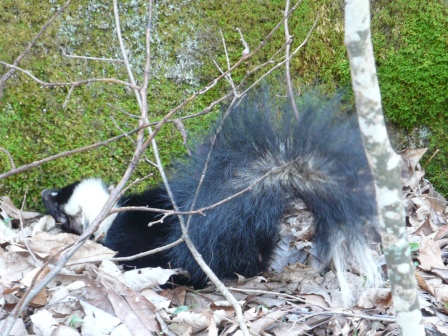
I was not the only mammal out and about in the balmy woods. Junebug the Hound found this skunk, but fortunately she paid attention to my bark: leave it! The skunk had its tail arched, ready to express its opinion.

Revival (no tent please)

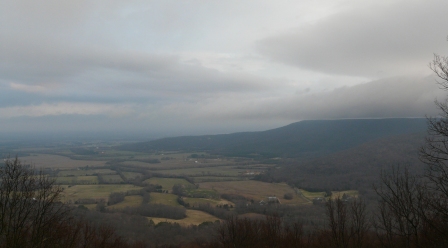
Air from the Gulf of Mexico has come for a visit, bringing warmth, rain, and ever-changing clouds. I took this shot yesterday morning before walking into Shakerag Hollow.

As wet air hits the slopes, it gets pushed up and cooled, making low-hanging clouds that rise and fall slowly, dipping us into and out of the fog.

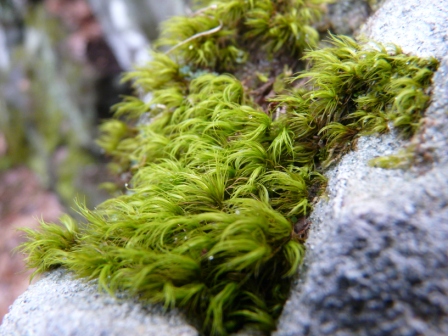
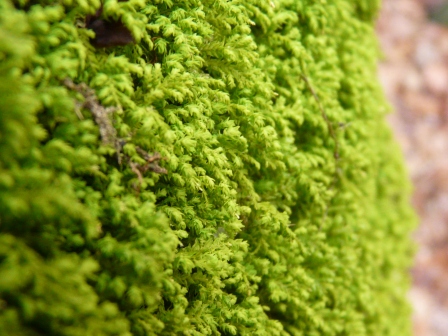
Mosses and lichens love this weather. No tree canopy interferes with their feeding (there is now more light on the ground than in mid-summer) and the gentle rains moisten, plump, and revive them.

They seem ignited, hungry for light. I could dive into their green: alive!

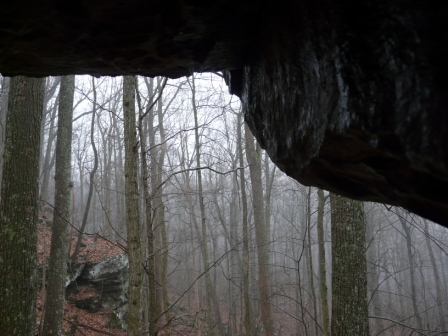
In the heavy rain, I briefly took shelter under a rock overhang.

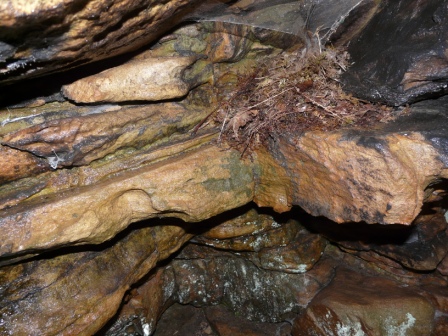
Another species had done the same last summer. This is the old nest of a phoebe, tucked into the back wall. It is lined with dried moss, perhaps plucked from the same clumps of moss that I had been admiring in the forest.

I enjoy a brief soaking in warm rain (is this January?), but Junebug says that the raindrops hurt her eyeballs…