Author Archives: David George Haskell

Rambling on the airwaves

I’ll be on the NPR show To The Best of Our Knowledge this weekend (April 28/29). The program is “Into the Woods,” and I’ll be talking about The Forest Unseen. Also scheduled for the show are Terry Tempest Williams, Stephen Sondheim, Marina Warner, and Stephen Long. I’m very grateful to be included in this line-up, to say the least.

Stations that carry the program and broadcast times are here. WPLN (Nashville) runs the show at 3pm on Sunday on its 1430 AM channel. WUTC (Chattanooga) runs at 12:00 (eastern time, 11am central) on Sunday on 88.1 FM. The show will also be available through podcasts, XM satellite, etc as detailed here.

Unlike previous interviews which have been live and over the phone, this interview was recorded last week in the WPLN studios in Nashville. The experience of sitting in a quiet studio, talking to people several states away, using a great mic and headphones was an unexpected treat for my senses. The studio was so quiet and the equipment so good that the world was stripped down to a nearly pure experience of sound. Just voices, hanging in a silvery space. It was almost enough to calm my nerves.

Paddling

For our last full lab of the semester, my ornithology class took canoes down to the Elk River. We put into the water where the Elk runs into Woods Reservoir.

Trip highlights include:

  • A great look at a Prothonotary Warbler. This warbler is unusual in that it nests inside old tree holes instead of making a twig or ground nest like most other warblers. It is found along waterways and lake edges.
  • Seeing a Great Blue Heron grab a big watersnake. The snake wrapped itself around the heron’s beak and neck like a whip around a post. The heron thrashed and leapt, perhaps feeling the sting of the snake’s bite, then the snake escaped. The heron kept probing in the water, but this snake was not about to come back.
  • Three Ospreys wheeling overhead, whistling loudly.
  • Two Black-crowned Night-herons, flying right over us, giving a great look at their head plumes and bright legs.
  • A mother goose on her eggs, flopped out with a “broken neck” — playing dead as a ploy to remain unmolested by these strange paddling primates.

(note: photo links above are not from this trip (I wish), but from Robert Royse, an outstanding bird photographer)

Trip lowlight: dozens of trotlines tied to branches overhanging the river. These are unattended fishing lines, mostly aimed at turtles, but anything that grabs at the large hooks on the lines gets snagged. Two years ago we found a heron that had died in a tangled trotline. Not so pretty, but 100% legal (as long as you don’t set more than 100 trotlines at a time…). This method of fishing is like deer-hunting by lashing shotguns to trees, then attaching tripwires to the triggers. You’ll get some deer, yes, but at what cost?

This slideshow requires JavaScript.

Three-way partnership = bad news for a two-by-four

This old piece of pine lumber (the stub end of a two-by-four) has been devoured by termites. The rest of our garage has been spared their attentions, so far.

A weighty block has turned to crumbly paper. The insects responsible for this impressive work were scurrying nervously in the too-bright light of day, each one looking like a fat grain of rice from a milk pudding. Add sugar and I’m ready to become an myrmecophage (yes, anteaters love termites).

Termites are like cows, they graze on plant material that is completely indigestible to them. Only by harboring an internal band of helpers can termites (and cows) free the nutrients and energy locked in woody tissues. The termites’ helpers are in the hind part of the gut. Here single-celled protists (relatives of “amoebae”) engulf small wood particles and digest them. But these protists are cows too…they have within their cells a peculiar group of bacteria, the critters that do the actual work of making wood-destroying enzymes. So helpers live within helpers.

The fact that only a few obscure groups of bacteria can digest cellulose (the main component of “wood”) explains a lot about our world. If more creatures could digest wood, then trees likely could not exist (their trunks would be gobbled up in short order), wooden structures would last about as long as gingerbread houses (which are, I’m told, digestible, explaining perhaps their limited popularity outside of confectioners), and our great stockpiles of coal (old compressed wood) would not exist. No forests, no houses, and no industrial revolutions (at least not coaly ones…and what other kind has there been?).

Nuclear power for Earth Week

At the CCJP Earth Week fair this weekend, Chris Lancaster had a great display of solar panels from the last decade. These panels are the best kind of nuclear power — harvesting energy from the nuclear fusion plant located at the center of the solar system. The risks associated with this nuclear power plant are outlined with admirable brevity here.

Chris’ display was a practical reminder that solar cell costs continue to decline, a trend that was discussed in this interesting blog post at Scientific American.

This slideshow requires JavaScript.

I threw in a slide of the oldest and the best panels of all.

The Forest Unseen, one month update. And an iris.

The Forest Unseen is celebrating its one month birthday. I’ve not used this blog to announce every tid-bit of news about the book’s first steps in the world, but here I’ll give a short overview and look forward to some upcoming events.

Upcoming lectures and signings:  In the next few weeks I’ll be in Knoxville, Nashville, Denver, Oxford, Pulaski, and Santa Cruz. Lauren Kirchner, writing in Capital New York, reviewed my lecture last month at the Explorer’s Club in NYC.

Reviews: the book’s website has a more complete listing, but two of the more detailed discussions are Hugh Raffles in the Wall Street Journal and Gina Webb in the Atlanta Journal and Constitution. Closer to home, Chapter 16, an organization devoted to Tennessee’s writers and readers, published a review by Michael Ray Taylor this week.

Other media: I’ll be on the NPR show, To the best of our knowledge the weekend of April 28/29. Frank Stasio from North Carolina Public Radio’s State of Things ran a nice long interview last week. Right after the book came out, the Gary Null show and Lewis Frumkes (show not yet archived) also did radio interviews. In addition to the book trailer, Penguin has uploaded some clips of me getting perhaps a little too excited about snails, soil, and hickory nuts.

If you’ve enjoyed the book and would like to spread the word, please tell your friends, put a review on your blog, or put some comments on Amazon. Thank you!

And now back to our regularly scheduled Ramblings:

This morning, I found some dwarf crested iris is in bloom in Shakerag Hollow. Unlike the tidy flowers of early spring, these blooms are frilly, complicated, and showy. They can get away with such extravagance because more insects are out now — in the bad weather of early spring, flowers have to be simple (with wide open petals) in order to maximize the chance that something will pollinate them. Bumblebees are the preferred pollinators of this iris species, I think, so their flowers exclude smaller bees and flies. The plants’ blade-like leaves slice up from below-ground rhizomes. Flowers and leaves are barely six inches tall. Cute.

Here is a bird in whose strain the story is told

I heard the first wood thrush this morning, singing in the thickets along Willie Six Rd. By the time I got my class out there, the bird was silent. Next year, I’ll reschedule this class to begin at 7am instead of 8am, for the whole darn semester. More in tune with reality, I think.

The wood thrush sings with pure notes, unadorned by harmonics, slightly offsetting the tones from the two sides of its throat. The result is gorgeous. Thoreau, as usual, had something to say about this:

“The wood thrush’s is no opera music; it is not so much the composition as the strain, the tone, — cool bars of melody from the atmospheres of everlasting morning or evening. It is the quality of the sound, not the sequence. In the peawai’s [Eastern wood-pewee] note there is some sultriness, but in the thrush’s, though heard at noon, there is the liquid coolness of things that are just drawn from the bottom of springs. The thrush alone declares the immortal wealth and vigor that is in the forest. Here is a bird in whose strain the story is told, though Nature waited for the science of aesthetics to discover it to man. Whenever a man hears it, he is young, and Nature is in her spring. Whenever he hears it, it is a new world and a free country, and the gates of heaven are not shut against him.” (from Thoreau’s Journals, July 5th, 1852)

The gates of heaven are not closed, agreed. But they are swinging shut, quite fast. Wood thrushes are in decline, the victims of fragmented forests, air-borne mercury from our coal plants, and lost wintering habitat. I culled the following graph from the Breeding Bird Survey. It shows an index of wood thrush abundance over the last forty years. In my lifetime, the species appears to have halved its abundance.

But, given a chance, these birds can bounce back. Indeed, it is likely that in many regions they were a lot less common in Thoreau’s day (the late 19th century was a time of massive deforestation) than they are now.

If you want a taste of heaven for yourself, The Music of Nature site has some nice footage and sound. But computer speakers and pixels are wan memories of reality. In the words of another bewhiskered New England word- and nature-lover, “You shall no longer take things at second or third hand, nor look through the eyes of the dead, nor feed on the spectres in books;/You shall not look through my eyes either, nor take things from me:/You shall listen to all sides, and filter them from yourself.”

Valley of dry bones

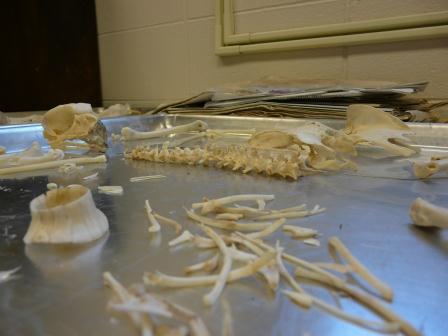
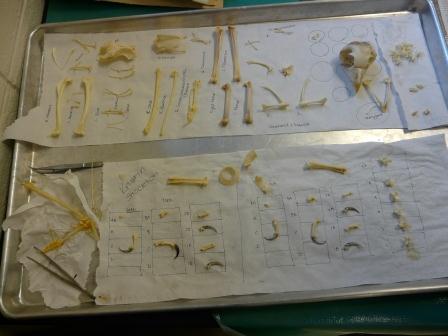
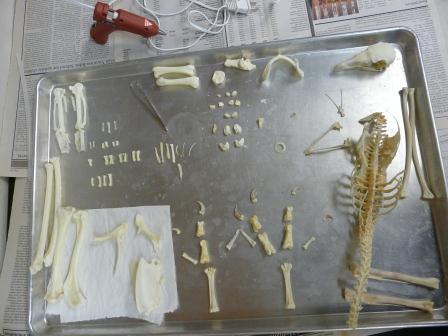
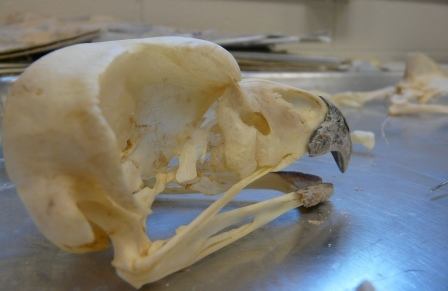
Students in my Ornithology class complete a term paper of bone. Each student is given a dead bird (window- and road-killed). The task: dissect and study the bird, then strip its bones bare (with the help of flesh-eating beetles), and finally re-articulate the skeleton (using the magic powers of the hot glue gun). The project sits at the junction of zoology, horror, and arts-and-crafts.

The bones are presently all cleaned up and ready to be put back together (owls and vultures shown below).

“the valley … was full of bones,/…and, behold, there were very many in the open valley; and, lo, they were very dry/…there was a noise, and behold a shaking, and the bones came together, bone to his bone”

Extra credit for breathing on the slain that they might live.

Paddling with Carson and Byron

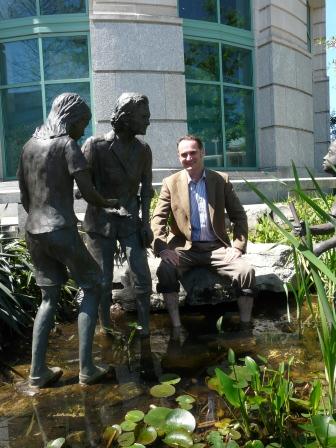
The entrance to the North Carolina Museum of Natural Sciences has a sculpture and native plant garden honoring the great writer Rachel Carson.

Carson is sculpted with her trousers rolled up, feet in a pond, showing two children the creatures in the water. Despite being dressed for oration instead of investigation, I decided to join her for a paddle. Stephen Garrett, a friend and former student who came to my talk was kind enough to take a photo or two. He was also kind enough not to say anything about my unsophisticated camera gear (he’s a pro, so I hesitated to hand over my little pixel-snatching machine).

cooooold

Child, Genius, and Grinnin' Fool.

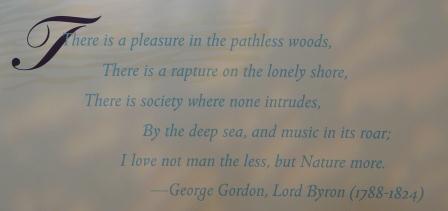
The Museum also had this nice quote painted in large print across one of its walls. In my experience, Lord Byron is not someone often featured in the halls of science or natural history museums. It is a pity that they left off the last four lines, “From these our interviews, in which I steal/From all I may be, or have been before,/To mingle with the Universe, and feel/What I can ne’er express, yet cannot all conceal.” ..stealing away from past and future, to the inexpressible present…nicely done.

“Lonely” the museum was not. There were an impressive number of people visiting its excellent exhibits. And, on April 20th, the museum will open a big new wing featuring “How Do We Know?” exhibits — e.g., “Dinosaurs taste like chicken — How do we know?” Good question. (I hear one answer from my Tennessee grilling friends: Yessir, but here in Tennessee our chickens taste a little better ‘n that, it’s in how you cook’em. Those Raleigh folks don’t know how its done.)

If you’re headed to Raleigh, I strongly recommend a visit (but not yet — the whole museum closes tomorrow to complete the last stages of construction).

Inky cap

I made a quick visit to Shakerag Hollow this morning and found the biggest Inky Cap mushroom that I’ve ever seen (genus Coprinus, probably — but see here for identification complications). It stood about a foot tall, growing right next to the trail.

Inky Caps are named for the dripping black goo that edges their caps. Like other mushrooms, spores are produced under the cap. Unlike other mushrooms, the cap liquifies after the spores have been released. Spores mature first on the outer edge of the cap, so the cap shrinks as the spores are released. This keeps the edge of the cap adjacent to the mature spores, letting them catch the best air currents. Liquefaction through self-digestion is somewhat horrifying but also strangely beautiful process (Salvador Dali, anyone?).