 …snuffling through the St Catherine’s Island salt marshes. I could hear the pig’s grumbling snout from nearly 100m away.
Sunrise over a feral hog
Leave a reply
…snuffling through the St Catherine’s Island salt marshes. I could hear the pig’s grumbling snout from nearly 100m away.
The salt marshes of the Atlantic coast are home to a variety of bird species that specialize on this harsh but productive habitat. One such denizen of the marshes is the clapper rail (Rallus longirostris). This bird is related to the cranes, but is the size of a small chicken. It spends its entire life squeezing through the densely packed vegetation in the marsh, poking around in its hunt for crabs and other mud-loving morsels. Its body is flattened side-to-side (thin as a rail) to assist this movement.
The rail’s song is a chugging, choking, coughing splutter. The Cornell bird site has a recording, but it doesn’t capture the attack and volume of the song. I took a group of students out in canoes yesterday to search for the rails and was impressed to hear the songs echo down the tidal creeks that we were traveling. The low walls of salt marsh vegetation along these creek act like the walls of a canyon and the songs ricochet as they shoot along.
Clapper rails normally keep themselves hidden, but this evening I saw one preening and singing on an exposed mud bank. The photo below show the bird’s impressive beak, a tool used to catch and dismember crabs.
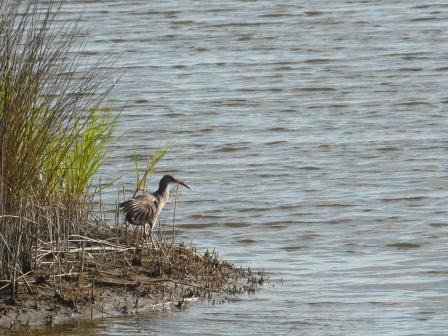 Clapper rails live along the coasts on both sides of North and South America, wherever salt marshes grow. These birds can be quite common in good habitat, but because salt marshes have decreased in extent over the last hundred years, they are not nearly as abundant as they used to be. Despite the best efforts of the legislature in North Carolina (who just passed a law more or less forbidding the sea to rise or, more precisely, asking scientists to stick their heads ostrich-like deep into the eroding sands), the ongoing and accelerating upward creep of the ocean will gnaw away at the rails’ home (and ours — see NASAs interesting animation on this topic).
The seaward beaches on St Catherine’s Island are littered with big clumps of sargassum, a type of seaweed normally found only far offshore. The tropical depression that blasted the island a week ago carried the sargassum toward the land and dumped it in untidy skeins in the wrack line. Some even got carried up into the marshes behind the beach.


Sargassum is incredibly important to the ocean’s ecology. It grows in vast floating mats in the warm tropical currents of the Gulf Stream and beyond, even giving its name to the gyre that sits at the center of the Atlantic, the Sargasso Sea. The mats of algae serve as a breeding ground for eels, the nursery of young sea turtles, the home for legions of fish, and the feeding ground for tropical seabirds. Several years ago I took a boat ride out to the edge of this strange sea-within-a-sea (it has no land borders, being surrounded by other bodies of water and ocean currents). The water and air were torrid; the abundance of sea life was phenomenal, especially the graceful terns that plucked fish from the startlingly blue water.
Algae were not the only creatures trapped and hurled to shore by the storm. This young frigatebird was lying on the wrack on the island’s easternmost point. Frigatebirds are the real pirates of the Caribbean, making their living by robbing gulls and terns of their hard-won prey. This young bird must have been blown out of its tropical home and perished on the Georgia shore, turned to acrid-smelling jerky in the sun’s blaze.

Magnificent Frigatebird (Fregata magnificens)
I’m spending ten or so days teaching on St Catherine’s Island, a coastal barrier island south of Savannah, GA. The island is swarming with interesting creatures; I’ll highlight just one in this post, with more to follow.
The gopher tortoise (Gopherus polyphemus) is the only “true tortoise” (Family Testudinidae) in eastern North America (the other shelled critters here are all turtles of one kind or another, even the terrestrial box turtle whose kinship is much closer to pond turtles than it is to tortoises). Gopher tortoises dig very long burrows in which they spend most of their time. Some burrows are four or five feet deep and twenty feet long. These subterranean homes help the animals escape the worst of the heat and the cold. They also provide a safe space when fires roar through the open piney forests that is the preferred habitat of the species. These fires help to maintain the savannah-like structure of the forest, but they are obviously also dangerous to resident animals.
The population of gopher tortoises on St Catherine’s came from the mainland. They were moved here when a commercial development destroyed their habitat. Since then, the tortoises here have thrived and bred. They live in a large pasture that is maintained as an open savannah. From the surface, all that is visible are the sand piles around the entrance to each burrow. It is seriously hot here at the moment, so the animals usually stay below in the cool.

Gopher tortoise burrow with apron of sand. The females lay their eggs in this apron.

The hole is tortoise-shaped…
Bess Harris, a graduate student at the University of Georgia, is on the island studying the tortoises. She kindly took some time out of her afternoon to talk about her work and show us some of the animals that she was fitting with radio-transmitters.
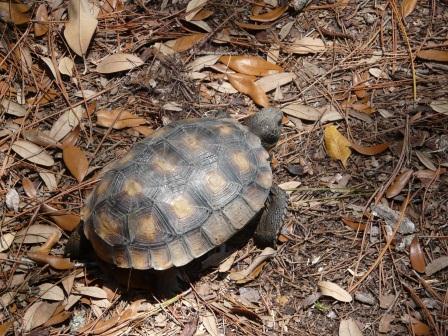
This one is eight years old. She/he has many more decades of life to come, hopefully.

The tortoises were surprisingly fast (Aesop never saw a gopher tortoise, it seems) and had to be grabbed and retrieved as they paddled away.
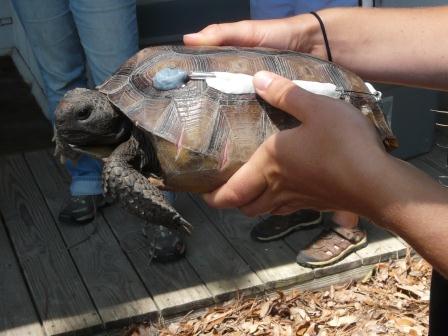
Radio transmitter.
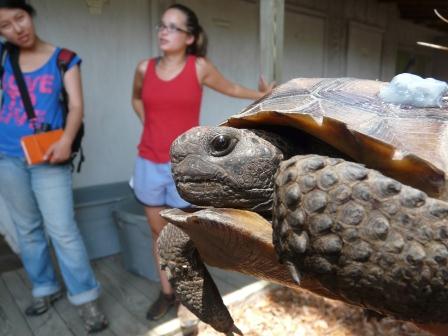
The front legs are flattened: great shovels.

Not only flattened, but strong. A full grown tortoise (about 20 lbs) can out-pull a human hand. This one is only half grown and inflicted no bruises.

Beautiful patterns in the keratin shell.
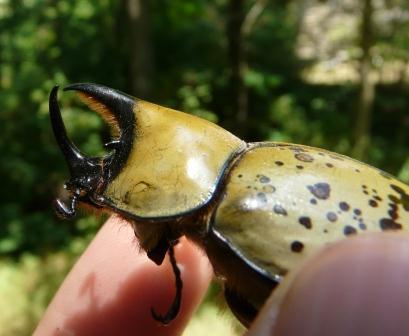 I found this impressive beetle lying dead alongside the trail in Abbo’s Alley. The two large horns identify it as a male. The somewhat fearsome appearance belies the animal’s nature. Hercules beetles are harmless creatures, feeding on rotting wood as larvae (fat white grubs, usually found in dead wood or tree holes) and nibbling on leaves or plant sap as adults. The horns are used as wrestling aides when males tussle during the mating season.
Number of species detected: 24 (a little lower than most years)
Number of individuals detected: 414 (way higher than most years)
Average temp: also approx 414
We found almost no butterflies over the majority of the areas surveyed. It is much too dry and baking. But in areas that had been irrigated or that were near bodies of water, we found impressive aggregations of butterflies supping on nectar. By far the most abundant species was the sachem (Atalopedes campestris). We saw 213 of these little skippers; the previous record for the species was 26 in 2001. This species thrives in disturbed areas where its caterpillars feed on grass.

Female sachem (photo from a previous year)
We also came across this spectacular pipevine swallowtail (judging from its freshness, it was newly emerged from its chrysalis):
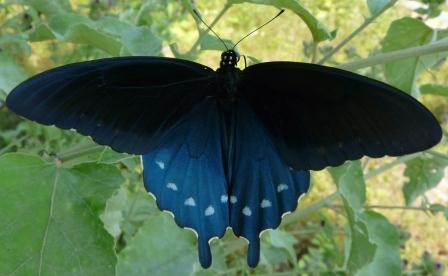
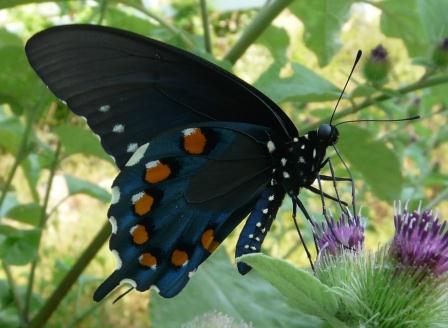
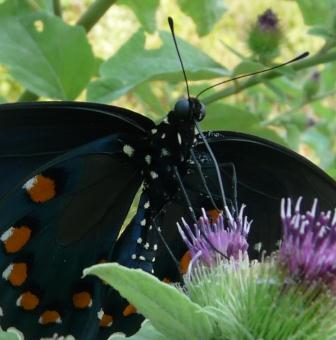
Thank you to my co-leader, David Coe, and to brave heat-defying participants Louise Kennedy and Tam Parker.
Complete results are summarized below:
| Common name | Scientific name | 2012 count |
| Pipevine Swallowtail | Battus philenor | 2 |
| Eastern Tiger Swallowtail | Papilio glaucus | 1 |
| Spicebush Swallowtail | Papilio troilus | 4 |
| Cabbage White | Pieris rapae | 13 |
| Orange Sulphur | Colias eurytheme | 7 |
| Gray Hairstreak | Strymon melinus | 1 |
| Red-banded Hairstreak | Calycopis cecrops | 4 |
| Eastern Tailed-Blue | Everes comyntas | 47 |
| Spring Azure | Celastrina ladon | 5 |
| American Snout | Libytheana carinenta | 5 |
| Gulf Fritillary | Agraulis vanillae | 3 |
| Variegated Fritillary | Euptoieta claudia | 6 |
| Great Spangled Fritillary | Speyeria cybele | 1 |
| Pearl Crescent | Phyciodes tharos | 7 |
| American Lady | Vanessa virginiensis | 4 |
| Red Admiral | Vanessa atalanta | 1 |
| Common Buckeye | Junonia coenia | 1 |
| Common Wood-Nymph | Cercyonis pegala | 1 |
| Silver-spotted Skipper | Epargyreus clarus | 74 |
| Horace’s Duskywing | Erynnis horatius | 1 |
| Least Skipper | Ancyloxypha numitor | 2 |
| Fiery Skipper | Hylephila phyleus | 10 |
| Little Glassywing | Pompeius verna | 1 |
| Sachem | Atalopedes campestris | 213 |
I came across this odd potato while digging the last row of the early crop of potatoes. The spud in question was mottled brown and yellow; its skin seemed rather tough.
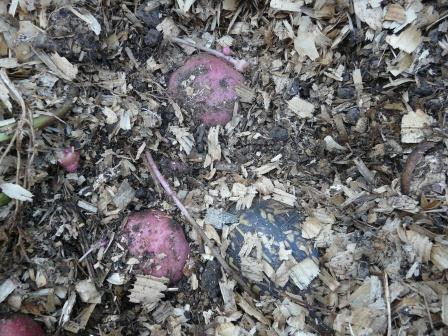
I grubbed around with my hand and pulled up the prize. He regarded me with a grumpy red eye.
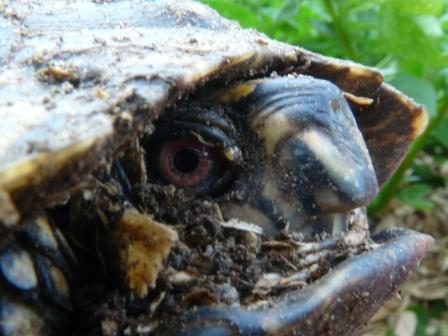 This eastern box turtle had dug himself down into the mulch that I hill up around potato plants. He was a good six inches down, where the soil is still somewhat moist and cool. All this happened several days ago. I replaced him, carefully covered him again with soil, and marked the spot so that I would not spear him with my garden fork. He’s still there: when I wiggle my fingers down I can touch his shell.
The technical name for this kind of summertime dormancy is estivation (aestivation in the Old World). The turtle is conserving water, saving energy, and waiting out this interminable heat. Which animal is smarter: the one snoozing in the shady soil or the one toiling to earn his potatoes with the sweat of his brow? I have my opinion on this; I’ll let you form your own.
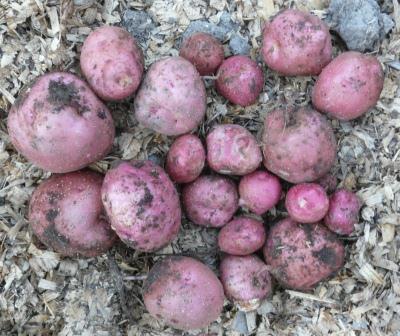
The potato plant that he cuddled up to yielded the biggest load of spuds that I’ve even seen from a single plant (boastful evidence below). So, this fellow either brought good vibes with him or he has a taste for moisture that led him to the most productive spot in the garden. Both, perhaps.
Last week, 350.org launched a twitterstorm to increase the profile of their campaign to end subsidies for fossil fuels. The storm was timed to coincide with the Rio+20 meetings. What’s a twitterstorm? A tempest of tweets, all with the same message, all sent at about the same time. The storm makes a tidal surge, hopefully breaching the dunes on the shores of the internet.
So what? Isn’t this less than a tempest in a teacup? After all, twitter is just thought, mere ether (miasma, some would say), with no physical substance; no tea, no cup. Perhaps. But the history of humanity (and the experience of our everyday lives) is surely a testament to the power of that ether to come to ground and change the world (how did that long-buried CO2 get burned up in the first place?). In the big scheme of things, one twitterstorm is a tiny gust, but the wind from this storm even pushed briefly into the normally airtight halls of power in DC.
The campaign’s launch persuaded me to sign up, dipping my toe (inexpertly, I’m sure) into the stream of @s, #s, RTs, and other obtuse ciphers of this clipped form of speech. I have a not-so-hidden agenda, a plan that has been brewing in various incoherent ways for a year now: to gather a cadre of naturalists to sing “nature” into the twitmosphere while digging deeper into the particularities of our places. The exact form of the idea is still composting, but some mature humus of thought will hopefully emerge soon. For now, I’m tweeting one natural history observation per day: a notable sighting, a sensory impression, or an interesting ecological interaction. With just 140 characters to play with, the right voice is not self-evident, so I’m goofing around. For now, I’m tweeting pretty much into the void, like praying to a non-existent god, or speaking a poem into air with no-one to hear. I’d be delighted to have this void populated by a few ears. So I invite you to take a look (you don’t have to be on Twitter to check it out) or to join me.
Unlike this blog, which I’ve tried to keep fairly clear of politics, I’m also retweeting a little information from ongoing environmental activist campaigns. In the very short time that I’ve been signed up, I’ve been pleasantly surprised at what a great tool Twitter is for keeping on top of what is happening in DC where, for better or worse, the fates of real storms in our atmosphere and biosphere are being decided.
I’m interested to see where, if anywhere, this little experiment goes. In my limited experience, the intersection between the sets (naturalists), (academics), and (twitter) is very, very small. My hunch is that this need not be the case: there is some creative potential to be played with in that space.
The usual critique of twitter, that it is just trivial chatter and therefore worthless, seems off the mark. Trivial chatter is part of our inheritance as ultra-social primates, a kind of linguistic grooming. Now that we don’t have fleas to pick off each other (or so I hope), social media fill the void. From ectoparasites to smartphones; our opposable thumbs come in handy once again.
Now that the summer season is wearing on, the thrushes are singing at dusk. More than any other songbird, their voices seem to rise as the sun sets. There is something irredeemably sad in the fluting of a thrush as the western horizon sweeps up and takes away the light.
We’ve heard Thoreau’s springtime rapture over the same song; Hardy’s refrain takes over as days shorten, with Hughes’ black silent waters lapping close.
But “irredeemable” must be a lie. Hardy kindles his hope and even Hughes bends to be blent in the prayer. And the thrush remains beautifully inscrutable in his otherness.
A gray fox swaggered across University Ave this morning, its bushy tail bouncing as it trotted. It was headed to the patch of woodland behind Otey Parish Hall and the Duck River Electric building. I’ve seen fox scat on the road there, so I think this must be a resident, perhaps the same animal that I saw last summer with a rabbit in its mouth.
This has been a busy few months for fox and coyote sightings in Sewanee. Now, a paper in the Proceedings of the National Academy of Sciences has added some insight into the tangle of interactions among these wild dogs and their prey. Apparently, tick abundance and Lyme disease risk is affected by the numbers of foxes and coyotes. The paper examines data from the northeast, but its results may also be relevant here.
Lyme disease (caused by the bacteria Borrelia burgdorferi) is transmitted to humans by tick bites (especially bites from nymphal stage of Ixodes scapularis, the black-legged tick) But humans are not the main host of these ticks, so the abundance of ticks is determined by the abundance of their other mammalian hosts, especially mice. Foxes and coyotes both prey on mice, so you’d think that more foxes and more coyotes would mean fewer mice, and therefore fewer ticks, and therefore fewer Lyme disease cases. But things are not quite so simple.
The abundance of foxes is indeed correlated with a decreased risk of Lyme disease. Foxes love to eat mice and fox populations can get quite dense, so mice fare poorly in areas with healthy fox populations. Coyotes also eat mice, but coyotes live at lower population densities than foxes. Coyotes also drive out foxes. So the overall effect of coyotes on Lyme disease is a positive one: more coyotes = fewer foxes = more mice (despite the few that get eaten by coyotes) = more ticks = more Lyme disease. And deer? There was no correlation with Lyme disease; mouse abundance drives the dynamics of the disease and deer abundance seems to have little effect (except in areas that have no deer — an unusual situation these days — that do have lower incidences of Lyme).
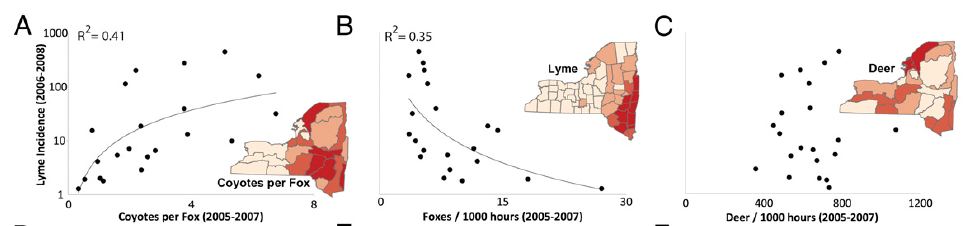
Excerpt from one of the paper’s figures, showing correlations (or lack thereof) between Lyme disease and either coyotes per fox (positive correlation), foxes (negative correlation), or deer (no correlation).
An important caveat: this paper examined correlations among estimates of the abundance of different animals. But correlations are slippery things. They seem to imply that we’ve discovered a cause-and-effect relationship, but this is often misleading. So I’m sure this story will evolve as scientists tease out the subtleties (does the effect of foxes depend on the availability of other prey?) and alternative explanations (might some unknown causative third variable be correlated with coyotes and Lyme?). I wonder how domestic cats play into all this. They are major predators on mice and often live at densities well above what could be supported without the subsidy of store-bought cat food. Do they also suppress Lyme?
Some notes for blog readers in the south:
1. We’re well outside the “hotspot” of Lyme disease, as shown on this CDC map. The disease does not seem to be increasing in many parts of the south. But, in Virginia and other areas that are close to the center of Lyme’s activity, the disease is increasing quite rapidly.
2. The south is blessed with other tick-borne diseases. Southern Tick-Associated Rash Illness is one; Rocky Mountain Spotted Fever is another.
3. Although we do have black-legged ticks here, lone star ticks and dog ticks are more common. These are not prime carriers of Lyme, but they can transmit the other tick-borne diseases.
For more info about ticks, the CDC site has some good links and great pictures (which will make your skin crawl). Obviously, if you have medical concerns about a bite, check in with an MD, not a Rambler.
 David George Haskell