Author Archives: David George Haskell

Guide to Sewanee’s butterflies now online

Eileen Schaeffer and Arden Jones’ guide to Sewanee’s butterflies is now available online (as a pdf at Issuu.com). Eileen and Arden are both rising seniors at Sewanee and have worked on this guide for the last two years, collating photographs, information about host plants, and data about abundance. The end result is a fabulous review of the diversity of these beautiful animals. The guide is also available in hard copy at Lulu.com.

This is not the only lepidopteran project that Eileen and Arden have undertaken. Last summer they completed a survey of the butterflies of St Catherine’s Island, GA. This summer they have taken a step into the daunting world of moth identification and are studying the moths of the Valles Caldera National Preserve in New Mexico.

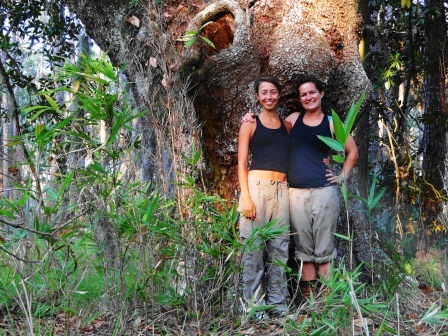
Taking a break from butterfly surveys, St Catherine’s Island, GA. Eileen Schaeffer (left) and Arden Jones (right). Both are Environmental Studies majors: Ecology and Biodiversity for Eileen and Natural Resources for Arden.

I have also uploaded a very short checklist of the butterfly species found in Sewanee.

One of my favorites: the long-tailed skipper.

“The butterfly counts not months but moments, and has time enough.” — Rabindranath Tagore

Agrippina visits Sewanee’s mushroom fest

This has been a phenomenal week for mushrooms. A reminder that we are not alone: below our feet lives an empire of rot. Stand still for too long and they’ll draw you into their net.

My last post on mushrooms discussed “American Caesar’s mushroom.” My friend and colleague Chris McDonough (and fellow blogger at Uncomely and Broken, a site that I highly recommend) added the following to our mycological ramble into the Classical World:

“The Caesar of the Linnaean term refers, it seems, to the unfortunate Claudius (you must recall that, after Julius and Augustus, all the emperors took the title “Caesar,” a tradition continued by the Czars and Kaisers into relatively modern times). Poor old Claudius, done in by a mushroom fed to him by Agrippina, who wanted her son Nero to ascend to the throne. It’s all in Suetonius, Life of the Divine Claudius, chap. 44, but you may want to watch the BBC’s “I Claudius” version (episode 13, “Old King Log”). The relevant portion is here.

The clip from I Claudius is fabulous. Never was a slowly advancing mushroom on a fork laden with such meaning. Suetonius’ account in no less gripping (taken from the public domain translation by Rolfe):

“That Claudius was poisoned is the general belief, but when it was done and by whom is disputed. Some say that it was his taster, the eunuch Halotus, as he was banqueting on the Citadel with the priests; others that at a family dinner Agrippina served the drug to him with her own hand in mushrooms, a dish of which he was extravagantly fond. Reports also differ as to what followed. Many say that as soon as he swallowed the poison he became speechless, and after suffering excruciating pain all night, died just before dawn. Some say that he first fell into a stupor, then vomited up the whole contents of his overloaded stomach, and was given a second dose, perhaps in a gruel, under pretense that he must be refreshed with food after his exhaustion, or administered in a syringe, as if he were suffering from a surfeit and required relief by that form of evacuation as well.”

‘Nuf said, I think, about the dangers of Amanita mushrooms.

Here is a slide collection of some of the diversity of form on display in the forest this week. My favorite, of course, is the photo with the snail — a young Ventridens, I think. Snails love to graze mushrooms, having the digestive enzymes needed to escape Agrippina’s reach.

This slideshow requires JavaScript.

Tracking migration: a window into the lives of wood thrushes

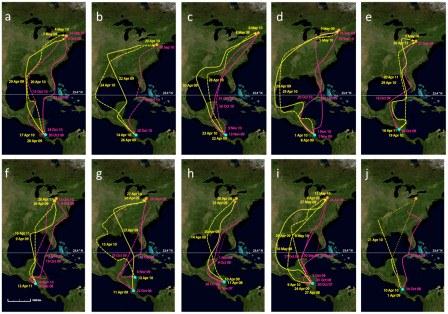
This image comes from a remarkable new paper about the migration of wood thrushes. A team of ornithologists led by Calandra Stanley and Maggie MacPherson from Bridget Stutchbury’s lab at York University in Toronto have used  tiny “light-level geolocators” to track the individual migration routes of wood thrushes. Geolocators use the daily cycle of sunlight and darkness, referenced to the time of day and date, to calculate where in the world they are. Sunrise and sunset vary consistently according to longitude (sun rises earlier in North Carolina than it does in Tennessee) and latitude (day length is longer in New York than in Belize in summer, but shorter in winter — except on the equinox when the machines get confused). Geolocators are not as accurate as GPS but they have the great advantage of being very small and lightweight. GPS needs a big, heavy antenna — there is no way that a songbird could carry even the smallest GPS unit.

The image above shows the path of one wood thrush over two years as it moves between its wintering area in Belize and its breeding grounds in Pennsylvania. The particularities of the route taken bring the map alive. The details change each year. In the fall of 2009, the bird came south over Florida and Cuba, but took the direct route across the Gulf of Mexico the next year. The map makes clear that migration is not an abstraction, but a yearly marvel.

This bird winged across Tennessee twice. That makes my heart leap — I may have heard this bird in Sewanee’s woods — but it also gives me chills. I have a freezer full of thrushes that hit windows and cars. (The dead birds are for use in the anatomy labs in my ornithology class.) We’ve thrown so many hurdles in the way of these migrating birds. To see the migration path is therefore not just to marvel, but to imagine the dangers.

A composite of the maps of multiple individuals shows the diversity of migratory paths within the species. Some birds hug the Mexican coast, some come through the Florida peninsula, and others take the dare-devil ocean crossing.

Joanna Foster’s article at the NYTimes Green blog does a great job of putting this study into the larger context of climate change and habitat loss. The important finding of this study was that the date of departure for spring migration barely varied from year to year. Individual birds, in other words, were consistent in when they left Belize. This is surprising — you’d expect them to be more sensitive to local conditions like the weather or their body condition. In the words of the authors, this lack of variability “may limit the ability of individuals to adjust migration schedules in response to climate change.” As my previous post of thrushes described, these birds have been declining for decades, so this is not good news.

Images here are from the paper: Stanley CQ, MacPherson M, Fraser KC, McKinnon EA, Stutchbury BJM (2012) Repeat Tracking of Individual Songbirds Reveals Consistent Migration Timing but Flexibility in Route. PLoS ONE 7(7): e40688. doi:10.1371/journal.pone.0040688 [Creative Commons]

For another mind-blowing set of maps from geolocators, see the Arctic Tern Migration Project website and click on “maps.”

A mushroom worthy of a Roman dictator?

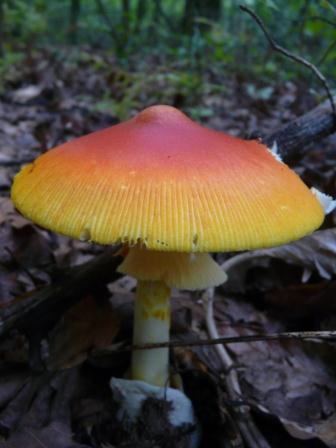
Early this morning I ran across this beauty growing on a dry slope in the upper reaches of Lost Cove. Even though the light was still dim, the mushroom’s sunny cap glowed. The species is Amanita jacksonii, or American Caesar’s mushroom. This is the American relative of a European delicacy which, it seems, was a favorite of Julius Caesar (evidence for this claim would be interesting to come by — perhaps when Chris McDonough returns from his conquest of Britain?). Several field guides claim that we have the European Amanita caesarea in North America; I think this is likely incorrect — see M. Kuo’s page over at MushroomExpert.com for an overview.

This is an edible species. But I’ll leave it in place. A small error can be costly in this genus of mushrooms — close relatives have cheery names like “destroying angel” and “death cap.” Interestingly, that venerable source of information on all things Classical, Wikipedia, notes that Roman Emperor Claudius may have been felled by Amantia phalloides, the death cap.

These mushrooms not only defend themselves with potent little peptides, they have interesting lives below the ground. Mushrooms are just temporary parts of much larger fungal bodies, like biological icebergs bobbing on the forest floor. The below-ground parts are filamentous, spreading through the leaf litter and slowly munching at their homes. The Amanitas also squeeze their filaments around tiny tree roots, exchanging minerals for sugars. This mutually beneficial relationship helps the forest retain its vitality. No dictators here, just plebeians trying to make it work.

For those in need of Scrabble words, the technical name for this is an “ectomycorrhizal” relationship — ecto because the filaments stay outside the plant cells, myco for mushrooms, and rhizal for roots. Regrettably, all these terms derive from Greek, not Latin, so they likely did not cross the lips of Caesar as he nibbled on his ‘shrooms.

Shakerag Hollow: update

Thank you to the University President, John McCardell, for making this statement: “We will solve this issue in a way that is not only exemplary, but permanent.” Kudos also to Jon Evans, my colleague in Biology and Assistant Provost for Environmental Stewardship and Sustainability, who first found the problem and took immediate action both in the field and in the administrative workings of the University. We are lucky to have leadership that understands the importance of Shakerag Hollow and that cares enough not only to remedy the present situation, but to look to the future and make permanent changes in University policy.

For the full text of the University’s initial statement, see here.

Regrettably, there is not word yet on whether we’ll maximize the educational potential of this debacle by making public the video and a full report. I’m sure more information will be forthcoming as the University takes its next steps.

Sad times in Shakerag Hollow

The drought has broken here in Sewanee, welcome news for most of us. But rain brings life only to healthy soil. Moonscapes and other bare-earthed areas are quickly scoured away. The rain’s clear blessing turns to choking brown sludge. This, regrettably, is what appears to have happened in a couple of the streams that feed off the golf course construction site into Shakerag Hollow.

The vigorous bulldozing and earth-moving that has raised huge clouds of dust into the air above Sewanee all summer has left large swaths of soil uncovered. A modest rain storm (not hard enough to flood my garage — my informal metric of severity) turned these areas to gullied mud pits. The water that ran off the construction site ran dark as chocolate milk.

The little barriers that were erected were totally inadequate for the job. They ran cross-ways to the streams’ flow and were quickly breached. Boards placed in rivers do not cause the water to stop; fabric placed across a torrent of muddy water has about as much effect.

I’m deeply saddened by this turn of events. Numbed, in fact. Downstream is the forest that E. O. Wilson has lauded as one of the South’s most spectacular. When he received his honorary degree here, he said: “This morning I was able to visit Shakerag Hollow…It is a cathedral of nature, more valuable for the history it preserves, millions of years, than any building.  It’s irreplaceable…I’m reminded of my friend John Sawhill, the late director of the Nature Conservancy. He said that society is defined not just by what it creates, but by what it refuses to destroy.”

This is not just the opinion of an out-of-town biologist. Several years ago, hundreds of members of the Sewanee community joined in the largest grassroots environmental fund-raising effort to that date, raising over $150,000 to protect the north slope of Shakerag.

So, the golf course debacle raises serious questions about how and why we got into this mess. But I am confident that the leadership that we have at the University will step up and respond to this in a way that not only corrects the problem (as much as is possible, one cannot unbury the streams and call back the stream creatures choked by the erosion), but looks to the future to make sure that we have a zero tolerance policy for this kind of destruction.

Some suggested steps that would help to increase confidence that we are indeed headed in that positive direction:

1. Make public the video of the failure of the “erosion control” mechanisms. This is an incredible opportunity to let this event not only change Sewanee’s policies, but to spread the educational message beyond the gates of the University’s land. Releasing the video will also go a long way to convincing people that we take seriously our responsibility as educators: facing the facts with complete transparency.

2. A public report about how we got to this sad place. What do the architects, contractors, and overseers have to say about this? What will be learned? The Sewanee website states that the project “will be in the capable hands of Hanse Golf Course Design, Inc. Founder and President Gil Hanse, whose reputation for artistry, craftsmanship, and personal attention earned him Golf magazine’s 2009 Architect of the Year Award.” Further, the new design will include “environmentally sustainable features that will both enhance the challenges of the course and preserve the delicate ecosystem of the Cumberland Plateau.” This, therefore, is another opportunity for reflection and education.

3. A new policy and set of enforcement mechanisms to ensure that we don’t repeat this tragedy. Every major project over the last couple of decades has resulted in erosion problems (some major, some minor): the Fowler Center, The Chapel of the Apostles, McClurg Hall, the airport expansion, Spencer Hall, and Snowden Hall. Community members, faculty, staff, and students have in each case asked for better safeguards. Evidently, we’re not there yet. But we could be. We have a strong group of leaders at the University who have a commitment to environmental responsibility. We should support them in their efforts to move forward.

I posted a short message on Facebook earlier today about my sadness. The response has been overwhelming both on Facebook and on email. Most people are just stunned or want more facts (information that I hope the University will provide). But there is also a lot of anger. Anger is understandable, but it is destructive in its own way: a mental flow of muddy water that smothers all in its path. Instead of anger, let’s face the facts, mourn, offer mea culpas where needed, fix what we can, then get on with doing the right thing. Pulling that off would be a lesson worth learning.

[Addendum added one day later: the University’s initial statement regarding this problem is here. “We will solve this issue in a way that is not only exemplary, but permanent,” said McCardell.]

[this is a personal blog, opinions here are my own]
A “must read” from Bill McKibben…

in Rolling Stone. McKibben has written what is, in my opinion, one of the more important and disturbing essays of the last few years. He lays out an unvarnished summary of where we stand with the destabilization of the climate. Where we stand is shameful and frightening: we’re locked in for disastrous changes to the climate and, worse, show every sign of moving full speed toward not only disaster but calamity, a “a planet straight out of science fiction.” McKibben’s unflinching words are, in my limited experience, a pretty fair reflection of what scientists are thinking. The essay is well worth your time.

So how to respond to this sobering reality check? I suspect that this is the question that we’ll be asking a lot in the coming decades. Maybe Jane Goodall’s thoughts are relevant. She has better reason than most to give up on this broken world — the animal species and ecosystems that she deeply loves have been pushed to the edge of annihilation before her eyes. Yet she responds with hope. That hope is easy to dismiss as mere fatuous or fluffy salve, but I think it reflects something deeper. The short time that I’ve spent in McKibben’s company showed me the same: against long odds, hope.

Reflections on The Forest Unseen

The Sewanee Magazine’s summer issue includes an article in which I offer some thoughts about my book, The Forest Unseen, and its relation to science, contemplation, and teaching. I’m delighted with the article’s layout and I’m particularly honored to have my photos of Shakerag Hollow featured alongside those of my friend and former student Stephen L. Garrett.

Thank you to Buck Butler for inviting and editing this essay. I’ve posted a pdf of the piece on Issuu.

Thoreau went to the woods to suck out all the marrow of life. I, too, wanted to learn what the woods had to teach, but my teeth are weaker, so I worried at the gristle, gradually gnawing my way into Sewanee’s bones…

Goodbye loggerhead sea turtle hatchlings…see you in the year 2042

Two nights ago, Gale Bishop has his colleagues at the St Catherine’s Island Sea Turtle Conservation Program were kind enough to invite the Sewanee Island Ecology Program crew along on the year’s first release of baby turtles. These little hatchlings all came from the same nest, a nest that was dug out by hand (not flipper) to save it from a predatory ghost crab that had started to munch its way through the clutch. The crab got three; one hundred and fourteen were released.

The turtles were kept through the day in a cooler (to keep them at the temperature of their sandy nest deep in a dune), then taken to the beach at sunset. This timing mimics the natural rhythm of hatching: the youngsters emerge at night when they are a little safer from the heat of the sun and from beach-hunting predators. They dig their way out of the nesting burrow high on the beach, then crawl down the sand (they all know which way to go) into the breaking surf. Once in the water, the turtles swim away, surfacing for gulps of air, then head out to the open ocean.

Many of these young turtles will follow the Atlantic gyre, passing Iceland, then Northern Europe, then Portugal, the Azores, finally ending up in the Sargasso Sea where they will live until they reach sexual maturity in about thirty years. Some will avoid the swirl of the Atlantic and swim directly to the Sargasso Sea. The “long and perilous journey” cliché applies here: one in a thousand will survive to breed. When mature, the females come back to shore to lay their eggs; the males never again set foot on land.

So if I’m lucky enough to reach my seventies, I’ll make a return trip to this island. If the hatchlings survive natural predators, legions of fishing boats (up to thirty massive shrimp trawlers at a time off this beach alone), and an ocean filled with tangling, choking garbage, I’ll greet again the turtles that we released onto the beach today. What will the beach be like in thirty years? It is presently eroding at two meters per year, a rate that will accelerate in a world with warmer, stormier, higher seas. But I hope some sand will still be here to greet the mothers as they crawl ashore.

Letting these youngsters go was an emotionally charged occasion. Turtles are ancient creatures, one hundred and forty million years on this OceanEarth, older than the flowering plants, older than most dinosaurs and mammals, and older than Homo rapaciens which has been around for a mere turtle’s blink, two hundred thousand years. Yet in the short time that humans have been here, we’ve pushed all sea turtle species to the edge of extinction. The vulnerability of the little hatchlings and the long long odds that each one faces, odds worsened considerably by the gutted state of the oceans, is profoundly sad. But the vigor and determination of the little turtles is an incarnation of hope, optimism scribed in turtle flesh: damn the odds, I’m headed down this beach with flippers whirring, then I’m taking to the dark ocean with gusto to swim into my fate. All this produces a powerful combination of feelings and thoughts in the watching bipeds. Several of us had tight throats and drops of ocean water in our eyes as we watched the turtles leave.

The photos below include a few from earlier in the week to illustrate the nesting process, then some of the release.

Tracks left in the sand by a mature female ascending the beach to lay her eggs. They do this at night when heat and predators are less of a problem.

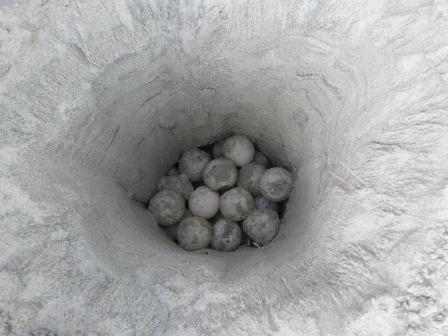
Loggerhead turtle nest. This one is being moved upshore to keep it out of the drowning high tides.

The nest chamber is dug by the female with her back flippers.

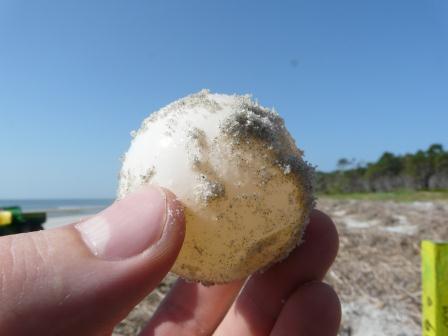
Loggerhead sea turtle egg. Unlike many reptilian eggs, sea turtles egg shells are partly calcified, giving them the feel of a bird egg.

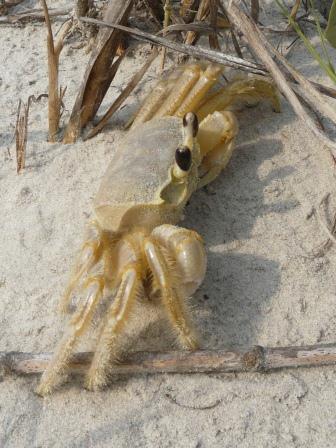
Ghost crab — they live in deep burrows and love to eat turtle eggs.

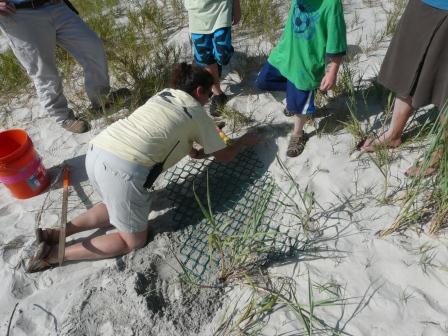
The new nest site is protected with a wire mesh. This keeps raccoons and feral pigs from digging up the eggs.

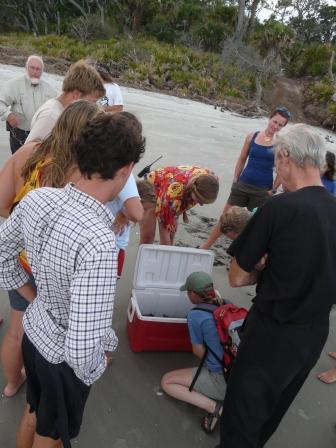
The cooler of turtles arrives…

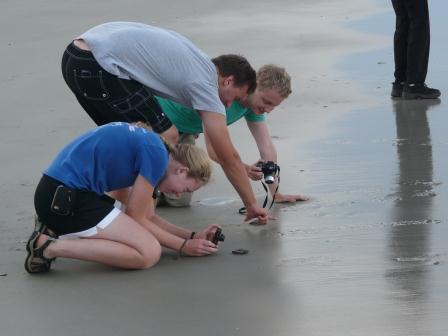
…and is admired.

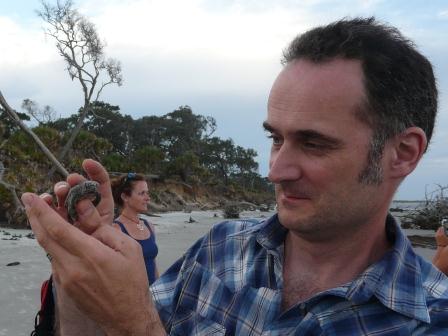
Loggerhead-to-head

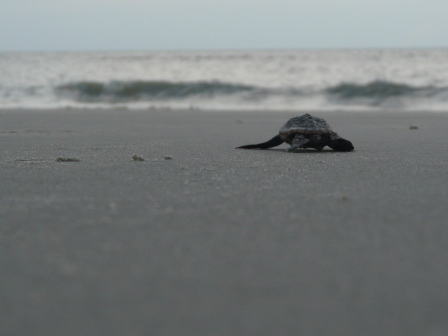
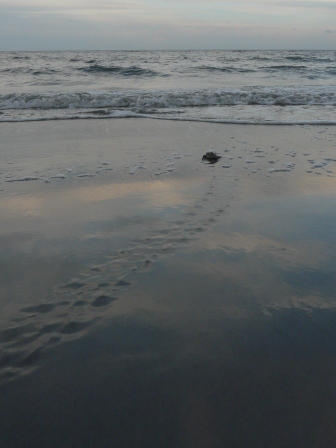
The following photographs are from the release of the turtles onto the beach. The hatchlings propel themselves down the beach on their flippers, then get caught up in the breaking waves.

Ring-tailed lemurs

A small population of ring-tailed lemurs lives on the north end of St Catherine’s Island. The animals are descendents of a handful of ancestors that originally lived in the Bronx Zoo and Duke University. The lemurs are free-ranging but receive daily dietary supplements (fruit and “primate biscuit”) and regular veterinary attention. They have been on the island since 1985.

The lemurs’ social behavior is very similar to that found in the wild — they live in matriarchal groups that keep to a home territory. The matriarch and her daughters are usually the dominant animals within the group. Social rank is therefore determined by kinship (and, secondarily, by reproduction — not having babies knocks down a female’s rank). Males are subordinate to females. They live with the group for their first few months, then disperse and try to join other groups.

The lemurs on St Catherine’s are not “tame” (no touching allowed) but they seem to have no fear of humans, frequently approaching very close. This opens the door to interesting studies of their lives and primatologists travel here from across the world to observe the lemurs’ behavior. Most of the animals have individually colored radio-collars. These chunky necklaces appear to cause them no discomfort and allow researchers to track each animal.

This slideshow requires JavaScript.