Author Archives: David George Haskell

Rambling into the Times

Finding Zen in a Patch of Nature” — The New York Times has published a beautiful profile of my work. I feel very lucky and honored to have my work discussed in this venue, especially the Science section which for years has been my go-to place for science news and great writing. Jim Gorman has done a fabulous job of situating The Forest Unseen at the junction of science, literature, and contemplative practice. Ramble also gets a mention and regular readers may recognize themes from some of the photographs. I’m looking forward to seeing the full spread in the print version tomorrow. Also in the works is an interview in the weekly Science Times podcast, available soon on the Science page.

Thank you, Ramble followers, for your ongoing support of this blog. It is a great pleasure and privilege to share my biological and literary musings with you. Our “regularly scheduled programming” will resume shortly (with more ticks, among other delights).

Parasitic ants, unwise language, and a little glimpse of Darwin

Several weeks ago I came across a curious highway of ants. They were streaming across the leaf litter in a column about a foot wide. The column started under an oak tree, traversed the leaf litter and hiking trail, then ended abruptly about forty feet away in an otherwise unremarkable patch of fallen leaves. Ants traveling away from the tree were carrying white, ant-sized objects in their jaws. Ants moving in the opposite direction were empty-mouthed. At the destination, a few smaller ants milled about, seemingly at ease among the larger ants that I was watching.

I suspected at the time that I was witnessing a raid by a so-called slave-making ant species. My skills as an ant taxonomist are limited and I turned to my colleagues for help. Thanks to James Trager and Ann Fraser, I’ve confirmed my suspicion and been able to tentatively identify the species in question as Formica subintegra and Formica subsericea (an aside: Ant Blog is a great place to seek answers about ants). The first species, the larger one, was attacking the nest of the other and carrying away eggs and larvae. These captured youngsters will be raised in the “den of thieves” and, when they emerge as adults, the newly pupated ants will have no idea that they do not belong. Because ants take their cues from the chemical milieu in which they grow up, the stolen ants consider themselves full members of the alien colony. This trickery buys the captors a work force to maintain the nest and rear more young. In some ant species, the captors are so dependent on the captured workers that they cannot survive without them, having lost the ability to feed themselves and take care of the brood.

In the biological literature this arrangement has, for many years, been called “slave-making.” This makes me deeply uncomfortable. Using a term — slavery — from a human institution that all (or nearly all) modern human societies have agreed is morally unacceptable seems unwise. Further, the “ant slavery” term implies a biological equivalence that does not exist. There is not a single biological parallel between the details of the situations in humans and ants (ants raid other species, ant societies and nervous systems differ radically from ours, etc). By using a term derived from human society, a term that comes with considerable moral heft, we blind ourselves to the otherness of the ants. So in addition to the moral argument (which is strong enough on its own, I think), there are scientific reasons for not using the term: our preconceptions may cause us to fail to understand ant biology.

In other areas of biology, we’ve thankfully tidied up our terminology a bit. Textbooks on animal behavior were formerly strewn with terms like divorce, rape, and prostitution. These days, textbooks generally leave these loaded terms at the door, although more popular media outlets and some scientists continue the unfortunate practice. For example: Wikipedia (of course), BBC, and The Independent (note how the coverage slips so easily into discussion of what is natural for humans; Hume shudders, as explained (of course) on Wikipedia). My point is not that conflict, coercion and suffering do not occur in nature (of course they do), but that the use of human categories to describe animal behaviors can lead us into trouble. This is especially true when those categories carry with them a strong emotional, intellectual or moral charge.

Back to the ants. I was particularly excited to see this process unfold because it has a place in the history of biological ideas. Darwin was fascinated by these ants and used them in Chapter Eight of On The Origin of Species as an example of how natural selection could mold behavior (or “instinct” as he called it). He writes:

We shall, perhaps, best understand how instincts in a state of nature have become modified by selection by considering a few cases. I will select only three, namely, the instinct which leads the cuckoo to lay her eggs in other birds’ nests; the slave-making instinct of certain ants; and the cell-making power of the hive-bee: these two latter instincts have generally and justly been ranked by naturalists as the most wonderful of all known instincts.

Darwin dug up and manipulated a number of nests in England, experimenting with the ants to better understand the nature of the “slaves” and “masters” as he termed them (Darwin was not shy here or elsewhere in his writing about linguistic cross-over from human behavior).  He concludes that:

…natural selection might increase and modify the [parasitic] instinct—always supposing each modification to be of use to the species—until an ant was formed as abjectly dependent on its slaves as is the Formica rufescens.

The complete account is available in the many online copies of The Origin (or in the treasured copy of this volume on your bookshelf).

In the years since Darwin, hundreds of studies have been conducted on the socially parasitic ants, many of which are summarized in a short review by Buschinger. One recent study of particular note is the discovery of retaliation by a genus of ant that is frequently attacked by parasites. The host genus is Temnothorax — tiny ants that nest inside acorns (!) and hollow twigs — and the parasite is Protomognathus americanus. Unlike the larva-robbers that I observed, Protomognathus parasitic ants invade and take over the nest of the host. Temnothorax adults are killed and their young are co-opted to work for the parasite. It appears that these attacks are so common that natural selection has produced a counter-measure: genes in some of the host workers cause them to attack the parasite, killing the developing Protomognathus pupae.

The authors regrettably use the terms “slave rebellion” and “revolt against their oppressors” to describe the behaviors that they describe. Surely a human rebellion against slavery is biologically and morally different than a gene variant causing an ant to use chemical cues to bite a pupa? My grousing about language aside, this is a remarkable study. Darwin would have loved to add this co-evolutionary tale to his chapter on the evolution of animal behavior.

From now on, I’ll be examining acorns more closely.

Rachel Carson’s legacy

The Sunday “Perspectives” section of the Chattanooga Times Free Press is running my column about Rachel Carson, along with a column about the politics of conservation by David Yarnold, president of the National Audubon Society. The layout is beautiful — I was expecting an unadorned column, but this morning I opened the paper to find a spread with Carson framed by bird sketches.
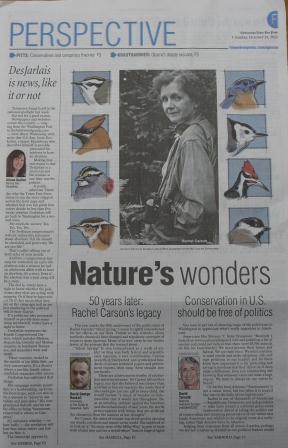
The columns are not online, so I can’t redirect you to the paper itself. I retain copyright, so I’ve reprinted my column below.

Rachel Carson’s legacy

This year marks the fiftieth anniversary of the publication of Rachel Caron’s Silent Spring. Carson is rightly remembered for her effects on our lives. Thanks to her, attitudes about synthetic chemicals have changed and regulatory oversight of toxins is more rigorous. Many of us now carry in our bodies fewer of the poisons that she warned about. Silent Spring is also remembered as a work of art. Her writing was both lyrical and scientifically rigorous, a rare combination. Carson unearthed, interpreted, and synthesized hundreds of arcane technical papers and government reports, then sung them straight into our hearts.

These are achievements worthy of celebration and remembrance. Yet Carson left another legacy, one that she believed was deeper than activism or literary mastery. She wrote that if she could give just one gift to every child, she would bestow “a sense of wonder so indestructible that it would last throughout life, as an unfailing antidote against the boredom and disenchantments of later years, the sterile preoccupation with things that are artificial, the alienation from the sources of our strength.”

For Carson, this sense of wonder was developed by opening our minds, emotions, and senses to the world. She implored us to look up at “the misty river of the Milky Way,” to peer at moss with a hand lens and see a world where “insects large as tigers prowl amid strangely formed, luxuriant trees,” to attend to our noses and “savor the smell of low tide,” and to hear in the dawn chorus of birds “the wild medley of voices . . . the throb of life itself.”

Carson established her reputation with books that celebrated the biological and physical marvels of the world: periwinkles, sea weeds, eels, and ocean currents. She lifted the study of natural history from the quiet, dusty parlors of the Victorian age and made it relevant for her generation, becoming, in her own words, a creator of a “new type of literature . . . representative of our own day.” In Silent Spring, she took this further and used the testimony of natural history — robins, earthworms, plankton, caterpillars, and cells under microscopes — to make her case against the imprudent use of chemicals. So although Silent Spring is remembered for bearing fruit in legislatures and regulatory offices, it was rooted in Carson’s life as a naturalist.

For Carson, the practice of natural history was a source of both delight and profound moral significance. Even at her most polemical, when delivering a speech on pollution to medical professionals as she was dying of cancer, her arguments were grounded in stories about the evolution and ecology of our world. Her speech was not focused on policy recommendations or the details of toxicology. Rather, she opens with a discussion of the origin and evolution of ecosystems, then closes with Charles Darwin. Where in today’s environmental discourse do we hear such zeal for the unfolding drama of evolution?

Carson’s references to biological context were not merely rhetorical window-dressings. The fact of our kinship with the rest of life was the foundation of her worldview; the joyous study of the particularities of the natural world was the ground from which her activism grew. In poisoning the world, she believed, we poison ourselves, for there is no separation between nature and mankind. And there can be no wise decisions about “our true relationship to our environment” without intellectual and emotional connection to the community of life. Darwin taught us that we are kin to the rest of life; Carson taught us that this kinship leads to empathy and responsibility.

So, how to celebrate, honor, and carry forward the insights of Silent Spring? Use synthetic chemicals with care and caution? Of course. Engage with the political process? Yes. But most of all, I think Rachel Carson would want us to take up “the creed I have lived by . . . a preoccupation with the wonder and the beauty of the earth.”

Is this preoccupation with the study of nature naïve or outmoded? No. Carson’s call is all the more pressing today. Biological diversity is plummeting worldwide and our climate is dangerously destabilized. Yet mere abstract knowledge of these trends is not enough. Without emotional and aesthetic connection to the natural world, we’re dislocated from any reason for action.

So our homework assignment from Carson, fifty years after Silent Spring, is to get to know a tree, to listen to a bird and to smell the beauty of soil. By giving our attention to the ecology of our homes, we’ll find Carson’s most important legacy: wonder.

David George Haskell is the author of The Forest Unseen: A Year’s Watch in Nature (Viking 2012). He is a Professor of Biology at the University of the South in Sewanee, TN.

Chattanooga Times Free Press, October 14th, 2012″

Spicebush swallowtail caterpillar

My colleague David Johnson’s Field Investigations in Biology class found this caterpillar on one of their forays into the woods. The animal was discovered hitching a ride on a student’s boot and was brought back to campus for the admiring crowds. I kidnapped it (the caterpillar, not the boot) for a photo shoot.

This slideshow requires JavaScript.

This caterpillar does a fabulous impression of an outrageously colorful snake. Note the light “reflection spots” within each “eye.” When distressed, the caterpillar will apparently inflate its head and rear up. I poked it a little, but could get no response. I did not feel like tearing at its skin like a real predator (my inner blue jay would not come to the surface), so the snake-charming will have to wait for another day.

Spicebush swallowtail caterpillars spend their first few instars (“life stages”) looking like bird droppings. This allows them to loiter in plain view and they generally sit on the upper surface of leaves. Their last instar is the snake-mimic. At this stage they roll leaves into loose cigars and hide inside the bore of the roll. Their snaky heads face outward.

The caterpillar will shortly turn into a crusty brown pupa from which the adult butterfly will emerge in the spring. Sewanee has plenty of the species’ two host-plants — spicebush and sassafras — so this species is quite abundant, but the spectacular caterpillar is surprisingly hard to find.

Migration

As we slide down the slope behind the equinox, animals have accelerated their autumnal movements. My backyard now consistently hosts several migrant bird species each day. In the last week: rose-breasted grosbeaks, magnolia warblers, Tennessee warblers, American redstarts, gray catbirds, chestnut-sided warblers, warbling vireos, and a summer tanager. Unlike the songsters of spring, these mostly silent birds can be hard to detect. A flicker of foliage reveals their presence, then a glimpse of their plumage as they prance through the concealing twigs. Grosbeaks are an exception to this crypsis. Although they can be hard to see, their sharp tweek call, given repeatedly through the day, gives them away. The sound is just like that of a sneaker squeaking on a gym floor. Listen for it, then look up.

Last night, as I left the Biology picnic on campus, another migrant bird making a spectacular display over the old building that houses the fire station. About two hundred chimney swifts were scything the air in a tight, fast vortex. They swirled around the brick chimney that protrudes from the station’s roof. One by one, they folded their wings and dropped in. Like hot cinders carried up by the wind, these birds seemed to ignite the dead dusky air with their coordinated vitality. A little tornado of life. The swifts are on their way south to the Amazon where they’ll feast on tropical gnats all winter. I suspect that they are speeding on their way as I write: this morning’s cold rain squalls mean there will be few flying insects in Sewanee today. Time for swifts to get out of here.

Birds are not the only migrant animals making their way through our skies. This week has seen an impressive number of monarch butterflies winging across the treetops. It seems impossible that so slow and delicate a flyer could make it all the way to Mexico, but that is where they are all headed, to a few small patches of dense fir forest in the highlands. The monarchs gather there in the tens of millions to rest in the cool but unfrozen woods. Remarkably, these autumnal migrants are the grandchildren of the butterflies that left Mexico this spring. Somehow their genes guide them to precisely the right location.

One for the road: a monarch loading up on thistle biofuel earlier this week near Lake Dimmick.

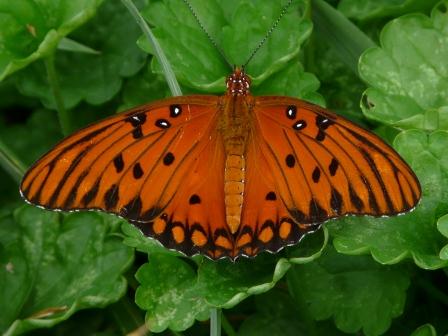
Another migrant butterfly, less celebrated than the monarch, is the gulf fritillary. This species breeds all over the southeastern U. S., but overwinters only in the deep south. Unlike the fluttery monarchs, these butterflies scull their way across the air with seemingly powerful and directed wingbeats. In Florida, where adults linger all winter, huge flocks of them will sometimes stream over fields and scrubby areas. A river of bright amber.

Gulf fritillary. Photo taken earlier in the year.

Crowned Slug Moth, Isa textula

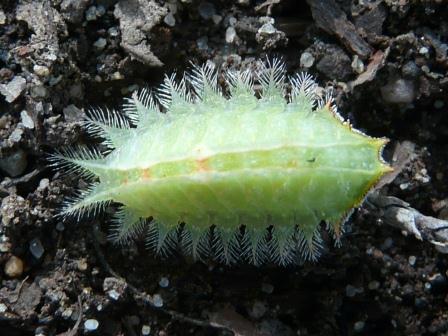
I came across this tiny (1.5 cm long) but handsome caterpillar on my walk to Piney Point this morning. It was lying immobile in the trail, under a white oak. Wagner’s Caterpillars of Eastern North America (what a great book!) notes that these caterpillars “may be active very late in the season, sometimes dropping down with autumn rains and winds.” After photographing the animal, I placed it on an adjacent oak sapling.

Murphy, Lill and Epstein’s study in the Journal of the Lepidopterists’ Society has some interesting background information on these caterpillars. They belong to the Limacodidae family, the so-called “slug caterpillar moths,” a group named for their strange offspring. All the species in the family have caterpillars that look like gummy worms going through a punk adolescence. Studs and spiky hair adorn colorful pudgy bodies. They can deliver quite a sting, as I noted a few weeks ago in my post about the saddleback, a different species in this family.

Murphy et al. confirm Wagner’s statement about the lateness of the species. This species is one of the season’s last active caterpillars, and are “frequently found feeding on leaves in the midst of turning color in late October, right up until leaf drop.”

Once they have finished growing, the caterpillars find a safe nook, then make a cocoon in which they enter a state of suspended animation (known as “diapause” in the zoological world). In the spring they make a pupa within the winter cocoon, then transform into an adult moth.

Tick Bush, Tennessee

It seems that my previous post about monstrous numbers of ticks near Lake Dimmick echoed a very old pattern. My friend Lizzie Motlow reminded me that the old name for the Lake Dimmick area is “Tick Bush.” Readers familiar with Sewanee history will remember that Ely Green’s autobiography from the late nineteenth and early twentieth centuries features a number of encounters with residents of the Tick Bush area. I had not, until now, known the exact location of Tick Bush.

Jerry Smith and Sean Suarez’s Sewanee Places corroborates this Acarine geography. They write that Tick Bush was down the hill from “Summit” or Midway. The two locations even had different schools. Smith and Suarez’s account places Tick Bush close to the present day airport, just two thousand feet upstream from where Lake Dimmick is located.

I think we can now say, with the confidence that comes from replicated quantified samples, that Tick Bush remains firmly planted on the map.

Now for some relief from discussions of ectoparasites… Ticks were not the only animals in evidence. The following male Black Swallowtail was nectaring on the thistles in the University’s cattle pasture. His beauty is a nice antidote to the creepiness of the skin-crawling masses emerging from Tick Bush’s bushes.

Dragging for ticks

My “Advanced Ecology and Biodiversity” class has been surveying ticks in and around Sewanee. We’re documenting which species live here, where they live, and what their relative abundance is in different habitats. So far, the hands-down winners for numbers of ticks are the cattle pasture and adjacent wooded roadsides near Lake Dimmick. In one twenty meter sample, we found nearly six hundred small ticks.

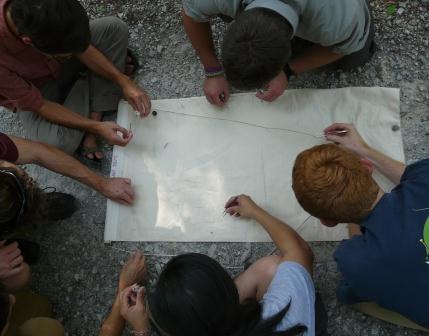
We sample by dragging a canvas cloth over the ground, then counting the ticks that have latched onto the cloth. This simple method is the standard protocol for assessing tick populations. These “tick drags” go very quickly when we encounter few animals, but when a seed tick “bomb” hits the cloth, it can take half an hour to pick off all the minute crawlers.

We’re storing the ticks in vials of alcohol. We’ll identify them later on in lab and we may also extract DNA to assess whether any of the ticks are carrying disease. We discovered today that when shaken the vials make snow-globe like ornaments. We’ll be marketing these as rustic woodland souvenirs.

Note that cloth drags are not the only way of sampling ticks. The label in the next vial hints at some misery.

Extra credit for students who wear T-shirts with slogans appropriate to the sampling method for the day:

As part of the class, students will be producing a pamphlet on the ticks and tick-borne diseases of Sewanee. I’ll pass it along through this blog when it is ready. For now, I recommend not rolling around in the cattle pasture at Lake Dimmick. The lawn around Stirlings coffee shop appears to be much safer for that kind of activity. (For real: we found no ticks there; Abbo’s Alley, on the other hand, had a few.)

Herp fest continues

Herpetological wonders continue to unfold. The Cumberland Plateau and the Southern Appalachians are among the most diverse places in North America (and the world) for amphibians and, to a lesser extent, reptiles. The last few weeks have not disappointed in encounters with this group.

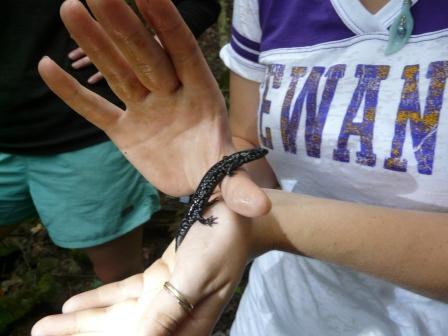
We found this Seal Salamander during my Advanced Ecology/Biodiversity lab last week. The animal was in a creek in Shakerag Hollow. It was about five inches long. Seal salamanders spend most of their time in water, but will wander on land to feed, especially on wet nights.

Unlike its close relatives, the Seal Salamander has tough cornified toe tips, possibly to help it climb vegetation during its terrestrial forays. You can see the blackened tips through the ziplock bag.

This Slimy salamander was under a rock in the same creek. This species is usually found away from water, under logs or rocks, so this individual may have just been passing through. Slimy salamanders lay their eggs in moist places on land and their young never dip their feet in water. Young Seal Salamanders, on the other hand, are aquatic and have feathery gills.

I found this Marbled Salamander during Intro Biology class. It was hiding under a log in a dried up vernal pool. In a normal year, the salamander would wait for several more months before the pool filled up. This week’s phenomenal rains mean that the pools are now overbrimming. We’ll see whether or not the water stays. If so, this will be the earliest filling of these ephemeral wetlands that I know of in recent years.

Scott Summers, a freshman at Sewanee, found this spectacular Red Salamander last week under a log near Morgan’s Steep. Great find!

A Pickerel Frog in Shakerag Hollow. Note the squarish spots on the back. The similar Leopard Frog has rounder spots that are more randomly scattered over the back.

A Green Frog snuggled underwater with an acorn. Also in Shakerag Hollow. Note the nice clear water — thankfully, not all streams have been impacted by silt runoff into the hollow.

And from an entirely different habitat, located just a stone’s throw away from the vernal pool: a fence lizard enjoying the baking sun on a sandstone outcrop near Piney Point. These outcrops are incredibly dry and blazing hot. Fence lizards love the heat.

In closing, a frission of danger. This Timber Rattlesnake was on the trail in the northern Smoky Mountains where I was botanizing with the TN Native Plant Society last weekend. The botanists stopped briefly to admire the snake’s freshly molted shine, then returned their attention to petioles, leaf margins, and floral structure. The snake had thirteen rattles, so it has molted thirteen times. They molt two or three times a year, so this one is relatively young. They live up to twenty years.

Crab spider

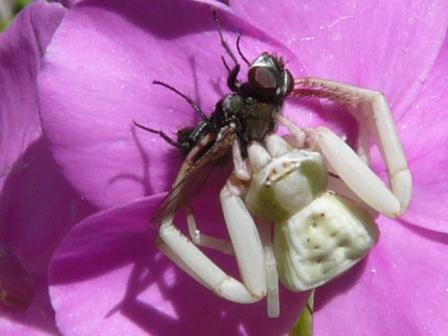
Just under the petal’s lip sat a small green spider. The fly landed. The petal twitched. The spider’s tidy fangs sank into the fly’s crunchy exoskeleton.

Next day, the spider sat on the same flower, but this time on the upper surface of a petal. The spider held its arms to the sky, keeping utterly still. Even some pokes from a piece of straw did not break its steely immobility. While I watched, no flies came to visit.

Crab spiders add a streak of danger to the cosy relationship between flowers and their pollinators. There are hundreds of species of these spiders (named, of course, for their crabby look while sitting) and in some habitats (e.g., Sewanee’s fall blooming meadows and roadsides) they are quite common. Their sit-and-wait hunting strategy makes them inconspicuous, but close attention (or the movements of unfortunate flies) will reveal their presence.

How many poems feature thorns and roses? Crab spiders seem so much more interesting. Not just the prick of a thorn, but the dying fall of a poisoned bite. And all the fly wanted was to touch its feet to a flower, to sip a drop of nectar. OK, that’s a pretty overworked theme. How about the flower’s perspective? A display of beauty, a straightforward offering of pollen, yet here come the Arachnid riff-raff, ready to knife the honest customers.