Author Archives: David George Haskell
Snow graphemes, scribed by plants
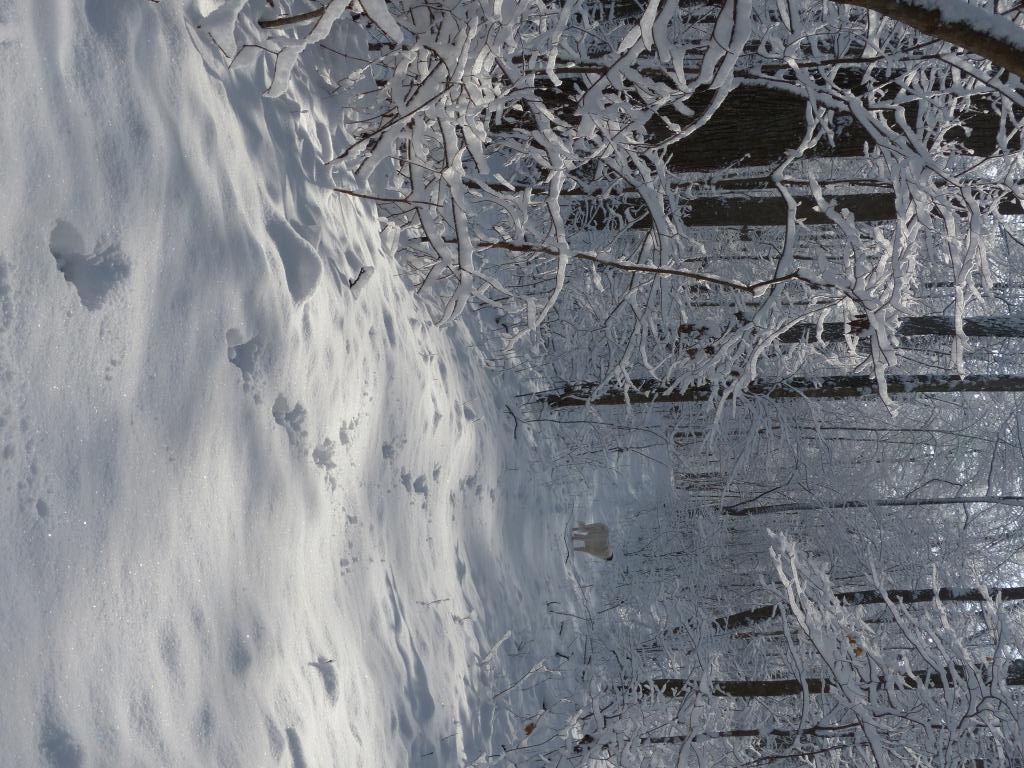
Fallen leaves and fruits etch the snow when caught by the wind, leaving inscrutable messages. Tree roots do the same as they carve up through asphalt. The last few weeks have provided ample opportunity to read these signs.
These snow scribblings bring to mind David Hinton’s description of the work of the Chinese poet Summit-Gate (峰門). Summit-Gate would gather particularly beautiful autumn leaves and carefully lay them in book-scroll boxes. These boxes were her library. When snows came, she took the leaves to her poetry shelter and released them one by one, watching their wind-blown botanical calligraphy on the snow. She could read the start of every poem but, by choice, the conclusions eluded her.
There is more to her story, all told in David’s excellent book, Hunger Mountain, a meditation on landscape, mind, and literature.
So in these snowy days, we can learn from Summit-Gate and keep our eyes on the surface to see what legumes, samaras, and cast-off leaves might be saying. Ideograms are also being continually made and erased on other surfaces: beaches, dusty roadsides, perhaps even the ooze on a scummy lake. This is “tracking” of a different sort.
Graupel into beech
Yesterday, on the leading edge of the snow storm, rain turned icy, pelting the woods with interesting nouns-that-should-be-verbs: rime and graupel. This bombardment made for delicious sounds, and not just on the human tongue.
Here is the percussive beat of this snowy ice falling into the marcescent leaves of a young beech (heard best with headphones):
In .wav format:
In case your browser doesn’t like .wav, the same recording, in .mp3 format:
Next morning, Junebug and I had the pleasure of making the first tracks on the snowy trails, listening to the whomp and whisper of the woods.
Florissant fossils
One of the many pleasures of my visit to Yale last month was a visit to the collections of the Yale Peabody Museum. Among its treasures, the museum holds many of the fossils that were collected in the early 1900s from Florissant, Colorado.
The Florissant site is famous for its beautifully preserved plant and insect fossils, remains of the flora and fauna of the late Eocene, about 34 million years ago. In those good ol’ days, the climate was warmer and wetter, so a rich temperate forest grew in what is now a mix of dry, open grassland and ponderosa pine (replete with modern mammals, as I learned during my visit to the site last summer).
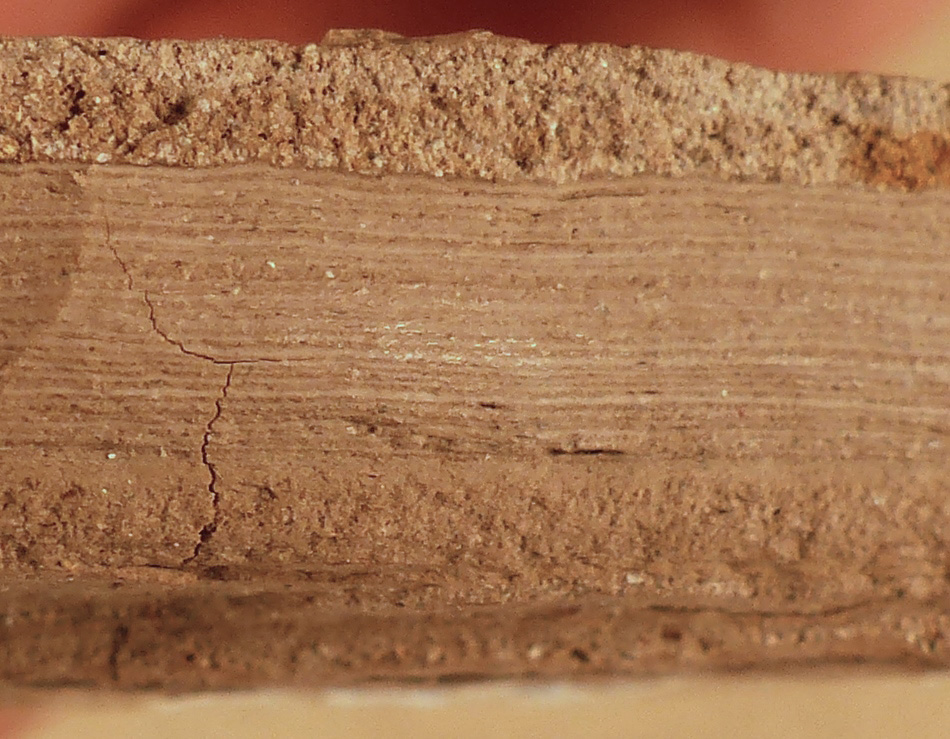
Most of the fossils are preserved in the finely laminate shale. Some of these laminae represent one year’s deposition: a layer of diatoms from the summer, overlain with ashy clay in the winter. These are interspersed with coarser material from rivers and landslides.

Division of Paleobotany, YPM 30074. Copyright 2014, Peabody Museum of Natural History, Yale University, New Haven, CT. All rights reserved. The whole section depicted here is about 5 mm deep.
Many of the animals from the Florissant fossil beds look familiar to us, an indication of the continuity of taxa and their ecological roles across tens of millions of years.
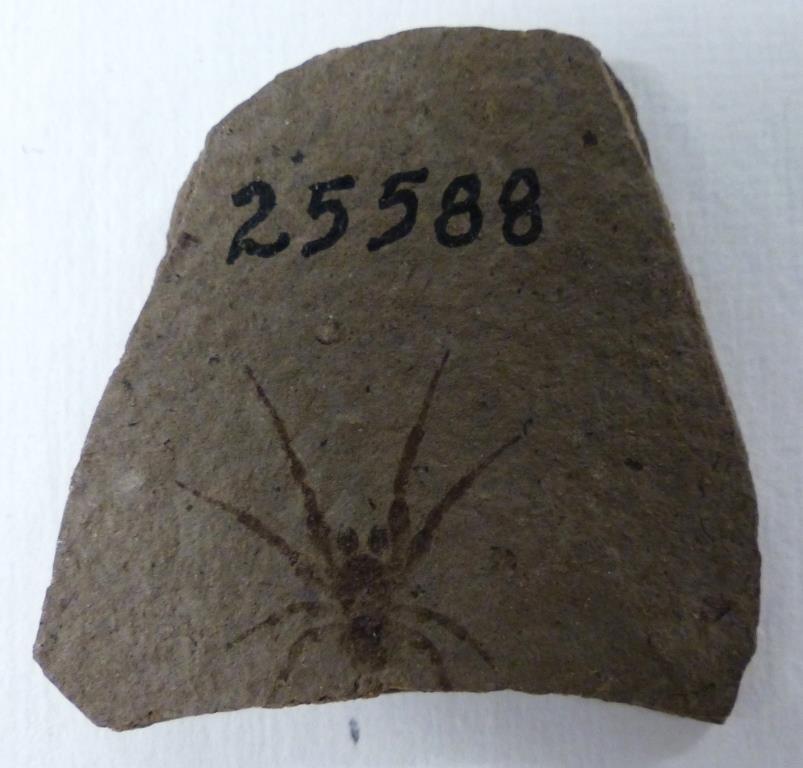
Tethneus twenhofeli (orb-weaving spider). Collected by W. H. Twenhofel, date unknown. Described by A. Petrunkevitch, 1922. (Division of Invertebrate Paleontology, YPM 25588. Copyright 2014, Peabody Museum of Natural History, Yale University, New Haven, CT. All rights reserved.)

Cranefly. Collected by J. T. Gregory, 1953. (Division of Invertebrate Paleontology, YPM 50208. Copyright 2014, Peabody Museum of Natural History, Yale University, New Haven, CT. All rights reserved.)
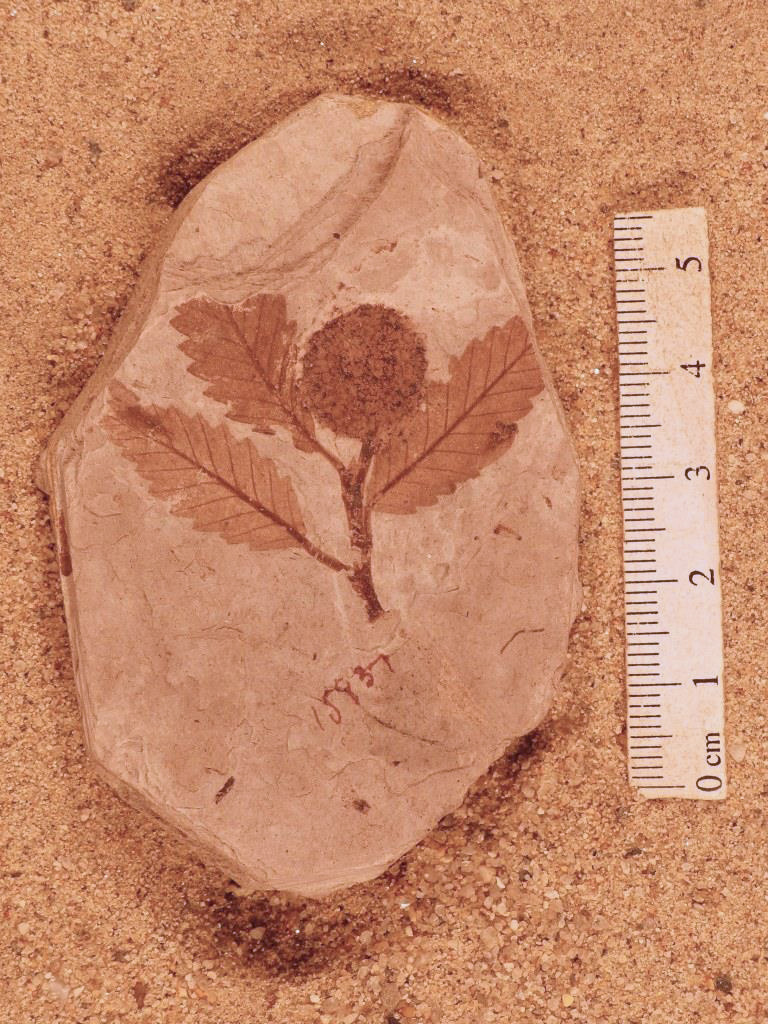
The flora likewise contains many familiar taxa — redwoods, poplars, pines, hickories — but it also contains some enigmatic extinct species. One such puzzle is Fagopsis longifolia, a tree that may belong to the Fagaceae. If this interpretation is correct, Fagopsis is kin to the modern oaks and beeches.
The following remarkable fossil shows Fagopsis with attached leaves and a fluffy ball of staminate inflorescences (i.e, the “male flowers,” bearing the stamens that produce pollen).

Fagopsis longifolia. Division of Paleobotany, YPM 30249. Copyright 2014, Peabody Museum of Natural History, Yale University, New Haven, CT. All rights reserved.
The separate pistillate inflorescence (the “female flower”) is also beautifully preserved.
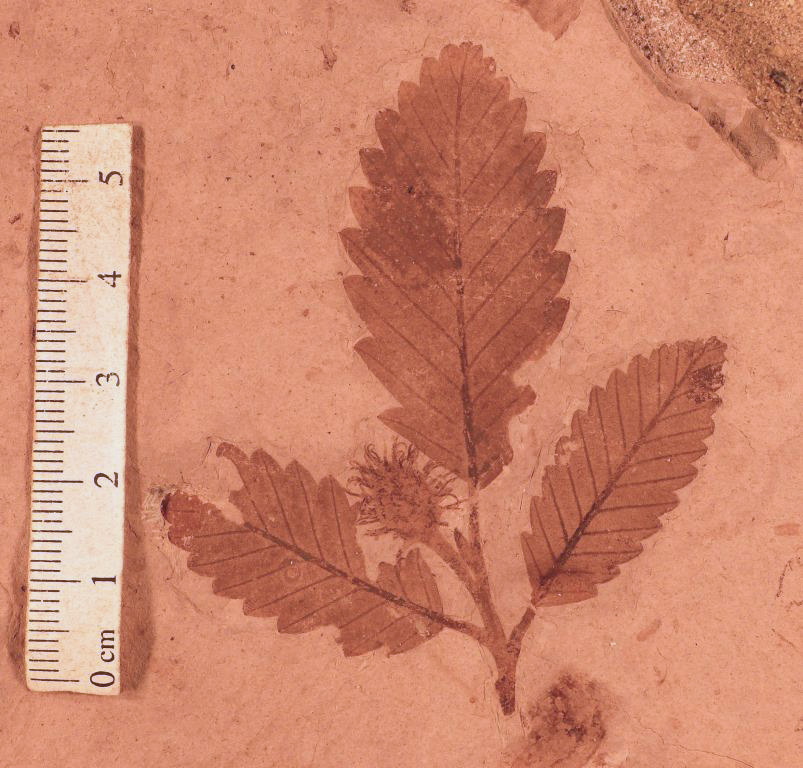
Fagopsis longifolia. Division of Paleobotany, YPM 30121. Copyright 2014, Peabody Museum of Natural History, Yale University, New Haven, CT. All rights reserved.
Here is a close-up of the same specimen, showing the details of the long styles.

Fagopsis longifolia. Division of Paleobotany, YPM 30121. Copyright 2014, Peabody Museum of Natural History, Yale University, New Haven, CT. All rights reserved.
The most comprehensive treatment of the Fagopsis is Manchester and Crane‘s analysis of the leaves, flowers, fruits, and pollen of the species. It was therefore a privilege to examine the fossils with Peter Crane and to learn that the species still presents something of a puzzle, not fitting neatly into any modern group.
My thanks to Peter Crane, Shusheng Hu, Susan Butts, Derek Briggs, and Rick Prum for their welcome and assistance at the Museum. If you’re in New Haven, I strongly recommend a visit to the museum.
The Forest Unseen audiobook from Tantor
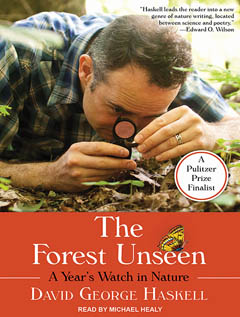
Unseen it may be, but it will not now be unheard. Tantor Audio has just published an audio edition of The Forest Unseen, narrated by Michael Healy. I have not yet listened to the whole reading, but the parts that I’ve heard are great.
You can hear a sample, buy the CDs or mp3s, and hear some clips from the woods on Tantor’s website.
Cover art for the CD case, with Buck Butler’s great photo making another appearance:
Icy
I’m in northwestern Ontario, paying a visit to some long-buried ancestors. As a bonus, I get to experience some chilly weather
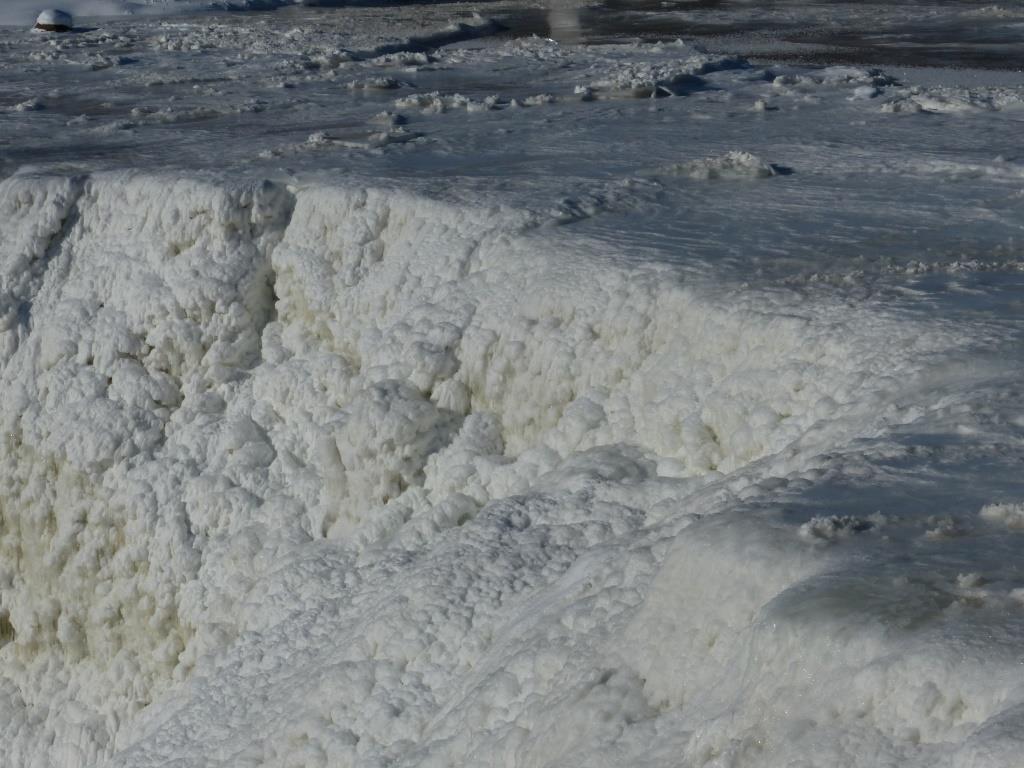
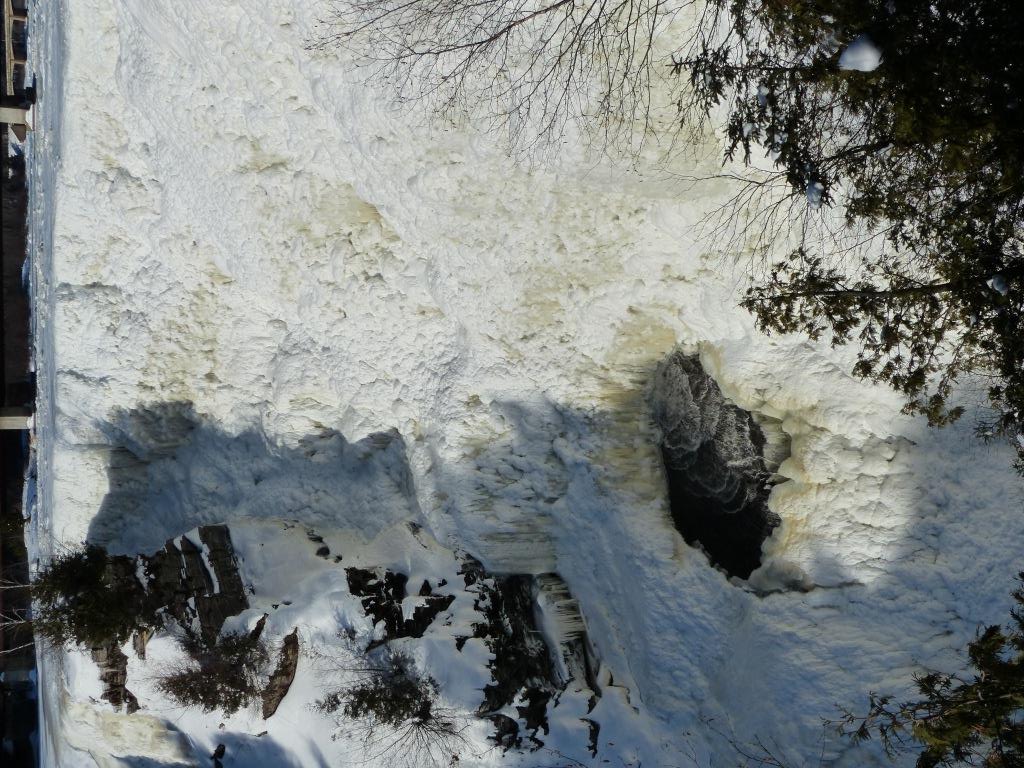
Here’s what happens to a waterfall in a chilly breeze at -25 (-13 Fahrenheit):

Some of the upstream river is still unfrozen and it slides behind the “ice falls,” briefly appearing in a pool below, before diving back down.
All this is very impressive, but the birds and mammals are even more staggering. Chickadees bounce among the branches, a goshawk chatters, ravens wing by, and red squirrels are out foraging. I took off my gloves (idiot) to snap a few bird photos. One minute later, the wind and cold did their work and I lost all feeling in my thumb. Its skin still tingles, hours later.
I salute you, boreal masters of mikwan, ice.
Blue homunculi invade the woods
The Ad Council and the US Forest Service evidently could not find a single charismatic native species with which to advertize the Southern Appalachians forests, so they imported Belgian cartoon characters and released them into the woods near Chattanooga. They photographed the results of this reckless transplant and, for the edification of us all, hoisted their snapshots onto a billboard. Walking in the strip mall, we cast our eyes to the heavens and are exhorted to get out and see some Nature-Sony. (The woods are now co-branded with Sony pictures, where movie ads are PSAs.)
Without a hefty dose of smurfshrooms, people are gonna be disappointed. Thankfully, anti-semitic, misogynistic, blue commune-dwellers are rare creatures in the forest.
But asinine illusions scrawled on billboards? Ah, there’s an American species that our institutions can get behind.
A sound: Ed Abbey snorts from his grave.
A dream: vultures on the billboard; a stucco of guano.
Ice flowers in Shakerag Hollow
The temperature dropped to minus five last night (minus twenty for disciples of Anders Celsius), the coldest that I’ve seen in Sewanee. I took a walk in Shakerag Hollow this morning to see how the woods were faring in this unusual chill. I’ve never experienced such silence here. The quiet was punctuated by woodpeckers drilling meager breakfasts from high in the canopy and trees occasionally snapping out gunshot sounds as their wood shattered. No sign of wrens, titmice, chickadees. The forest floor was mostly clear. Only a few deer tracks. Most birds and mammals are in hunker-down mode.
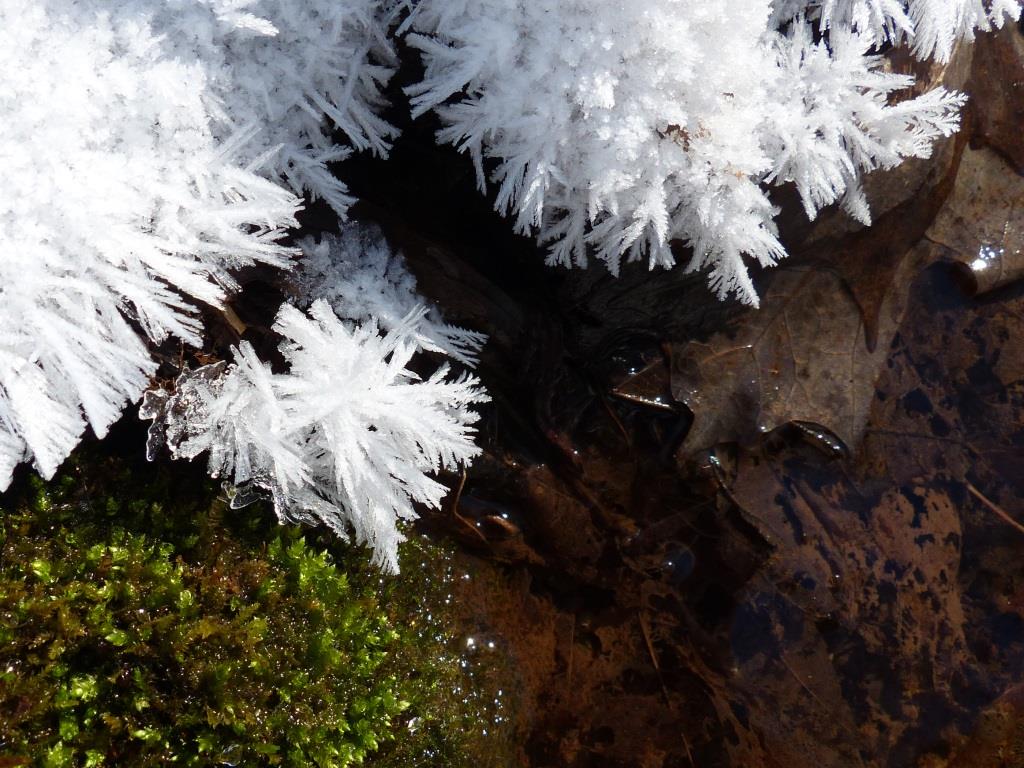
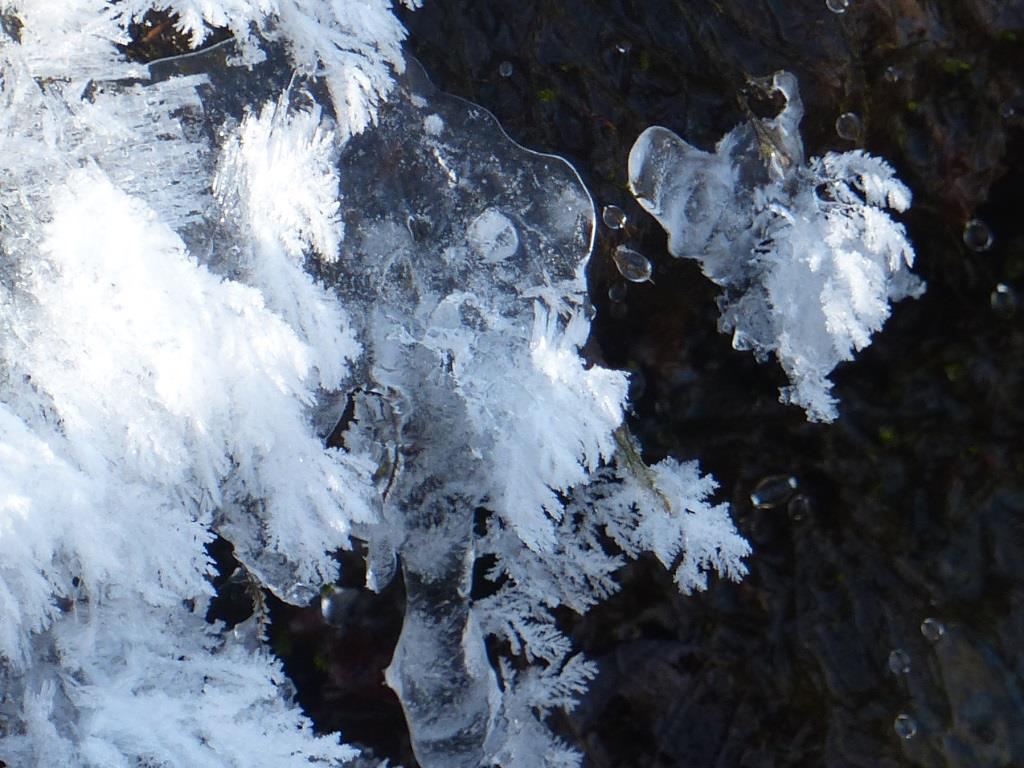
Amazingly, given the cold, the springs were still running. This flowing water created some beautiful ice formations on the rocks all around. When water vapor rises from the stream, it hits cold, dry air. This is an unstable mix, ripe for an encounter with a pointy nucleation site: an icy strand of moss or rock edge. Once they get started, these crystals build on themselves, growing “flowers” from the air. An icy foreshadow of the spring ephemerals? The largest ones are a couple of inches across. Similar formations are found in polar seas and host very unusual communities of bacteria.
So welcome to Tennessee, Polar Vortex. Here are your blooms:
Happy 100th Birthday, Lewis Thomas
Lewis Thomas was born one hundred years ago today (thank you, Writer’s Almanac for spicing your daily poetry with these biographical seasonings).
By happy coincidence I’m currently re-reading The Medusa and the Snail, taking great pleasure in Thomas’ wit and insight. Warm-hearted irony leavens what might otherwise be heavy discussions of science, ethics, and humanity’s place in the biological world. Although his words are now forty years old, they illuminate many of our modern preoccupations: genetic engineering, the importance of biological networks, the beauty and mystery of evolution, and our endless paradoxical capacity for both destroying and ennobling the world.
Here is a short excerpt from The Medusa and the Snail, an essay titled The Youngest and Brightest Thing Around (Notes for a Medical School Commencement Address), in which Thomas reflects on Homo sapiens’ relationship with the rest of the community of life:
And now human beings have swarmed like bees over the whole surface, changing everything, meddling with all the other parts, making believe that we are in charge, risking the survival of the entire magnificent creature.
…
Mind you, I do not wish to downgrade us; I believe fervently in our species and have no patience with the current fashion of running down the human being as a useful part of nature. On the contrary, we are a spectacular, splendid manifestation of life. We have language and can build metaphors as skillfully and precisely as ribosomes make proteins. We have affection. We have genes for usefulness, and usefulness is about as close to a “common goal” for all of nature as I can guess at. And finally, and perhaps best of all, we have music. Any species producing, at this earliest, juvenile stage of its development — almost instantly after emerging on the earth by any evolutionary standard — the music of Johann Sebastian Bach, cannot be all bad.
For more on Thomas, The New York Times obit has some interesting stories and context.
Late-blooming catchflies (and STDs?)
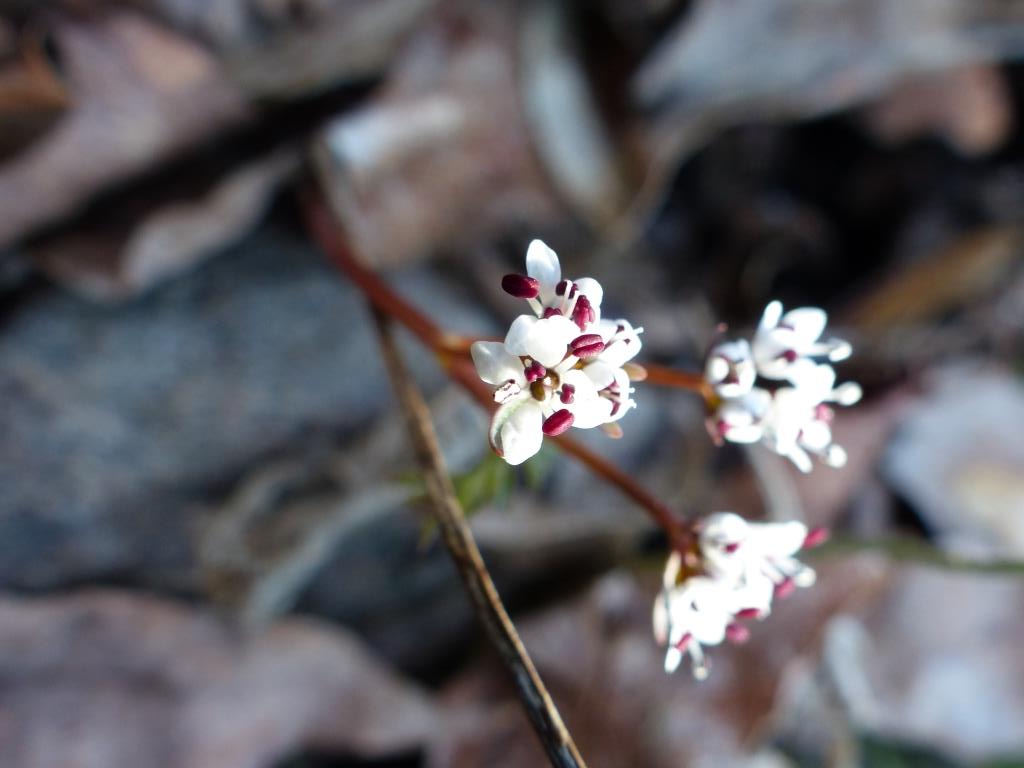
The south-facing sandstone cliffs of the Cumberland Plateau soak up heat all summer, then bathe the early winter forest in emitted warmth. Trees close to the cliffs keep their leaves for weeks after others have turned bare. Joseph Bordley and I took a walk along the cliffs yesterday to see what might be stirring. One of our finds were these round-leaved catchflies, Silene rotundifolia, growing out of cracks in the rock face. They’re still in bloom, although their pollinators (mostly hummingbirds) are long gone. A phenological time warp in the cliffs’ bubble of heat?
These plants might have caught more than flies. The anthers seem too fuzzy and purple for normal pollen. I’d welcome insight from botanists: does this look like normal Silene to you? If this is an infection, anther-smut fungus is the culprit.

The smut fungus infects cuts off the normal process of pollen production and converts the anthers to fungus spore factories. The spores are purple, hence the species name Microbotryum violaceum. The ovaries are also destroyed or damaged, so the plant is sterilized by the infection.
Microbotryum smut fungus is a sexually-transmitted disease, the gonorrhea of flowers. As bees, flies, or hummingbirds move among flowers they carry with them not just pollen, but unwanted fungal colonists. The pollinators’ promiscuous feeding habits makes them ideal transmitters of disease, poxed Don Juans that plants cannot turn away.
A study of herbarium records found that incidence of the fungus has increased over the last century in two closely related species, S. virginica and S. caroliniana. In Europe, the fungus seems to have spread northward after the last ice age, following its host plants as they expanded their range. Whether that is also true in North America is not known.
Apparently, the disease has not been found in S. rotundifolia, so I’m particularly keen to hear from readers who can comment on whether or not the anthers in the photos above are infected.
Bibliography:
Antonovics, Janis, Michael E. Hood, Peter H. Thrall, Joseph Y. Abrams, and G. Michael Duthie. 2003. “Herbarium Studies on the Distribution of Anther-Smut Fungus (Microbotryum Violaceum) and Silene Species (Caryophyllaceae) in the Eastern United States.” American Journal of Botany 90 (10) (October 1): 1522–1531. doi:10.3732/ajb.90.10.1522.
Vercken, Elodie, Michael C. Fontaine, Pierre Gladieux, Michael E. Hood, Odile Jonot, and Tatiana Giraud. 2010. “Glacial Refugia in Pathogens: European Genetic Structure of Anther Smut Pathogens on Silene Latifolia and Silene Dioica.” PLoS Pathog 6 (12) (December 16): e1001229. doi:10.1371/journal.ppat.1001229.