Yearly Archives: 2012

Sad times in Shakerag Hollow

The drought has broken here in Sewanee, welcome news for most of us. But rain brings life only to healthy soil. Moonscapes and other bare-earthed areas are quickly scoured away. The rain’s clear blessing turns to choking brown sludge. This, regrettably, is what appears to have happened in a couple of the streams that feed off the golf course construction site into Shakerag Hollow.

The vigorous bulldozing and earth-moving that has raised huge clouds of dust into the air above Sewanee all summer has left large swaths of soil uncovered. A modest rain storm (not hard enough to flood my garage — my informal metric of severity) turned these areas to gullied mud pits. The water that ran off the construction site ran dark as chocolate milk.

The little barriers that were erected were totally inadequate for the job. They ran cross-ways to the streams’ flow and were quickly breached. Boards placed in rivers do not cause the water to stop; fabric placed across a torrent of muddy water has about as much effect.

I’m deeply saddened by this turn of events. Numbed, in fact. Downstream is the forest that E. O. Wilson has lauded as one of the South’s most spectacular. When he received his honorary degree here, he said: “This morning I was able to visit Shakerag Hollow…It is a cathedral of nature, more valuable for the history it preserves, millions of years, than any building.  It’s irreplaceable…I’m reminded of my friend John Sawhill, the late director of the Nature Conservancy. He said that society is defined not just by what it creates, but by what it refuses to destroy.”

This is not just the opinion of an out-of-town biologist. Several years ago, hundreds of members of the Sewanee community joined in the largest grassroots environmental fund-raising effort to that date, raising over $150,000 to protect the north slope of Shakerag.

So, the golf course debacle raises serious questions about how and why we got into this mess. But I am confident that the leadership that we have at the University will step up and respond to this in a way that not only corrects the problem (as much as is possible, one cannot unbury the streams and call back the stream creatures choked by the erosion), but looks to the future to make sure that we have a zero tolerance policy for this kind of destruction.

Some suggested steps that would help to increase confidence that we are indeed headed in that positive direction:

1. Make public the video of the failure of the “erosion control” mechanisms. This is an incredible opportunity to let this event not only change Sewanee’s policies, but to spread the educational message beyond the gates of the University’s land. Releasing the video will also go a long way to convincing people that we take seriously our responsibility as educators: facing the facts with complete transparency.

2. A public report about how we got to this sad place. What do the architects, contractors, and overseers have to say about this? What will be learned? The Sewanee website states that the project “will be in the capable hands of Hanse Golf Course Design, Inc. Founder and President Gil Hanse, whose reputation for artistry, craftsmanship, and personal attention earned him Golf magazine’s 2009 Architect of the Year Award.” Further, the new design will include “environmentally sustainable features that will both enhance the challenges of the course and preserve the delicate ecosystem of the Cumberland Plateau.” This, therefore, is another opportunity for reflection and education.

3. A new policy and set of enforcement mechanisms to ensure that we don’t repeat this tragedy. Every major project over the last couple of decades has resulted in erosion problems (some major, some minor): the Fowler Center, The Chapel of the Apostles, McClurg Hall, the airport expansion, Spencer Hall, and Snowden Hall. Community members, faculty, staff, and students have in each case asked for better safeguards. Evidently, we’re not there yet. But we could be. We have a strong group of leaders at the University who have a commitment to environmental responsibility. We should support them in their efforts to move forward.

I posted a short message on Facebook earlier today about my sadness. The response has been overwhelming both on Facebook and on email. Most people are just stunned or want more facts (information that I hope the University will provide). But there is also a lot of anger. Anger is understandable, but it is destructive in its own way: a mental flow of muddy water that smothers all in its path. Instead of anger, let’s face the facts, mourn, offer mea culpas where needed, fix what we can, then get on with doing the right thing. Pulling that off would be a lesson worth learning.

[Addendum added one day later: the University’s initial statement regarding this problem is here. “We will solve this issue in a way that is not only exemplary, but permanent,” said McCardell.]

[this is a personal blog, opinions here are my own]

A “must read” from Bill McKibben…

in Rolling Stone. McKibben has written what is, in my opinion, one of the more important and disturbing essays of the last few years. He lays out an unvarnished summary of where we stand with the destabilization of the climate. Where we stand is shameful and frightening: we’re locked in for disastrous changes to the climate and, worse, show every sign of moving full speed toward not only disaster but calamity, a “a planet straight out of science fiction.” McKibben’s unflinching words are, in my limited experience, a pretty fair reflection of what scientists are thinking. The essay is well worth your time.

So how to respond to this sobering reality check? I suspect that this is the question that we’ll be asking a lot in the coming decades. Maybe Jane Goodall’s thoughts are relevant. She has better reason than most to give up on this broken world — the animal species and ecosystems that she deeply loves have been pushed to the edge of annihilation before her eyes. Yet she responds with hope. That hope is easy to dismiss as mere fatuous or fluffy salve, but I think it reflects something deeper. The short time that I’ve spent in McKibben’s company showed me the same: against long odds, hope.

Reflections on The Forest Unseen

The Sewanee Magazine’s summer issue includes an article in which I offer some thoughts about my book, The Forest Unseen, and its relation to science, contemplation, and teaching. I’m delighted with the article’s layout and I’m particularly honored to have my photos of Shakerag Hollow featured alongside those of my friend and former student Stephen L. Garrett.

Thank you to Buck Butler for inviting and editing this essay. I’ve posted a pdf of the piece on Issuu.

Thoreau went to the woods to suck out all the marrow of life. I, too, wanted to learn what the woods had to teach, but my teeth are weaker, so I worried at the gristle, gradually gnawing my way into Sewanee’s bones…

Goodbye loggerhead sea turtle hatchlings…see you in the year 2042

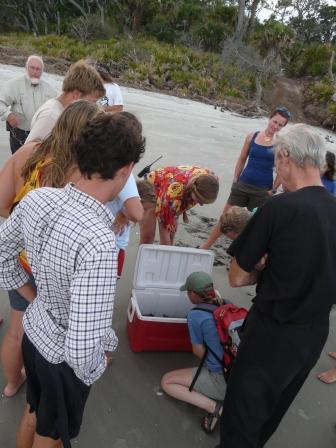
Two nights ago, Gale Bishop has his colleagues at the St Catherine’s Island Sea Turtle Conservation Program were kind enough to invite the Sewanee Island Ecology Program crew along on the year’s first release of baby turtles. These little hatchlings all came from the same nest, a nest that was dug out by hand (not flipper) to save it from a predatory ghost crab that had started to munch its way through the clutch. The crab got three; one hundred and fourteen were released.

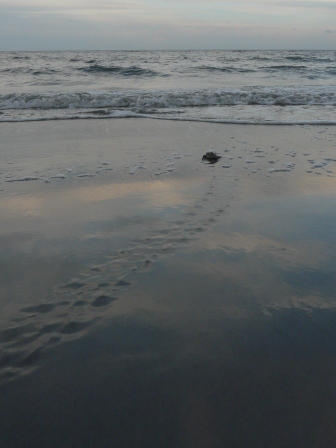
The turtles were kept through the day in a cooler (to keep them at the temperature of their sandy nest deep in a dune), then taken to the beach at sunset. This timing mimics the natural rhythm of hatching: the youngsters emerge at night when they are a little safer from the heat of the sun and from beach-hunting predators. They dig their way out of the nesting burrow high on the beach, then crawl down the sand (they all know which way to go) into the breaking surf. Once in the water, the turtles swim away, surfacing for gulps of air, then head out to the open ocean.

Many of these young turtles will follow the Atlantic gyre, passing Iceland, then Northern Europe, then Portugal, the Azores, finally ending up in the Sargasso Sea where they will live until they reach sexual maturity in about thirty years. Some will avoid the swirl of the Atlantic and swim directly to the Sargasso Sea. The “long and perilous journey” cliché applies here: one in a thousand will survive to breed. When mature, the females come back to shore to lay their eggs; the males never again set foot on land.

So if I’m lucky enough to reach my seventies, I’ll make a return trip to this island. If the hatchlings survive natural predators, legions of fishing boats (up to thirty massive shrimp trawlers at a time off this beach alone), and an ocean filled with tangling, choking garbage, I’ll greet again the turtles that we released onto the beach today. What will the beach be like in thirty years? It is presently eroding at two meters per year, a rate that will accelerate in a world with warmer, stormier, higher seas. But I hope some sand will still be here to greet the mothers as they crawl ashore.

Letting these youngsters go was an emotionally charged occasion. Turtles are ancient creatures, one hundred and forty million years on this OceanEarth, older than the flowering plants, older than most dinosaurs and mammals, and older than Homo rapaciens which has been around for a mere turtle’s blink, two hundred thousand years. Yet in the short time that humans have been here, we’ve pushed all sea turtle species to the edge of extinction. The vulnerability of the little hatchlings and the long long odds that each one faces, odds worsened considerably by the gutted state of the oceans, is profoundly sad. But the vigor and determination of the little turtles is an incarnation of hope, optimism scribed in turtle flesh: damn the odds, I’m headed down this beach with flippers whirring, then I’m taking to the dark ocean with gusto to swim into my fate. All this produces a powerful combination of feelings and thoughts in the watching bipeds. Several of us had tight throats and drops of ocean water in our eyes as we watched the turtles leave.

The photos below include a few from earlier in the week to illustrate the nesting process, then some of the release.

Tracks left in the sand by a mature female ascending the beach to lay her eggs. They do this at night when heat and predators are less of a problem.

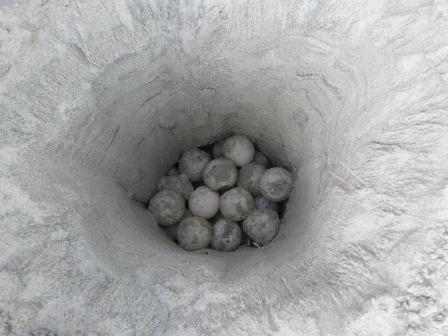
Loggerhead turtle nest. This one is being moved upshore to keep it out of the drowning high tides.

The nest chamber is dug by the female with her back flippers.

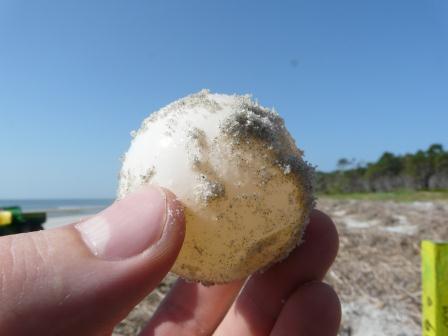
Loggerhead sea turtle egg. Unlike many reptilian eggs, sea turtles egg shells are partly calcified, giving them the feel of a bird egg.

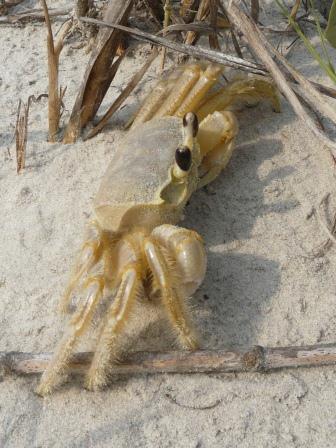
Ghost crab — they live in deep burrows and love to eat turtle eggs.

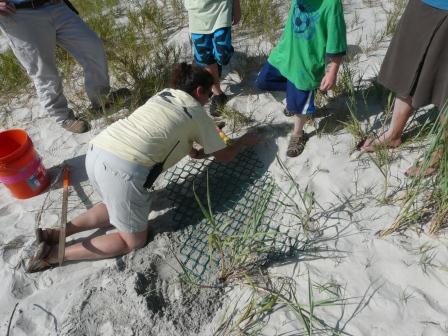
The new nest site is protected with a wire mesh. This keeps raccoons and feral pigs from digging up the eggs.

The cooler of turtles arrives…

…and is admired.

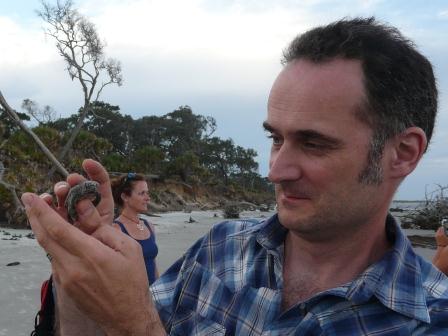
Loggerhead-to-head

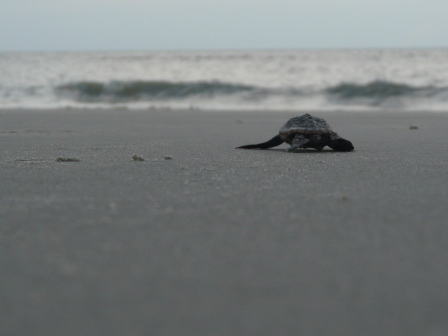
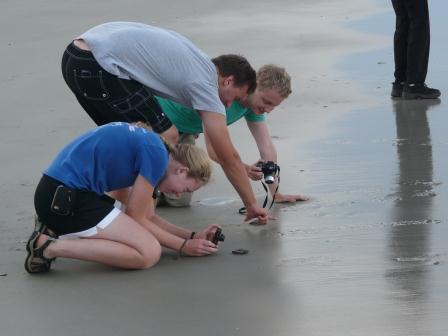
The following photographs are from the release of the turtles onto the beach. The hatchlings propel themselves down the beach on their flippers, then get caught up in the breaking waves.

Ring-tailed lemurs

A small population of ring-tailed lemurs lives on the north end of St Catherine’s Island. The animals are descendents of a handful of ancestors that originally lived in the Bronx Zoo and Duke University. The lemurs are free-ranging but receive daily dietary supplements (fruit and “primate biscuit”) and regular veterinary attention. They have been on the island since 1985.

The lemurs’ social behavior is very similar to that found in the wild — they live in matriarchal groups that keep to a home territory. The matriarch and her daughters are usually the dominant animals within the group. Social rank is therefore determined by kinship (and, secondarily, by reproduction — not having babies knocks down a female’s rank). Males are subordinate to females. They live with the group for their first few months, then disperse and try to join other groups.

The lemurs on St Catherine’s are not “tame” (no touching allowed) but they seem to have no fear of humans, frequently approaching very close. This opens the door to interesting studies of their lives and primatologists travel here from across the world to observe the lemurs’ behavior. Most of the animals have individually colored radio-collars. These chunky necklaces appear to cause them no discomfort and allow researchers to track each animal.

This slideshow requires JavaScript.

Clapper Rail

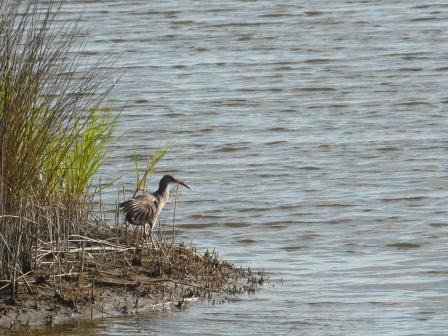
The salt marshes of the Atlantic coast are home to a variety of bird species that specialize on this harsh but productive habitat. One such denizen of the marshes is the clapper rail (Rallus longirostris). This bird is related to the cranes, but is the size of a small chicken. It spends its entire life squeezing through the densely packed vegetation in the marsh, poking around in its hunt for crabs and other mud-loving morsels. Its body is flattened side-to-side (thin as a rail) to assist this movement.

The rail’s song is a chugging, choking, coughing splutter. The Cornell bird site has a recording, but it doesn’t capture the attack and volume of the song. I took a group of students out in canoes yesterday to search for the rails and was impressed to hear the songs echo down the tidal creeks that we were traveling. The low walls of salt marsh vegetation along these creek act like the walls of a canyon and the songs ricochet as they shoot along.

Clapper rails normally keep themselves hidden, but this evening I saw one preening and singing on an exposed mud bank. The photo below show the bird’s impressive beak, a tool used to catch and dismember crabs.

Clapper rails live along the coasts on both sides of North and South America, wherever salt marshes grow. These birds can be quite common in good habitat, but because salt marshes have decreased in extent over the last hundred years, they are not nearly as abundant as they used to be. Despite the best efforts of the legislature in North Carolina (who just passed a law more or less forbidding the sea to rise or, more precisely, asking scientists to stick their heads ostrich-like deep into the eroding sands), the ongoing and accelerating upward creep of the ocean will gnaw away at the rails’ home (and ours — see NASAs interesting animation on this topic).

Sargassum

The seaward beaches on St Catherine’s Island are littered with big clumps of sargassum, a type of seaweed normally found only far offshore. The tropical depression that blasted the island a week ago carried the sargassum toward the land and dumped it in untidy skeins in the wrack line. Some even got carried up into the marshes behind the beach.

Sargassum is incredibly important to the ocean’s ecology. It grows in vast floating mats in the warm tropical currents of the Gulf Stream and beyond, even giving its name to the gyre that sits at the center of the Atlantic, the Sargasso Sea. The mats of algae serve as a breeding ground for eels, the nursery of young sea turtles, the home for legions of fish, and the feeding ground for tropical seabirds. Several years ago I took a boat ride out to the edge of this strange sea-within-a-sea (it has no land borders, being surrounded by other bodies of water and ocean currents). The water and air were torrid; the abundance of sea life was phenomenal, especially the graceful terns that plucked fish from the startlingly blue water.

Algae were not the only creatures trapped and hurled to shore by the storm. This young frigatebird was lying on the wrack on the island’s easternmost point. Frigatebirds are the real pirates of the Caribbean, making their living by robbing gulls and terns of their hard-won prey. This young bird must have been blown out of its tropical home and perished on the Georgia shore, turned to acrid-smelling jerky in the sun’s blaze.

Magnificent Frigatebird (Fregata magnificens)

Gopher tortoises on St Catherine’s Island, GA

I’m spending ten or so days teaching on St Catherine’s Island, a coastal barrier island south of Savannah, GA. The island is swarming with interesting creatures; I’ll highlight just one in this post, with more to follow.

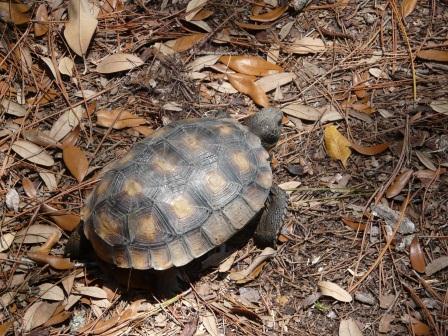
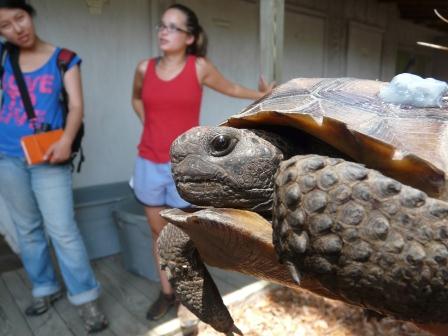
The gopher tortoise (Gopherus polyphemus) is the only “true tortoise” (Family Testudinidae) in eastern North America (the other shelled critters here are all turtles of one kind or another, even the terrestrial box turtle whose kinship is much closer to pond turtles than it is to tortoises). Gopher tortoises dig very long burrows in which they spend most of their time. Some burrows are four or five feet deep and twenty feet long. These subterranean homes help the animals escape the worst of the heat and the cold. They also provide a safe space when fires roar through the open piney forests that is the preferred habitat of the species. These fires help to maintain the savannah-like structure of the forest, but they are obviously also dangerous to resident animals.

The population of gopher tortoises on St Catherine’s came from the mainland. They were moved here when a commercial development destroyed their habitat. Since then, the tortoises here have thrived and bred. They live in a large pasture that is maintained as an open savannah. From the surface, all that is visible are the sand piles around the entrance to each burrow. It is seriously hot here at the moment, so the animals usually stay below in the cool.

Gopher tortoise burrow with apron of sand. The females lay their eggs in this apron.

The hole is tortoise-shaped…

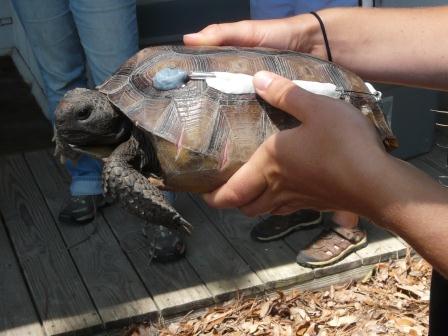
Bess Harris, a graduate student at the University of Georgia, is on the island studying the tortoises. She kindly took some time out of her afternoon to talk about her work and show us some of the animals that she was fitting with radio-transmitters.

This one is eight years old. She/he has many more decades of life to come, hopefully.

The tortoises were surprisingly fast (Aesop never saw a gopher tortoise, it seems) and had to be grabbed and retrieved as they paddled away.

Radio transmitter.

The front legs are flattened: great shovels.

Not only flattened, but strong. A full grown tortoise (about 20 lbs) can out-pull a human hand. This one is only half grown and inflicted no bruises.

Beautiful patterns in the keratin shell.

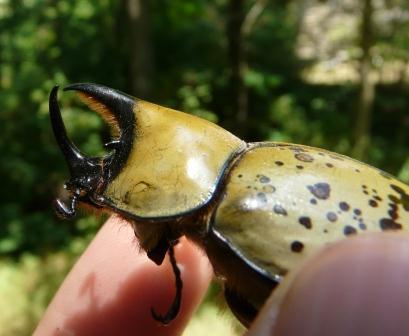
Eastern Hercules beetle — Dynastes tityus

I found this impressive beetle lying dead alongside the trail in Abbo’s Alley. The two large horns identify it as a male. The somewhat fearsome appearance belies the animal’s nature. Hercules beetles are harmless creatures, feeding on rotting wood as larvae (fat white grubs, usually found in dead wood or tree holes) and nibbling on leaves or plant sap as adults. The horns are used as wrestling aides when males tussle during the mating season.