Yearly Archives: 2012

Needle ice, springtails, and sunshine

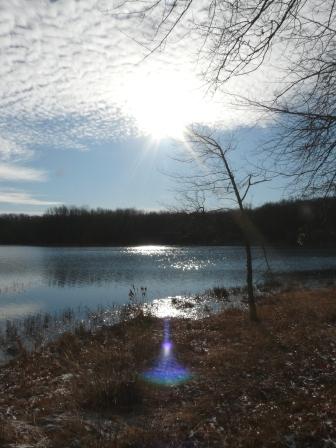
The temperature dipped into the teens last night, so my walk on the new trail to Lake Dimmick was an invigorating one. The trail is not officially open yet, but it runs from the perimeter trail (paved portion) out past the firing range, across JumpOff Rd, then skirts Lake Jackson to get to Lake Dimmick.

Ice needles were abundant on the sandy old road beds and in bare soil around the lake. These needles form when the air is freezing and the water in the soil is still unfrozen. As the aboveground water freezes in the chilly air, it wicks more water up from the soil. The pull of capillary action keeps the water moving upward, creating vertical columns of ice. Soil particles get carried up by the rising ice.

A miniature forest of ice needles

Each column of ice is about six inches tall

The edge of the lake was iced over, but springtails (Collembola) were clustered on the ice and in small pools where water had seeped up. These tiny arthropods (barely visible with the naked eye) use a spring-loaded catapult on their bellies to jump around on the water surface. Springtails feed mostly on decaying plant material and on the microbes that live in the soil. In some habitats, they are the most abundant animal by far, reaching densities of tens or hundreds of thousands per square meter. They are very vulnerable to desiccation, so they hang out either below the soil surface or close to (and on) water.

The sun came out, finally. It has been a full ten days since I last felt it on my face. Welcome back, friend.
The Hermitage…

…named by Andrew Jackson, 7th president of the United States, a man whose life did not manifest much affinity for the usual pursuits of a hermit. His original name for the house was “rural retreat,” so perhaps he always yearned for a little peace and quiet. The site is now not at all rural — Nashville’s growth has encompassed the area with urban and suburban development.

I visited The Hermitage with a group of faculty and staff from a variety of disciplines within the University. We discussed how we might involve our students in the ongoing study, preservation, and management of the site — internships, on-site classes, collaborations.

From an ecological perspective, sites like this provide “green” spaces within the more heavily urbanized surroundings. These areas can, depending on how they are managed, provide habitat for native species, “windows” of natural space in an otherwise human-dominated landscape. Just as important, they provide places where people can connect to the rest of the community of life, something that is not always possible in urban areas, particularly if those areas have not been planned with green spaces in mind. But there is a tension here: places that are preserved for historical reasons, like the Hermitage, are sometimes not open to the general public without a fee. So, unlike greenways, urban parks, and state natural areas, historical preservation sites are often off limits to many people. A management challenge is therefore how to maximize access while protecting the historical value of the site.

Slave quarters (formerly the early Jackson house), with an impressive understory of privet in the forest behind

Turkeys moved onto the site a few years ago and are now abundant, as are deer, groundhogs, and foxes.

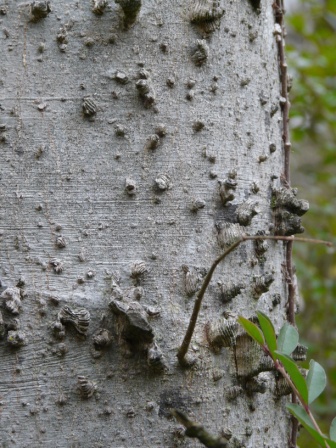
Hackberry is the dominant tree in the forested areas. Its bark is characteristically "knobby" with corky projections

Hackberry

A few years ago, the Hermitage cleaned out this sink hole (>80 tons of garbage). Andrew Jackson's horse was reputed to lie at the bottom. The horse was never found, but when the wind settles down, the smell of the chemicals that were dumped down there wafts up. Humans have been dumping history into this hole for generations.

Jackson did not like to spend money unnecessarily. The columns on the front of the main house are wooden, painted with sand-encrusted paint to make them look like stone. The "marble" inside the house is cleverly painted wood. The "mahogany" doors are faux. Perhaps there is a reason why Jackson was the only president to pay off the national debt...

Music City, early 1800s. The family room.

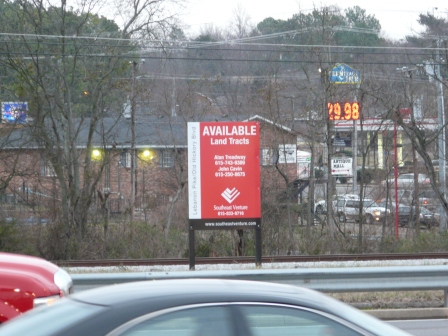
Old Hickory subdivided -- a few steps down the road. The real estate market is not necessarily friendly to green space, although many studies have shown that open spaces not only increase people's quality of life, they improve "home values" as measured in dollars.

Revival (no tent please)

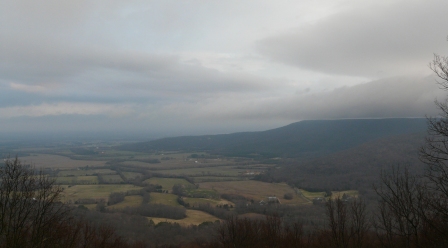
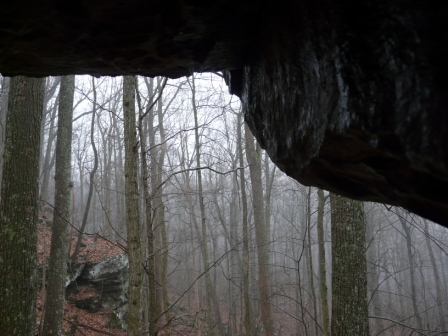
Air from the Gulf of Mexico has come for a visit, bringing warmth, rain, and ever-changing clouds. I took this shot yesterday morning before walking into Shakerag Hollow.

As wet air hits the slopes, it gets pushed up and cooled, making low-hanging clouds that rise and fall slowly, dipping us into and out of the fog.

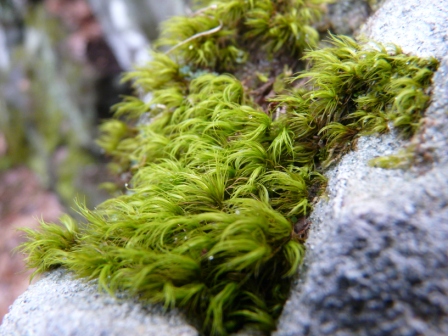
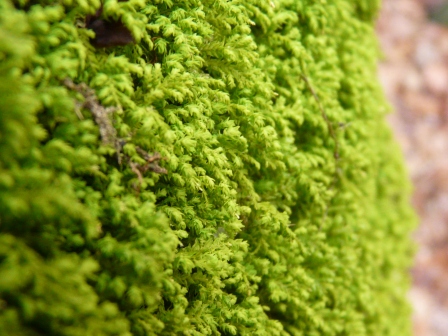
Mosses and lichens love this weather. No tree canopy interferes with their feeding (there is now more light on the ground than in mid-summer) and the gentle rains moisten, plump, and revive them.

They seem ignited, hungry for light. I could dive into their green: alive!

In the heavy rain, I briefly took shelter under a rock overhang.

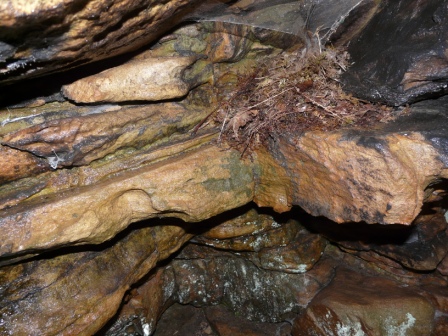
Another species had done the same last summer. This is the old nest of a phoebe, tucked into the back wall. It is lined with dried moss, perhaps plucked from the same clumps of moss that I had been admiring in the forest.

I enjoy a brief soaking in warm rain (is this January?), but Junebug says that the raindrops hurt her eyeballs…


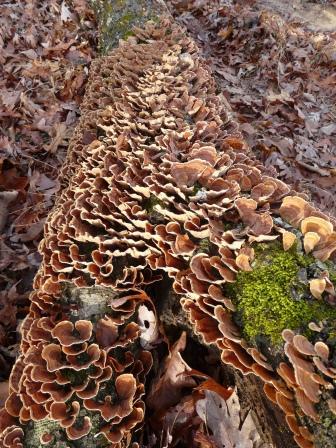
Turkey Tails

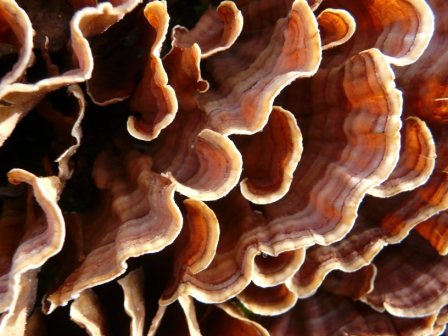
"Turkey tail" fungus, Trametes versicolor

The surface of the downed log is covered -- a spectacular display of hundreds of colorful fungal fans.

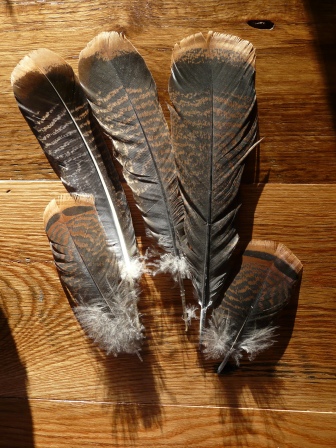
And, for good measure, some real turkey tail feathers. These were "donated" by birds from Lost Cove, just south of Sewanee.

Cranefly orchid

“Midway on our life’s journey, I found myself/In dark woods…lost.” The tangle of old logging roads and abandoned trails north of Kings’ Farm turned me around this morning, adding a half hour or more to my trek. Virgil did not appear. He never does. But, by getting lost, I did stumble on some great little plants: about a dozen cranefly orchids in the leaf litter on the side of an old trail.

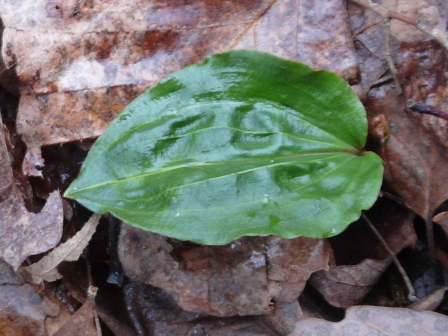
Cranefly orchid, Tipularia discolor

Unlike most other woodland plants, cranefly orchids grow their leaves in the fall, keep them through the winter, then let them die in spring. Later, in midsummer, the spindly flower stalk emerges without any leaves, using belowground food stores to power its growth. So, this orchid’s life is powered by the weak winter sun.

The green, upper surface of the leaves is pleated, giving it a crinkled appearance. More striking, though, is the purple underside of the leaf. Sometimes this purple bleeds into the upper surface, especially later in winter.

Underside of cranefly orchid leaf

This purple pigment is there to protect the leaf on cold days. When the photosynthetic machinery inside the leaf is iced-up, it can no longer absorb the energized electrons that sunlight knocks free from chlorophyll and other green pigments. The purple pigment soaks up these crazed electrons, keeping the leaf’s innards safe.