Yearly Archives: 2012

Ocean

The Pike Place market in Seattle is piled high with seafood, especially seafood from the Pacific. The smell and the look of it make me mighty hungry, like a bear that needs to fatten up on the flesh of salmon. Part of the hunger is for the sea itself, I think. After all, we came from the sea and every cell in our bodies carries the salty water inside, an ionic memory of our ancestry.

So, do we, also, go well with butter and lemon?

Fishes are not the only ocean creatures on display. Invertebrates, especially my friends the molluscs, were also abundantly displayed, some pre-cooked (crabs), some just plain ol’ dead (squid, octopus), and others awaiting the future tucked into their shells (clams).

This slideshow requires JavaScript.

The abundance on display in the fish market belies the state of our oceans. The seas are thinner, diminished. Large predatory fish are down 80% compared to the days before industrial fishing. We take so much from the oceans that we’ve become an evolutionary force, changing the genetic code of fishes. Massive “by-catch” of seabirds threatens the survival of a large fraction of these species. The red snappers in the slideshow above are a good example — many of their populations are a disaster of bad management. These days, much “red snapper” in stores is actually some other species, mislabeled as snapper, thus hiding the truth from us hungry bears.

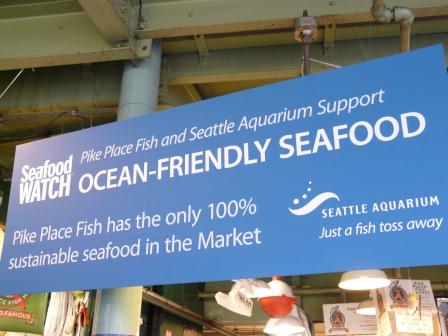
To be fair to the Pike Place folks, much of their seafood comes from Alaska, where fisheries are generally well-managed. And, more and more people care, leading to the following sign over one stall. Hope is the thing with feathers fins.
Kidding #1

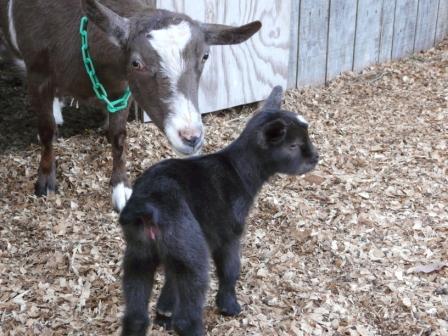
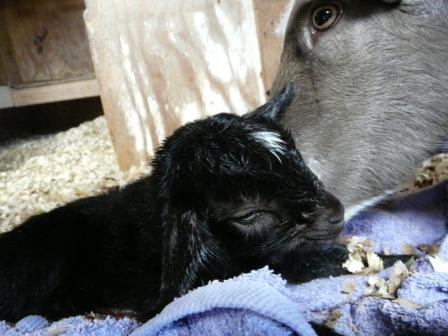
Hazel had her baby this afternoon, the first of the year for the goat herd. Sarah has named the kid Foxglove.

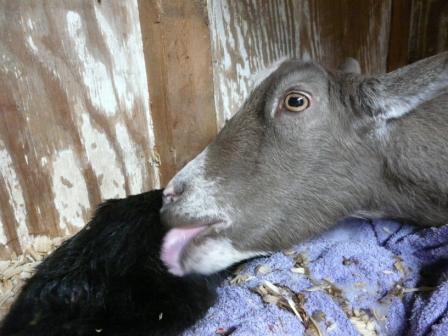
The first thing Hazel did was, like all new goat mothers, to subject Foxglove to a frenzy of licking. This licking dries the kid, stimulates her to get up, and lets the mother know the smell and taste of her youngster. No licking, no bonding. Sarah’s blog has some good video.

Within a few hours, Foxglove was up and about, even trying a few little leaps. She looks to be a strong, sassy one.

Across the path, the two young boys crowded at the fence to see the new arrival. Pretty much anything excites these little guys, so a new herd member about blew their rambunctious minds.

Spuds for St Patrick’s day

The soil temperature is above fifty and dandelions are blooming, so it is time to get potatoes in the ground. I got four rows planted this morning with sprouted seed potatoes from the Farmer’s Coop. “Seed potatoes” are misnamed, they are not seeds but tubers certified to be disease-free and therefore good for replanting. Raising potatoes from actual seeds is almost never done.

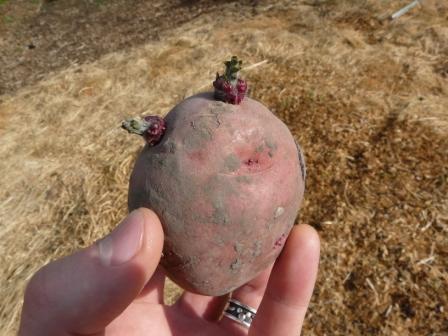
Sprouted potato. When left in the light for a week or two, the potato breaks its dormancy and sprouts little shoots from "eyes." The potato is a swollen stem; the "eyes" are the nodes, like the buds on the side of a tree branch.

Eye-to-eye with a sprouted eye. Baby leaves are visible atop an expanding mass of tissue that will ultimately form the stems and roots of the new plant.

The date came to me as I planted: St Patrick’s Day. Of course, the Irish potato famine also came to mind, a disaster made possible by the combined forces of a genetically uniform potato crop (only one clone, the Lumper potato, was grown, making the crop very vulnerable), an attack by Phytophthora infestans (a water mold), and the policies of the British government.

Phytophthora is still a major pest of many crops worldwide. It caused the massive tomato die-off in the eastern U. S. in 2009. Its disease potential increased recently as new strains arrived in North America and Europe, allowing the species to engage in sexual reproduction (previously it had been breeding only asexually) and thus create new genetic combinations with which to attack its hosts.

The Forest Unseen

March 15th: an auspicious day for killing dictators, aligning planets, and publishing books.

The Forest Unseen hits the streets today (and wiggles its words through wires in e-books).

A couple of quotes from some fellow writers seem well-suited to the moment:

Franz Wright’s poem, Publication Date, starts, “One of the few pleasures of writing/is the thought of one’s book in the hands of a kind-hearted/intelligent person somewhere. I can’t remember what the/others are right now.” Indeed.

Regina Spektor sings, “No, this is how it works/You peer inside yourself/You take the things you like/And try to love the things you took/And then you take that love you made/And stick it into some/Someone else’s heart/Pumping someone else’s blood.” (from On The Radio). Love? Blood? Isn’t this a book about science? Indeed. Bloody, loving science.

I’m honored that my words are in bookstores, in the pixels of the ether-world, in people’s hands, and perhaps even energizing some ventricles. If you’re interested in learning more, the book’s website has photos, a video, reviews (some new ones out this week and more on the way), and information about upcoming lectures and signings.

Next week, I’ll head out for several weeks of lectures, so this blog will be Rambling further afield than Shakerag Hollow, starting with the Pacific North-West next week. I hope to learn some interesting natural history and meet some fellow rambling Homo sapiens along the way.

Another great sign for the Ides of March: this morning, the first Tree Swallow showed up at Lake Cheston.

Shakerag Hollow: spring ephemeral wildflowers

Our campus emptied out this afternoon as spring break began. After a few hours of cleaning the lab, answering emails, and pushing papers from one place to another I finally cracked (or woke up) and set out for the woods to enjoy some reality.

This slideshow requires JavaScript.

Spring ephemeral wildflowers covered the forest floor. In the richer areas, each palm-sized patch of forest had a dozen blooms crowded together. There are few places in the world that rival the profusion of blooms in this north-facing Appalachian cove (and the snails, insects and salamanders that ply the leaf litter below the flowers are equally diverse).

These “ephemeral” wildflowers are hurrying through their flowering and photosynthesizing in the short weeks that remain before the tree canopy steals all their light. But the plants don’t disappear for the rest of the year. Instead, most of them persist underground in roots and swollen stems. So, the “ephemerals” appear to be short-lived, but are in fact many years old, perhaps as old as many of the trees that loom over them.

No canopy = a great opportunity

Evening

Venus and Jupiter swing past each other, but don’t connect. No luck seeing them. Cloudy Sewanee.

To make up for it, about two hundred robins fly right past my face in a storm of dusky wings as the light fails. They are headed to roost in the evergreens.

This week, robin numbers are building as wintering birds from AL and FL move northward. Robins get little respect from birders — too common — but I find their abundance and ubiquity impressive. There are over three hundred million robins in North America. They live in almost every habitat that has trees and some open space (from urban parks, to scrubby deserts, to the edge of the tundra). Tremble, earthworms, tremble.

Toad song

Click below to hear…

…the sweet trill of amorous American toads (Anaxyrus americanus). Half a dozen males have been chorusing in the small pond at our house for the last week or so. For a warty ol’ amphibian, they sure make a nice sound. The recording has several individuals calling, some sweeter than others. Female toads, I’m told, prefer males that can produce low-pitched trills over many hours. I’m not that fussy. Any trill will do: the song of these toads is one of my favorite sounds. Winter is done. The acoustic world expands.

Last night, the male toads were joined by a couple of females. Amplexus ensued and now the pond is festooned with long strings of eggs.

I’m pretty sure the female in the photo above is the same one that has been here the last several years – she’s a rich chestnut color, quite unlike most local toads. She is also about twice as big as the males, a dream-mate because size correlates with egg number, and egg number correlates with numbers of toadlings, and toadlings are what natural selection cares about, and dreams are made by brains, and brains are made by natural selection. Happy slumbers.

The eggs are neatly lined up in jelly strands. Usually these strands are coiled, but they straighten out when pulled out of the water for a photo. The eggs hatch in about a week (depending on temperature) and the tadpoles graze on algae underwater for a couple of months before emerging onto land.

The future.

Down under

Several weeks ago I posted a short homage to the Sign Bandit of Jumpoff Road who had defaced public property with a turtle-honoring artwork. Today, I received a postcard that lifts the carapace on this mystery. Shortly after the Deed was Done, the honorable malfeasants entered the Turtle Witness Protection Program and were relocated south, far south.

Bandidas: you make me proud. If you ever sneak back into this country, a beer awaits you. In the meantime, go find a tuatara. Although New Zealand has no native turtles (a few marine ones visit the coasts), the tuatara more than makes up for it. These lizard-like critters have been lumbering along on their own branch of the evolutionary tree for 220 million years.

I made a drive-by check-in of the installation just to check on its status last night…still there.


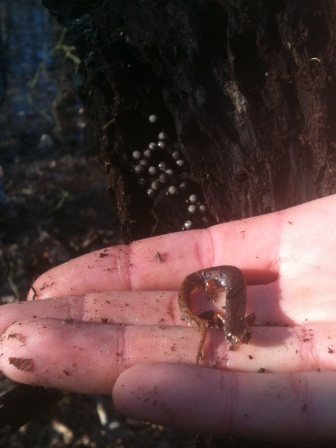
Four-toed salamander with her eggs

This week’s theme seems to be salamanders, perhaps appropriate given that it is early springtime in one of the world’s hotspots for amphibian diversity. (An aside: when will TN sports teams figure this out? Titans, Predators, Kats, Tigers = yawn; Cave Salamanders, Spadefoot Toads, Barking Treefrogs, Mudpuppies = oh yeah, very memorable). I stopped by the Brakefield Rd ephemeral wetland this afternoon with the “Field Investigations in Biology” class. We found larvae of marbled salamanders, an adult mole salamander, and this four-toed salamander (Hemidactylium scutatum) guarding her eggs.

Her eggs are visible on the underside of the log which we temporarily lifted up to take a look. She'll stay with them for about two months, defending them from predators and keeping fungi at bay. The young will hatch, then move to the adjacent pond for a month, before finally taking the woods for the rest of their lives.

Four-toed salamanders are relatively small, with mottled brown backs and a constriction at the base of their tails.

All four-toed salamanders have bold black spots on their white bellies -- very distinctive. (We flipped her back upright after this five second demonstration of her spotty belly.)

This species builds its nests at the edge of ephemeral pools, in sphagnum moss, and along stream banks. Because of its specialized habitat requirements, it is listed as “vulnerable” and “in need of management” in Tennessee.

I did not have my camera on me, so special thanks to Julia Galliher who took those photos with her phone. (iPhones are this week’s subplot on the blog, it seems)

Microsafari bycatch

Our search for the mini-creatures of the world also turned up some interesting macro-organisms. Spend a few hours in the woods with a bunch of biologists and you’ll see a good array of remarkable critters. Here is a selection.

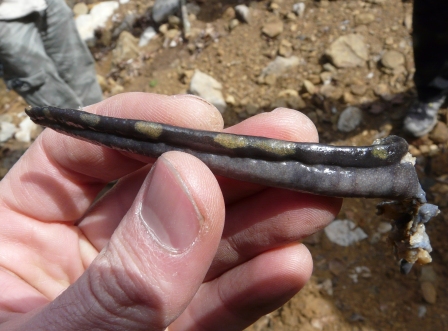
Zigzag salamander (Plethodon dorsalis/ventralis -- can't tell which without a DNA-o-tron), found under a limestone slab. This species is strongly associated with karst limestone, especially along streams and near springs. The females lay their eggs in caves and brood the eggs until they hatch. These are long, skinny salamanders, like pencils.

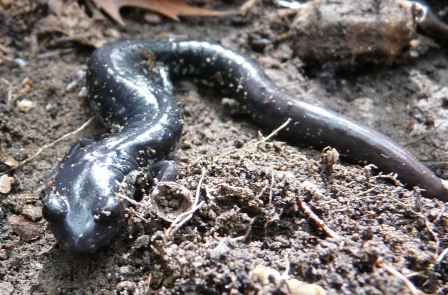
Slimy salamander (Plethodon glutinosus), also found under a rock. Black with silver spots: beautiful. When handled, they produce gluey defensive slime that gums up your fingers.

Admiring Plethodon glutinosus

...and slimy makes her escape

Box turtle (Terrapene carolina) shell. The colored plates are made from keratin, the same material as our hair and fingernails.

The same turtle shell seen from below. The animal’s spine is visible and, above that, the carapace which is made from fused ribs combined with dermal bone. So, evolution has flipped the ribs of turtles onto their backs and fused them into a solid plate.

The tail of a spotted salamander...evidently a raccoon or some other predator ate well. We found spotted salamander eggs in a nearby pool, so life goes on, the torch has been passed, etc, etc ...fill in your own favorite death-surmounting cliche here...

Hepatica nobilis. Most Hepatica here are white or pale purple. This one was unashamedly ultra-purple. Yeah, the torch got passed to this one alright.

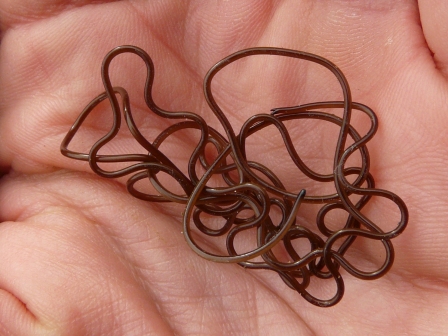
A nematomorph, also called a “horsehair worm.” These are parasites inside the bodies of insects. When the worm is ready to exit, it causes its host to jump suicidally into water, then the worm rips open the insect and emerges. These lovely critters feature in the first chapter of my book, The Forest Unseen -- nematomorphs surely embody one pole of nature’s range of cooperation and conflict.