Yearly Archives: 2012

Mountain laurel pummels bees

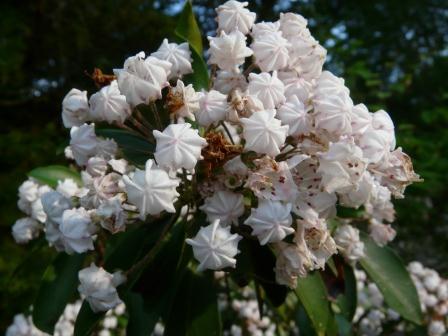
Mountain Laurel (Kalmia latifolia) is in bloom on the dry ridges and steep slopes around Sewanee.

Its closed blooms look like piped icing:

And open to reveal purple and pink within:

The center of each flower has a pollen-receiving pad, the stigma, surrounded by ten filaments that curve out from the center. At each filament’s tip is an anther, a little purple pouch of pollen. These anthers are lodged inside pockets at the edge of the flower. The filament elongates as it grows and pushes against this pocket. When a bee lands on the flower, the anther is jostled out of its pocket and the tension in the filament causes the anther to spring upward, slapping the bee with a dusting of pollen. You can mimic this action by prodding the anthers with a small twig. The pollen shoots out for several inches. Very amusing, I find. If no bee or human comes along, the anthers will eventually rise up and dust the stigma with pollen, ensuring fertilization.

Imaginings of avian reincarnation

At the end of the final exam in my Ornithology class, I ask the students, “If you could come back as a bird, which species would you choose and why?” No grades for this question… The diversity of answers is always interesting. This question can be taken in a number of ways: which bird most represents something about who you are, which bird most represents something about who you’d like to be, or which bird offers something to you now that you find compelling, amusing, or interesting?

I’ll list summaries of student answers below, then offer my own thoughts.

Student answers:

Wood thrush – for Thoreau

Oystercatcher

Blue-footed Boobies — because they are called blue-footed boobies; I’d choose the mate with the silliest foot-waving dance.

Arctic tern – they migrate between hemispheres; it is always summer for them.

Brown pelican – great life on the ocean

Owl – great songs; they are so quiet; come out in the evening, my favorite time of day.

Turkey vulture – they eat well and I could terrorize people with my unholy hissing sound.

A crane – to migrate and see the world; protected from hunters; I’d be tall and have few predators.

Peregrine falcon – amazing speed, control, and acute senses.

Whatever that bird was on the Life of Birds video that actually enjoyed sex.

Osprey – aerial and aquatic superiority, and a vision of the future…

Cedar waxwing – roll deep with a huge posse and get drunk off of berries while looking like a superhero/bandit.

Wood thrush – they make the most beautiful sound, magical, mysterious.

American crow – they do pretty well as a species (apart from West Nile virus); I like the idea of a family unit; fly high and fast.

Barred owl – I like owls, this species is the best looking. I’m not feisty enough to be a screech owl and I don’t have enough Rowan Williams in me to be a Great Horned Owl…

Common loon – I really like the song

Lyre bird – the ultimate song learner. Amazing feathers.

Spotted owl – neatest looking birds (soft and fluffy while also being murderous and cunning); I could stand in the way of deforestation in the NW, a beautiful place; no long migrations; people would be happy to see me; rad call.

Cedar waxwing – love their song and their appearance, especially the bar stripe through the eyes.

It heartens me to see how many of these answers refer to sound. Developing acoustic awareness is a big part of this class.

Here are my responses. I write the exam and the blog, so I get to bend the rules and choose three different species. A divided afterlife? Why not? I picked these three for the physical experience of the world that they would offer my body-jumping soul.

Wandering albatross – the purest experience of air possible, winging for hours without a flap of the wings, caught in the strength of the endless south polar winds; alone for months with ocean, salt, wind, and a gray horizon that never resolves into land. I can feel the streaming cold air in my nostrils already. A meditation.

Mousebird – a life tumbling in a flutter of sociable activity, my flockmates always close; we gorge on fruits and flower buds, then recline in the sun to let its warming rays toast our bellies, chattering all the while. Conviviality.

Winter wren – an unassuming bird, at home in the undergrowth, half bird half mammal. My song slices open the forest air and the moon pours out, splintered into a million pieces. My heart breaks at the beauty of the flowing air in my throat. An exaltation.

Of course, beyond these dreams, the task for today is to want to be who we are. As Oscar Wilde said, “Be yourself; everyone else is already taken.”
Skullcap and Catchfly

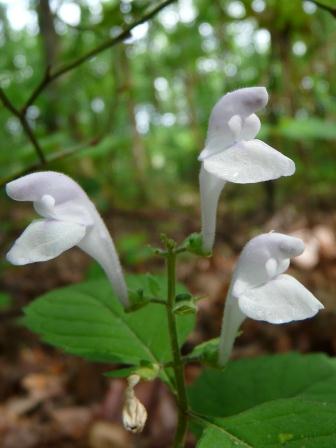
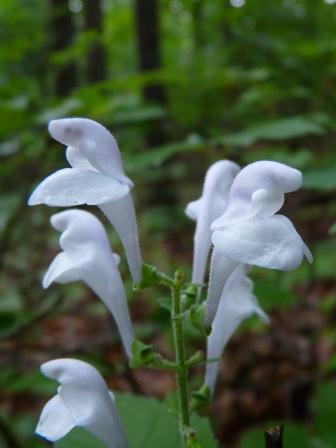
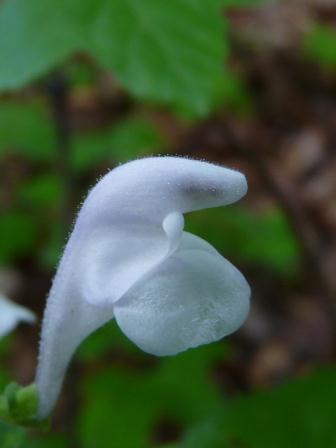
I ran into a small cluster of Showy Skullcap, Scutellaria pseudoserrata, on the trail that winds through a dry upland oak forest in Sewanee (for local readers: the perimeter trail, north of the memorial cross). This wildflower grows about a foot fall and has pearly-purple flowers at the top of a slender stem. It was the only herbaceous plant in bloom under the forest canopy. The dry upland woods don’t support the profusion of flowers found in the moist coves, so the these skullcap flowers are visually striking in the otherwise green understory.

The tube leading from the lip of the flower down to the nectar the flower’s base is very long, excluding all but the longest-tongued bees and moths. Keeping the nectar relatively inaccessible saves the plant from giving nectar to insects that are poor pollinators (e.g., ants), but it also means that in many years no pollination takes place at all. In the closely related large-flowered skullcap (S. montana), a study by Mitchell Cruzan from the University of Tennessee reported that “several hundred hours of observation over four seasons suggest that these pollinators may be rare or lacking.” Most flowers either produce no seeds, or self-pollinate. This seems like a dreadfully slow way of propagating the species, but these plants are perennial, coming back year after year, so they don’t have to spew thousands of seeds into the world each year to pass along their genetic legacy. A more open flower might attract more insects, but the costs of such a flower design (wasted nectar and visits from insects that will not visit another skullcap) may outweigh the benefits. Or, an undocumented decline in the local moth and bee populations has left this species high and dry. No way to know for sure.

[Thanks to Mary Priestley and Jon Evans for helping me sort out the difference between pseudoserrata and montana. The latter is found just to our east and has leaves with velvety short hairs all over its upper surface. The species is listed as “threatened” by the USFWS.]

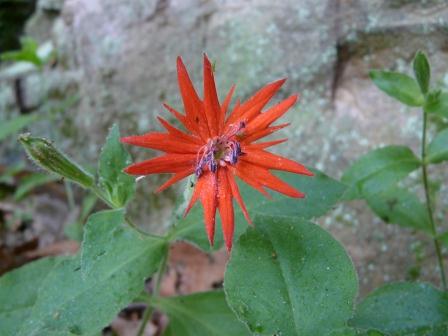
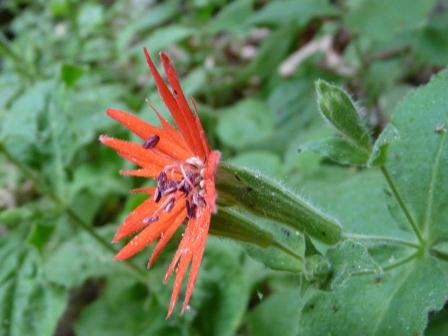
Further along the trail, out of the woods in a tumble of rocks on the cliff edge, I found another showy flower, the Roundleaf Catchfly, Silene rotundifolia. This species’ leaves and petals are covered with sticky secretions that snare wandering insects, keeping them away from the flowers’ nectar. This stickiness also catches crud and dust, giving the plant an untidy, unwashed appearance. My Horn et al. wildflower book (an excellent guide in almost every way) tells me that “flying insects” are the pollinators, but I doubt that. The bright red flowers, splayed open and pointing skyward, strongly suggest that hummingbirds are what the plant seeks. A quick search on the web confirmed this suspicion, at least for the look-alike Silene virginica.

Back to 6th grade

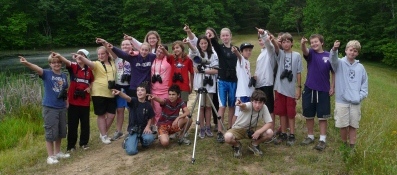
I started the day with an early morning visit to the Saint Andrew’s Sewanee 6th grade campout. Despite the early hour, the energy level was high. The birds were also active: in just a few minutes of quiet listening we heard nearly ten different species, right from the campground. We took a stroll around the lake and into the woods to find some more.

Pointing at a displaying red-winged blackbird. So what if we’re not all pointing in the same direction?

Thank you to Cindy Potter for the invitation to join the group, and to Cindy, Doug Burns, and Reid Fisher who camp out with the students. For many students, this is their first experience of camping. I was glad to learn that the whip-poor-wills had serenaded the campers over night.

Pedaling a mile up

I’m in Denver for a conference, which means lots of time in chilled conference rooms, viewing the world through powerpoint slides. Great stuff, up to a point. Butt and brain give out after a while, so off comes the neck tag (a little frisson of excitement at liberation from group identity) and out the door I go…

I quickly found the Denver Bikes, a bike-sharing program that has bikes for check-out in racks across the central part of the city. Check-out privileges come in daily ($8), weekly ($20), monthly ($30), and yearly ($59) increments. Once you’ve registered at a kiosk (takes about a minute), you can check a bike out from any stand, then return it to any stand. The system is designed for short trips, so check-outs over 30 mins incur extra costs ($1 for an extra half hour, then $4 after that). The bikes themselves are tanks, seemingly indestructible, but surprisingly easy to ride.

Many streets in the city center have bike lanes and they seemed, in my few miles of pedaling, pretty well respected by cars and trucks.

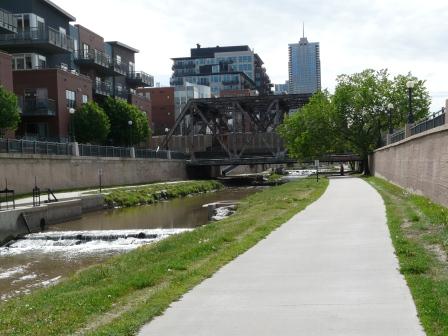
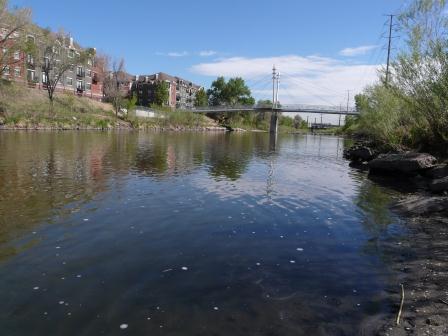
Even better, the city has several bike paths along waterways, so it is possible to go through the center of town and into outlying areas along bike-only paths that wind along running water. Hard to beat. (But stay out of the water — looks great, but bacterial counts are high.)

The best part: avoiding the Denver Boot, an enforcement device invented here in the 1940s by, of all people, a violinist. The boot shown below was put on a car right outside the window of the conference lunchroom. It was very kind of the local police to enliven our dining experience with a historical reenactment of traditional western vehicle wrangling:

[and this news added after I made the original post: bike-share is coming to Chattanooga…]

Rambling on the airwaves

I’ll be on the NPR show To The Best of Our Knowledge this weekend (April 28/29). The program is “Into the Woods,” and I’ll be talking about The Forest Unseen. Also scheduled for the show are Terry Tempest Williams, Stephen Sondheim, Marina Warner, and Stephen Long. I’m very grateful to be included in this line-up, to say the least.

Stations that carry the program and broadcast times are here. WPLN (Nashville) runs the show at 3pm on Sunday on its 1430 AM channel. WUTC (Chattanooga) runs at 12:00 (eastern time, 11am central) on Sunday on 88.1 FM. The show will also be available through podcasts, XM satellite, etc as detailed here.

Unlike previous interviews which have been live and over the phone, this interview was recorded last week in the WPLN studios in Nashville. The experience of sitting in a quiet studio, talking to people several states away, using a great mic and headphones was an unexpected treat for my senses. The studio was so quiet and the equipment so good that the world was stripped down to a nearly pure experience of sound. Just voices, hanging in a silvery space. It was almost enough to calm my nerves.

Paddling

For our last full lab of the semester, my ornithology class took canoes down to the Elk River. We put into the water where the Elk runs into Woods Reservoir.

Trip highlights include:

  • A great look at a Prothonotary Warbler. This warbler is unusual in that it nests inside old tree holes instead of making a twig or ground nest like most other warblers. It is found along waterways and lake edges.
  • Seeing a Great Blue Heron grab a big watersnake. The snake wrapped itself around the heron’s beak and neck like a whip around a post. The heron thrashed and leapt, perhaps feeling the sting of the snake’s bite, then the snake escaped. The heron kept probing in the water, but this snake was not about to come back.
  • Three Ospreys wheeling overhead, whistling loudly.
  • Two Black-crowned Night-herons, flying right over us, giving a great look at their head plumes and bright legs.
  • A mother goose on her eggs, flopped out with a “broken neck” — playing dead as a ploy to remain unmolested by these strange paddling primates.

(note: photo links above are not from this trip (I wish), but from Robert Royse, an outstanding bird photographer)

Trip lowlight: dozens of trotlines tied to branches overhanging the river. These are unattended fishing lines, mostly aimed at turtles, but anything that grabs at the large hooks on the lines gets snagged. Two years ago we found a heron that had died in a tangled trotline. Not so pretty, but 100% legal (as long as you don’t set more than 100 trotlines at a time…). This method of fishing is like deer-hunting by lashing shotguns to trees, then attaching tripwires to the triggers. You’ll get some deer, yes, but at what cost?

This slideshow requires JavaScript.

Three-way partnership = bad news for a two-by-four

This old piece of pine lumber (the stub end of a two-by-four) has been devoured by termites. The rest of our garage has been spared their attentions, so far.

A weighty block has turned to crumbly paper. The insects responsible for this impressive work were scurrying nervously in the too-bright light of day, each one looking like a fat grain of rice from a milk pudding. Add sugar and I’m ready to become an myrmecophage (yes, anteaters love termites).

Termites are like cows, they graze on plant material that is completely indigestible to them. Only by harboring an internal band of helpers can termites (and cows) free the nutrients and energy locked in woody tissues. The termites’ helpers are in the hind part of the gut. Here single-celled protists (relatives of “amoebae”) engulf small wood particles and digest them. But these protists are cows too…they have within their cells a peculiar group of bacteria, the critters that do the actual work of making wood-destroying enzymes. So helpers live within helpers.

The fact that only a few obscure groups of bacteria can digest cellulose (the main component of “wood”) explains a lot about our world. If more creatures could digest wood, then trees likely could not exist (their trunks would be gobbled up in short order), wooden structures would last about as long as gingerbread houses (which are, I’m told, digestible, explaining perhaps their limited popularity outside of confectioners), and our great stockpiles of coal (old compressed wood) would not exist. No forests, no houses, and no industrial revolutions (at least not coaly ones…and what other kind has there been?).

Nuclear power for Earth Week

At the CCJP Earth Week fair this weekend, Chris Lancaster had a great display of solar panels from the last decade. These panels are the best kind of nuclear power — harvesting energy from the nuclear fusion plant located at the center of the solar system. The risks associated with this nuclear power plant are outlined with admirable brevity here.

Chris’ display was a practical reminder that solar cell costs continue to decline, a trend that was discussed in this interesting blog post at Scientific American.

This slideshow requires JavaScript.

I threw in a slide of the oldest and the best panels of all.

The Forest Unseen, one month update. And an iris.

The Forest Unseen is celebrating its one month birthday. I’ve not used this blog to announce every tid-bit of news about the book’s first steps in the world, but here I’ll give a short overview and look forward to some upcoming events.

Upcoming lectures and signings:  In the next few weeks I’ll be in Knoxville, Nashville, Denver, Oxford, Pulaski, and Santa Cruz. Lauren Kirchner, writing in Capital New York, reviewed my lecture last month at the Explorer’s Club in NYC.

Reviews: the book’s website has a more complete listing, but two of the more detailed discussions are Hugh Raffles in the Wall Street Journal and Gina Webb in the Atlanta Journal and Constitution. Closer to home, Chapter 16, an organization devoted to Tennessee’s writers and readers, published a review by Michael Ray Taylor this week.

Other media: I’ll be on the NPR show, To the best of our knowledge the weekend of April 28/29. Frank Stasio from North Carolina Public Radio’s State of Things ran a nice long interview last week. Right after the book came out, the Gary Null show and Lewis Frumkes (show not yet archived) also did radio interviews. In addition to the book trailer, Penguin has uploaded some clips of me getting perhaps a little too excited about snails, soil, and hickory nuts.

If you’ve enjoyed the book and would like to spread the word, please tell your friends, put a review on your blog, or put some comments on Amazon. Thank you!

And now back to our regularly scheduled Ramblings:

This morning, I found some dwarf crested iris is in bloom in Shakerag Hollow. Unlike the tidy flowers of early spring, these blooms are frilly, complicated, and showy. They can get away with such extravagance because more insects are out now — in the bad weather of early spring, flowers have to be simple (with wide open petals) in order to maximize the chance that something will pollinate them. Bumblebees are the preferred pollinators of this iris species, I think, so their flowers exclude smaller bees and flies. The plants’ blade-like leaves slice up from below-ground rhizomes. Flowers and leaves are barely six inches tall. Cute.