Monthly Archives: September 2011

Goldenrod pollen

Goldenrods (Solidago sp.) are in full bloom, giving insects a welcome bonanza of pollen.
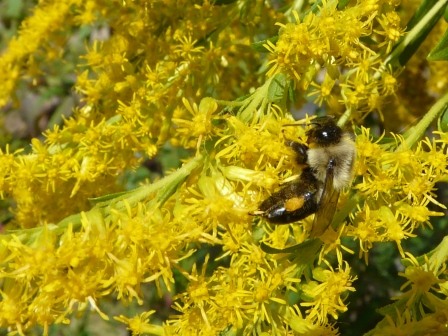
A bumblebee packs pollen into "baskets" on its hind legs. The baskets are made from long hairs.
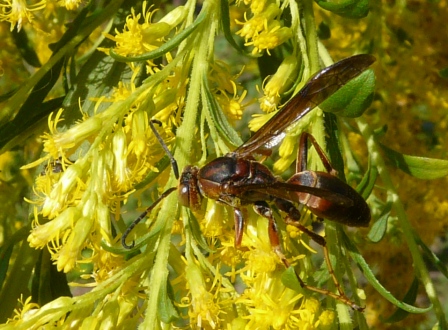
Paper wasps (genus Polistes) also love the flowers. Some studies of goldenrod ecology suggest that these wasps may be the main pollinators of goldenrod. These wasps are normally very flighty, but on goldenrod they seem to settle down to the serious business of investigating every floret on the flower stalk.
Puffball fungi

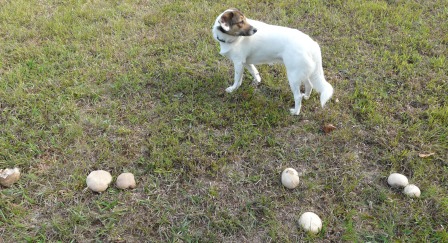
A row of puffballs curves down the grassy hillside at Lake Cheston. These fungi are related to mushrooms (in the Basidiomycota) but grow all their spores internally, then either puff them from an orifice at the top of their swollen bodies, or let them passively disperse when the puffball disintegrates.

Puffballs, possibly genus Scleroderma, with Canis junebugi for scale

Several puffballs had been gnawed. The size of the bite marks suggests that deer were responsible. This one has three large bites taken out.

The skin is like bread that has been baked in a wood oven.

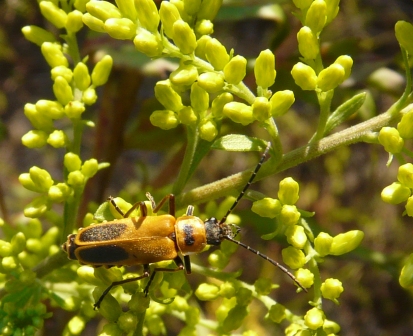
Yellow and black beetle — the Goldenrod Soldier

These beetles become very abundant in late summer and early autumn. As their name implies, they are fond of goldenrod flowers, but they are also common on asters and other late-blooming flowers. In addition to pollen and nectar, the adult beetles eat aphids and other herbivorous insects, so these beetles are a gardener’s friend. The larvae are also predaceous, feeding on the eggs and larvae of other insects.

Chauliognathus pensylvanicus (yes, spelled with no double "n"s, a leftover from the 18th century when De Geer described the species. Under the rules of zoological nomenclature, the original spelling cannot be "updated")

Other species in this family have red markings like British soldiers, hence the name.

Ironweed

The rain is finally over, leaving cold gray skies in its wake. The storm gave us a little more than six inches of rain. After the month of drought, this moisture is very welcome.

I inspected the ironweed patch at the end of the garden and found that the plants had withstood the rain. Not one of them was knocked down, even though they stand on skinny, four foot stems.

The color of their flowers is remarkable. I’ve been letting the flowers go to seed for several years, so we now have several dozen plants in a big patch. When the sun returns, the insects will swarm all over them, sipping their abundant nectar.

Microbial ecology: follow your nose

The arrival of tropical storm Lee has broken a month of drought. After weeks of heat and no rain, we’re getting a steady downpour that so far has lasted 24 hrs, with another day or so to come. Lee is an insistent fellow who may yet outstay his welcome.

One of the many benefits of the return of the rain is the reactivation of the microbes that have been in suspended animation in the dry soil. We can’t see them, but we can smell them. Their odors waft up to us as we walk — some are musty, some sharp, others are rounded and pleasant. The actinobacteria are particularly special. They smell of healthy, rich soil. These actinobacteria are a diverse group, some of whose members gave us chemicals that we use as antibiotics.

I’ve prepared an online experience of the richness of these creatures for you. Follow the instructions below: