Monthly Archives: September 2011

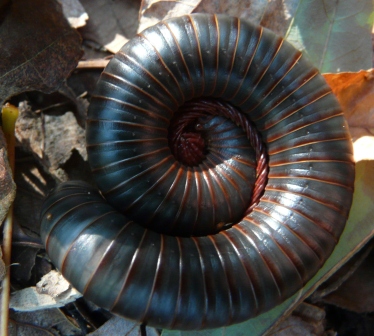
Narceus millipede, with mites

Look closely at this Narceus millipede and you’ll see two small hitch-hikers (one near the center of the  coil and one at opposite end of the millipede). These mites have a very close relationship with their millipede host.

Narceus millipedes live on and in dead logs. At this time of year, they gather together in writhing mating tangles. Because the adult mites never wander away from their millipede, this is their only chance to meet other mites, so they also breed now, having synchronized their life-cycle to that of their host. Both millipede and mite will then overwinter buried in logs or the soil. In spring, both species lay eggs in millipede frass (dung) in logs; the eggs hatch out together.

The millipedes and mites live for several years. Millipedes feed on fungi and dead wood. Adult mites feed on exudations from the millipedes’ bodies. Young mites wait for millipedes to hide from the sun inside a log, then wander off the host to feed on small invertebrates.

This whole family of mites, the Heterozerconidae, live exclusively on millipedes.

For more info, see: Gerdeman and Garcia (2010).  Heterozerconidae: A comparison between a temperate and a tropical species. Trends in Arachology.

Dick Cove

My Field Investigations in Biology class ventured into the old growth forest in Dick Cove (aka Thumping Dick Hollow, apparently named for a former inhabitant who built an ingenious corn-pounding device). In addition to measuring trees to quantify how the forest community is changing, we found some interesting creatures in the undergrowth.

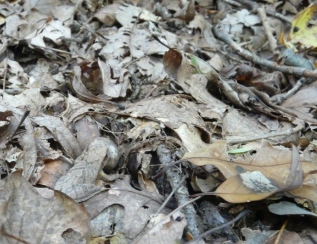
First question, thanks to Ruffin: can you spot the animal?

Camouflage on leaves

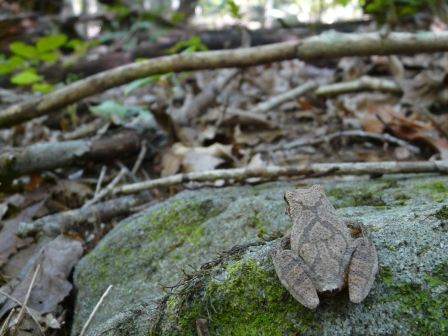
How about now, when it sits on a rock?

Spring peeper, Pseudacris crucifer. The scientific name derives from the cross on the animal's back.

Another cryptic creature, this time an unknown Hemipteran bug:

...and Mary demonstrates how to "picture-bomb."

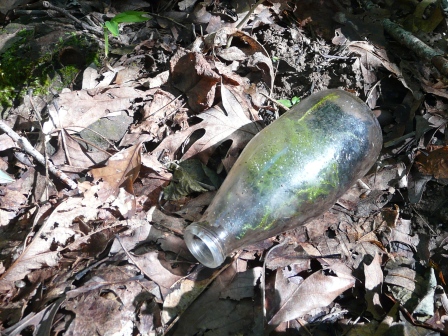
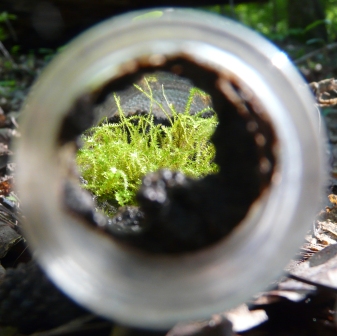
Allie found an archaeological artifact (or, trash, depending on your perspective). After some debate, we left it in place. The mini-terrarium inside was remarkable — soil had accumulated over the years, then moss spores somehow found their way in.

Bryophytes in a bottle

Another world inside; like the Sewanee Bubble.

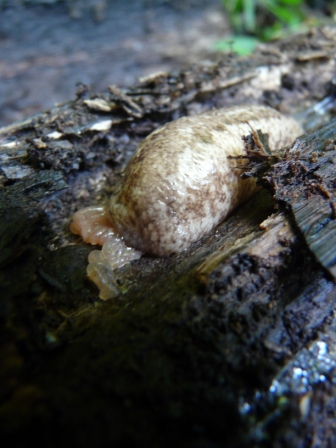
Last, Jeff found a spectacular Philomycus under some bark of a downed log. These native gastropods are “mantleslugs” and they are as big as cigars.

Philomycus with the fecal remains of its fungus dinner.

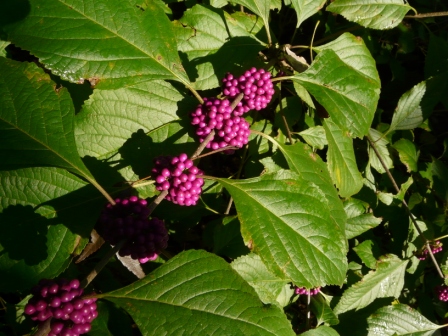
Beautyberry, Callicarpa americana

Each cluster of purple berries is about as big as a lemon. And each beautyberry shrub has dozens of clusters: a fruit-eating bird’s dream.

 In addition to providing food for birds (our resident mockingbird has occupied the bush and gorges herself several times each day), the bruised leaves of this shrub produce mosquito-deterring chemicals, making it a good shrub to turn to when under mossie assault in the woods

These photos are from our garden. In the wild, this species prefers the lower elevation limestone slopes over the sandstone uplands.

Clubmoss

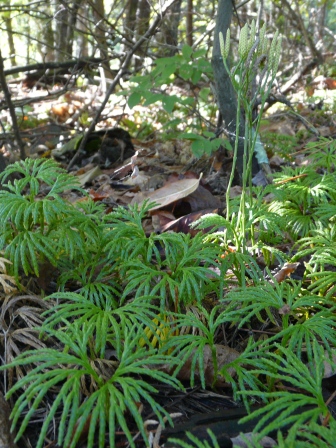
Clubmoss with its spore-bearing "clubs" and branching, green stems

A colony of the clubmoss Lycopodium digitatum lives on the bank of the Lake Cheston overflow. This species is sometimes called running-cedar or fan ground-pine, although it is neither a cedar nor a pine. Rather, it belongs to an ancient group of plants, the Lycopods, that date back more than 400 million years, making them the most ancient of living vascular plants.

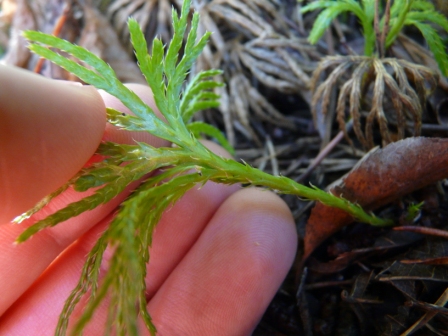
Like other Lycopods, this species has small, scale-like leaves that emerge from the stem. Unlike the leaves of flowering plants, these "mircophyll" leaves are supplied by a simple, unbranched vein.

This Lycopodium is a diminished shadow of its ancestors. Three hundred million years ago, another Lycopsid, Lepidodendron, grew in vast forests all across our region (and well beyond, where-ever the Carboniferous coal forests grew). Lepidodendron also had scale-like leaves, restricted to the tips of it long bifurcating branches. These plants grew up to 30m high and their remains form part of the coal deposits that we now use to power our economy. Unless you’re on green power, the light coming from the image of the tiny clubmoss on this post is likely fueled, in part, by these ancient relatives: their stored photosynthetic energy flickers one more time.

Double-crested cormorant

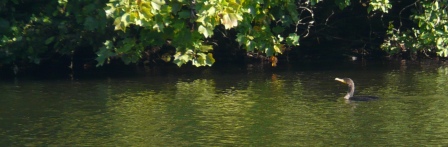
A single cormorant was cruising Lake Cheston this morning. It looked lost: gazing around in an agitated manner. Cormorants are gregarious, so it may have felt ill at ease without its companions.

These fish-eating birds migrate to Tennessee from further north and spend the winter on larger unfrozen lakes. I sometimes see them fly across Sewanee, but I don’t think I’ve ever seen one on our small lakes. Before the 1950s, these birds bred in some numbers in Tennessee, but DDT wiped them out. Now, a few small colonies have been reestablished. A few breed down in the valley, around Woods Reservoir.

Phalacrocorax auritus, seemingly bemused

Swimming into Deep Time

This week, the Biodiversity class took a break from random numbers tables and rarefaction curves, and visited the Tennessee Aquarium in Chattanooga. Our goal: to study representatives of the most ancient lineages of vertebrate animals. The rivers of the south-eastern U.S. are home to several such venerable creatures and the aquarium has examples of these local species as well as species from more far flung places.

The ancient pedigree of gar is revealed by their skin. They have diamond-shaped ganoid scales, a character they share with extinct relatives and with paddlefish (who have a few such scales around their tail). The scales interlock all over the body, making armor-plating. The scales are very tough and Native Americans used them as arrow heads. Early European settlers covered plough blades with gar skin, literally tearing up the earth with the hides of these fish.

Spotted gar, Lepisosteus oculatus. Note the long mouth: gar grab prey by side-swiping these jaws

Paddlefish were also well represented in the aquarium’s tanks. Like gar, paddlefish date back to the late Cretaceous, so they swam around the ankles of river-stomping dinosaurs. Their long “nose,” the rostrum, is used both as a sense organ and as a stabilizing device. Paddlefish feed by cruising with their large mouths wide open, creating backwards drag that is counteracted by the rostrum.
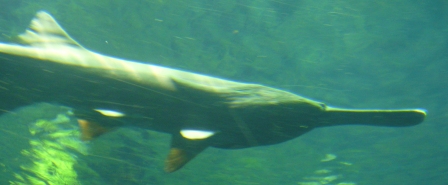
Paddlefish, Polyodon spathula

The paddlefish is native to the mid-western and south-eastern U.S., although its range is now much smaller than it used to be, partly due to overfishing and partly due to habitat degradation. Some states now have restocking programs for the species. The only other living paddlefish species is found in the Yangtze River in China. It may well be extinct now: no living specimens have been found since 2003.

Paddlefish are not the only ancient lineage to suffer from the ill effects of modernity. Sturgeon rival sharks as the oldest group of fish still alive, with relatives dating back in the fossil record to the Devonian, 400 million years ago. The IUCN now classifies sturgeon as the most endangered group of animals on the planet. Unfortunately for sturgeon, a hyper-abundant species of Old World ape regards sturgeon eggs as a delicacy and a status symbol. Our taste for caviar is hard for the slow-reproducing, long-lived sturgeon to sustain; their populations cannot persist in the face of our nets.

Beluga or European Sturgeon, Huso huso. The four barbs on the lower surface of the snout are used to find food in muddy river bottoms. This individual is about six feet long.

This Stellate Sturgeon shows the heteroceral tail that characterizes many of these old lineages. The vertebral column and associated muscles extend into the top lobe of the tail. This design provides a lot of power, but because the tail is asymmetrical, it twists the fish as it swims and this twisting force has to be counteracted by the pectoral fins.

The Tennessee Aquarium, along with TWRA and other partners, have been reintroducing thousands of Lake Sturgeon in east Tennessee. Hopefully, some of these animals will survive long enough to help buoy the population. This species is listed as endangered by the State of Tennessee, although compared to most other sturgeon species worldwide it is faring rather well, with small but seemingly secure populations.

All these species carry Deep Time in their blood. They are the incarnation of our family tree, ancestors swimming alongside us.

I’ll close with a quote from E. O. Wilson, who became a biologist along the banks of Alabama’s streams:

Waterscorpion

My Field Investigations in Biology class ignored the rain and had a great time scooping various animals from Lake Cheston. The finest catch was this waterscorpion. The insect was as long as my index finger. Waterscorpions are fierce predators and will eat both insects and small vertebrates. They pierce the victim with their sharp mouthparts, then suck it dry.

Waterscorpion (Genus Ranatra, Family Nepidae) impaling a dragonfly nymph. The long thread-like attachments on the tail are breathing tubes that the waterscorpion raises above the water surface when it needs oxygen.