I took two boxes (called “supers”) of honey from our hives. Each super has ten rectangular frames that hang vertically inside the super. The bees store their honey inside wax cells on each frame.
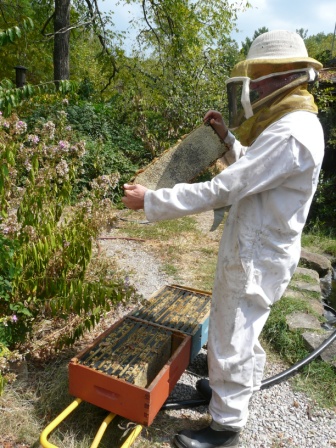
Inspecting frames of honey
Each hexagonal cell on the frame is full of honey and capped with a thin layer of wax.

Cells full of honey
To get at the honey, I first scratch off the top layer of wax with a sharp fork made specially for the purpose. Some beekeepers prefer to use a hot knife to slice away the top surface.
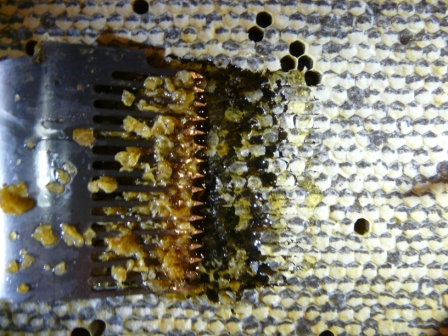
Getting at the honey: vandalism of the bee's careful constructions
Then I put the frames into a centrifugal extractor. This tall metal cylinder has baskets inside which hold the frames vertically. These baskets are then whirled around at an alarming speed by cranking the handle on the top of the machine. This whirling motion flings the honey out of the frames and onto the inside of the metal cylinder. The honey then flows down through a mesh filter into a storage area at the bottom of the cylinder.

Honey frames (left), centrifugal extractor (center), and holding tank for opened frames (right)
After all the frames have been spun, I pour the honey into glass jars.

Flowing honey
The two supers had nearly six gallons of honey between them.
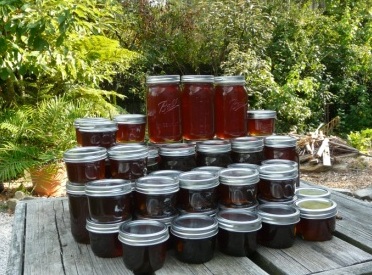
2011 honey harvest: the stored concentrated sweetness of Sewanee's forests and gardens
When I’m finished, I put the equipment and the emptied frames at the bottom of the garden. There, hundreds of bees come out to clean up the left-overs. Within a few hours, no trace of honey remains.

Bees gather for mop-up operations
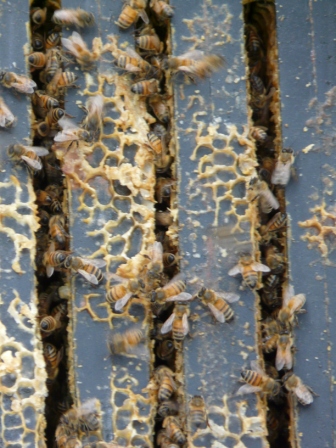
Wriggling between frames to slurp up every last drop
I left each hive with one or two supers of honey to keep them happy through the winter.
 David George Haskell