Category Archives: Water

Solstice Quiz

The theological overlay has changed over the years, but the underlying principle is the same: Sun = Life. So, on this most life-affirming day of the year, Happy Solstice to you (11:30pm CST is the hour, for those who like some precision).

In celebration, let’s have a quiz. These photos are all from along the Elk River, taken earlier this week.

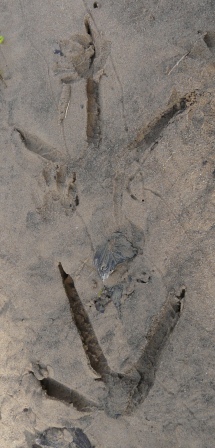
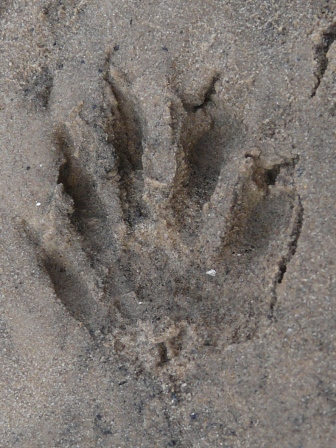
Who made these tracks in the sand (each print would nestle easily in the palm of your hand)?

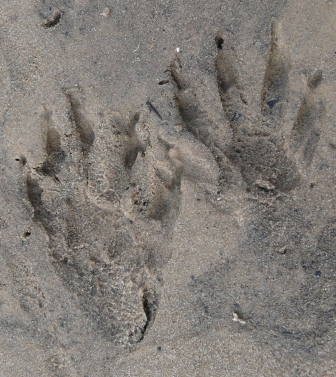
The same animal, showing back and front feet:

How about this one (a bigger track, about human hand-print sized, or a little smaller)? Normally, this creature has a fourth toe, pointing backward, but this time the mystery track-maker must have been walking daintily.

Now, look up. Whose nest is this?

Answers: here, here, and here.

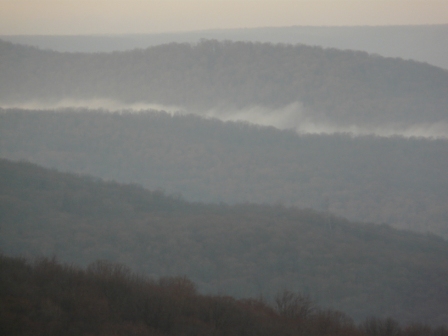
I’ll close this ramble with a shot of the dawn mist on the Elk. Around my feet was strewn the plastic detritus of Homo sapiens (fishing tackle, TVs, bags of household junk, oil cans — all the usual suspects, minus needles this time), but the place was still beautiful.

Five ridges

From Morgan’s Steep, Sewanee, early this morning. The ridges are the rocky wake left by the slow eastward erosion of the Cumberland Plateau. The air was thick with water vapor rising from the wet woods, blurring the focus on everything in the distance.

Quite possibly the most overused image of North American bird life

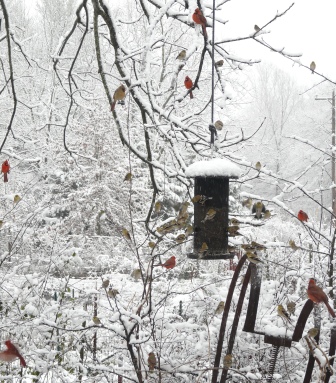
Wet encrustations of snow forced dozens of birds to the sunflower seed feeder. All their usual feeding places, the nooks and crannies in bark, are plugged with frozen flakes.
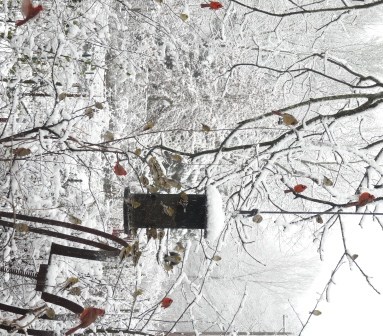
Hard times for birds create interesting viewing opportunities for humans and other mammals with keen ornithological interests. We stay inside and watch through the windows.

Of course, we also have the old standby, “cardinals in snow,” an image found on so many greeting cards, mailbox paintings, Christmas shopping flyers, nature magazines, and, yes, blogs, that the weight of accumulated cultural exposure squashes the actual experience.
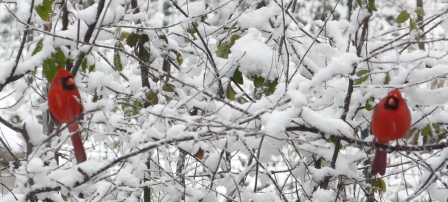
My thought on seeing them was, Oh how cliché, an absurd response to the sight of birds that were minding their own business as they fed on my sunflowery largess. Once I got over my overly puffed up horror at participation in such a tawdry aesthetic experience, I saw them with new eyes. They were stunning.

So, what is it about red-on-white? Our eyes are easily beguiled: cardinals in snow, STOP signs, Texaco, the Red Cross, Marilyn Monroe’s lips, Coca-Cola, candy canes, and flags, endless flags (USA, Japan, Canada, England, Poland, Turkey, Singapore, it goes on…). None of these are particularly subtle signals. The recurring theme is, “gimme your attention.”

So, why does it work? The contrast of hue and saturation obviously helps. But so does our heritage as primates. We’re unusual among mammals in being able to “see red.” In fact, most mammals lack the right type of receptor cell in their eyes and so miss out on the cardinals’ display. Only in one lineage of primates did this receptor evolve, probably to see red fruits (our monkey cousins still eat actual fruit, we use the receptor to find candy and sodas, then to define national boundaries — that’s evolutionary progress for you). So thank you, mutant ancestors, for my experience of the cardinals’ winter glory.

The cardinals themselves have an even richer experience. Not only do birds see red, but their receptors open the UV-range of light to them. We can’t begin to imagine the experience of these extra colors. What does snow look like in UV?
Precip

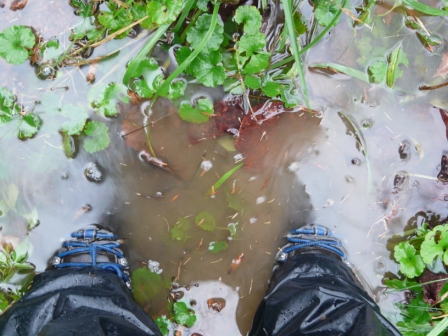
The four or five inches of rain that have fallen in the last day have me thinking that the garden is ready for conversion to rice paddies.

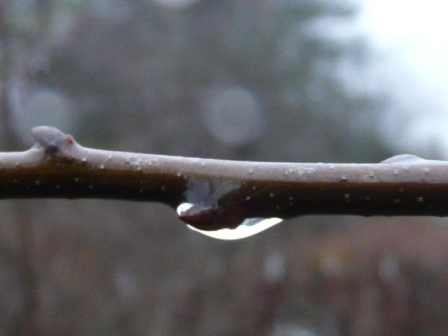
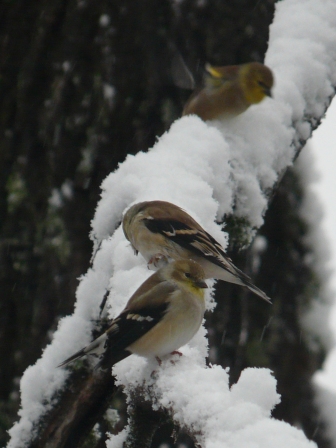
You would think that with all this rain, wild animals would have their fill of water. But goldfinches perched in the rain and carefully caught water drops from the underside of twigs. The birds would reach their heads down, below their feet, then twist to the side and scoop pendulous drops of water from under tree buds. The contrast between the elegance of the birds’ water-gathering and the disorganized squalling of the rain was striking.

Last night the rain turned to snow. Barely enough to dust a goldfinch’s knee, but wet enough to weigh down tree limbs.

A little jaunt in the early morning…

…down to Bridal Veil Falls, below Morgan’s Steep. Unlike yesterday when the air was warm and the spring peepers were calling, a cold front has pushed some real November chill into the woods. The frogs were silent, but a Winter Wren was singing its heart out. Surely this species is our most vigorous songster, heard only in the winter months (this video and recording from Lang Elliott and Bob McGuire is remarkable — these are not easy birds to approach).

The stream at Bridal Veils comes out of the sandstone scree, hits the limestone layer, then plunges into a pit.

Junebug was fascinated by the pit, but didn’t take the leap. There are some huge toads, snails, and slugs down there. Even in summer, the air at the bottom is moist and cool.

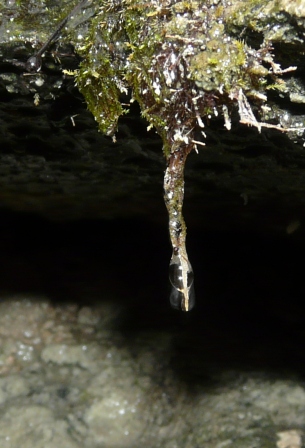
The big waterfall is not the only force sculpting the rock here. Limestone dissolves readily and the rocks have been shaped by years of trickles and oozes.

Even a tiny drip over the lip of a rock has cut a U into its path.