Category Archives: Travels

Wrestling with privet on Bluebell Island

Sharp blades and muscles: These are the lab tools used lately by my class. We’ve been mapping and eradicating privet from Bluebell Island, a local hotspot for wildflowers. Privet is a non-native invader and it overshadows and kills native plants.

Setting up the mapping transect.

Setting up the mapping transect.

The View from Lazy Point used as a field clipboard. The class  combines field work with discussions of readings, so hardback books find multiple uses. I hope Carl Safina would approve.

The View from Lazy Point used as a field clipboard. The class combines field work with discussions of readings, so hardback books find multiple uses. I hope Carl Safina would approve of the students’ improvised use of his fabulous book.

This project started in 2001 when my Ecology class measured and mapped every privet stem on the east side of the island where the flower populations are concentrated. I repeated the project in 2007 with my Seminar in Ecology and Biodiversity, then this year with the Advanced Ecology and Biodiversity class.

We uproot the privet plants...

We uproot the privet plants. Easy to do when they are small…

...not so easy when they are big. Katie pulled this one by hand. All that work on the swim team has paid off.

…not so easy when they are big. Katie pulled this one by hand. All that work on the swim team has paid off. No need to pull out the saw.

We’re building an interesting dataset. There are not too many places where we have long-term data on the details of how invasive plants respond to attempts at control. Along with this scientific goal, we’re hoping to leave the island in much better shape for wildflowers.

What have we found? At first glance, the project seems to be failing spectacularly. There are many, many more privet plants within the project area now than there were in 2001.
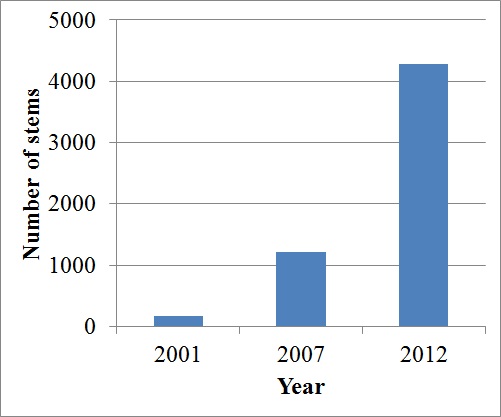
Total number of privet stems increased over time.

Total number of privet stems increased over time.

But this graph does not capture the whole story. The vast majority of the stems in 2012 are tiny little sprouts, reaching to knee-height. In 2001, the stems reached over our heads and were casting dense shade.
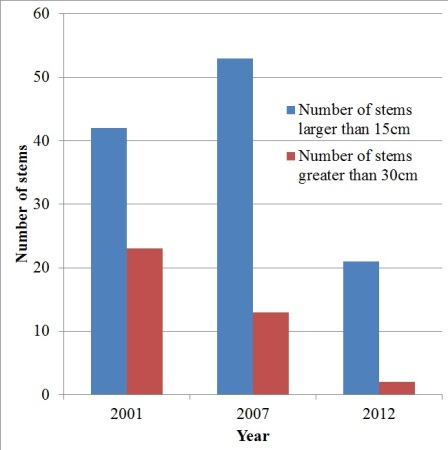
The number of large plants has decreased over time.

The number of large plants (>15 or 30 mm in diameter) has decreased over time.

The average (mean) size of stems decreased over time. The graph also shows that the variability in stem diameter (standard error of the mean) also decreased over time.

The average (mean) size of stems decreased over time. The graph also shows that the variability in stem diameter (standard error of the mean) also decreased over time.

So we’ve lost big plants and gained lots of little seedlings. It seems that the removal of large privet plants allows light to reach the ground which encourages both wildflowers and new privet plants. Long term success will depend on continued visits to the island to stop new privet sprouts from getting too big. The rest of the island, outside the study area, serves as an interesting contrast. It is overrun with large privet plants and the wildflower populations are dying out. Eradication of privet over the whole island would be a more major undertaking than could be accomplished by one class, even with many days’ work. Fire and goats might help.

Tyler Johnson prepared this map of the location of every privet stem (2007 data) in Dr. Chris Van De Ven's GIS class. We'll be expanding the mapping analysis in coming months to include all three sapling periods, examining whether the spatial distribution of privet has shifted over time.

Tyler Johnson prepared this map of the location of every privet stem (2007 data) in Dr. Chris Van De Ven’s GIS class. We’ll be expanding the mapping analysis in coming months to include all three sampling periods, examining whether the spatial distribution of privet has shifted over time.

Bluebell Island is owned by the South Cumberland Regional Land Trust and was bought with contributions from naturalists in Sewanee and beyond. It hosts dense populations of bluebells, trout lilies (including white trout lily), and even the rare dwarf trillium. I’m grateful to the SCRLT board for their continued support for this work, a project that started when I served on the board but has now extended for more years than I at first imagined.

Privet is not the only threat to the island’s famous wildflower display. Gill-over-the-ground is another non-native plant species that has made inroads on the island, as has exotic honeysuckle. In addition, poachers have dug significant numbers of plants over the years. About ten years ago they hit the island so hard that many parts looked as if they had been rototilled. The bluebells gradually regrew. This year, the trespassers hit again, digging large patches. I’m pretty sure that one of these patches encompasses the only known plant of the dwarf trillium in this part of Tennessee, so this rare species may now be extirpated from the island. The poachers are targeting bluebells, but the tiny trillium plant got taken as collateral damage. I may be wrong – we’ll know in the spring – but the digging crosses the exact spot where the plant lives. So if you’re tempted by the pretty bluebells for sale at the nursery, I’d advise you to skip them unless the seller can prove to you that they were nursery-propagated.

Despite the pressures, Bluebell Island is still a marvelous place. In addition to the flowers, old trees provide great habitat for woodpeckers, owls, and wood ducks. Beavers and mink swim the river. Migrant birds ply the riverbanks in the spring. Butterflies are abundant in summer. The river itself is different on every visit. It runs clear and calm in winter dry spells; swells silty and trashy in the floods; then courses bluegreen in the warm algal summer months. Suwannee is a river, but Sewanee is not; so I enjoy my visits off “the mountain” to see some real flow.

Beavers came around after us and snacked on the discarded privet stems.

Beavers came around after us and snacked on the discarded privet stems.

I’m grateful to the many cohorts of Sewanee students who have yanked, sawed, tweaked, measured, mapped, and analyzed these thousands of privet stems.
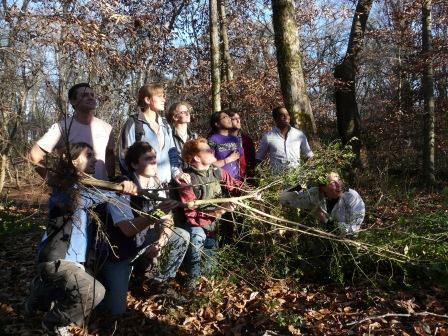
Sewanee's Bio 315 class in "gaze at the sun as if something inspiring and important was happening" pose after pulling 4275 privet stems. The largest vanquished stem is held as a trophy. We omitted the blooding ceremony.

Sewanee’s Bio 315 class in “gaze at the sun as if something inspiring and important were happening” pose after pulling 4275 privet stems. The largest vanquished stem is held as a trophy. We omitted the blooding ceremony.

Trash whale

As Homo plasticus shambles its clumsy way through the world, pieces of junk slough off its body. Much of this exfoliated detritus finds its way to water. The sea is now comprised of water, plastic, and life, in that order.

A collaboration among scientists, artists, and engineers at Olympic College in Bremerton, Washington, holds these facts before us in a striking way. A three-month-old gray whale hangs in the gallery, its body made from plastic bags woven into the surface of a welded armature. The baby whale swims through a room strewn with one month’s worth of rubbish collected from the shoreline along a small sampling area in Puget Sound. Toys, tags, wrappers, cups, pieces of Styrofoam, bits of houses, syringes, bottles: the downstream remnants of our appetite for indestructible plastic stuff.

The whale reminds us that many parts of our oceans contain as many bits of floating plastic as plankton. Seabird guts are choked with these fragments. Dissections of the stomachs of beached gray whales show that they also ingest large quantities of plastic. Because they feed, in part, by scooping at the sea floor, their guts get populated not just by the floating plastic, but by heavy sunken objects. And here we find a surprise: golf balls, sitting like modern Jonahs in the guts of whales. Immediately I was transported out of the gallery, away from the coast and across the continent: back to the Tennessee woods, gazing at plastic globes in a mountain forest in Sewanee.

There is no escape, it seems, from the products of our re-creation.

[Special thanks to Susan Digby, geography professor at Olympic College, one of the whale’s creators, for opening the gallery after hours to give me and my friend Peter Wimberger a tour. You can read more about the project on the gallery’s website.]

This slideshow requires JavaScript.

Forest on Whidbey Island, Washington

An empire of moss and broadsword ferns. Douglas fir trees bend the sea wind. Reams of gold leaf — bigleaf maple — drop through thickets of hemlock and cedar.

Kinglets hammer the forest’s ceiling with sharp brads of sound. Then they drop, working the ferns. Ten of them, right here: hazed wings and stone-bright eyes. Sulfur headstripes; bright, they slice open the heavy green drapes.

Wads of old leaf caught in maple tree crotches, rotted mats lodged inside sprays of alder twigs. Seedlings take root there, above our heads. The soil’s upper boundary is fogged. In walking, we worm through soil passages, burrows of air.

This slideshow requires JavaScript.

Savanna

This slideshow requires JavaScript.

The photos above are from the savanna restoration site along the Mackinaw River at Merwin Preserve near Bloomington, Illinois. The site is managed by the ParkLands Foundation. The savanna portion of this natural area is maintained by periodic burning which thins the understory but keeps in place the mature trees. Illinois was, until settlement by Old World colonists, over ninety percent prairie and prairie-savanna. Now, about one tenth of a percent of the original habitat remains, and maybe one tenth of that is in “good shape.” So small islands of remnant habitat, such as the one we visited, serve both as reminders of the past and as critically important habitat for today’s native biodiversity.

All around, the land has been ploughed, revealing the famously productive soil that underlies the region. The soil is the color of dark chocolate. Just gazing at the soil made me hungry: here is land that can feed. The soil’s richness was built by the plants and animals of the prairie. But that very richness expelled these creators from most of the landscape. Now the former prairies grow corn and soy, in fields whose size is measured in thousands of acres. That food sustains many people and, lately, our cars. Nearly half of this year’s corn crop will be poured into gas tanks. So as we drive over this land to see its native species, we’re powered by the work of those species’ ancestors.

Even in its plowed state, central Illinois has an open beauty, a beauty that was magnified many times in the savanna itself. The wind loves that openness, so the sound of air against grass (whether prairie grass or corn) and trees (in savannas or in farm windbreaks) forms the acoustic frame for an experience of the land. And, like the soil, the wind now also powers our technology. Copses of wind turbines stand at the edge of town, hopeful new savannas, twisting electricity from the sky.

I am very grateful to Given Harper at Illinois Wesleyan University for arranging my visit. Thanks also to the students, staff and faculty for greeting me with such warmth.

Taking some contemptuous cross-fire. Disappointed.

Wow. The NY Times piece about my book has inflamed some sensitive nerves out there. Jerry Coyne, a distinguished evolutionary biologist at the University of Chicago, has taken issue with part of the article, a so-called “drive-by diss” of Richard Dawkins (the Dawkins Foundation site has reposted Coyne’s attack). Further, Coyne argues that this diss was a craven attempt to gain readers. He writes:

What galls me is the increasing desire of people to gain credibility by a drive-by snipe at Dawkins’s materialism and atheism. There’s no need for that here, and no need to mention the man.  Haskell is going for readership, pure and simple, and wants to get it by criticizing a well known atheist.

This saddens me and, to be honest, seems uncalled for. Coyne says that he has not read the book, so I would expect maybe just a touch more humility in his questioning of my ideas and perhaps the civility not to impute my motives. He also sticks his neck out and offers a critique of my writing (“breathless lubrications”) without having set eyes on the book. I’m disappointed that an honest and non-aggressive expression of a difference of opinion about a difficult philosophical question — the nature of the universe — should be greeted with such a vigorous and contemptuous slap-down.

For the record: Dawkins’ work is one the reasons I got into biology in the first place. But, yes, I personally stop short of the kind of full-blooded philosophical certainty that Dawkins has used in his writing. All this is evident in my writing and in the many interviews I’ve given lately. But none of this data was used, nor did Coyne stop to ask what I meant.

Drive-by diss, indeed.

[Correction: the first draft had an errant “a” added in the last paragraph which I have now removed.

Additions: For those who do not want to wade through the entire comments section, I have cut-and-pasted Jerry Coyne’s follow-up and my further comments below.

Coyne: I’m curious, though. Did you make that statement about Dawkins or not? Jerry Coyne

Haskell:

Hi Jerry,

Thanks for connecting here. I sure did say that I *suspect* that the universe (multiverse?) may consist of more than atoms re-arranging themselves. (If inherent value and “rights” exist, as you say in your post, then you’ve perhaps agreed — neither of those are made of atoms and both are pretty hard to pin down.) I also said that I do not buy the full Dawkins position on atheism. To suggest that this was an attempt to get readers is absurd — I had a multi-hour conversation with Jim Gorman about the book and biology, so of course we talked about the big questions in evolution and the world of ideas. Dawkins has outlined MANY of those big ideas and so I don’t think it is unreasonable for me to say that I disagree with him on some of them. Surely we’re allowed to have disagreements without getting slammed for being desperate book-sellers, bad writers, etc, etc. Especially when those disagreements are about things with such a history of being quite difficult.

I’d be happy to send a copy of the book. It is, in part, a book-long celebration of what it means to look at the world through evolutionary lens. You might like it. :)

Again, thanks for connecting here. I admire your work and have done for many years.

Haskell: Oh, I just saw the post on your website. Simple answer: no I did not DISS anyone. To diss is, as I understand it, to disrespect someone, treat them rudely.

Haskell (after several days of comments by others):

Thank you to everyone who has contributed comments here.

A few brief thoughts from my end of things:

1. Comment about atoms. Ethical claims (about species extinction, human rights, etc) are not, to my knowledge, fully derivable from the laws of physics, chemistry, or biology. Yet I “deeply suspect” some ethical claims reflect more than the passing whims of nervous systems and might, therefore, have some kind of objective nature. What that nature is, I do not know, but it seems unlikely to be made out of atoms. I’m the first to admit that the suspicions that I harbor might just be feelings in an evolved brain and nothing more. But perhaps not.

2. For those who want a single number on the Dawkins probability dial, I’ll have to disappoint you. The answer to the question depends on what you mean by “God”. If the god that you’re imagining presupposes a fundamental ontological division between humans and other creatures, then the needle surges up, red-lining the dial. But if by “god” you mean the idea that ethical statements might reflect some kind of objective reality in the universe, the needle does not know what to do, but is inclined to remain low, listening.

3. Dawkins’ long-standing and vigorously argued positions on religion are well known and in many ways they define the way in which the field of biology is seen by non-biologists, especially in the area of biology’s relationship with religion. As my book’s Preface makes abundantly clear, I used an idea taken directly from religious traditions – the potential insights offered by contemplative practice, a practice that has an important role in my life – and applied it to observation of the ecology of a forest. Mine is a markedly different attitude toward the biology-religion relationship than has been advocated by Dawkins. So I mentioned him briefly in a multi-hour interview, indicating that I did not agree with some of his positions and statements. For those who don’t want to read the book, but want to assess my approach, the reviews of the book (http://theforestunseen.com/reviews/) do a good job of outlining my basic stance towards the use of contemplative practice in the context of scientific observation and reflection.]

Rambling into the Times

Finding Zen in a Patch of Nature” — The New York Times has published a beautiful profile of my work. I feel very lucky and honored to have my work discussed in this venue, especially the Science section which for years has been my go-to place for science news and great writing. Jim Gorman has done a fabulous job of situating The Forest Unseen at the junction of science, literature, and contemplative practice. Ramble also gets a mention and regular readers may recognize themes from some of the photographs. I’m looking forward to seeing the full spread in the print version tomorrow. Also in the works is an interview in the weekly Science Times podcast, available soon on the Science page.

Thank you, Ramble followers, for your ongoing support of this blog. It is a great pleasure and privilege to share my biological and literary musings with you. Our “regularly scheduled programming” will resume shortly (with more ticks, among other delights).

Migration

As we slide down the slope behind the equinox, animals have accelerated their autumnal movements. My backyard now consistently hosts several migrant bird species each day. In the last week: rose-breasted grosbeaks, magnolia warblers, Tennessee warblers, American redstarts, gray catbirds, chestnut-sided warblers, warbling vireos, and a summer tanager. Unlike the songsters of spring, these mostly silent birds can be hard to detect. A flicker of foliage reveals their presence, then a glimpse of their plumage as they prance through the concealing twigs. Grosbeaks are an exception to this crypsis. Although they can be hard to see, their sharp tweek call, given repeatedly through the day, gives them away. The sound is just like that of a sneaker squeaking on a gym floor. Listen for it, then look up.

Last night, as I left the Biology picnic on campus, another migrant bird making a spectacular display over the old building that houses the fire station. About two hundred chimney swifts were scything the air in a tight, fast vortex. They swirled around the brick chimney that protrudes from the station’s roof. One by one, they folded their wings and dropped in. Like hot cinders carried up by the wind, these birds seemed to ignite the dead dusky air with their coordinated vitality. A little tornado of life. The swifts are on their way south to the Amazon where they’ll feast on tropical gnats all winter. I suspect that they are speeding on their way as I write: this morning’s cold rain squalls mean there will be few flying insects in Sewanee today. Time for swifts to get out of here.

Birds are not the only migrant animals making their way through our skies. This week has seen an impressive number of monarch butterflies winging across the treetops. It seems impossible that so slow and delicate a flyer could make it all the way to Mexico, but that is where they are all headed, to a few small patches of dense fir forest in the highlands. The monarchs gather there in the tens of millions to rest in the cool but unfrozen woods. Remarkably, these autumnal migrants are the grandchildren of the butterflies that left Mexico this spring. Somehow their genes guide them to precisely the right location.

One for the road: a monarch loading up on thistle biofuel earlier this week near Lake Dimmick.

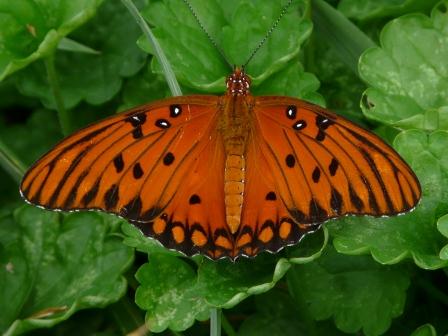
Another migrant butterfly, less celebrated than the monarch, is the gulf fritillary. This species breeds all over the southeastern U. S., but overwinters only in the deep south. Unlike the fluttery monarchs, these butterflies scull their way across the air with seemingly powerful and directed wingbeats. In Florida, where adults linger all winter, huge flocks of them will sometimes stream over fields and scrubby areas. A river of bright amber.

Gulf fritillary. Photo taken earlier in the year.

“…somewhere about the middle of the month when suddenly there’s a foretaste of fall”

This morning, my friend Bill Keener sent me the following words from Faulkner. They relate directly to the bodily experience of the past few days, so I though I would share them here.

The quote comes from a 1957 question-and-answer session in an American Fiction class at the University of Virginia. You can hear digital audio clips of portions of the session here.

Question: “You spoke of titles before, Mr. Faulkner. I’d like to ask you about the origin of Light in August.”

Faulkner’s answer: “Oh, that was—in August in Mississippi there’s a few days somewhere about the middle of the month when suddenly there’s a foretaste of fall, it’s cool, there’s a lambence, a luminous quality to the light, as though it came not from just today but from back in the old classic times. It might have fauns and satyrs and the gods and — from Greece, from Olympus in it somewhere.  It lasts just for a day or two, then its gone, but every year in August that occurs in my country, and that’s  all that title meant, it was just to me a pleasant evocative title because it reminded me of that time, of a luminosity older than our Christian civilization…that light older than ours.”

If this seems an overblown response to a cool day in August, remember that Faulkner lived in Mississippi, without AC. For months, life was lived under a sheen of sweat. Any exertion, even in the relative cool of morning, would soak a shirt. At night, lying immobile in bed, tiny rivulets pool in the hollows of collarbones. And the light? A haze of water drawn into air. So when these August days come, the texture of life is transformed. The heat-fogged light snaps into clarity. The simple pleasure of working outside all day and barely breaking a sweat takes on a mythic quality — the body is transported, abruptly, to another world.

Tracking migration: a window into the lives of wood thrushes

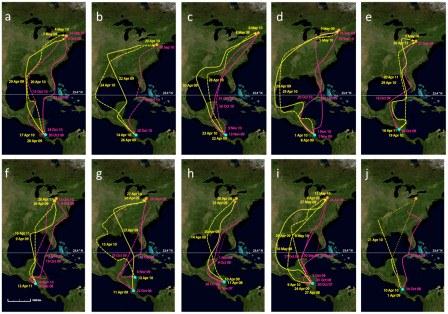
This image comes from a remarkable new paper about the migration of wood thrushes. A team of ornithologists led by Calandra Stanley and Maggie MacPherson from Bridget Stutchbury’s lab at York University in Toronto have used  tiny “light-level geolocators” to track the individual migration routes of wood thrushes. Geolocators use the daily cycle of sunlight and darkness, referenced to the time of day and date, to calculate where in the world they are. Sunrise and sunset vary consistently according to longitude (sun rises earlier in North Carolina than it does in Tennessee) and latitude (day length is longer in New York than in Belize in summer, but shorter in winter — except on the equinox when the machines get confused). Geolocators are not as accurate as GPS but they have the great advantage of being very small and lightweight. GPS needs a big, heavy antenna — there is no way that a songbird could carry even the smallest GPS unit.

The image above shows the path of one wood thrush over two years as it moves between its wintering area in Belize and its breeding grounds in Pennsylvania. The particularities of the route taken bring the map alive. The details change each year. In the fall of 2009, the bird came south over Florida and Cuba, but took the direct route across the Gulf of Mexico the next year. The map makes clear that migration is not an abstraction, but a yearly marvel.

This bird winged across Tennessee twice. That makes my heart leap — I may have heard this bird in Sewanee’s woods — but it also gives me chills. I have a freezer full of thrushes that hit windows and cars. (The dead birds are for use in the anatomy labs in my ornithology class.) We’ve thrown so many hurdles in the way of these migrating birds. To see the migration path is therefore not just to marvel, but to imagine the dangers.

A composite of the maps of multiple individuals shows the diversity of migratory paths within the species. Some birds hug the Mexican coast, some come through the Florida peninsula, and others take the dare-devil ocean crossing.

Joanna Foster’s article at the NYTimes Green blog does a great job of putting this study into the larger context of climate change and habitat loss. The important finding of this study was that the date of departure for spring migration barely varied from year to year. Individual birds, in other words, were consistent in when they left Belize. This is surprising — you’d expect them to be more sensitive to local conditions like the weather or their body condition. In the words of the authors, this lack of variability “may limit the ability of individuals to adjust migration schedules in response to climate change.” As my previous post of thrushes described, these birds have been declining for decades, so this is not good news.

Images here are from the paper: Stanley CQ, MacPherson M, Fraser KC, McKinnon EA, Stutchbury BJM (2012) Repeat Tracking of Individual Songbirds Reveals Consistent Migration Timing but Flexibility in Route. PLoS ONE 7(7): e40688. doi:10.1371/journal.pone.0040688 [Creative Commons]

For another mind-blowing set of maps from geolocators, see the Arctic Tern Migration Project website and click on “maps.”

A “must read” from Bill McKibben…

in Rolling Stone. McKibben has written what is, in my opinion, one of the more important and disturbing essays of the last few years. He lays out an unvarnished summary of where we stand with the destabilization of the climate. Where we stand is shameful and frightening: we’re locked in for disastrous changes to the climate and, worse, show every sign of moving full speed toward not only disaster but calamity, a “a planet straight out of science fiction.” McKibben’s unflinching words are, in my limited experience, a pretty fair reflection of what scientists are thinking. The essay is well worth your time.

So how to respond to this sobering reality check? I suspect that this is the question that we’ll be asking a lot in the coming decades. Maybe Jane Goodall’s thoughts are relevant. She has better reason than most to give up on this broken world — the animal species and ecosystems that she deeply loves have been pushed to the edge of annihilation before her eyes. Yet she responds with hope. That hope is easy to dismiss as mere fatuous or fluffy salve, but I think it reflects something deeper. The short time that I’ve spent in McKibben’s company showed me the same: against long odds, hope.