Category Archives: Travels

Reed Environmental Writing Award

This afternoon The Forest Unseen and Jay Leutze’s Stand Up That Mountain were awarded the Reed Environmental Writing Award. This award is given by the Southern Environmental Law Center in recognition of books that address the changing southern environment, especially the relationships between humans and the rest of the community of life. Undoubtedly many readers of this blog will know that SELC has been, for more than twenty five years, an extraordinarily effective voice for the protection of land, air and water in the southeastern U. S. I therefore feel particularly honored and humbled to be recognized by the Reed Award.

It also gives me special pleasure to share the award with Jay Leutze. Jay and I met just a few weeks ago when he gave a reading at Sewanee. (I dragged him out in the rain to look for woodcock displays, to no avail, a cold Sewanee baptism.) Jay’s book describes a years-long struggle to keep a huge open-pit mine away from the Appalachian Trail and a local community. At least, that is what the book is about on the surface. But along with the gripping storyline comes a portrait of the people involved in the case: neighbors who’ve lived on the mountainside for generations, lawyers and judges of all stripes, a motley collection of professional and home-spun conservationists, tireless and sometimes tiresome state officials, and a lively cast of other characters ranging from unsung saints to deluded drunks. Jay uses his considerable talent as a writer to interweave these tales with beautiful descriptions of the history and ecology of the landscape. Let me rephrase that. The tales are not interwoven, but so tightly connected that the strands cannot be teased apart. Stand Up That Mountain is full of memorable images and tells a fascinating story. I highly recommend it. And if you have a chance to hear Jay speak, grab the opportunity. He’s a great speaker and, I now know, a tough act to follow.

The Southern Environmental Law Center’s work is not usually thought of as “art” or “literature,” but it struck me during my visit that theirs is a high form of writing. By integrating love for the land, deep intellectual analysis, massive amounts of hard work, and a long list of creative partnerships, SELC scribes works of lasting beauty on the land, in the air, through the water, and into our communities. Their words are etched deep and form the stories that future generations will read and live by. Noble literature, for all.

Least Trillium lives on…

I’m happy to report that the Least (or Dwarf) Trillium (Trillium pusillum) that I feared had been dug up by the plant poachers (as an incidental effect of bluebell thieving) has escaped the spade for another year.

My Ornithology class looked down from the skies today and admired some of the wildflowers on Bluebell Island. The Least Trillium was in bloom. Hooray! The species is classified as endangered in Tennessee, so every plant matters. There is only one other location known for the species in our county.

Note that the annual land trust hike to the island is this weekend. (I’ll be out of town and will have to miss the event.) Land trust volunteer leaders will be on hand to help people across the log to the island (a fun challenge) and to point out interesting plants.


Thanks to Will Coleman and his iPhone for this shot.

Thanks to Will Coleman and his iPhone for this shot.

Over the winter I had some new signs made for the island. A few weeks ago Sanford McGee, Joseph Bordley, Bran Potter, and Bob Salter joined me in a little expedition to put them up. Hopefully the message is clear and people will leave the plants in place:

BluebellSignComp

John James Audubon exhibition at New-York Historical Society

It feels like blasphemy to admit it, but I have for some time felt over-Auduboned. In the world of ornithological and environmental studies, reproductions of John James Audubon’s work abound. Coffee mugs, posters, websites: he’s everywhere. Overexposure produces ennui. Surely North American bird art has more to offer than the endless repetition of these 19th century engravings?

A visit to the recently opened exhibition at the New-York Historical Society cracked my armor, snapping my senses out of their laziness.  The exhibition is the first of a three part celebration of the watercolor studies that Audubon painted in preparation for the engravings that in turn produced his famous double-elephant-folio, The Birds of America (1827–38). The paintings have a stunning vivacity and range of feeling. Unlike so many reproductions, these works are alive with Audubon’s hand.

What struck me most was his grand ecological statement: the bird cannot be understood, or felt, or even seen apart from its relationships with other species. Audubon make this case with compelling vigor. As a naturalist, I was also impressed by the sensory truthfulness of his work. The years that he spent tramping the woods and fields shine through.

Of course, Audubon’s style is one of exaggeration: four thrashers defending a nest, one bird swooning into roll-eyed death as the snake slides upward. A spike-crested osprey cries out as it carries away a fish whose mouth echoes the bird’s scream. But though this melodrama sometimes skates on the edge of sentimentality or absurdity, his intimacy with the lives of the birds keeps the paintings grounded in each species’ character, even as his flamboyant emotion takes flight.

The exhibition also has a copy of one of the original double-elephant printings. A magnificent book, the product of meticulous engraving on copper plates, followed by hand-tinting by dozens of colorists. One of the original copper plates is also on display. It was rescued from the melting pot after Lucy Audubon sold it for scrap years after her wandering husband, whom she had propped up financially for years, had died. This copper plate, although it is not centrally displayed, is a significant part of the exhibition. It hints at the costs of Audubon’s obsession.

If you’re in New York, I strongly encourage you to visit this important exhibition. To learn more about the show and its context, I recommend Edward Rothstein’s excellent review in the New York Times. And the exhibition’s catalog is a work of art in its own right.

Addendum: Part II is showing in the summer of 2014. Reviewed in the NYT here. Bring on Part III! (Date not yet announced.)

Upcoming speaking engagements

Next week I’ll travel to New York to give a lecture at the American Museum of Natural History. I’m very honored to speak at such a fabulous center for the study and celebration of the natural world. Please consider attending if you live nearby. Or if you have friends and family in the area, I’d be very grateful if you could spread the word. The talk is at 6:30pm on Wednesday March 13th. Reservations are recommended.

In April I’ll be speaking at Trails and Trilliums, an event organized by the Friends of the South Cumberland. I’ll be giving a lecture and leading a couple of bird walks. The events are in the Monteagle Assembly, April 12-14th, with exact times to be announced on the event’s webpage. The event will also feature a native plant sale (with plants not dug from the wild!), an art show, guided walks and a reception. Please join us, if you can.

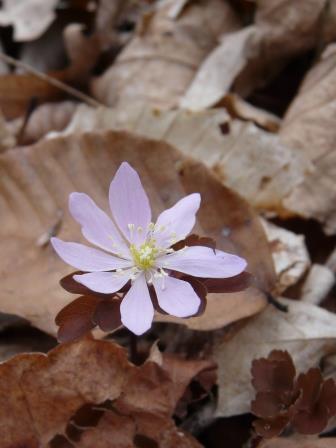
In closing, an early rue anemone, poking up despite the cold:

Rue anemone


Ugly Ducklings, Lent, French translations and counting birds

Some news about Cudzoo Farm and The Forest Unseen:

Sarah has opened a new page on her soap website for sales and specials. These special prices on organic goat-milk soaps will be offered only intermittently, so I encourage you to investigate them now. Currently, she has a Five-for-four Special and an Ugly Duckling Assortment. Great soaps, fabulous prices: from our hard-working herd of goat princesses.

From soaps to books. The Times (London) has published a list of recommended reading for Lent. I was surprised and delighted that Jane Shaw, Dean of Grace Cathedral, San Francisco, chose The Forest Unseen. She writes that the book “is not a religious book, but [Haskell’s] careful observation of a one-square-metre patch of Tennessee forest over a year teaches us something vital about training our attention on the world around us, to see what we usually miss. That sense of attention and focus is central to all Lenten practices.” Is there a parallel between the study of natural history and the Lenten disciplines? This is an interesting idea. Within their own traditions they are both seen as practices that help us to pay attention to what matters: snails on one hand, the divine on the other (and a few of us think that some snails are themselves simply divine). Both practices are also often misunderstood as dour and outdated (Lent? Names of birds? How Victorian…), yet they have within them the potential for unrivaled connection to the world beyond and within ourselves (if such worlds exist, of course…). I’m intrigued by this Lenten connection and honored to have The Forest Unseen highlighted as helpful to those engaged in meditative practices.

I’ve also received some other good news about the book. A French translation will shortly be underway, joining ongoing translations into Japanese, Korean, and Chinese. I grew up in France and I’m especially happy that the book will be available to French readers. Schools in France used to (and maybe still do) celebrate the work of Jean-Henri Fabre, a close observer of the ecology of his home and prolific author. So I hope that my approach might fall on some ready ears, even if mine is a vastly more modest contribution (in many ways) than that of Fabre.

Last, readers of Ramble might be interested to know that this is the weekend of the Great Backyard Bird Count. From Feb 15-18 we’re all encouraged to submit checklists of the birds that we see in our neighborhoods. Last year the count collected over one hundred thousand checklists (!) comprising 17.4 million individual bird observations: a rich source of data on the populations of North American birds. This year the project has gone global and is connected to ebird.org, an amazing site that “crowd-sources” data (hundreds of millions of observations to date) about birds. So our bird sightings are now both rewarding for us as individuals and they can contribute to a better understanding of global ecological patterns. I encourage you to participate. The count is set up for non-specialists including beginning birders, so do not feel that you have to be an “expert” in order to join the project.

Eagles

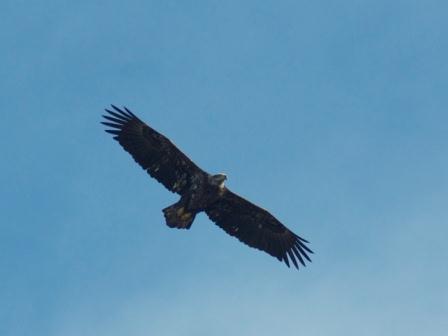
My Ornithology class had some great views of bald eagles this week near Woods Reservoir.

Adult bald eagle. Photo taken by Jamie Sue Wilson who is enrolled in the class.

Adult bald eagle. Photo taken by Jamie Sue Wilson.

In addition to two adults, we saw a couple of young eagles circling overhead.

Immature bald eagle. Photo by Jamie Sue Wilson.

Immature bald eagle. Photo by Jamie Sue Wilson.

Immature bald eagle. Photo by Jamie Sue Wilson.

Immature bald eagle. Photo by Jamie Sue Wilson.

Bald eagles take four years to reach full adult plumage. The individual shown above is likely a second or third year bird. For two great overviews (and some fabulous photos) of the maturation sequence of eagle plumage, see Ron Dudley and Mia McPherson’s pages.

The two adults were nesting: one sat in the nest and one stood close by in the tree. Until recently, such a sight would have been very rare in Tennessee. In 1990, only sixteen nests were known in the whole state. Now, there are at least one hundred and seventy five nesting pairs of eagles in Tennessee.

The population increase in Tennessee is part of a nationwide trend. After decades of decline caused by shootings and poisonings (encouraged by bounties), followed by the impacts of DDT, bald eagle populations have edged higher year-by-year since the 1970s. In 2007 the species was removed from the federal list of threatened and endangered species, although it (and its cousin, the golden eagle) remain protected by other laws.

Bald eagle nests are huge: brush piles crammed into the crowns of high trees. Nest-building can take up to three months, although when pressed the birds can slap something together in a few days. Most clutches have just two eggs (a few have one or three). Both male and female incubate the eggs, although the female does most of this work. Between them, the parents keep the eggs covered by a warm body for 98% of the time. Eagles are relatively heavy and they have sharp claws, so the parents take extreme care in the nest, walking around the eggs with clenched feet.

The incubation period lasts 35 days; the young leave the nest two to three months after hatching. These young birds stay with the parents for a variable period, from a couple of weeks to several months, then set off on an extended period of wandering. During this unsettled stage they have no fixed territory but move around, presumably seeking food and, later, mates and a good place to nest. The immature birds at Woods Reservoir are likely in this wandering stage.

The return of nesting eagles to the U. S. has intersected with the internet age to produce a new phenomenon: the eagle cam. You can now follow the adventures of nesting eagles from your computer, an activity that is usually considerably more compelling than working through your email inbox. So, be warned, there is a reason why some of these websites get millions of viewers… Here is one in Florida with two eaglets (hatched back in early January).

The Newtownian Apple, the Darwinian Galapagos, and the Archimedes’ Bath of Geology.

The city of Edinburgh is overlooked by the cooled remnants of ancient volcanoes. The most famous of these fiery landmarks is Arthur’s Seat, the highest point in the city and a popular place from which take in the view (and the wind) after a vigorous climb. The dome of Arthur’s Seat was formed from the inner “pipe” of a volcano, the central conduit through which molten rock rose. The rest of the volcano has, over about three hundred and fifty million years, eroded away.
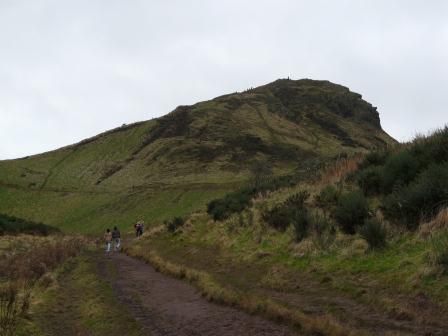
Arthur's Seat, viewed from one of many well-worn access trails. Who "Arthur" was is unclear.

Arthur’s Seat, viewed from one of many well-worn access trails. The origin of the name, including the identify of “Arthur,” is unknown.

My guides: Photographic evidence that locals and their half-tamed wolves sometimes join visiting American tourists at the peak.

The Grindley mountain guides, Julia, Kathy, and Hannah: Photographic evidence that locals and their half-tamed Scottish wolves sometimes join visiting tourists at the peak.

Next to Arthur’s Seat, facing Edinburgh castle (itself perched on volcanic rock, one of the vents from Arthur), an escarpment curves around, presenting an impressive cliff line to the city. These are the Salisbury Crags: cliffs that contain some of the most famous rocks in the world.
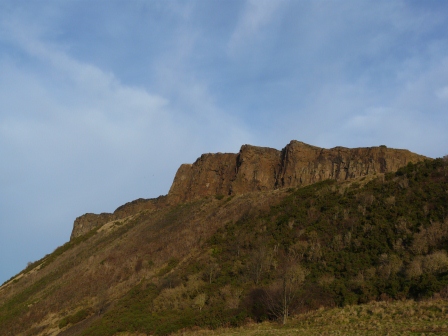
Salisbury Crags.

Salisbury Crags, viewed from the southeast.

It was on the Salisbury Crags that James Hutton, the Scot whose work founded the modern science of geology, saw evidence to refute the “Neptunian” view that rocks had been recently deposited as sediments in a catastrophic flood. Hutton’s views inspired Charles Lyell who in turn strongly influenced Darwin. So the Salisbury Crags are also foundation stones for modern biology.

In the crags, Hutton saw flows of magma crunching into sedimentary rock (magma is molten rock; lava is the above-ground manifestation of magma). The sedimentary rocks were formed in an ocean, but the magma was not; it came from a volcano then flowed into (and distorted) the other rocks. Here, then, was evidence that the world’s geology could not be explained by catastrophist, diluvian processes. Instead, these rocks (and unconformities from elsewhere in Scotland) showed Hutton that the world was very old and that ongoing interaction between processes like vulcanism, sedimentation, and erosion could explain how the physical features of the world came to be.

In Theory of the Earth (1795) Hutton writes (with my explanatory additions in square brackets):

the whin-stone [rock formed from magma/lava] is interjected in form of strata, having various degrees of regularity, and being of different thickness. On the south side of Edinburgh, I have seen, in little more than the space of a mile from east to west, nine or ten masses of whin-stone interjected among the [sedimentary] strata. These masses of whin-stone are from three or four to an hundred feet thick, running parallel in planes inclined to the horizon, and forming with it an angle of about twenty or thirty degrees, as may be seen at all times in the hill of Salisbury Craggs.

…these masses, which have flowed by means of heat among the strata of the globe…[are] subterraneous lavas, as they may be termed.

This view is confirmed by present-day geologists. The crags are a sill (a sheet of igneous rock intruded between sedimentary layers) that formed when magma flowed out into the oceans, pushing into sedimentary layers.

For good measure, here is the most famous passage from this book. Hutton emphasizes a uniformitarian worldview: nature operates according to a system of rules and these rules are consistent across time and space. He makes an analogy to the law-like motion of the planets (as would Darwin, many decades later, in the concluding paragraphs of The Origin) and ascribes the operation of the physical world to these natural laws, not to higher causes. We now know that his famous “no vestige of a beginning, no prospect of an end” is not true, at least as far as the Earth is concerned. But the rest of his vision still stands.

We have now got to the end of our reasoning; we have no data further to conclude immediately from that which actually is: But we have got enough; we have the satisfaction to find, that in nature there is wisdom, system, and consistency. For having, in the natural history of this earth, seen a succession of worlds, we may from this conclude that there is a system in nature; in like manner as, from seeing revolutions of the planets, it is concluded, that there is a system by which they are intended to continue those revolutions. But if the succession of worlds is established in the system of nature, it is in vain to look for any thing higher in the origin of the earth. The result, therefore, of this physical inquiry is, that we find no vestige of a beginning,—no prospect of an end.

Dolerite (cooled lava flow) on top. Sedimentary rock below.

Hutton’s famous rocks. Dolerite (cooled lava flow) on top. Slab of pushed up sedimentary rock below.

I'm pointing to the famous point of contact between the two rock types. Ably assisted by Rocky (yes, a geological dog) and Kathy.

I’m pointing to the point of contact between the two rock types. I’m ably assisted by Rocky (a geological dog) and Kathy who sports her new snow leopard headgear.

Edinburgh’s growth and the industrial revolution created a market for the crags’ cooled magma, dolerite. The hard rock was used for paving streets, including some as far away as London. Quarrying activities on the crags removed large quantities of rock, but Hutton convinced the operators to leave one small rock with a particularly good example of a hematite seam (formed by hydrothermal venting into the rock). So Hutton not only founded modern geology, but enacted the first conservation program for significant geological formations. The rock stands to this day.

Some of Edinburgh's streets are lined and paved with dolerite to this day. This example (inscribed outside the Scottish Parliament) may be the world's only example of a gutter with mineralogical engraving.

Some of Edinburgh’s streets are lined and paved with dolerite. This example (outside the Scottish Parliament) may be the world’s only example of a street gutter with mineralogical engraving.

huttonsrock

Hutton’s Rock, being closely observed by Edinburgh’s next generation. The rock marks the original front wall of the cliff. The quarry pushed this wall back to the location seen behind. Arthur’s Seat rises in the background.
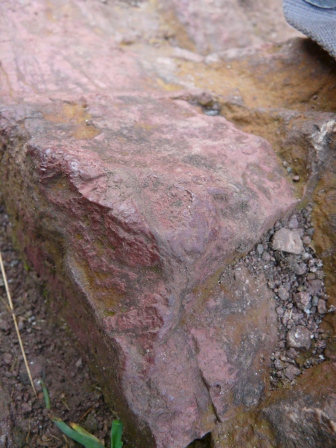
Hematite seam running through the middle of Hutton's Rock. It is worn smooth by the many tourists who clamber over the rock each day.

Hematite seam running through the middle of Hutton’s Rock. It is worn smooth by the many tourists who clamber over the rock each day.

Remarkably, no signage notes (or protects) these treasures of our shared intellectual heritage. Tourists walk past ignorant of the fact that they are passing the Newtownian Apple, the Darwinian Galapagos, and the Archimedes’ Bath of Geology. Bouldering hands have chalked up nearby rock faces. Hammers have chipped at some exposed areas, including a portion of Hutton’s Rock. In hindsight, I feel bad for sitting on the famous rock, adding my little bit of buttock-polishing to the well-rubbed patina. The whole area is officially a designated Site of Special Scientific Interest, but this has not resulted in any on-site signage. Surely a place that tore apart a befuddled worldview and launched one or more new scientific disciplines deserves more than a “Beware” sign?

Danger.

Danger — Enlightenment may strike and spread across Europe. It happened once; it could happen again. So think with care.

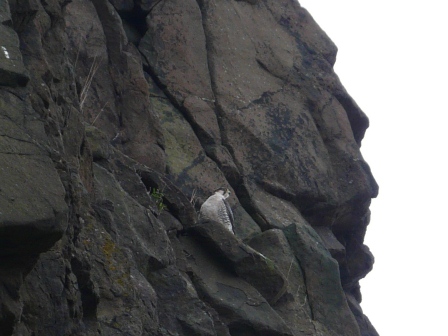
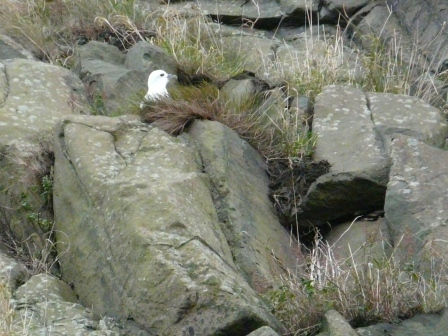
The crags also host some biological gems. Peregrine falcons patrol the cliff faces. Fulmars nest on precarious rock ledges: these are birds of the wild North Atlantic, yet here they are at the center of a major European city.

This peregrine flew past, sending pigeons swirling away.
This peregrine flew past, sending pigeons swirling away.

Northern Fulmar, getting its nesting area ready for spring. The bird is lodged way up a cliff. Any mammal skilled enough to climb up there will be rewarded with a face-full of vomited fish oil. Welcome to Edinburgh, laddie.

Northern Fulmar, getting its nesting area ready for spring. The bird is lodged way up a cliff. Any mammal skilled enough to climb up there will be rewarded with a face-full of vomited fish oil. Welcome to Edinburgh, laddies and lassies. Fulmars are related to albatrosses, soaring birds of the wind-blown oceans.
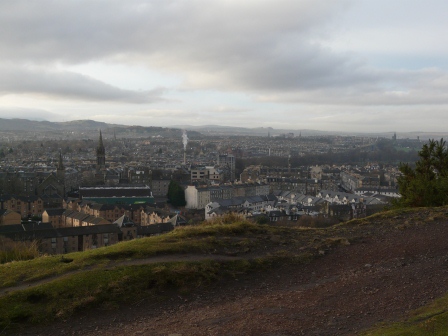
The view from Hutton's Rock: Edinburgh.

The view from Hutton’s Rock: Edinburgh.

[Thanks to Chris Clinkscales for comments that clarified the magma/lava terminology in this post and for insights into geological mechanisms — see comments section below.]

Happy New Year from the Blue-spotted Mudskipper

One of the many delights of working with Sewanee’s students is the biodiversity that they bring to my desktop. Sometimes, these species arrive on my actual desktop (snails, leaves, dead coots, live hummingbirds, and so forth…), but species also arrive via the glow of the screen. Here is one such arrival. I’m posting it for no other reason than the smile it brought to my face. Thank you, Dr. Bert Harris (Sewanee class of 2006 — a great vintage), for sharing this after a recent research trip to Sumatra. Without further ado, the blue-spotted mudskipper:

mudskippers

These air-breathing fish live in the mud flats of Asia. Males come out of their burrows to joust each other and to perform leaping dances for females. You can read more about their biology here and here.

What these websites will not explain is why they make me slightly nervous: I get the sense that they are ready to step in and take over when the current gaggle of tetrapods finally gives up the ghost. Give these mud-skippers three hundred million years and they’ll be strutting around with sapiens after their names. So this New Year, let’s look sharp and keep focused. We have competition.

Addendum: Thank you to Karen C. Rio for pointing me to this video of the mudskippers in action :)

Reindeer carved deep into our history

How long have reindeer been dancing through our midwinter celebrations?Rudolph,_The_Red-Nosed_Reindeer_Marion_Books

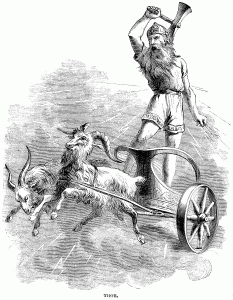
Rudolph is seventy three years old. He came into being in 1939 for a Montgomery Ward Christmas publicity campaign. He joined his older cousins Dasher, Dancer, Prancer, Vixen, Comet, Cupid, Donner, and Blitzen, a little herd that celebrates its one hundred and ninetieth birthday this week. The eight “tiny rein-deer” originated with Clement Clarke Moore’s poem, A Visit from St. Nicholas, written in 1822. Moore apparently re-imagined some Norse myths, replacing Odin’s Wild Hunt with St. Nicholas’ sleigh-in-the-sky. To power the sleigh, Moore replaced Thor’s goats (called teeth-barer — the snarler — and teeth-grinder) with more kid-friendly reindeer. Moore may also have penned a slightly older poem, Old Santeclaus, that also places reindeer at the head of a sleigh (originally published in a pamphlet by William B. Gilley, but the poem’s authorship is apparently in doubt). Unlike A Visit from St. Nicholas, this poem languishes in obscurity, perhaps because it ends with the gift of a birch rod with which parents can enact God’s will by thrashing their kids. Montgomery Ward would have a hard time weaving that idea into their sales pitch. Christmas is a lot tamer these days: gone are the snarling goats and instruments of corporal punishment.thor-clipart

In sum, Rudolph is a bit of an upstart. But all these modern deer are babies compared to the venerable grandma and granddaddy of them all: the Swimming Reindeer of Montastruc. This pair of reindeer are thirteen thousand years old. They live in the British Museum, in a carefully climate-controlled case. The pair were carved by an artist in what is now France. The artist carved a mammoth tusk (!) to create a sculpture of two reindeer swimming across a river.swim

This carving is a work of stunning beauty, carrying the artist’s skill across a chasm of time. More, it reveals much about the world in which the artist lived. Reindeer (Rangifer tarandus, called caribou in North America) are animals of the tundra and northern forests. Their presence in France is a reminder that at the time of the carving the world was engulfed by the last ice age. Half of Britain was under ice, as was much of North America. The people of Europe were living in conditions similar to those of modern northern Scandinavia. Reindeer formed a substantial part of the diet of these early modern people, especially in the coldest years of the ice age. (The so-called Cro-Magnon/Paleo diet should, if carried out with rigor, be comprised of about 95% reindeer, with a little horse, cave bear, chamois, and mammoth thrown in for good measure. And don’t expect to live much beyond forty.)

I’m awed by the sculpture. For a more complete discussion of the artistic and archeological context, I recommend Robin McKie’s recent article in the Observer (reprinted in the Guardian). Here I’ll just note the artist’s attention to the particularities of the animals’ lives. This is the work of someone who understood their subject and was able to convey this understanding through sophisticated artistic technique. Natural history, science, and art have been close companions for a long, long time.

For a good view of the carving, use the British Museum’s online viewer and press the “zoom” buttons to magnify the image. Click the little square underneath these buttons to flip into “full screen” mode. You can see most of the details quite clearly and thus imagine the hands that conjured reindeer from a tusk so long ago.

Of all the various symbols and myths of the modern solstice celebration, reindeer may perhaps be the oldest. Humans were celebrating the return of Light with reindeer meat, hides, and carvings long before the agrarian revolution, let alone the origin of the Abrahamic religions. Clement Clarke Moore tapped something deep. Lighted reindeer on lawns and Rudolph songs are reminders of who we are: a species that has depended on ungulates for tens of thousands of years. These animals are carved into our psyche.

I know nothing about the midwinter traditions of cultures in places other than western Europe (transplanted to North America). Like most arctic animals, reindeer have a circumpolar distribution, so I’d predict that they appear in solstice stories in other northern temperate regions. If anyone know of any such stories (or their absence), I’d love to hear about them.

[Photo sources/credits: Rudolph, Thor, Swimming Reindeer.]

Fifty Shades of Grey: Woodland Edition

Sitting in the woods with my class last week, I was struck by how grays had come to dominate. The light environment is transformed. Of course, a “fifty shades” wisecrack had to work its way into my impromptu lesson on the visual aesthetics of the forest. The witticism turned into a small project for my walks of the last week: pay attention and find these shades. So here they are, fifty photographs of variations on the theme.

Gray is the most egalitarian of hues. Indeed, its essence is that is not a single color. Instead, gray gives us a muted echo of all the light spectrum, a moody version of white. Contrast this with the bias of other pigments — reds, blues, yellows — that reflect just a tiny slice of the light available to them.

Gray is an unassuming mirror of the world and a quiet companion for its more assertive kin. It absorbs metaphors with ease, having combined light and dark: ash, silver, lead, pepper. A suitable tone, then, for winter reflections.

Happy Solstice, fellow ramblers.

This slideshow requires JavaScript.