Category Archives: Travels

Banana slugs

The hilly redwood forests of Santa Cruz are home to a spectacular gastropod, the Slender Banana Slug (Ariolimax dolichophallus). These sulfurous-yellow slugs are large: many are over six inches long. They creep through the forest floor and across trails in broad daylight, munching on fallen leaves, fungi, and low-growing plants. Apparently, they don’t eat redwood seedlings, so they keep the competition down in the understory, helping the redwoods to regenerate.
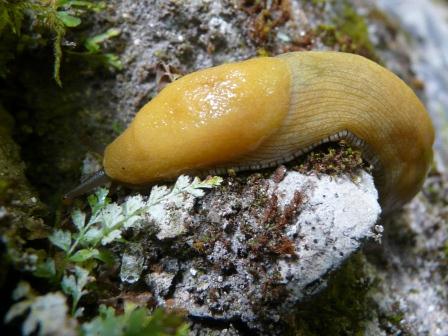
A general rule of natural history is that brightly colored animals that wander around in the open without any visible means of defense or escape are likely to be poisonous in some way. As far as I can tell, the chemical ecology of banana slugs has not been fully analyzed, but among Santa Cruz naturalists there is a tradition of experiential investigation of these slugs, an experience that is mediated through the tongue. So, eager to join the inner circle of initiates, I genuflected then prostrated myself before a large specimen on the trail. The animal was strangely unperturbed by my licking. The same could not be said about my tongue. I did not taste much in the way of noxious secretions, but for half an hour afterward I had a layer of gelatin firmly adhered to the top of my tongue.
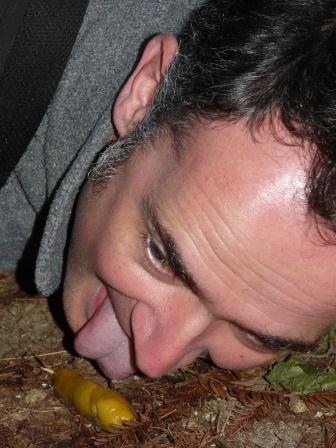
Note for Tennessee readers: please do not try this at home. Thanks to the action of the 2012 state legislature, this kind of behavior is considered “gateway activity” and may result in your having to repeat a grade in school, the revocation of your concealed weapon permit, or both.

Following this encounter, I learned that the tangy stalks of redwood sorrel (Oxalis ¿oregana?) do a great job of “cleansing the palate” (an expression that I believe originated somewhere a little more classy than among the Ariolimax-lickers of California). For those of you whose thoughts are turning to hallucinogens: you’re thinking of toad-licking. Believe me, lying flat out on a redwood forest floor licking a giant yellow slug is experience enough for me. What could a hallucination possibly add?

The slug is endemic to the Santa Cruz area (two other species are found elsewhere on the west coast) and is the mascot of UC Santa Cruz. The T-shirts say: “Banana Slugs: No Known Predators” which is catchy but not entirely true. The less well-informed Pacific giant salamanders eat them, as do snakes and some other creatures.

I looked into Mead’s original 1943 description of this species and the diagnostic character  is the length of the penis: “not infrequently of greater length than the slug itself.” Mead was so breathless with amazement that he added an exclamation point in the scientific description, a form of punctuation that is as rare as the smiley face in taxonomic journals. Quite why the famously enterprising undergrads of UCSC have not developed a T-shirt emphasizing this zoological phenomenon in their hermaphroditic mascot, I don’t know.

Thank you to my friend and former student Leighton Reid for being my host for this visit and guiding me in the ways of the banana slug.
Forest Unseen, update II

I just learned that The Forest Unseen is now in its second printing, which is great news. I know that the enthusiasm of many of the followers of this blog is part of the reason for this success: thank you. A paperback version will be coming out in spring of 2013.

Some recent reviews include one in the NRDC’s magazine, OnEarth, and inclusion in John Sutherland’s essay about the direction of modern “nature writing” in the Financial Times. I was particularly honored to be included in this essay alongside authors whose work I greatly admire.

I am in Santa Cruz, CA, today giving a talk at UCSC. Banana slugs are underfoot, ravens overhead, and redwoods surround buildings on campus. What passes for rain in these parts is falling outside, what Tennesseans might call a vigorous, organized mist; apparently this may be the only precipitation until the autumn.

A peek inside the cabinet

Thanks to a kind invitation from my friends and colleagues at The Land Trust for Tennessee, I was able to attend a meeting today with Ken Salazar, Secretary of the Interior. The meeting was focused on the top priorities in the state of Tennessee under the Obama administration’s America’s Great Outdoors program. This program is focused on land and water conservation and on providing access to “the outdoors,” especially in urban areas. Other attendees included representatives from local, state, and federal agencies and offices; conservation NGOs; foundations; and a few other academics.

The specific projects under discussion were: (1) the proposed new National Wildlife Refuge in the Paint Rock River watershed (just south of Sewanee), (2) the Tennessee Riverwalk in Chattanooga, and (3) the Harpeth River project in and around Franklin. Background information the first two projects is here; the third is described here.

In all three cases, private donors, NGOs, and local, state, and federal agencies have worked together to make long-term plans that enhance both “the environment” and human well-being. In the case of the Paint Rock, one of the Eastern U.S.’s crown jewels (if you’ll excuse the royalist metaphor in this republic) of biodiversity would be protected, with the additional benefit of providing public access (including hunting) to large areas of unfragmented forest, access that is becoming harder and harder to secure as the last remaining “open” lands get closed off by development and other pressures. I am delighted that this project has received such high priority — it would be a major win for the people of Tennessee and Alabama (and for the world‘s biodiversity — few places can rival the Paint Rock River).

The other two projects are in more urban areas. The first of these involves continuing the Riverwalk in Chattanooga, extending it into lower-income areas and completing the original plan for interconnecting different parts of the city. I’ve ridden this fabulous walkway many times on my bike and I am continually impressed by how many people use the walkway, how diverse their backgrounds seem to be, and how flat-out delightful it is to pedal along the Tennessee River for miles. I know less about the Harpeth River project, but when it is complete (after dam removal, for one), it will restore the river to an entirely free-flowing state, one of the few such rivers in Tennessee. In addition, the project will provide public access, assist with riverbank restoration, and integrate with the freshwater supply in Franklin. This project is being looked to as an example for how other communities can move forward with river restoration and increased quality of life for human communities along rivers (i.e., most of our towns and cities).

Salazar impressed me with his genial nature, his ability to remember names in a room of fifty new people, and his careful questions, designed both to affirm the good in these projects and to sniff out without undue fuss any hint of problems. I can’t say that I agree with his positions on some issues, but I came away understanding a little bit more about what it takes to get good work done in complex political contexts.

Kudos to the amazing folks at The Land Trust for Tennessee for arranging this meeting on very, very short notice. Salazar’s schedule allows literally just hours to get things together (his full-time schedule man looked kinda worn out…).

Venus swinging past the sun…get ready

When I first heard about the upcoming transit of the planet Venus across the sun, I confess that my first thought was: ho-hum, kinda interesting but planets and stars move around all the time, so what if Venus swings across the face of the sun? Then I listened to the interview with Andrea Wulf on the Nature podcast (direct link to the interview is here; the podcast is also on iTunes, etc). How wrong I was in my initial judgment (which grew entirely from my ignorance — the world is only a ho-hum place when your head is buried in the sands of your own limitations).

The transit will certainly be less dramatic than lunar and solar eclipses, but unless any of us are planning to be around in 2125, this is our only shot. But rarity is not the main attraction. When the little dark disc of Venus hits the sun, we’ll be able to witness a natural phenomenon that changed the shape of the world of ideas. Now that is worth paying attention to.

The two transits in the 18th century — in 1761 and 1769 — allowed astronomers to estimate the distance of the sun from the Earth. This was a major achievement, made possible first by the heliocentric view of the solar system (unless you assume that the planets orbit around the sun, your trigonometry is very wrong) and, second, by the calculations of Edmond Halley (of comet fame) who correctly predicted in 1716 that Venus’ transit would offer an excellent alignment of celestial angles, allowing astronomers to get an accurate estimate of the distance to the sun from the Earth (this video has a great overview of how these estimates are made; in this case, we’re using parallax).

Halley did not just point out the scientific potential latent in Venus’ transit, he developed a detailed plan for how to take advantage of this opportunity, although he knew that he would be dead by the time the transit happened. The plan was necessary because an accurate estimate of the distance depended on timing the transit from multiple points on the Earth’s surface, preferably with these points being spread far apart (triangulation works best when the two people conducting the measurement are located at some distance from each other). And so this transit became the motivating force behind large, government-funded, collaborative international expeditions. Astronomers trekked to far-flung places with huge boxes of gear, then hoped for a clear day. Never before had such an enterprise been undertaken and science was forever changed by the success of the project. It is not too much of a stretch to say that the intellectual history of the West was nudged by this event: the measurement of the distance to the sun through the use of scientific principles and predictions was both a product of the Enlightenment and a spur to its further development. So let’s go out on June 5th and pay homage.

The website transitofvenus.org has much useful information about the upcoming event, including how to view the event without being blinded by Enlightenment (a useful skill, especially for those at liberal arts colleges). If you have binoculars, use them to project an image of the sun onto paper (as shown here), being careful not to look at the sun through the binocs — ouch.

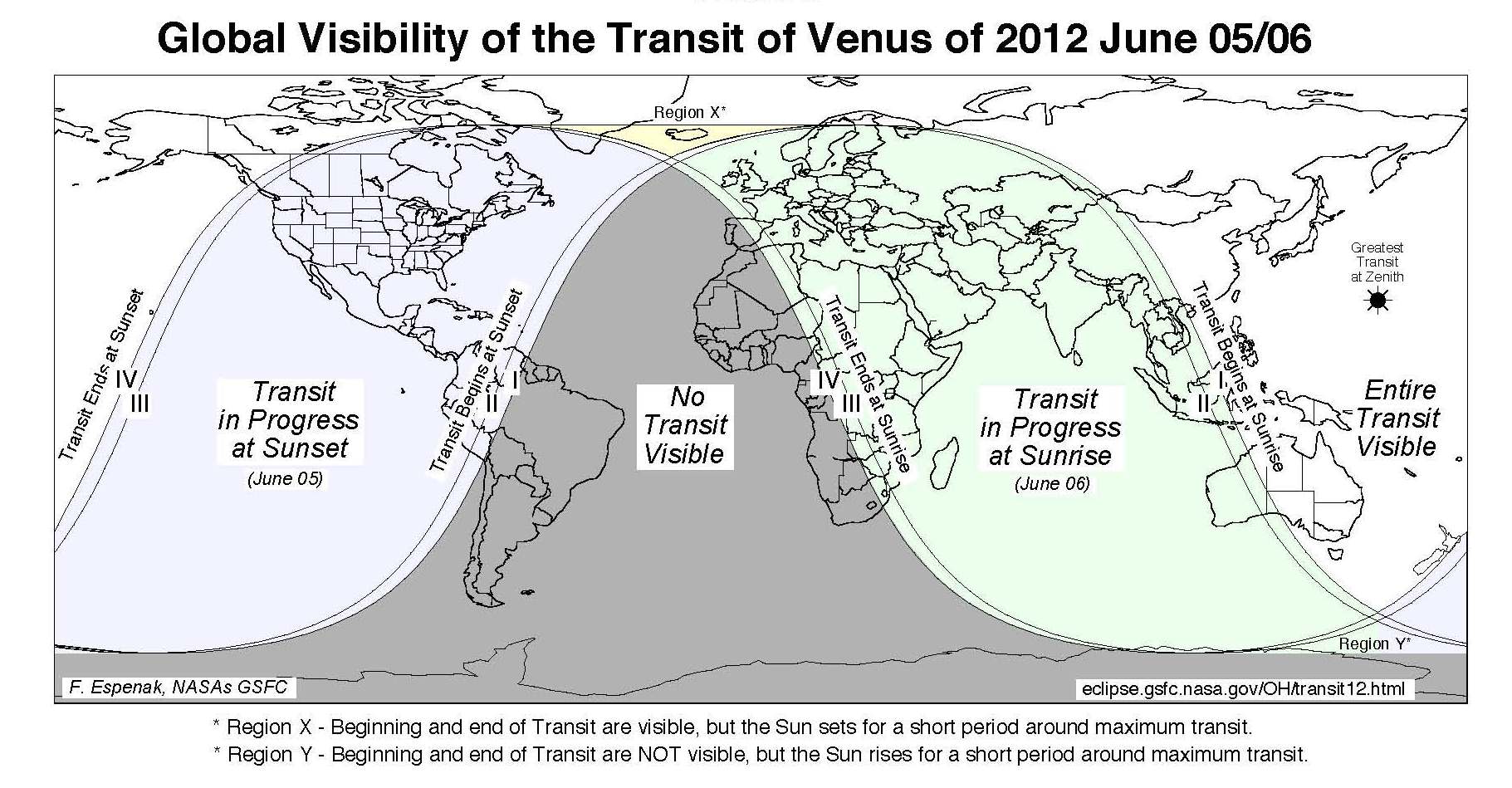
I found the maps on the site particularly helpful:

Map showing where and when you can see the transit (from transitofvenus.org)

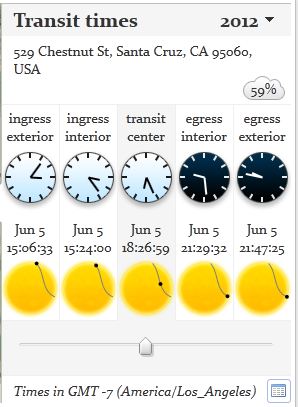
For a more precise indication of when you should look, enter your location here. You’ll get a nice set of times and mock-ups of what the transit should look like. Here are the data for Sewanee, TN, where the transit will be visible from 5pm until the sun goes down:

And Santa Cruz, CA (where I’ll be — please, please let it be “sunny California”):

Last, for some musical accompaniment for the event, John Philip Sousa’s Transit of Venus March (who knew?) might be suitable (available in high school bandwidth here).

Reblog: Memorial Day

I’m “reblogging” this thoughtful and moving Memorial Day post from my friend and colleague Chris McDonough. I’ll add that the poppy referred to in the poems of WWI is the European poppy, Papaver rhoeas, a annual plant that specializes on colonizing disturbed soils. It therefore bloomed all over the bombed-out landscape of Northern Europe during the war. The plant is still a successful “weed” in European grain fields; these days, the “war” is against herbicide-resistant varieties of poppy: progress of a kind, surely.

Rachel Carson’s birthday: “No one could write truthfully about the sea and leave out the poetry.”

This week I’ve been reading Rachel Carson in preparation for a short essay that I’m working on. Today is her birthday, so I thought I’d post a few quotes from her work. She is a fabulous writer, channeling her extraordinary passion through thoughtful metaphor and confident but understated prose. The quotes come from her article “Help your child to wonder” which ran in Woman’s Home Companion in 1956. I had not read this article before; it is not widely reprinted, but is full of gems. Thankfully, the U.S. Fish and Wildlife Service Conservation Library has a scanned pdf available of the original.

“Out there, just at the edge of where-we-couldn’t-see, big waves were thundering in, dimly seen white shapes that boomed and shouted and threw great handfuls of froth at us. Together we laughed for pure joy – he a baby meeting for the first time the wild tumult of Oceanus, I with the salt of half a lifetime of sea love in me.”

“If I had influence with the good fairy who is supposed to preside over the christening of all children I should ask that her gift to each child in the world be a sense of wonder so indestructible that it would last throughout life, as an unfailing antidote against the boredom and disenchantments of later years, the sterile preoccupation with things that are artificial, the alienation from the sources of our strength.”

“It is not half so important to know as to feel. If facts are the seeds that later produce knowledge and wisdom, then the emotions and the impressions of the senses are the fertile soil in which the seeds must grow.”

When she received the  National Book Award in 1952, she said: “The winds, the sea, and the moving tides are what they are. If there is wonder and beauty and majesty in them, science will discover these qualities. If they are not there, science cannot create them. If there is poetry in my book about the sea, it is not because I deliberately put it there, but because no one could write truthfully about the sea and leave out the poetry.”

Goslings and caterpillar

Continuing with the theme of cute animals, I was in Chattanooga today and took time out for a bike ride along the Riverwalk. Young animals from two very different parts of the tree of life caught my attention.

This mixed brood of Canada goose goslings was making its way upstream along the Tennessee River. There are at least two families, possibly three, in this “crèche.” Mixing families like this is common in waterfowl, although less so among Canada geese. There is safety in numbers, so these goslings benefit from each other’s presence.

This pipevine swallowtail caterpillar was crossing the concrete path. Although it looks fearsome, it is harmless to handle. But any would-be predator foolish enough to try to eat the caterpillar will soon regret its decision. These caterpillars feed on poisonous pipevine plants and sequester the toxins in their bodies. The toxins then get passed to the adult butterfly. The adult tastes so nasty that half a dozen other species of butterfly mimic the butterfly’s blue and black colors, gaining protection through deception. Predators generally leave these mimics alone for fear of biting into a pipevine swallowtail. The photo below is from last summer — note the remarkable iridescent blue. Although I frequently encounter the adults I have never before seen the caterpillar. So a close encounter with this bristly rubbery beast made my day. I put it back in the vegetation, away from the walkway.

Mammoths

The discovery of the remains of a miniature mammoth on the Mediterranean island of Crete was announced last week. These mammoths stood about waist-high and the reconstruction of the animal in the journal Nature must rank as one of the cutest scientific reports in a long time.

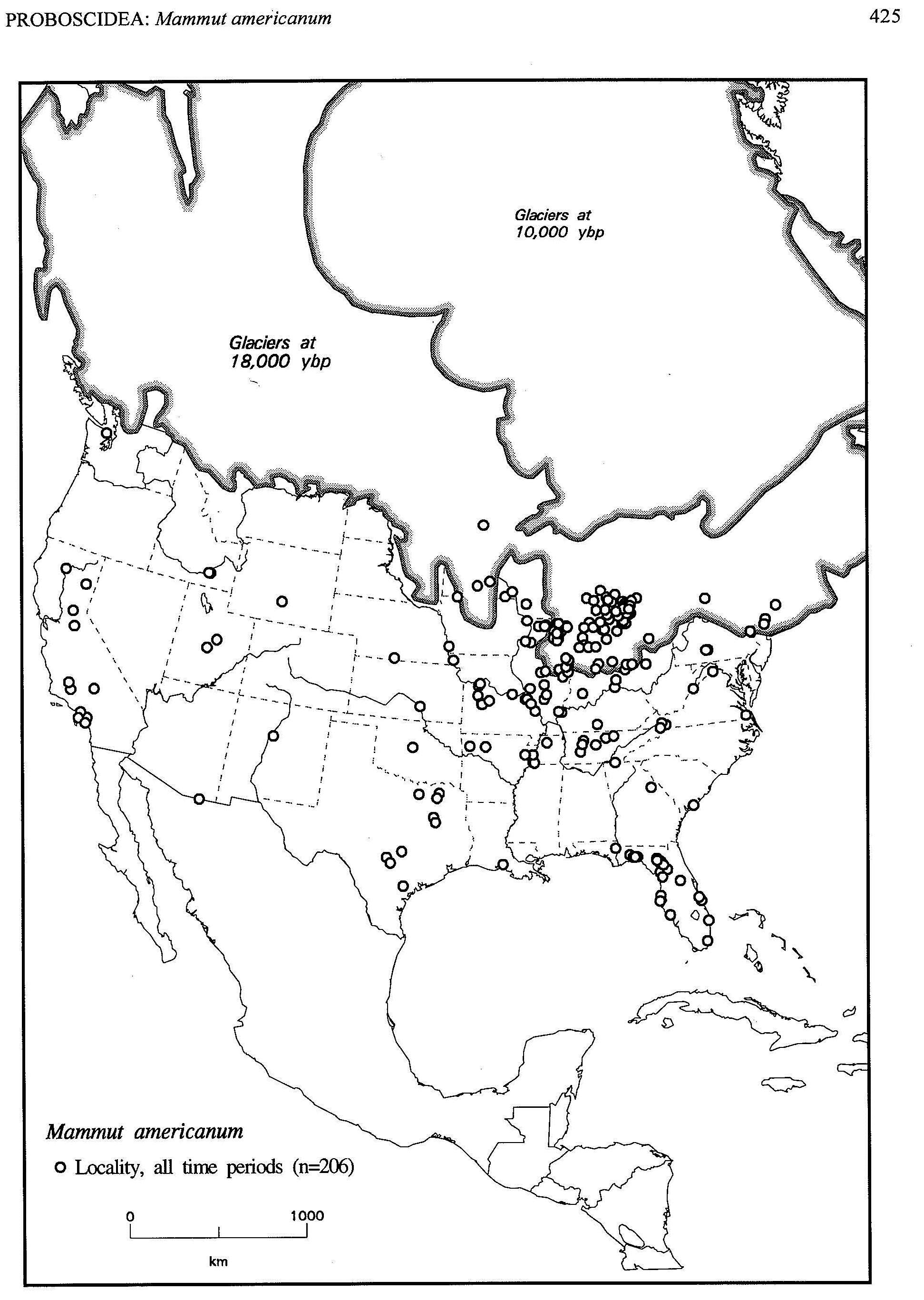
If Crete seems impossibly remote, the map below serves as a reminder that mammoths and mastodons (full-sized: three meters high) roamed North America until very recently. For three million years, this species wandered through forests in small bands, tearing up the vegetation. The “damage” left by the much maligned white-tailed deer is nothing compared to what these giant herbivores wrought. About ten thousand years ago the mammoths and mastodons disappeared. A combination of climate change (the last of many ice ages was ending) and predation (humans had just shown up on the continent) probably did them in.

So, we have to turn to our imaginations to experience what our forests were like for most of their evolution. We sit on a mountain ridge and watch a group of huge elephant-like beings work their way across the valley, twisting at tree trunks with their five meter tusks, ripping and nibbling at branches with their mouths. Their calls? Stirring, no doubt.

Each dot is the location of a fossil. Image from FaunMap: http://www.museum.state.il.us/research/faunmap/ This map is for the American mastodon. The fossils from Crete were mammoths, a different genus.

Trees in Oxford, MS

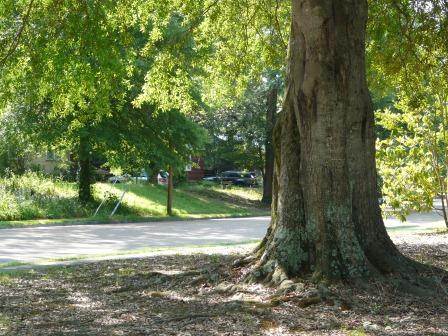
The number and stature of trees in Oxford, MS, is impressive. My stay was quite short, so my ramblings were brief, but it seemed to me that the sylvan nature of town extended well beyond the upscale neighborhoods. Urban trees and other forms of biodiversity are well-known to be associated with the more wealthy parts of towns (e.g., this and this study), so the presence of large trees in less affluent neighborhoods can be thought of as a measure of the “eco-justice” in communities: access to the practical and aesthetic benefits of nature.

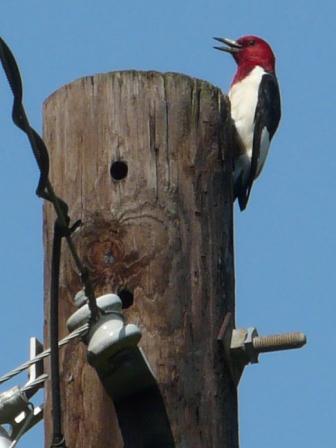
The large trees in the suburbs of Oxford attract a good diversity of bird species, including this red-headed woodpecker that was using the top of the power pole as a place to carry insects or seeds to jab with its beak.

The impressive tress in town contrast with much of the rural land in northern Mississippi where large plantations of loblolly pine dominate. These plantations are planted and cut like crops and, although they have more biodiversity than cotton fields, they generally host fewer species than native forests or residential areas (for my study of these differences on the Cumberland Plateau, see here).

Oxford’s wealth of trees didn’t “just happen.” The town has a tree board and a plan that not only seeks to preserve existing trees but also to expand plantings for the future. So, what lies behind the leafy charm of one of the most beautiful (and consequently one of the more prosperous) southern towns? Proactive urban planning, the work of loving the people and trees of the future.

“Given a choice between grief and nothing, I’d choose grief” — William Faulkner

Rowan Oak, the home of William Faulkner from 1930 until his death in 1962, has the feel of a sarcophagus from which the King has been ghosted away. The ornamented shell is there, the bones have moved on, yet the spirit lingers. I think Faulkner would have liked it that way. I’m no expert on his work, but the interpretation (and preservation) of memory runs through his writing. Memory is now preserved and interpreted at Rowan Oak with care and skill.

A few of his own words about time, memory, and writing:

“The aim of every artist is to arrest motion, which is life, by artificial means and hold it fixed so that a hundred years later, when a stranger looks at it, it moves again since it is life.”

“Clocks slay time… time is dead as long as it is being clicked off by little wheels; only when the clock stops does time come to life.”

“I have found that the greatest help in meeting any problem is to know where you yourself stand. That is, to have in words what you believe and are acting from.”

“The past is never dead. It’s not even past.”

…and most telling of all, “Given a choice between grief and nothing, I’d choose grief.” Memory, indeed.

From the house and grounds:

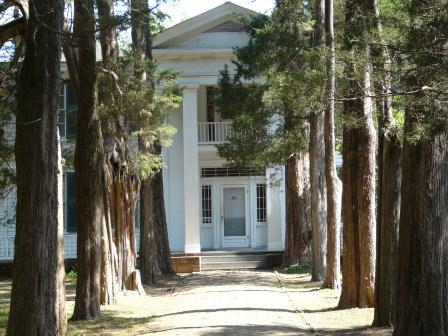
The entrance to the main house. Cedars line the driveway. Although they are not native to this part of Mississippi, they were planted with the hope that they would ward off yellow fever. Now they are grand old trees, filled with woodpecker holes.

Typewriter in his writing room.

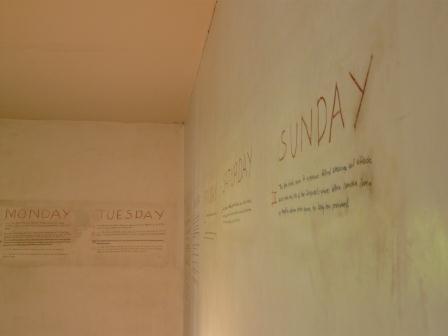
Plot outline for The Fable drawn on the wall of the same room.

His thoughts on tools of the trade.

Punctuation to his writing.

More punctuation.

Estelle Faulkner’s watercolors line the walls.

…and she had this window AC unit installed the day after his funeral. He objected to AC until the end. The timing of the appearance of the unit no doubt is loaded with meaning that we’ll never have access to — did she willingly respect his wishes, or chafe at his strong-headed bullying, or did grief finally make the heat intolerable?

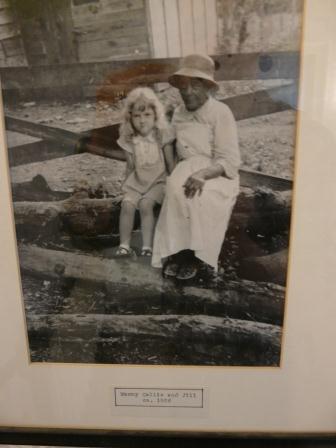
The Faulkner’s servants have a low profile in the house. A form of erasure. “Mammy Callie” is present in the house in this photograph; I did not encounter the other two servants. 

Servants’ quarters in the back of the house. These memories are locked. Hopefully restoration will be coming soon.

The old man’s boots have some miles left in them…