Category Archives: Plants

Shakerag Hollow: spring ephemeral wildflowers

Our campus emptied out this afternoon as spring break began. After a few hours of cleaning the lab, answering emails, and pushing papers from one place to another I finally cracked (or woke up) and set out for the woods to enjoy some reality.

This slideshow requires JavaScript.

Spring ephemeral wildflowers covered the forest floor. In the richer areas, each palm-sized patch of forest had a dozen blooms crowded together. There are few places in the world that rival the profusion of blooms in this north-facing Appalachian cove (and the snails, insects and salamanders that ply the leaf litter below the flowers are equally diverse).

These “ephemeral” wildflowers are hurrying through their flowering and photosynthesizing in the short weeks that remain before the tree canopy steals all their light. But the plants don’t disappear for the rest of the year. Instead, most of them persist underground in roots and swollen stems. So, the “ephemerals” appear to be short-lived, but are in fact many years old, perhaps as old as many of the trees that loom over them.

No canopy = a great opportunity

Microsafari: Bear hunting

I spent much of Saturday on a trip organized by the Sewanee Herbarium, led by Paul Davison from the University of North Alabama. In addition to being a botanical expert, Paul is a master of finding the “wee beasties” (a phrase used by the pioneering microscopist Van Leeuwenhoek) that surround us: the micro-world of single-celled protists and tiny animals, all existing just beyond the limits of our vision. But, with some simple equipment and a hand lens or microscope, this world opens up for us. About 24 people came on the trip, a good mix of Sewanee biology students and faculty, along with community members.
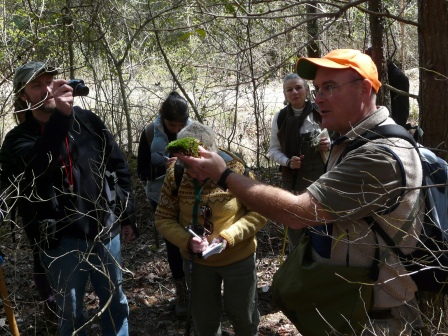
Paul Davsion discussing the "pin cushion" moss, Leucobryum.
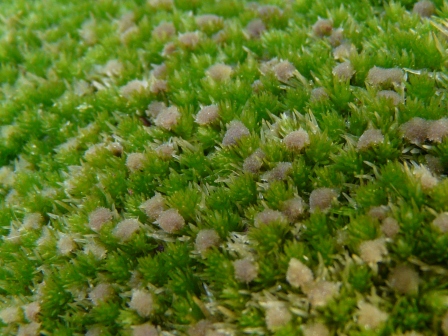
Curious structures growing in the Leucobryum moss: undescribed in the North American literature, apparently. Perhaps micro-male mosses growing within the larger female parts of the plant (the Archegonia, for lovers of botanico-jargon).
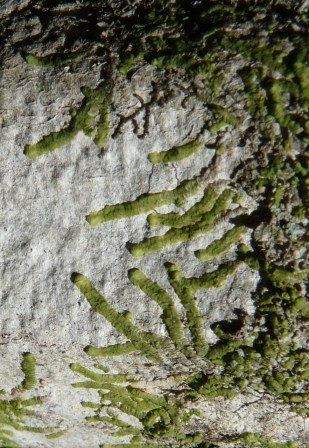
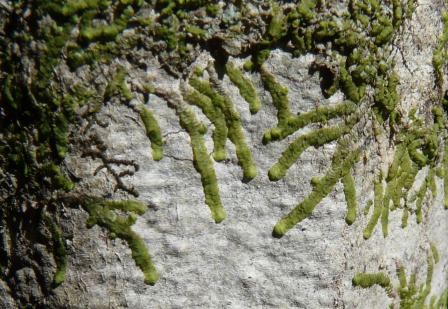
Leafy liverworts creeping across tree trunks.
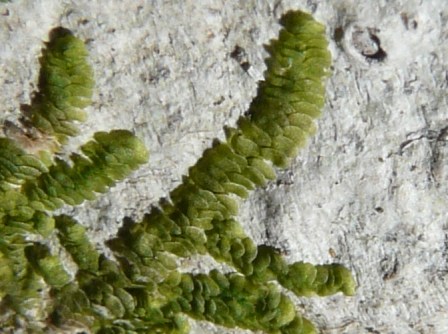
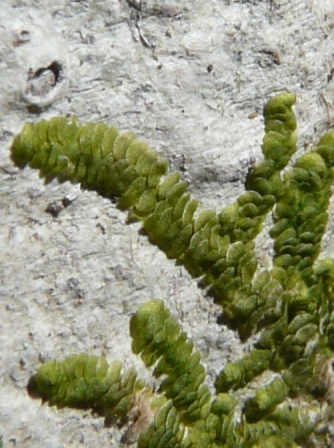
Seen close, the alternating scale-like flaps (not true leaves) of the liverwort are visible.

After a foray into Lost Cove, we returned to the lab to pull open the door to another world (amazingly, also the same world) by looking at critters under microscopes. We found legions of algal cells, whizzing crustacea, lumbering protists, and gliding flatworms.

By holding my camera up to the microscope lens, I snapped a few shots of a couple of my favorites.
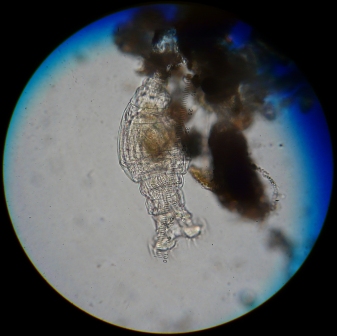
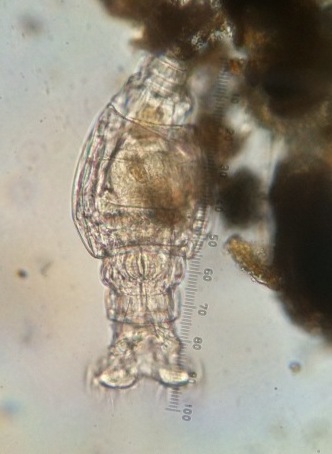
A rotifer, or "wheel animal". Its head is pointing down and its rear end is clasping some dead plant material (aka crud). the two Mickey Mouse ears are ciliated (cilia = hairs that stir the water) feeding devices, moving food into the mouth.
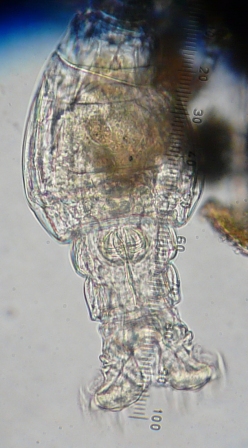
A close look at this shot shows the grinding pharynx that pulverizes food as it moves through the gut (look for the round structure to the left of the "60" mark).

Commercial break: go buy Apple products. Chris Waldrup sent me this photo that he took through the scope with his iPhone. Pretty darn good. Yes, I want one.
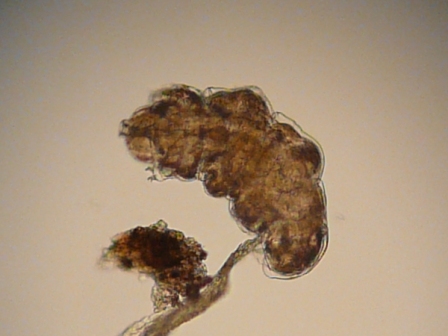
Now for the bear: this is a tardigrade, also called "waterbear" or "moss piglet" (with some crud to the left and below -- the waterbear is at the top). It was indeed living in some moss. They have eight little legs and amble along like bears. This one is stranded on its back with its front legs pointing to the left and its hose-like mouth just visible. Don't let the rolly-poly cuteness fool you: these are the toughest animals in the world, able to enter suspended animation and survive the deepest cold imaginable, vacuums, radiation blasts, utter dryness for years, and exposure to temperatures above the boiling point of water.
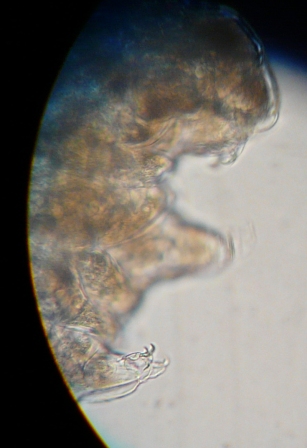
Tardigrade feet, equipped with claws for clinging to their mossy homes. They'll still be hanging on when Homo sapiens has turned to a layer of dust in the geological column. So far, tardigrades have been around for 600 million years. Modern humans, less than one tenth of one percent of that.

Thank you, Paul Davison, for leading the hunt. Thank you also to Jon Evans and Mary Priestley for organizing the event.

Some early stirrings in Shakerag Hollow

After work yesterday I headed down into Shakerag Hollow to see what was stirring at the end of the warm afternoon. It was a pleasure to walk with just a shirt on my back — discarding the wintry weight and confining clutter of jackets and gloves and fleeces and hats. Ah!

Scarlet cup fungi (Sarcoscypha sp.were fruiting in one or two places on the side of the trail. They feed on decaying plant matter and grow their striking red “cups” throughout the year, but especially in cooler months. Spores are produced from the inner surface of the cup. These blow away (or are carried on mouse feet) to colonize more dead vegetation, of which there is no shortage on the forest floor. The scarlet cup is a favorite of mine –saturated with color at a time of year when the rest of the forest is mostly muted.

Bloodroot plants were poking up their flowers. Most were still tightly closed, but one or two had cracked open a little. The deeply incised leaves are held clasped against the stem, only relaxing into an open posture when the flower is mature or dead.

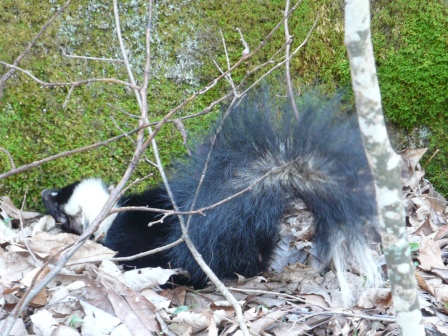
I was not the only mammal out and about in the balmy woods. Junebug the Hound found this skunk, but fortunately she paid attention to my bark: leave it! The skunk had its tail arched, ready to express its opinion.

Little blooms

Gray, gray day: you will not win.

As an antidote to the unrelenting rain and murk, here are a couple of tiny beauties that I photographed earlier this week. Both were growing between lettuce plants as “weeds” in my cold frames.

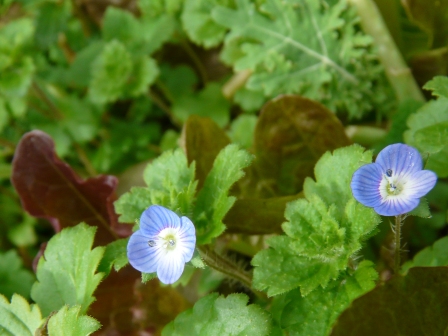
Bird's-eye Speedwell, Veronica persica. So small that ten of these flowers would fit onto my thumb-nail.

Wikipedia says that this species has "no known horticultural uses." Unbidden beauty is utility enough for me.

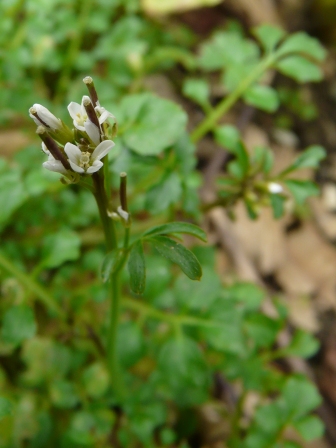
Small-flowered bittercress, Cardamine parviflora.

Each flower is about as big as a grain of rice.

This is the first year that either of these species has shown up in the cold frames. Their seeds may have come with compost from other parts of the garden or as “extras” in packets of lettuce seeds.

Merlin!

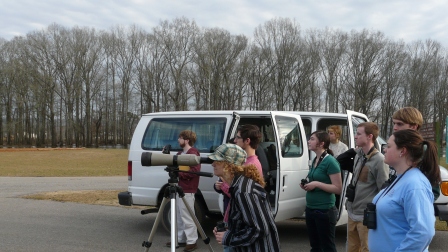
This lonesome old tree by the waterline has a special visitor perched at its top: a merlin visiting from Northern Canada. Merlins (Falco columbarius) are small falcons that breed in the boreal forest. They are uncommon winter visitors to our region. We found the bird at the end of our class visit to Crow Creek Wildlife Refuge near Stevenson, AL.

Merlin, condensed to about 2 pixels. Great views through the scope, though.

Merlins are spectacular little birds. They sit and wait for an unsuspecting songbird to fly past, then they explode into rapid flight and chase down the prey, catching it in midair. They are the fighter jets of the bird world: fast, maneuverable, and uncompromisingly fierce. “…no falsifying dream/Between my hooked head and hooked feet”.

Scoping

The warm weather turned up some other unusual phenomena: great-blue herons standing over their big stick nests, maples in bloom, and chorus frogs singing. This is a very peculiar January — prolonged warm weather has unlocked all kinds of activity that in normal years would not happen for another month.

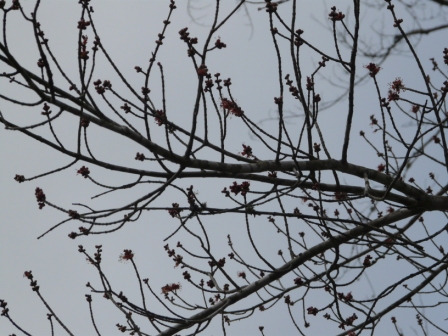
Red maple flowers...on Jan 31st

In summer, the water in the Crow Creek Refuge is carpeted with the large round leaves of American Lotus (Nelumbo lutea; also called Water Chinquapin). Now, the plants are invisible (their stems are underwater in the mud) except for the strange seed receptacles that litter the shoreline like organic showerheads.

Seeds fit inside the holes on the top surface.

We also found a rare specimen of Florus plasticus washed up on shore.

The pollinator of this flower is unknown, but it probably requires a battery.

Limestone foray

I rambled halfway down the mountain to visit some caves this morning. The Cumberland Plateau is a layer-cake of rock: the top layer is sandstone, the bottom is limestone. Sandstone does not dissolve in water, but limestone does. Over millions of years, this dissolution of rock by water has gouged holes in the lower reaches of the mountainside, creating an impressive network of caves.

From the outside, looking in.

From the inside, looking out.

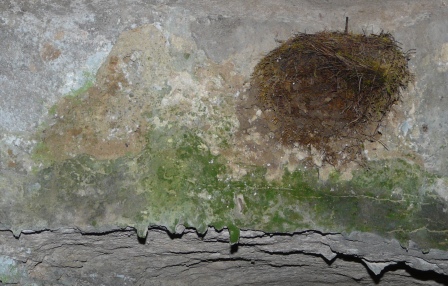
A phoebe nest on the inner wall of the cave, about fifty feet back from the entrance. These nestlings were raised in near darkness. Their first flight out into the world must have been a revelation.

"Solomon's Temple" cave entrance. No Ark of the Covenant here, just limestone-adapted spleenwort ferns.

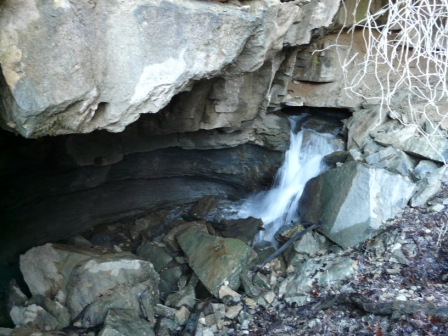
An underground stream surfaces briefly at the base of the cliffs. Inside the cave, this stream roars away at the bottom of large pits. I was by myself, so I did not scramble into the cave to see them again -- rule number one of caving is 'don't go inside dangerous caves alone'.

Multiple layers of eroding and fractured rock: another reason for caution.

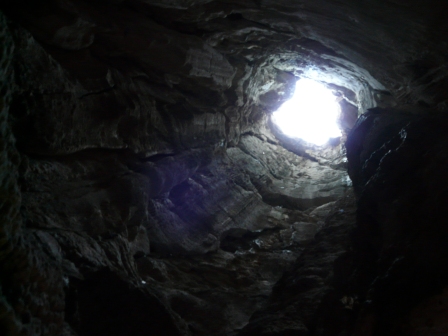
My favorite spot around these caves. This is a vertical tube, about twelve feet wide, running straight down from a hole on the forest floor, emerging far below in a pile of debris on the side of the cliff face.

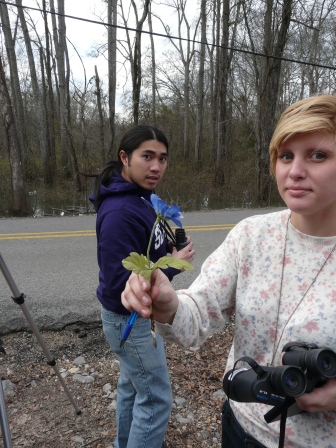
Just below the cliffs and caves, I found the first wildflower of the the year, “pepper-and-salt” or “harbinger-of-spring”, Erigenia bulbosa. It seems a little early to be harbinging the spring — we’ve got plenty of winter to go yet — but it is good to be reminded that spring will come. These little flowers belong to the carrot family and their tuberous root is supposedly edible. I’d rather leave them rooted and feed on the hope they offer.

Cranefly orchid

“Midway on our life’s journey, I found myself/In dark woods…lost.” The tangle of old logging roads and abandoned trails north of Kings’ Farm turned me around this morning, adding a half hour or more to my trek. Virgil did not appear. He never does. But, by getting lost, I did stumble on some great little plants: about a dozen cranefly orchids in the leaf litter on the side of an old trail.

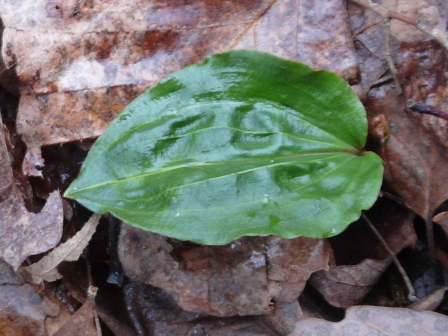
Cranefly orchid, Tipularia discolor

Unlike most other woodland plants, cranefly orchids grow their leaves in the fall, keep them through the winter, then let them die in spring. Later, in midsummer, the spindly flower stalk emerges without any leaves, using belowground food stores to power its growth. So, this orchid’s life is powered by the weak winter sun.

The green, upper surface of the leaves is pleated, giving it a crinkled appearance. More striking, though, is the purple underside of the leaf. Sometimes this purple bleeds into the upper surface, especially later in winter.

Underside of cranefly orchid leaf

This purple pigment is there to protect the leaf on cold days. When the photosynthetic machinery inside the leaf is iced-up, it can no longer absorb the energized electrons that sunlight knocks free from chlorophyll and other green pigments. The purple pigment soaks up these crazed electrons, keeping the leaf’s innards safe.

Walking fern, Asplenium rhizophyllum

These ferns were rooted in the moss on the north side of a large boulder in Shakerag Hollow.

The fronds arch through the air and, when they are fully grown, their skinny ends touch down into the moss…

…and root, producing a new fern, a clone of the parent. This baby will ultimately grow into an independent individual, arch its own fronds outward, and continue the “walk” across the boulder.
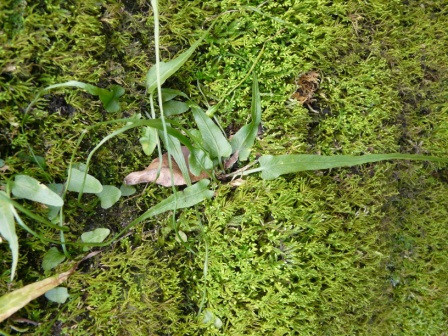
Walking ferns need a moist carpet to take root and they are seldom found away from thick mossy mats. Unfortunately their diminutive charm makes them attractive to plant-thieving gardeners. Transplants seldom survive, so it is best to leave them unmolested in the woods.

Deck the… lab walls

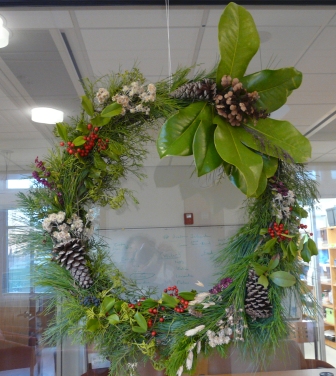
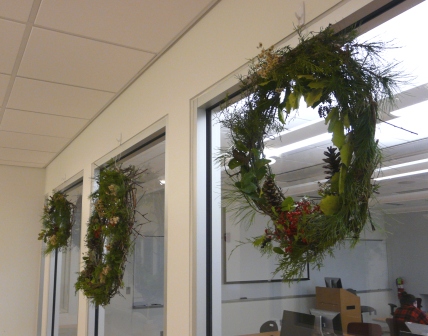
My colleague, Jon Evans, asks students in his Plant Systematics and Evolution class to produce a holiday wreath at the end of the semester. Their challenge: to build an attractive wreath using as many plant species as possible. Sewanee’s 13,000 acres have no shortage of plants to select from, over one thousand species at last count (of course, no rare species find their way into the wreaths).

The wreaths are hung on the walls in Spencer Hall, giving us all a nice boost as we work on final exams.

Luckily, the Microbiology class has chosen not to mount their ripe petri dishes on the adjoining walls.

Mistletoe

A single mistletoe plant is growing near the top of an ash tree behind Shenanigans and Woody’s Bikes. Mistletoe is not common in Sewanee, although it can be quite abundant on the lower slopes of the coves.

American mistletoe, Phoradendron leucarpum (literally, the "white-seeded tree thief")

Recently, biologists have realized that mistletoe is a very important part of the ecology of forests. In fact, mistletoe has such a major effect on other species that it has been called a “keystone species,” one of the major determinants of a forest community’s vitality. How so? Mistletoe steals some of its host tree’s food and combines this with the food that it makes for itself through photosynthesis. This combination of a big trust fund (the tree) and a steady job (the mistletoe’s own leaves) allows the plant to live large, offering abundant nectar in the early spring and fat, nutritious fruit later in the year.

Bees love the nectar which comes earlier in the year than the nectar of most other flower species. Birds and many climbing mammals adore the fruit. The pulp of the fruit is sticky, ensuring that it will stick to branches after it has passed through the bird. More, the seed is often so gummy that it sticks to the birds’ feathers. Birds have to grab the seed, then wipe it off on a branch — a perfect way for the mistletoe seed to get placed exactly where it needs to be. So, this small plant is used by dozens of invertebrate and vertebrate animals. One butterfly, the great purple hairstreak, has gone so far as to become wholly dependent on the plant. Its caterpillars will eat nothing else.

In other parts of the world, including the western U.S., different mistletoe species provide a similar range of services. Some even provide favored nesting areas for many birds. A review of mistletoe biology a few years ago stated that, “…the widespread perception of mistletoes as destructive weeds needs to be challenged. Many landholders, managers, and even biologists regard mistletoes as invasive pests, damaging to individual trees and detrimental to forest health. [But] …mistletoes have a substantial positive role in many forests and woodlands, and should be given appropriate recognition.” (from: Watson, D. M.. 2001. Mistletoe — a keystone resource in forests and woodlands worldwide. Annu. Rev. Ecol. Syst. 32:219–49)

Of course, mistletoe has other roles in the ecology of our world. So, I’ll sit and do my end-of-semester grading under the thief, ever hopeful that songbirds will visit.