Category Archives: Bioacoustic revelry

A little jaunt in the early morning…

…down to Bridal Veil Falls, below Morgan’s Steep. Unlike yesterday when the air was warm and the spring peepers were calling, a cold front has pushed some real November chill into the woods. The frogs were silent, but a Winter Wren was singing its heart out. Surely this species is our most vigorous songster, heard only in the winter months (this video and recording from Lang Elliott and Bob McGuire is remarkable — these are not easy birds to approach).

The stream at Bridal Veils comes out of the sandstone scree, hits the limestone layer, then plunges into a pit.

Junebug was fascinated by the pit, but didn’t take the leap. There are some huge toads, snails, and slugs down there. Even in summer, the air at the bottom is moist and cool.

The big waterfall is not the only force sculpting the rock here. Limestone dissolves readily and the rocks have been shaped by years of trickles and oozes.

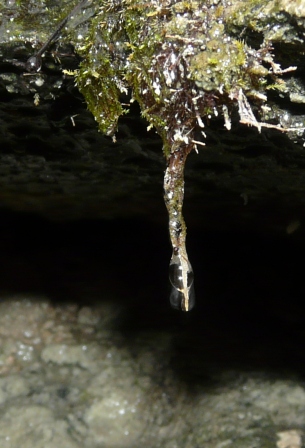
Even a tiny drip over the lip of a rock has cut a U into its path.
Lesser angle-wing katydids

They start singing about an hour after dark, calling with short bursts of high-pitched sound. Each call is somewhat like a can of dried peas being shaken rapidly. In the following recording, the lesser-angle wings call five times. You’ll also hear the common true katydid singing “di-di-did” in the background. Crickets are also singing in this clip — they form a continuous band of sound against which the katydids play.

Lesser angle-wing katydid, Microcentrum retinerve. This individual flew into the kitchen and posed briefly on the wall.

For comprehensive identification information on America’s many katydids (including sound files) see Walker and Moore’s excellent online guide.

The king and queen of Bonnaroo

Kingbirds sing from the treetops on the festival grounds.

Eastern kingbird, barely visible, centered in the O of ROO in the hand/globe sculpture. He sings without amplification.

The queen? Perhaps Alison Krauss who, with an inflection of a sung note, can send chills down the spines of thousands of listeners standing in the Tennessee afternoon sun.

Alison Krauss and Union Station. Approximate air temperature: sunny side up.

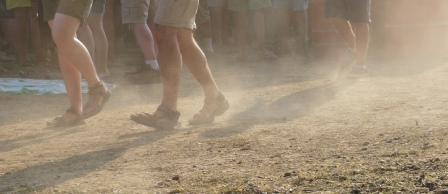
The royals preside over a Dominion of Dust.

Quarter of a million feet on a few dozen acres.

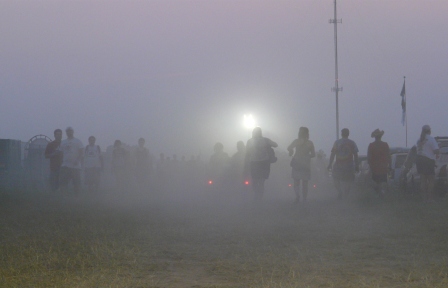
Nightfall.

Grasshopper Sparrow plays Bonnaroo

tik tik bzzzzzz

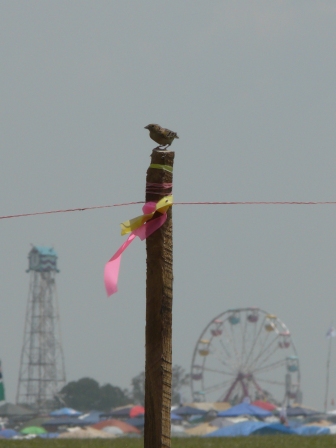
I stepped out of my car into the vast field that is the Bonnaroo parking area and immediately heard the avian headliner for the day: a grasshopper sparrow singing from a post. This is not a common bird, so I knew immediately that I’d come to the right place for acoustic revelry. No doubt the bird wonders why eighty thousand people just showed up in his territory.

Grasshopper sparrow with Bonnaroo's firetower and Ferris wheel in the background.

Cope’s Gray Tree Frogs

Despite the lack of rain, the tree frogs have been calling every night from our small pond.

The croak calls are the tree frogs; the sweeter trill is an American toad.

In the morning, about a dozen small clutches of eggs were floating on the water surface.

Cope's gray tree frog eggs. The whole cluster is about as big as a my thumbnail.

The eggs will hatch in less than a week, then the tadpoles will take another month or so to develop. To make sure that the ducks don’t destroy all the eggs, I have scooped some of the eggs masses out of the pond. I’m keeping them in a bucket until they hatch, then I’ll return the tadpoles to the pond. Ducks don’t seem to be good at catching tadpoles.

Visual confirmation of the waaa-oo cicada

…also known as Magicicada tredecim. I’ve been hearing them for weeks, but this is the first one I have managed to catch and examine closely. Regrettably, all the thirteen year cicadas seem to be fading away now. So long, until 2024…

Magicicada tredecim. Underside of abdomen is mostly orange. Compared to Magicicada tredecassini, which is often found at ground level, this species seems to prefer the treetops.

Broad-winged hawk

I had a sound recorder in my hand when the bird flew over. The hawk’s whistled cry is a quintessential sound of the summer forest. Think: sweat and lush green humidity. The birds are secretive during breeding and so are more often heard than seen. They are much more conspicuous when they migrate in the spring and fall, circling high as they soar to Central and South America .

The recording is quiet, but the two-part whistle is evident. A chickadee calls at the end:

90 decibels…

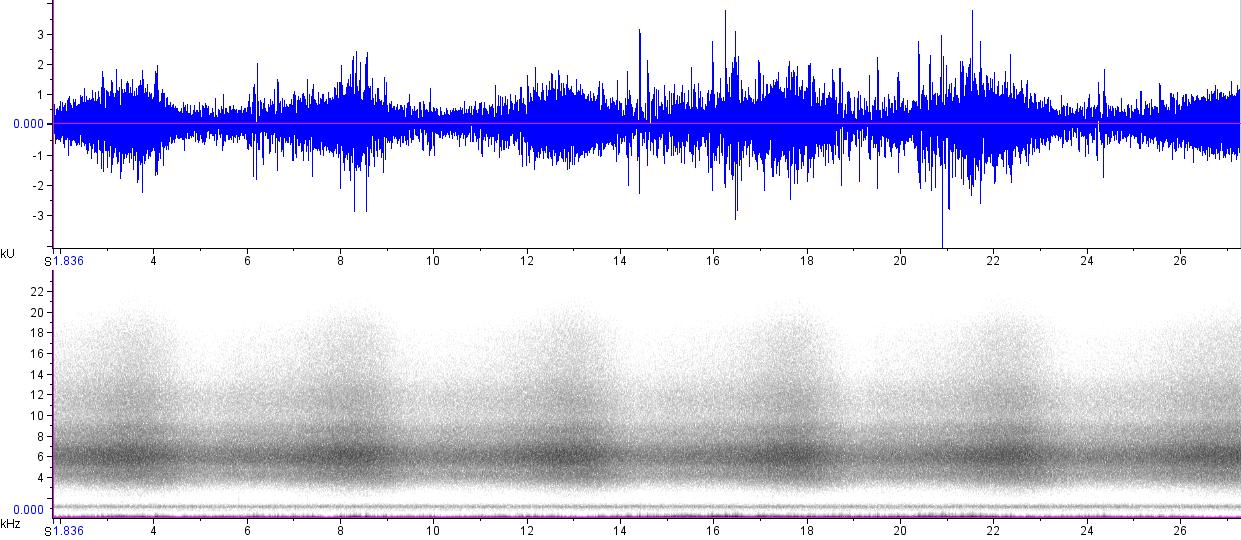
…is how loud the 13-year cicadas were when I made a pilgrimage to Sweeten Cove to listen to them this afternoon. The CDC recommends that humans limit their exposure to any sound louder than 85 dB. I can see why — my ears were ringing after spending half an hour in the midst of a cluster of cicadas.

Thirteen-year cicadas pulse the loudness of their sounds every four or five seconds (top graph). Their hissing, buzzy sound is concentrated in the middle and high ranges (bottom graph; for comparison, humans talk below 1 kHz). I made these recordings standing under a hackberry tree that was swarming with cicadas, then used Raven to draw the graphs.