Category Archives: Archosaurs

Pileated woodpecker feasting on magnolia fruits

The sun was rising directly behind the magnolia tree

Southern magnolia (Magnolia grandiflora) fruits are dyed bright red by lycopene pigment, the same colorant that gives tomatoes their glow. They are buried in the brown husk at the bird’s feet. Like other colored autumn fruits, the magnolia is advertising its wares to passing seed-dispersers.

Across the road, the male’s mate was pecking at a dead tree trunk. After a minute or two, she flew down to join him at the fruit bar.

Note her black mustache and black forehead (the male has red in both places).

Migrant thrush

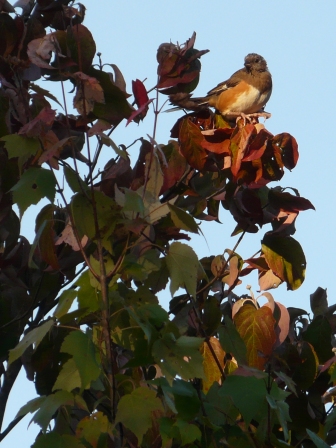
Despite the best efforts of our resident mockingbird, the beautyberry shrubs are still loaded with fruit. Today, two Swainson’s thrushes (Catharus ustulatus) found the bounty and have been feasting ever since. They can swallow a dozen fruits per minute.

Swainson's thrush -- note the smudged spots on the chest and the buffy eyering

Swainson’s thrushes nest in the spruce-fir boreal forests of Canada and the coniferous woods of the western U.S. The ones in our garden are on their way to South America, where they will spend the winter. Interestingly, many birds in western North America fly due east for thousands of miles before heading south. This seemingly wasteful route (why not fly directly south?) appears to be a consequence of their history: the western birds are descended from easterners and they retrace the migratory route of their ancestors.

Jewelweed

The last hummingbirds of the season are feeding in the jewelweed patch behind Stirling’s Coffee House.

Jewelweed flowers offer nectar to the hummingbirds from a nectar spur at the end of a cone-shaped flower. The hummingbirds have to insert their beaks all the way in to reach the nectar and in doing so they receive a dab of pollen on their foreheads. Many of the hummingbirds in the patch have heads that are completely coated in pollen.

Jewelweed, Impatiens capensis, with nectar spur visible on the far right

The last thing a hummingbird sees before it sinks its beak into the flower. The pollen dusters are at the top of the flower.

Not all spurs are the same shape. Some are curled, others are straight. It turns out the the more curvy spurs result in better pollen transfer to the hummingbirds, probably because the birds have to reach down further to get the nectar.
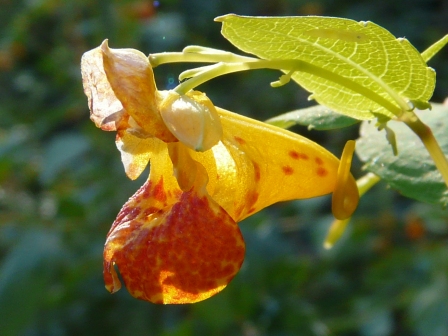
Compare this piglet-tailed spur to the one above.

The degree of curvature is heritable, so this is a feature that can evolve through natural selection. Why, then, don’t all flowers have the same degree of curl? No-one knows, but the diversity of pollinators that visit jewelweed may favor a diverse set of nectar spur designs.
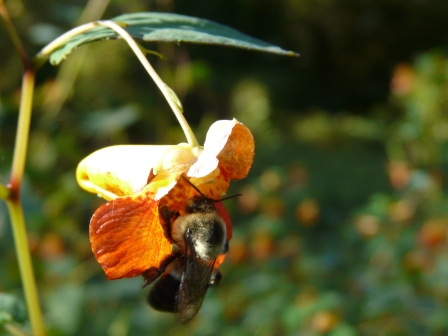
Bumblebee visiting the same jewelweed patch.

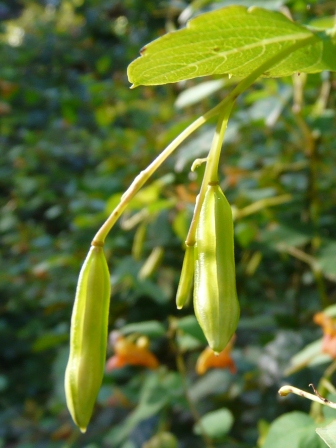
Jewelweed is also called-touch-me-not: a gentle pinch to the bottom of the seed capsule will cause the seeds to explode outwards, shooting several feet away. Gram for gram, the energy stored in these seed pods exceeds that of steel in springs.

Waiting to explode...

As an extra bonus today, the jewelweed patch also hosted a beautiful red phase screech owl. The scolding wrens gave away its location in the shrubs.

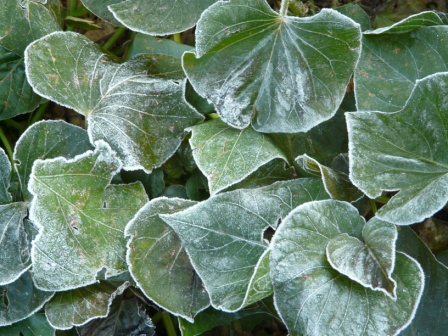
First frost

Sweet potato vines: time to dig

And, the steady north wind has brought a pulse of migrant birds: veery, Swainson’s thrush, common yellowthroat, Tennessee warbler, summer tanager, yellow-throated warbler, magnolia warbler, rose-breasted grosbeak, ruby-throated hummingbird, and chimney swift. Every other tree has a couple of warblers flitting through its branches. Even our okra patch has a Tennessee warbler and a common yellowthroat rummaging through its old stems.

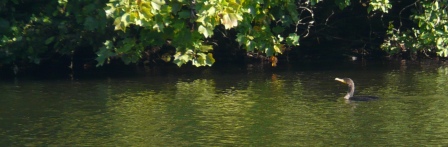
Double-crested cormorant

A single cormorant was cruising Lake Cheston this morning. It looked lost: gazing around in an agitated manner. Cormorants are gregarious, so it may have felt ill at ease without its companions.

These fish-eating birds migrate to Tennessee from further north and spend the winter on larger unfrozen lakes. I sometimes see them fly across Sewanee, but I don’t think I’ve ever seen one on our small lakes. Before the 1950s, these birds bred in some numbers in Tennessee, but DDT wiped them out. Now, a few small colonies have been reestablished. A few breed down in the valley, around Woods Reservoir.

Phalacrocorax auritus, seemingly bemused