Category Archives: Archosaurs

Bait

“’Hope’ is the thing with feathers,” so tells us Ms. Dickinson.

So, a bird feeder is a baiting station for hope. And why not invite wild, feathered dreams? Hope is also a classroom full of students eager to learn about feathers and other seemingly esoteric parts of the community of life.

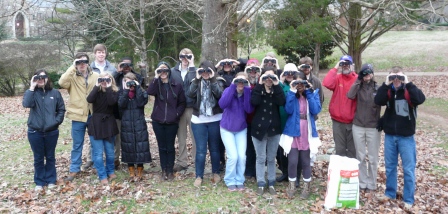
The 2012 Ornithology class, giving me some scrutiny. We'd just installed the feeder behind.

The feeder sits below the “moon tree” – a tree whose seed went to the moon (oh, curious journey), and is now back on Earth.

I imagine that no other tree on the planet is more relieved to have its roots worming through the soil of home.

Red Jungle Fowl sighted in Sewanee

I’ve been looking after the chickens at the student Green House for the last few days. The birds live behind the Green House “eco-dorm” and provide eggs, education, amusement, and, in the end, flesh. Their caretakers have dispersed, so a motley group of those “left behind” are coming in to feed, water, and check on the birds.

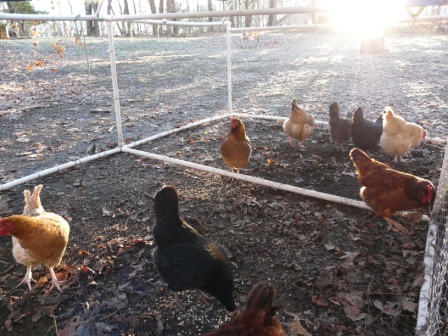
Dawn breaks on chickens pecking in the frost...in a PVC enclosure (wandering dogs love to eat chicken).

This gal is good-looking...

...and she's feisty. About one microsecond after this blurry photo was taken, she launched a lightning jab at the lens -- ping! She looked disappointed that the lens filter didn't crack, then she moved on to a vigorous attack of my boots.

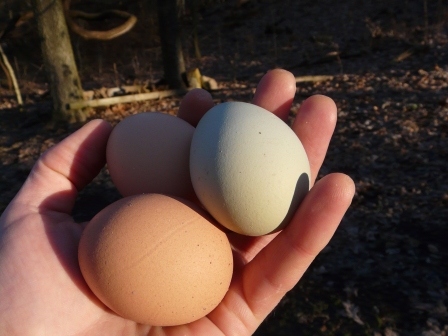
The nest boxes in their shed have half a dozen eggs each morning -- including, today, a blue one.

I can’t help but think of Asian jungles whenever I’m around these birds — and what a long strange trip it’s been.

Solstice Quiz

The theological overlay has changed over the years, but the underlying principle is the same: Sun = Life. So, on this most life-affirming day of the year, Happy Solstice to you (11:30pm CST is the hour, for those who like some precision).

In celebration, let’s have a quiz. These photos are all from along the Elk River, taken earlier this week.

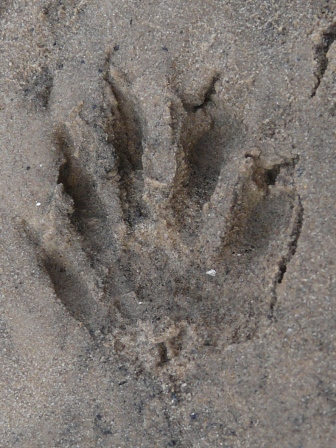
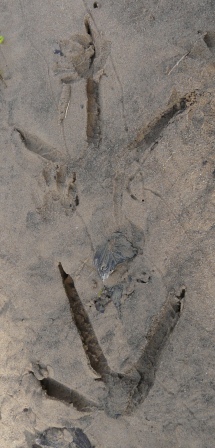
Who made these tracks in the sand (each print would nestle easily in the palm of your hand)?

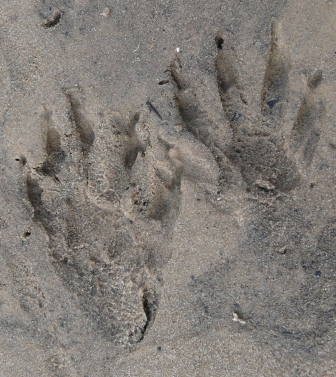
The same animal, showing back and front feet:

How about this one (a bigger track, about human hand-print sized, or a little smaller)? Normally, this creature has a fourth toe, pointing backward, but this time the mystery track-maker must have been walking daintily.

Now, look up. Whose nest is this?

Answers: here, here, and here.

I’ll close this ramble with a shot of the dawn mist on the Elk. Around my feet was strewn the plastic detritus of Homo sapiens (fishing tackle, TVs, bags of household junk, oil cans — all the usual suspects, minus needles this time), but the place was still beautiful.

Christmas Bird Count

The Audubon Society runs an annual “Christmas” Bird Count across the Americas. This count was started in 1900 by Frank Chapman at the American Museum and has continued ever since. Each individual “count circle” is fifteen miles in diameter and volunteers fan out within this circle to record all the birds they can find. The data is then compiled across the whole continent to give a large-scale picture of the health of bird populations.

This morning, I took one pie segment of the Franklin/Coffee County circle. (LouAnn Partington organized the whole event, I was just one of many “counters.”) The weather made this outing a treat: mid-50s and sunny. In New York, I remember doing one of these counts on cross-country skis in biting cold.

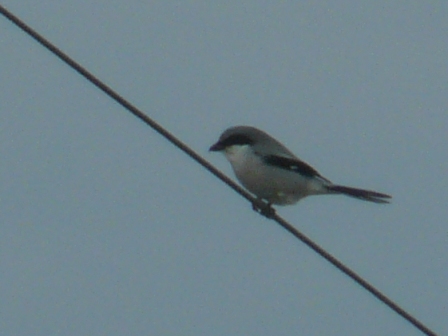
In all, I found over fifty species. Some highlights included finding a Loggerhead Shrike, a species that is in serious decline. Shrikes are birds of mixed grassland and shrubs, and they have been hit hard by the intensification of modern agriculture which removes their habitat and potentially exposes them to agrochemicals. They are fierce little birds, preying on small mammals and large insects. They impale some of their dead prey on thorns and barbed wire as a signal of their hunting prowess: mini trophies.

Loggerhead Shrike, one of the few remaining in the county.

Population trend for Loggerhead Shrike. Data taken from US Christmas Bird Count database. The Breeding Bird Survey (a summertime census) reports a minus three percent per year decline for the last thirty years.

Some other personal highlights were hearing Sandhill cranes make their bugling sounds, getting blasted by a blue jay with an imitation of a red-tailed hawk keeer as I walked under the jay’s perch, watching a belted kingfisher fly through the mist along the Elk River, and seeing Henbit the goat’s namesake plant, Henbit the little pasture weed.

Lamium amplexicaule, Henbit

Waay?

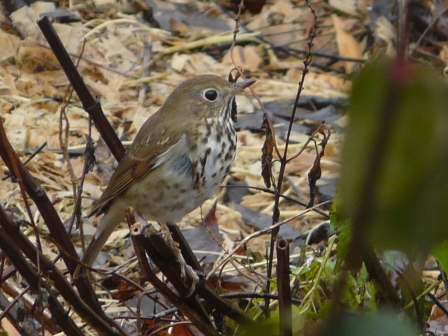
For several weeks now, I’ve been hearing a short sweet whistle from the treetops, but have been unable to identify (or even locate) the bird responsible for the sound. Usually the call comes just once or twice, then stops. The sound is high-pitched, like a titmouse call, but sweeter and inflected slightly in the middle. I had just about given up and dismissed the sound as an unusual titmouse, when a hermit thrush landed close to me in a small tree in the garden, cracked its beak slightly, and made the sound.

I’ve poked around on the web and cannot find any good recordings of this particular sound, although there are plenty of songs and calls from this species out there. The closest is the waay call on Lang Elliott’s site, but the sound I heard here is not nearly so nasal.

This morning, the thrush landed close enough to get a decent photo. Subtle beauty, but beauty nonetheless. I love the thin eyering.

Immature Cooper’s Hawk

I got a call today from the Sewanee Children’s Center: a dead hawk was lying in the playground. On my way home, I stopped by and did an impromptu “show and tell” for the kids. Nothing is more interesting at 5pm than dead animals, it seems. Because Sewanee is a small town, I know which households some of the kids came from. Interestingly, those from homes with nature-loving/trail-hiking/garden-keeping parents were very keen to hold the bird (wash your hands afterward kiddo…) and feel its soft feathers and sharp toes. Those from iHomes shrunk back: ah, the horrors of nature.

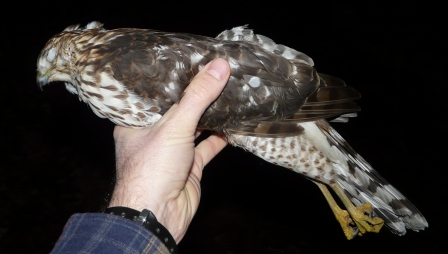
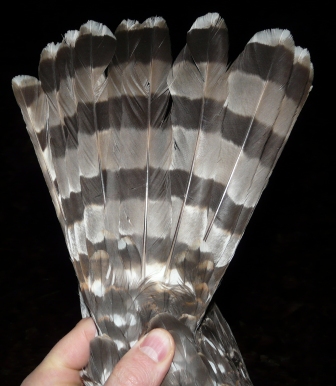
The bird was a Cooper’s Hawk in its immature plumage. The bird was full grown, but had not yet molted into the adult breeding plumage. It may have hit a window and fallen to the playground below.

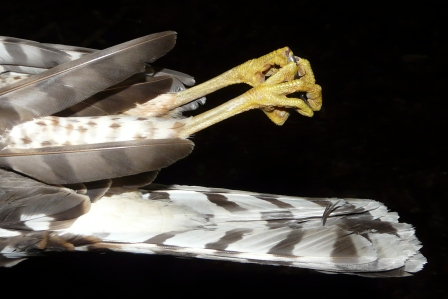
Cooper’s Hawks hunt other birds by chasing them down at high speeds in the forest canopy. To pull off this feat in the clutter of twigs and branches, the hawk has fairly short rounded wings and a long rudder-like tail. Its legs are also quite long — all the better to fish hiding birds out of tree holes.

The look-alike Sharp-shinned Hawk can be hard to tell apart from Cooper’s Hawks. I’m calling this one a Cooper’s because of the broad white band at the end of its tail, the relatively fine streaks on the belly that taper off to mostly white, the somewhat rounded end to the tail, and the fact that it is larger than some (but not all, females can be quite big) “Sharpies.”

This bird is now in my freezer and will become a student’s Ornithology project next semester. I’d much rather the bird was alive, roosting in an oak tonight. But, because death has yet again paid an untimely visit, we may as well use its remains to learn more about the world.

Ruddy Duck

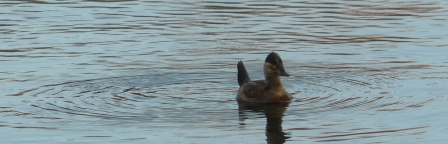
This lone, female Ruddy Duck has been paddling around Lake Cheston for the last two weeks. Unlike mallards and other “dabbling” ducks that feed by poking around on the surface of the water, ruddy ducks dive down and feed on aquatic invertebrates under the surface. Their dive starts with a short leap, then the birds take a vigorous plunge, propelling themselves through the water with strokes of their feet (they have some of the largest feet of any waterbird). They stay down for about half a minute at a time as they probe the bottom of the lake. Midge larvae are their favorite food.

Ruddy ducks are “stiff tailed” ducks. The photos above show the bird with these spiky feathers cocked, but they are more often held down, flat against the water surface.

The male, who has a blue beak and “ruddy” plumage, makes one of the best sounds of all American birds, utterly charming in its goofiness. The accompanying display is just as compelling.

This species breeds mostly in the “prairie pothole” region of the upper midwest and Canada, then winters along the coasts and on southern lakes. This is the first one I’ve seen in Sewanee, although they can be fairly common on the larger lakes around Winchester and Stevenson.

(Grackles)*n

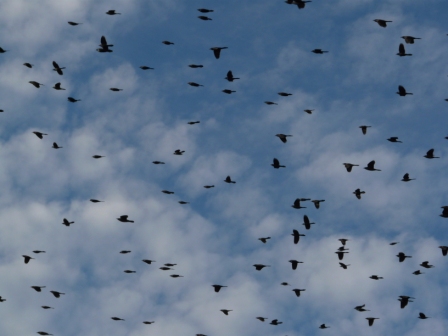
I heard them first, then they rose up from the adjacent field, winging toward me. I held still and they came right overhead, a storm of dark feathered electricity. Ten thousand? Twenty? Frankly, who cares about numbers — they were there; I was there. For a minute or two, they settled in the grass around me and in the trees behind. The sounds made by each bird, the grackles’ characteristic creaking and whistling, merged into a rhythmic drumming, like hail beating on a roof. Then, they were gone, leaving me alone, bound to the ground, with static coursing through me.

Quite possibly the most overused image of North American bird life

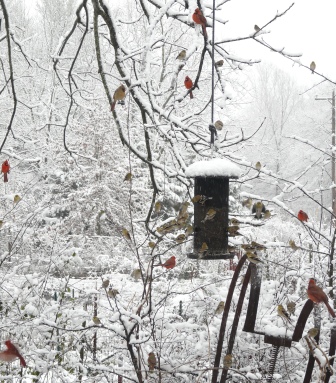
Wet encrustations of snow forced dozens of birds to the sunflower seed feeder. All their usual feeding places, the nooks and crannies in bark, are plugged with frozen flakes.
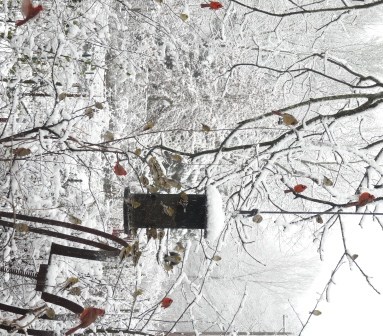
Hard times for birds create interesting viewing opportunities for humans and other mammals with keen ornithological interests. We stay inside and watch through the windows.

Of course, we also have the old standby, “cardinals in snow,” an image found on so many greeting cards, mailbox paintings, Christmas shopping flyers, nature magazines, and, yes, blogs, that the weight of accumulated cultural exposure squashes the actual experience.
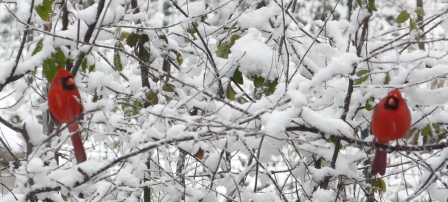
My thought on seeing them was, Oh how cliché, an absurd response to the sight of birds that were minding their own business as they fed on my sunflowery largess. Once I got over my overly puffed up horror at participation in such a tawdry aesthetic experience, I saw them with new eyes. They were stunning.

So, what is it about red-on-white? Our eyes are easily beguiled: cardinals in snow, STOP signs, Texaco, the Red Cross, Marilyn Monroe’s lips, Coca-Cola, candy canes, and flags, endless flags (USA, Japan, Canada, England, Poland, Turkey, Singapore, it goes on…). None of these are particularly subtle signals. The recurring theme is, “gimme your attention.”

So, why does it work? The contrast of hue and saturation obviously helps. But so does our heritage as primates. We’re unusual among mammals in being able to “see red.” In fact, most mammals lack the right type of receptor cell in their eyes and so miss out on the cardinals’ display. Only in one lineage of primates did this receptor evolve, probably to see red fruits (our monkey cousins still eat actual fruit, we use the receptor to find candy and sodas, then to define national boundaries — that’s evolutionary progress for you). So thank you, mutant ancestors, for my experience of the cardinals’ winter glory.

The cardinals themselves have an even richer experience. Not only do birds see red, but their receptors open the UV-range of light to them. We can’t begin to imagine the experience of these extra colors. What does snow look like in UV?
Precip

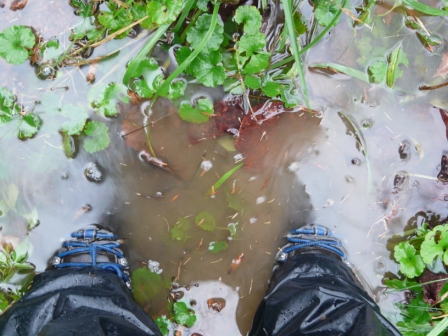
The four or five inches of rain that have fallen in the last day have me thinking that the garden is ready for conversion to rice paddies.

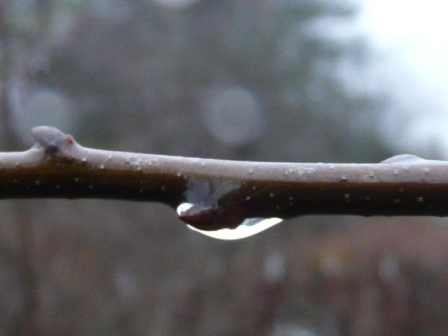
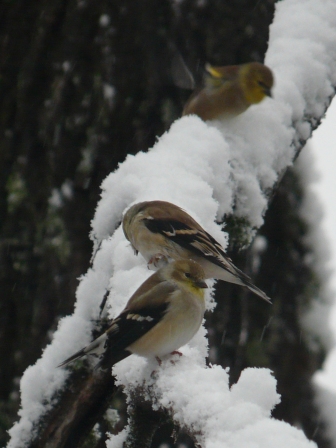
You would think that with all this rain, wild animals would have their fill of water. But goldfinches perched in the rain and carefully caught water drops from the underside of twigs. The birds would reach their heads down, below their feet, then twist to the side and scoop pendulous drops of water from under tree buds. The contrast between the elegance of the birds’ water-gathering and the disorganized squalling of the rain was striking.

Last night the rain turned to snow. Barely enough to dust a goldfinch’s knee, but wet enough to weigh down tree limbs.