Category Archives: Archosaurs

Valley of dry bones

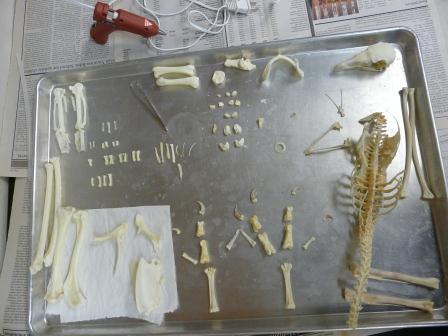
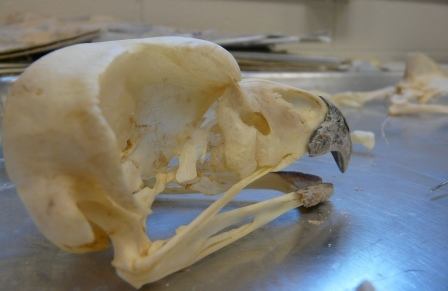
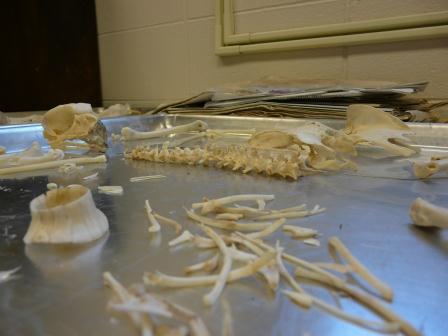
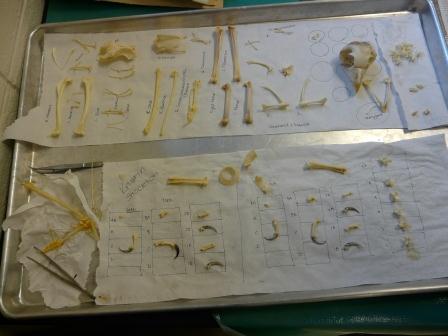
Students in my Ornithology class complete a term paper of bone. Each student is given a dead bird (window- and road-killed). The task: dissect and study the bird, then strip its bones bare (with the help of flesh-eating beetles), and finally re-articulate the skeleton (using the magic powers of the hot glue gun). The project sits at the junction of zoology, horror, and arts-and-crafts.

The bones are presently all cleaned up and ready to be put back together (owls and vultures shown below).

“the valley … was full of bones,/…and, behold, there were very many in the open valley; and, lo, they were very dry/…there was a noise, and behold a shaking, and the bones came together, bone to his bone”

Extra credit for breathing on the slain that they might live.

Inching into the future

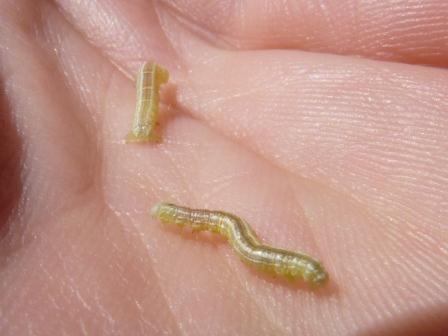
I’m visiting the University of Richmond where, just like Sewanee, spring is in full force and many weeks early. In addition to great people and beautiful buildings, the campus is populated by millions of inchworm caterpillars. Just walking between buildings results in the acquisition of half a dozen hitch-hikers, each one hanging by a silk thread from above, presumably drfiting down to new feeding areas or places to pupate. These caterpillars belong to the Geometrid moths, a family of brown moths named for the looping walking habit of the caterpillars — they appear to “measure, metron, the Earth,Geo,” as they walk along.

These seemingly insignificant creatures are one of the hinges on which our changing world swings.

The caterpillars come out when the oaks and other trees first unfurl their leaves. The young leaves have not yet had time to accumulate toxins to deter the inchworms, so the little caterpillars feast quickly, then their numbers dwindle.

Migrant birds time their arrival to catch the burst of caterpillars (food!). But, lately, the caterpillars are emerging so early that by the time the migrant birds arrive, the party is over. In Europe, this mistiming is so severe that it has caused significant population declines in some birds.

How or whether these dissonant changes in tempo will resolve is unclear.

Puget Sound

After my talks in Seattle, Olympia, and Tacoma, I spent Saturday in Tacoma with my friend Peter Wimberger. We were in graduate school together back in the early 1990s and we have a shared affinity for natural history, helping our students see the world through the eyes of evolutionary biology, and eating salmon. He was kind enough to take me on a tour of some good bird-watching spots on Puget Sound.

A different world from the forests of Tennessee.

Douglas firs, western cedars, Pacific yews. Ever Green. Tree trunks thicker than any that have grown in most eastern forests for hundreds of years. There is no “ground,” no litter layer; instead, moss, moss, moss, as if a bryophyte blizzard had passed through, leaving drifts everywhere.

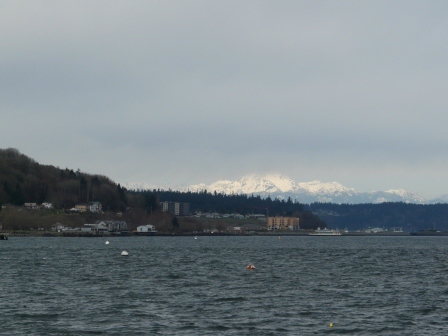
And on the water: murrelets, goldeneyes, harlequin ducks, scoters, loons, red-necked grebes. These are birds of cool rocky coasts, of Alaskan inlets, of moutain lakes, of streams running out from mountain glaciers. Look up from the water, and there are the snowy mountains rising behind wooded slopes and coast-hugging cities.

We conducted our bird-watching through binoculars and a scope, out of range of my modest, weak-lensed camera. But, a few ducks were bobbing close to shore. These Barrow’s goldeneyes were close to the dock. I’d never seen this species before. It is distinguished from its cousin, the common goldeneye, by the bright orange beak of the female and the crescent-shaped white patch on the male’s head. They winter on the coasts, but move inland to mountain lakes to breed, building nests in holes in dead trees. They feed by flipping their compact bodies forward and diving under the surface with a little splash. They swim down to grab mussels and other invertebrates from the rocky bottom. Their eyes are, indeed, golden — just visible in this photo.

Next stop, Newark, NJ…

Poultry Art installation

During my brief visit to Olympia, I stayed at Fertile Ground, a beautiful b&b right next to the public library where I gave my talk. Fertile Ground also serves as a hub for urban ag, art, and community building.

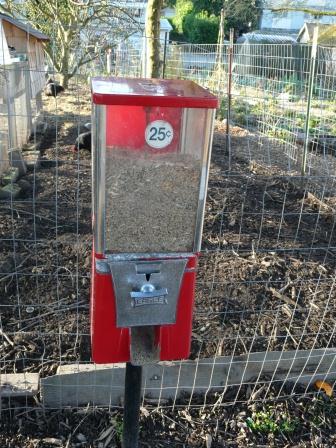
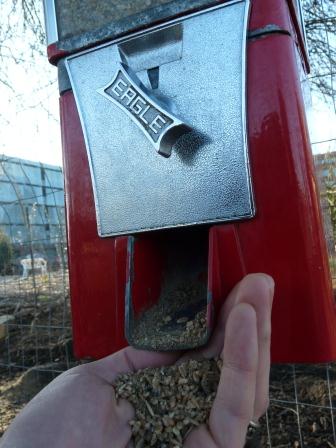
A small chicken pen sits next to the sidewalk, with hens scratching away within sight of the multistory office buildings and parking lots near downtown. The stroke of genius, though, is the chicken feed dispenser, right there on the sidewalk. Put in your quarter, turn the dial, and get a handful of feed to throw to the hens.

 There is something very rewarding about getting a handful of grain for your quarter, then tossing it to the hens (who know very well what is coming when someone approaches the dispenser). Like Vegas slot-machines, but the payoff is three hens in a row — winner!

I talked to Gail at Fertile Ground about this project of hers. Apparently, local kids love to put in their change and feed the birds. For me, this was the crowning achievement of the project: kids using quarters to get bird seed instead of sugary gumballs; kids playing Happy Birds (feathery real!) instead of Angry Birds (pixely fake!); and kids able to get a smile during their walk home.

The Forest Unseen

March 15th: an auspicious day for killing dictators, aligning planets, and publishing books.

The Forest Unseen hits the streets today (and wiggles its words through wires in e-books).

A couple of quotes from some fellow writers seem well-suited to the moment:

Franz Wright’s poem, Publication Date, starts, “One of the few pleasures of writing/is the thought of one’s book in the hands of a kind-hearted/intelligent person somewhere. I can’t remember what the/others are right now.” Indeed.

Regina Spektor sings, “No, this is how it works/You peer inside yourself/You take the things you like/And try to love the things you took/And then you take that love you made/And stick it into some/Someone else’s heart/Pumping someone else’s blood.” (from On The Radio). Love? Blood? Isn’t this a book about science? Indeed. Bloody, loving science.

I’m honored that my words are in bookstores, in the pixels of the ether-world, in people’s hands, and perhaps even energizing some ventricles. If you’re interested in learning more, the book’s website has photos, a video, reviews (some new ones out this week and more on the way), and information about upcoming lectures and signings.

Next week, I’ll head out for several weeks of lectures, so this blog will be Rambling further afield than Shakerag Hollow, starting with the Pacific North-West next week. I hope to learn some interesting natural history and meet some fellow rambling Homo sapiens along the way.

Another great sign for the Ides of March: this morning, the first Tree Swallow showed up at Lake Cheston.

Evening

Venus and Jupiter swing past each other, but don’t connect. No luck seeing them. Cloudy Sewanee.

To make up for it, about two hundred robins fly right past my face in a storm of dusky wings as the light fails. They are headed to roost in the evergreens.

This week, robin numbers are building as wintering birds from AL and FL move northward. Robins get little respect from birders — too common — but I find their abundance and ubiquity impressive. There are over three hundred million robins in North America. They live in almost every habitat that has trees and some open space (from urban parks, to scrubby deserts, to the edge of the tundra). Tremble, earthworms, tremble.

Waxwing invasion

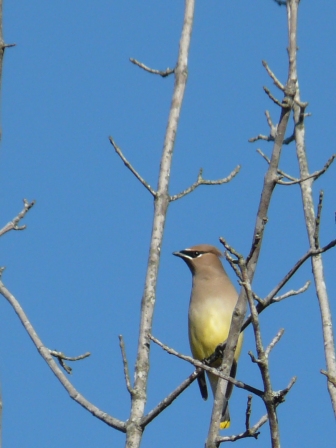
Flocks of hundreds of cedar waxwings descended on Sewanee this week. They travel in nomadic groups, searching for sugary fruits. Unlike most birds in our region, waxwings feed almost exclusively on fruit for much of the year. In Sewanee, they are sporadically common in the spring and fall, but very scarce in summertime. Most of the birds that are here this week will move north and east to breed. Look for them perched in tight clusters in the treetops or fluttering around fruiting shrubs.
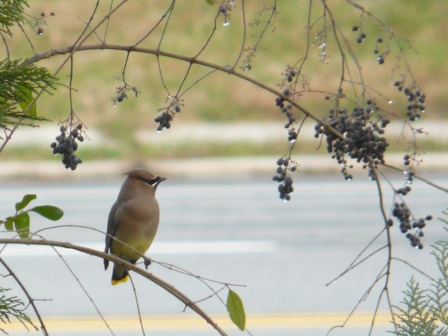
The waxwings’ high-pitched calls (up to 8kHz, nearly twice as high as the highest piano note) are distinctive, but they test the limit of our hearing. For many people, the calls are inaudible except at close range when the sound gets loud enough to cross the ears’ detection threshold. As we age, we naturally lose hearing in the high range, although this can be accelerated by exposure to loud noise (earplugs are a naturalist’s best friend…).
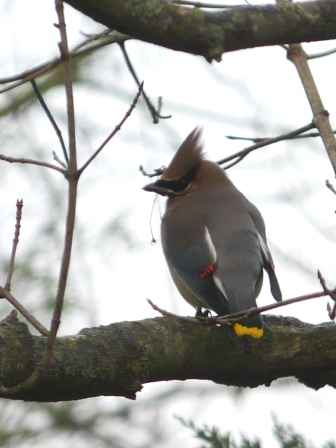
Waxwings are named for the tiny red “flags” on the end of some of their wing feathers. Although these little flags look like wax, they are made of the same material, keratin, as the rest of the feather, infused with red pigment. Young birds have fewer flags, so these red marks may act as social signals through which older birds can avoid breeding with inexperienced youngsters. Older birds have higher breeding success, so it is to their advantage to stick together.

The yellow bar across the end of the waxwings’ tails is also produced by a pigment in the feathers. Over the last forty years, waxwings with orange-banded tails have appeared, especially in the north-eastern parts of the continent. At first, scientists speculated that this was a new mutation, spreading through natural selection. Further study showed that no genetic change was involved. Instead, the waxwings were feeding on the fruits of an invasive plant, Morrow’s honeysuckle, that contained orange pigment. If a molting waxwing feeds on this honeysuckle, the new feathers will pick up the orange pigment. In addition, all the fat in their bodies gets stained. I think of waxwings every time I see someone sucking on a blue slurpee. Surely their insides must be turning blue; maybe the hair will follow.

The photos on this page show the various ways that the waxwings use their silky crests to signal to each other — flat, cocked, and spiky. This expressiveness, combined with their eye-bands and overall silky plumage makes them one of the sharper-dressed birds in our region. Classy.

My account draws on information in: Witmer, M. C., D. J. Mountjoy and L. Elliot. 1997. Cedar Waxwing (Bombycilla cedrorum), The Birds of North America Online (A. Poole, Ed.). Ithaca: Cornell Lab of Ornithology. doi:10.2173/bna.309  The lead author on this paper is Mark Witmer, a colleague from grad school. He showed me the orange insides of a waxwing once — very cool.
Cranes over Chattanooga

I was in Chattanooga yesterday and took an hour off to bike the Riverpark, a fabulous linear park that starts in downtown, then stretches for ten miles along the Tennessee River.

The highlight of the ride was a flock of sandhill cranes (Grus canadensis) overhead. They were flying along the river, wheeling occasionally in a big disorganized circle, then reforming into a northbound V. I suspect that they were looking for somewhere good to feed and were disappointed by the lack of swamps in the urban center, so they chose to move on. They are likely part of the congregation of overwintering cranes at Hiwasee Refuge, a gathering that numbers in the tens of thousands is the largest wintering aggregation of sandhills outside of Florida. These Tennessee birds return to the upper mid-west to breed.

This slideshow requires JavaScript.

Aldo Leopold wrote of these birds, “When we hear his call, we hear no mere bird. We hear the trumpet in the orchestra of evolution.” This is no accident — the trachea of these cranes coils within their sternum (chest bone) to make a resonating instrument very much like a trumpet. Both sexes call, often in vigorous duets.

For some remarkable footage of cranes in flight, see this almost dream-like series of shots of common cranes flying over Venice.

Merlin!

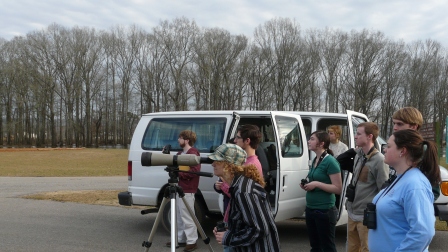
This lonesome old tree by the waterline has a special visitor perched at its top: a merlin visiting from Northern Canada. Merlins (Falco columbarius) are small falcons that breed in the boreal forest. They are uncommon winter visitors to our region. We found the bird at the end of our class visit to Crow Creek Wildlife Refuge near Stevenson, AL.

Merlin, condensed to about 2 pixels. Great views through the scope, though.

Merlins are spectacular little birds. They sit and wait for an unsuspecting songbird to fly past, then they explode into rapid flight and chase down the prey, catching it in midair. They are the fighter jets of the bird world: fast, maneuverable, and uncompromisingly fierce. “…no falsifying dream/Between my hooked head and hooked feet”.

Scoping

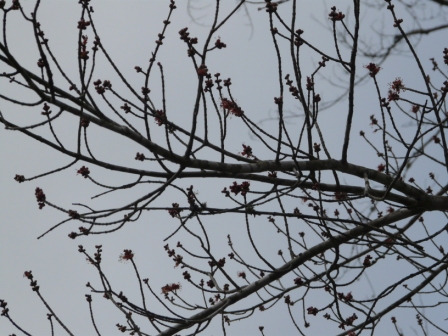
The warm weather turned up some other unusual phenomena: great-blue herons standing over their big stick nests, maples in bloom, and chorus frogs singing. This is a very peculiar January — prolonged warm weather has unlocked all kinds of activity that in normal years would not happen for another month.

Red maple flowers...on Jan 31st

In summer, the water in the Crow Creek Refuge is carpeted with the large round leaves of American Lotus (Nelumbo lutea; also called Water Chinquapin). Now, the plants are invisible (their stems are underwater in the mud) except for the strange seed receptacles that litter the shoreline like organic showerheads.

Seeds fit inside the holes on the top surface.

We also found a rare specimen of Florus plasticus washed up on shore.

The pollinator of this flower is unknown, but it probably requires a battery.

Woods Reservoir Trip

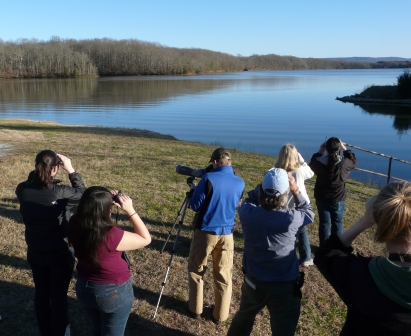
Yesterday, I took my Ornithology class to Woods Reservoir to look for ducks and other waterbirds. Many of these species overwinter here in the south before heading back north to breed in the boreal forest, the prairie-potholes, or the arctic. The weather was as warm and balmy as I’ve experienced in January and the duck count reflected this: we see fewer ducks during extended warm spells, presumably because they have not been pushed south by hard weather up north. However, we did see a good assortment, with the coots leading the count, as usual.

Many of the waterbirds that we saw are fish-eaters (loons, grebes, herons, mergansers). Unfortunately for them, Woods Reservoir is contaminated with PCBs and the fish bioacummulate these toxins and pass them up the food chain to the birds. The PCBs came from the Air Force’s Arnold Engineering Development Center (Woods Reservoir was built in 1952 to provide cooling water for the site). The Tennessee Department of Public Health has issued an advisory that recommends no human consumption of catfish caught from Woods Reservoir. They recommend that consumption of other fish species be limited to one fish per month. The birds (and the many fishermen at the lake) have evidently not heard this advice.

PCBs are found in the lake sediment and fish accumulate these pollutants in their bodies, especially in fat. Manufacture (but not use) of PCBs was banned in 1979, but the chemicals are very persistent, so linger in many ecosystems. PCBs were used at AEDC from approximately 1952 to 1990 and they are believed to have entered Woods Reservoir via streams draining contaminated soil at the site (2007 TDEC report).

Two non-duck highlights were a Bald Eagle and a Northern Harrier. The eagle gave us a great display, soaring in great ascending circles over the lake against the blue sky. Its slow, self-assured flight and eight-foot wing span embodied unfashionably grand qualities: majesty, imperialism, and hauteur. Bald Eagles may be ill-tempered, bad-breathed fish-scavengers, but they’re awesome nonetheless. The harrier flew across the lake with lazy wing beats as the sun set.