Category Archives: Archosaurs

Brood

Cuteness alert: Brown Betty (a bantam cochin chicken) broods her small flock of chicks.

brown betty with chicksOne of the youngsters has clambered onto her back, the others poke out from under her generous bustle or peer at the world from under her wing. These birds continue a long dinosaurian tradition: their extinct forebears and kin incubated eggs and were solicitous parents.

For cute Archosaurs and more, Sarah’s blog has pictures of the tumbling profusion of baby animals that have greeted the spring at Cudzoo Farm.

Bird skeletons alight in the library

“…there was a noise, and behold a shaking, and the bones came together, bone to his bone”

This slideshow requires JavaScript.

This morning a small procession of bird skeletons made its way from the science building to the library: one last flight for the calcified remnants of wild lives that ended on windshields and picture windows in and around Sewanee. These skeletons are the result of the work of students in my Ornithology class, each of whom received a bird carcass at the beginning of the semester. The students have now cleaned and articulated the skeletons. Their work is on display within the belly of David Henderson’s Brief History of Aviation sculpture.

These unclothed cousins of ours reveal the relationship between unity and diversity in biology. The tension between these poles is what animates life: one theme, many variations.

Many thanks to Kevin Reynolds and the staff of duPont library for their fabulous help with this project and to David Henderson for letting my students use the remarkable space that he has created.

John James Audubon exhibition at New-York Historical Society

It feels like blasphemy to admit it, but I have for some time felt over-Auduboned. In the world of ornithological and environmental studies, reproductions of John James Audubon’s work abound. Coffee mugs, posters, websites: he’s everywhere. Overexposure produces ennui. Surely North American bird art has more to offer than the endless repetition of these 19th century engravings?

A visit to the recently opened exhibition at the New-York Historical Society cracked my armor, snapping my senses out of their laziness.  The exhibition is the first of a three part celebration of the watercolor studies that Audubon painted in preparation for the engravings that in turn produced his famous double-elephant-folio, The Birds of America (1827–38). The paintings have a stunning vivacity and range of feeling. Unlike so many reproductions, these works are alive with Audubon’s hand.

What struck me most was his grand ecological statement: the bird cannot be understood, or felt, or even seen apart from its relationships with other species. Audubon make this case with compelling vigor. As a naturalist, I was also impressed by the sensory truthfulness of his work. The years that he spent tramping the woods and fields shine through.

Of course, Audubon’s style is one of exaggeration: four thrashers defending a nest, one bird swooning into roll-eyed death as the snake slides upward. A spike-crested osprey cries out as it carries away a fish whose mouth echoes the bird’s scream. But though this melodrama sometimes skates on the edge of sentimentality or absurdity, his intimacy with the lives of the birds keeps the paintings grounded in each species’ character, even as his flamboyant emotion takes flight.

The exhibition also has a copy of one of the original double-elephant printings. A magnificent book, the product of meticulous engraving on copper plates, followed by hand-tinting by dozens of colorists. One of the original copper plates is also on display. It was rescued from the melting pot after Lucy Audubon sold it for scrap years after her wandering husband, whom she had propped up financially for years, had died. This copper plate, although it is not centrally displayed, is a significant part of the exhibition. It hints at the costs of Audubon’s obsession.

If you’re in New York, I strongly encourage you to visit this important exhibition. To learn more about the show and its context, I recommend Edward Rothstein’s excellent review in the New York Times. And the exhibition’s catalog is a work of art in its own right.

Addendum: Part II is showing in the summer of 2014. Reviewed in the NYT here. Bring on Part III! (Date not yet announced.)

Why so many vultures?

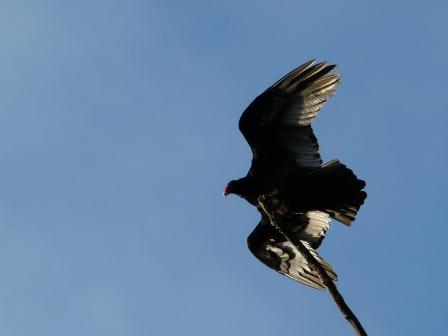
Coasting down the hill on my bike, I turn my head and there it is, a dark angelic form, big as an eagle, soaring just off my left shoulder. We cruise together for a spell, then the bird banks away, the low sun laying a rosy tint on its black feathers. Ahead, hundreds circle low, turning the sky into a swimming confusion of slicing dark lines.

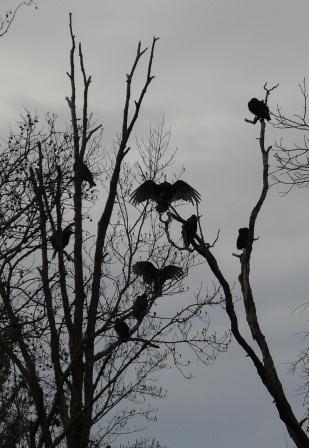
As dusk approaches, the vultures gather in tall pines and oaks around Sewanee’s downtown, clumping by the dozen on high branches. They settle slowly, restlessly hissing at new arrivals and flailing their huge wings at neighbors. With a start, the whole group startles into wheeling flight, then returns to roost with flustering feathers.

vulturesafterwetcoldnight

This roost formed last year in early winter, grew into a gathering of two to three hundred birds, then dissolved as spring wore on. This winter they are back. The talk in town often drifts their way. Why so many? Are they drawn to some hidden bounty of dead animals? Might a leaking gas pipeline be luring them? What danger do they pose?

I suspect that several factors have converged to bring us this spectacular daily display. One of these causes is the regional increase in vulture abundance. DDT’s effects are no longer felt by these birds, fewer people shoot them, and as deer and small mammal populations have increased, the vultures’ food has become more plentiful.

Wintertime abundance of Turkey and Black vultures. I constructed this graph from the Christmas Bird Count data from Alabama, Tennessee, Georgia, and South Carolina.

Wintertime abundance of Turkey and Black vultures. I constructed this graph from Christmas Bird Count data from Alabama, Tennessee, Georgia, and South Carolina. The graph shows populations since 1970.

In addition to this long-term trend, the record-breaking warmth of the last two winters also likely contributes to the recent increase in vultures in our area. Birds that previously would have flown to Florida or Mexico may have curtailed their migration. Why wing to Veracruz when you can dine on ‘possum and venison in a relatively balmy Tennessee or Georgia?

Local changes also play a role. Until last winter, the vultures were roosting here, but mostly out of sight in the valleys and mountain slopes. Why the move? We cannot know for sure, but it may be that these vultures have discovered that no-one harasses or shoots them here in town. It may also be slightly warmer. Like some other native animals, they have found that lingering near human habitation may bring benefits.

The vultures in town are gathering to sleep, not to feed. On all but the most dismal days they disperse every morning, surveying the surrounding countryside for food. They return to sleep in the safety of a group. Certainly any dead animal near the roost gets eaten promptly (a dead deer on the highway near town was snarfed within a couple of days), but feeding is not the purpose of this gathering. Nor can gas leaks explain the behavior. The birds are congregating away from the gas pipeline and show no attraction to any of the gas pumping stations in town.

Do the birds present a danger to humans or pets? My research indicates that dangers are few. If the roosts get larger and persist for many years, their fecal matter might accumulate and start to smell. These droppings are no more threatening than those of other birds; indeed vultures’ powerful guts probably kill more bacteria than the guts of other bird species. Temporary winter roosts present less of a problem in this regard than permanent roosts located further south (where some vultures have, in addition to depositing guano, turned into vandals). Another threat is unlikely, but memorable: vultures defend themselves by vomiting on their assailants, so it is possible that foolhardy hazers of the roost might get an unpleasant (and potentially bacteria-laden) shower. This outcome can be avoided with some common sense. Don’t climb roost trees. And remember the ornithologists’ Golden Rule: keep your mouth shut when you look up.

vulture

Of all the species that I researched for The Forest Unseen, vultures were perhaps the one that most changed my everyday experience. I see them many times each day, yet until I knew just how fabulous they are at purging the land of dead animals, my appreciation for their lives was far too limited. No other animal removes carrion with such unassuming efficacy. A vulture gut will kill anthrax and other bacteria, a feat that no other scavenger can match. The near extinction of vultures in India has underscored their importance. As vultures declined, the populations of other scavengers surged, leading to a plague of feral dogs and rabies (and problems for people who use vultures for funerary purposes).

Being followed on my bike by a death-eating scavenger was, therefore, an unexpected delight. The dark forms that soar overhead or sit hunched in tall oak trees are to be admired. Their easy, loping wingbeats are beautiful memento mori, sky burials for the thousands of animals that live and die on this mountain. Like living prayer flags, their presence delivers a very real ecological blessing on the land below.
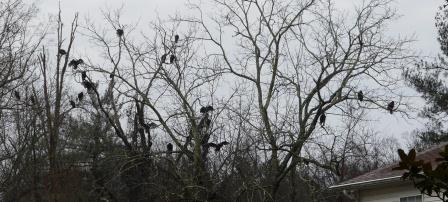
vulturerow

Quiz: Bird Beaks

Last week my Ornithology class started their bird anatomy studies with dissections of road- or window-killed birds. The project will continue, as in years past, with cleaning of bones and reconstruction of the skeleton, ending with an articulated specimen.

I took the following photographs of beaks before the class started. Can you identify the bird from the beak? Answers with some additional information are listed below. Hovering your mouse over the images will reveal the name (take care when dangling rodents next to birds of prey) or click on any of the images to see a slideshow with answers included.

Answers:

  1. The insect killer. Carolina Wren. Long beak with a downward curve. Great for probing insects out of tangles of vegetation.
  2. Worm slayer. American Robin. “with a start, a bounce, a stab/Overtake the instant and drag out some writhing thing” Also fond of fruit. Hughes didn’t mention that.
  3. Glutton of small mammals and invertebrates. Eastern Screech Owl.
  4. Seed cracker and insect slicer. Northern Cardinal.
  5. Insect gleaner and, especially, fruit fiend. Gray Catbird.
  6. Serious seed cracker and bug crusher. Rose-breasted Grosbeak.
  7. Connoisseur of little insects and dainty fruit. Swainson’s Thrush.
  8. Omnivorous rascal, fond of using its beak to lever into hidden things. Common Grackle.
  9. Bunnies, beware. Red-tailed Hawk.
  10. Everything, beware, including most of the birds on this list. Great-horned Owl.
  11. Bird and rodent destroyer. Note the tomial tooth: a notch in the beak used to pop the neck vertebrae of victims. This notch is shared by all falcons. For the prey, a fast way to go. Merlin.
  12. A mellow forager on plants, algae, and invertebrates. Beaks the muddy edges of lakes, grabbing underwater snails and water bugs. American Coot.
  13. Silencing songbirds. Cooper’s Hawk.

Ugly Ducklings, Lent, French translations and counting birds

Some news about Cudzoo Farm and The Forest Unseen:

Sarah has opened a new page on her soap website for sales and specials. These special prices on organic goat-milk soaps will be offered only intermittently, so I encourage you to investigate them now. Currently, she has a Five-for-four Special and an Ugly Duckling Assortment. Great soaps, fabulous prices: from our hard-working herd of goat princesses.

From soaps to books. The Times (London) has published a list of recommended reading for Lent. I was surprised and delighted that Jane Shaw, Dean of Grace Cathedral, San Francisco, chose The Forest Unseen. She writes that the book “is not a religious book, but [Haskell’s] careful observation of a one-square-metre patch of Tennessee forest over a year teaches us something vital about training our attention on the world around us, to see what we usually miss. That sense of attention and focus is central to all Lenten practices.” Is there a parallel between the study of natural history and the Lenten disciplines? This is an interesting idea. Within their own traditions they are both seen as practices that help us to pay attention to what matters: snails on one hand, the divine on the other (and a few of us think that some snails are themselves simply divine). Both practices are also often misunderstood as dour and outdated (Lent? Names of birds? How Victorian…), yet they have within them the potential for unrivaled connection to the world beyond and within ourselves (if such worlds exist, of course…). I’m intrigued by this Lenten connection and honored to have The Forest Unseen highlighted as helpful to those engaged in meditative practices.

I’ve also received some other good news about the book. A French translation will shortly be underway, joining ongoing translations into Japanese, Korean, and Chinese. I grew up in France and I’m especially happy that the book will be available to French readers. Schools in France used to (and maybe still do) celebrate the work of Jean-Henri Fabre, a close observer of the ecology of his home and prolific author. So I hope that my approach might fall on some ready ears, even if mine is a vastly more modest contribution (in many ways) than that of Fabre.

Last, readers of Ramble might be interested to know that this is the weekend of the Great Backyard Bird Count. From Feb 15-18 we’re all encouraged to submit checklists of the birds that we see in our neighborhoods. Last year the count collected over one hundred thousand checklists (!) comprising 17.4 million individual bird observations: a rich source of data on the populations of North American birds. This year the project has gone global and is connected to ebird.org, an amazing site that “crowd-sources” data (hundreds of millions of observations to date) about birds. So our bird sightings are now both rewarding for us as individuals and they can contribute to a better understanding of global ecological patterns. I encourage you to participate. The count is set up for non-specialists including beginning birders, so do not feel that you have to be an “expert” in order to join the project.

Eagles

My Ornithology class had some great views of bald eagles this week near Woods Reservoir.

Adult bald eagle. Photo taken by Jamie Sue Wilson who is enrolled in the class.

Adult bald eagle. Photo taken by Jamie Sue Wilson.

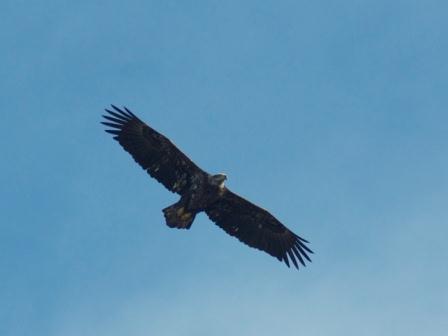
In addition to two adults, we saw a couple of young eagles circling overhead.

Immature bald eagle. Photo by Jamie Sue Wilson.

Immature bald eagle. Photo by Jamie Sue Wilson.

Immature bald eagle. Photo by Jamie Sue Wilson.

Immature bald eagle. Photo by Jamie Sue Wilson.

Bald eagles take four years to reach full adult plumage. The individual shown above is likely a second or third year bird. For two great overviews (and some fabulous photos) of the maturation sequence of eagle plumage, see Ron Dudley and Mia McPherson’s pages.

The two adults were nesting: one sat in the nest and one stood close by in the tree. Until recently, such a sight would have been very rare in Tennessee. In 1990, only sixteen nests were known in the whole state. Now, there are at least one hundred and seventy five nesting pairs of eagles in Tennessee.

The population increase in Tennessee is part of a nationwide trend. After decades of decline caused by shootings and poisonings (encouraged by bounties), followed by the impacts of DDT, bald eagle populations have edged higher year-by-year since the 1970s. In 2007 the species was removed from the federal list of threatened and endangered species, although it (and its cousin, the golden eagle) remain protected by other laws.

Bald eagle nests are huge: brush piles crammed into the crowns of high trees. Nest-building can take up to three months, although when pressed the birds can slap something together in a few days. Most clutches have just two eggs (a few have one or three). Both male and female incubate the eggs, although the female does most of this work. Between them, the parents keep the eggs covered by a warm body for 98% of the time. Eagles are relatively heavy and they have sharp claws, so the parents take extreme care in the nest, walking around the eggs with clenched feet.

The incubation period lasts 35 days; the young leave the nest two to three months after hatching. These young birds stay with the parents for a variable period, from a couple of weeks to several months, then set off on an extended period of wandering. During this unsettled stage they have no fixed territory but move around, presumably seeking food and, later, mates and a good place to nest. The immature birds at Woods Reservoir are likely in this wandering stage.

The return of nesting eagles to the U. S. has intersected with the internet age to produce a new phenomenon: the eagle cam. You can now follow the adventures of nesting eagles from your computer, an activity that is usually considerably more compelling than working through your email inbox. So, be warned, there is a reason why some of these websites get millions of viewers… Here is one in Florida with two eaglets (hatched back in early January).

Shelf fungus as a rain shelter for woodpeckers?

Older black locust trees in our region are often rotten on the inside. Fungi worm through the tree trunks, digesting their cores. When these fungi are mature enough to reproduce, they sends filaments (hyphae) to break through the tree bark. The exposed hyphae grow into “shelves” on the trees’ trunks. These shelves are comprised of the remains of thick-walled dead hyphae, intermingled with thin-walled living strands. The “wooden” feel of the shelves comes from the walls of the dead cells; the spores are made by living hyphae. “Wooden” is not quite accurate: fungi cell walls are strengthened not with the stuff of wood, cellulose, but with chitin, a molecule that also finds use in the exoskeletons of insects. The shelves are tough enough to persist for many years.

Rotten trees provide habitat for many animals. Much of this utility is mediated through the work of woodpeckers. In excavating a fresh nesting hole each year, woodpeckers leave a trail of convenient roosting and nesting sites for other species, most obviously many bird species (titmice, chickadees, great-crested flycatchers, wood ducks, owls, etc), some mammals (flying squirrels), and bees (feral honey bees love big hollow trees). Most woodpeckers will only attack trees that are partly rotten, so it is the combination of bird and fungus that produces this real estate boon in the forest.

Woodpeckers and fungi may also have more short-lived associations. My friend Joseph Bordley pointed out to me that the tree bark under shelf fungi is often scratched up. This seems to be particularly true for shelves of Phellinus robiniae on locust trees. I found one such example this weekend on the trail to Bridal Veils falls near Sewanee. As the photos below demonstrate, the distressed bark sits directly below the shelf. Are woodpeckers using shelves as shelters in the rain? Despite keeping my eye on locust trees for many years now, I’ve yet to see any birds under shelves in rain or shine. I’d be interested to hear whether anyone has any other relevant observations. Might animals be gnawing the wood to slurp mushroom spores? Is there some other reason for the mysterious scratchings?

wpumbrella

wpumbrella2

Winter birds

This afternoon, I heard the querulous call of my first yellow-bellied sapsucker of the season. This migratory woodpecker breeds in mixed coniferous woodlands in the northern forests, then winters in the southern U. S. and in Mexico. Unlike their woodpecker cousins, sapsuckers prefer to feed on live trees. They take a delicate approach to drilling, making horizontal lines of holes from which they drink sap and eat sap-tippling insects. With the sapsucker’s arrival, Sewanee’s woodpecker count is up to seven species. The others are: pileated, hairy, downy, red-bellied, red-headed, and northern flicker. (The endangered red-cockaded woopecker used to breed in Savage Gulf, just north of here, but has been extirpated from Tennessee for more than thirty years.)

So far, this has been a good year for sightings of winter birds. Pine siskins have been quite abundant and I saw a pair of red-breasted nuthatches in early October. In some winters both these species are rare or absent. All this good birding for southerners results from hard times for the birds up north. When pine and hardwood seed crops are poor in Canada and the Northeast, birds are driven south by hunger.

According to Ron Pittaway of the Ontario Field Ornithologists, this will be a bad year for northern seed crops. His “bird forecast” focuses on Ontario, but what happens up north will be reflected in bird life across the country.

Humans add an interesting overlay to this natural year-to-year variation in food supply. As I note in The Forest Unseen, our love of birds results in the transport of millions of tons of sunflower seeds from the former prairies into bird feeders all over the country. This makes life easier for many birds, causing some of them to expand their winter ranges northward. Bird-hunting hawks therefore also linger in the northern woods. Our bribes have shifted the calculus of migration.

We know surprisingly little about how feeders affect the day-to-day behavior and ecology of birds. New technology, deployed (appropriately enough) at Sapsucker Woods where the Cornell Lab of Ornithology is located, is starting to shed some light into these questions. Least we humans feel left out, the same technology is being used to study our own “day-to-day behavior and ecology” and, like the birds, as long as the sunflower seeds keep coming, we’re happy to play along.

Migration

As we slide down the slope behind the equinox, animals have accelerated their autumnal movements. My backyard now consistently hosts several migrant bird species each day. In the last week: rose-breasted grosbeaks, magnolia warblers, Tennessee warblers, American redstarts, gray catbirds, chestnut-sided warblers, warbling vireos, and a summer tanager. Unlike the songsters of spring, these mostly silent birds can be hard to detect. A flicker of foliage reveals their presence, then a glimpse of their plumage as they prance through the concealing twigs. Grosbeaks are an exception to this crypsis. Although they can be hard to see, their sharp tweek call, given repeatedly through the day, gives them away. The sound is just like that of a sneaker squeaking on a gym floor. Listen for it, then look up.

Last night, as I left the Biology picnic on campus, another migrant bird making a spectacular display over the old building that houses the fire station. About two hundred chimney swifts were scything the air in a tight, fast vortex. They swirled around the brick chimney that protrudes from the station’s roof. One by one, they folded their wings and dropped in. Like hot cinders carried up by the wind, these birds seemed to ignite the dead dusky air with their coordinated vitality. A little tornado of life. The swifts are on their way south to the Amazon where they’ll feast on tropical gnats all winter. I suspect that they are speeding on their way as I write: this morning’s cold rain squalls mean there will be few flying insects in Sewanee today. Time for swifts to get out of here.

Birds are not the only migrant animals making their way through our skies. This week has seen an impressive number of monarch butterflies winging across the treetops. It seems impossible that so slow and delicate a flyer could make it all the way to Mexico, but that is where they are all headed, to a few small patches of dense fir forest in the highlands. The monarchs gather there in the tens of millions to rest in the cool but unfrozen woods. Remarkably, these autumnal migrants are the grandchildren of the butterflies that left Mexico this spring. Somehow their genes guide them to precisely the right location.

One for the road: a monarch loading up on thistle biofuel earlier this week near Lake Dimmick.

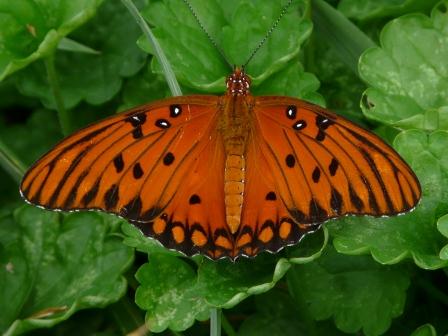
Another migrant butterfly, less celebrated than the monarch, is the gulf fritillary. This species breeds all over the southeastern U. S., but overwinters only in the deep south. Unlike the fluttery monarchs, these butterflies scull their way across the air with seemingly powerful and directed wingbeats. In Florida, where adults linger all winter, huge flocks of them will sometimes stream over fields and scrubby areas. A river of bright amber.

Gulf fritillary. Photo taken earlier in the year.