Author Archives: David George Haskell

Anguispira holotype-fest

Ooo la la, Holotypes galore at the Carnegie Museum in Pittsburgh!

Anguispira picta holotype, Carnegie Museum

Specimen labels from Anguispira picta holotype, Carnegie Museum
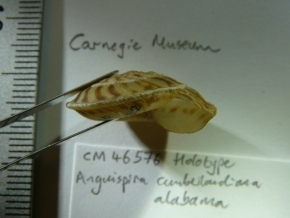
Anguispira alabama holotype, Carnegie Museum
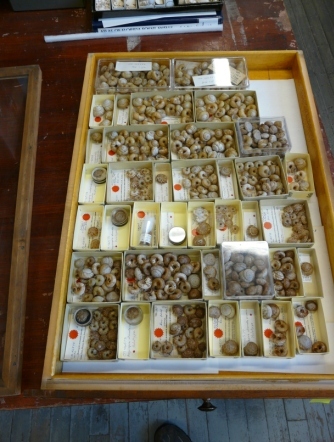
Drawer full of type specimens, Carnegie Museum

These are the original specimens from which the venerable G. H. Clapp described the rare tigersnails (genus Anguispira). These snails live in the rocky limestone outcrops that jut from the low mountain slopes around Sewanee.

After studying these snails for several years it was a treat to see and photograph these beautiful shells. The “holotypes” are the individual specimens to which the name of each species is attached – the throbbing heart of all of biology because without species names, the life sciences could not operate. Yay for taxonomy!

Jia Pan and I have been sequencing the snails’ mitochondrial DNA to peer into their evolutionary history and present-day genetic diversity. Our genetic work suggests that some previously undescribed forms may lurk in the shady mountain coves – we’re now checking to see how the appearance of the shells matches (or not) the genetic information. Thank you to Tim Pearce, Asst. Curator & Head, Section of Mollusks at the Carnegie Museum of Natural History for making my visit such a pleasure.

Surprisingly, the museum chose not to feature Anguispira in their street art:

Diplodocus, Carnegie Museum

Diplodocus nameplate, Carnegie Museum

Triceratops in full breeding colors, Carnegie Museum

90 decibels…

…is how loud the 13-year cicadas were when I made a pilgrimage to Sweeten Cove to listen to them this afternoon. The CDC recommends that humans limit their exposure to any sound louder than 85 dB. I can see why — my ears were ringing after spending half an hour in the midst of a cluster of cicadas.

Thirteen-year cicadas pulse the loudness of their sounds every four or five seconds (top graph). Their hissing, buzzy sound is concentrated in the middle and high ranges (bottom graph; for comparison, humans talk below 1 kHz). I made these recordings standing under a hackberry tree that was swarming with cicadas, then used Raven to draw the graphs.

Mimus polyglottos…

…the scientific name of the mockingbird. You can tell where they’ve been by who they imitate. This morning, the male near our house showed his interesting background in a remarkably varied two-minute song: summer tanager (a bird of the forest), tufted titmouse (forest and suburbia), house sparrow (suburbia and urban areas), cardinal (rural and suburban), and killdeer (bare ground and grassy areas). Evidently, our mockingbird is a well-traveled fellow. And, he has paid attention wherever he went.

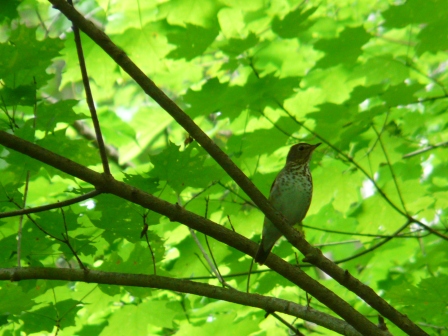
Swainson’s Thrush

A Swainson’s Thrush was singing during my late afternoon walk in Shakerag Hollow. The song is an exquisite series of rising notes, seeming to overlap each other as they spiral up. He sang for several minutes, then watched me from a branch upslope. The photograph is taken from a distance, but his identifying buffy eyering is clearly visible. Swainson’s thrushes breed in Canadian forests, so this bird has many wingbeats to go before he reaches his summer territory.

Swainson's Thrush in Shakerag Hollow, Sewanee, TN

Tending bees

The bees were active today, the first sunny day in a week, so I took the opportunity to add frames to their hives.

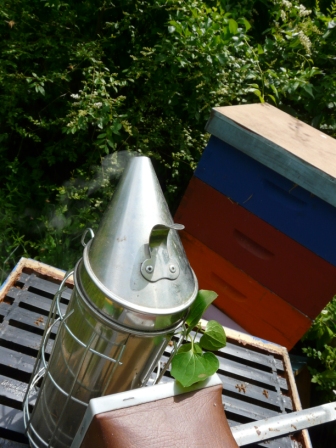
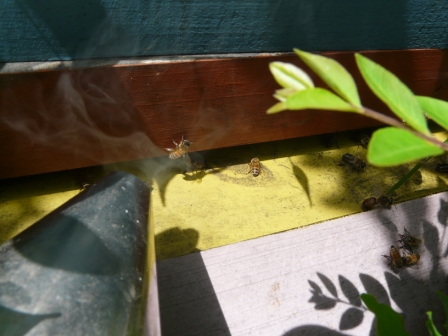
First task: use the smoker to puff smoke into the hive entrance. This causes the bees to calm down a bit…

Smoker

Puffing smoke into hive

…although calm is not quite the right word for tens of thousands of agitated stinging insects. Here is a stinger embedded in the leather palm of my glove.

Bee stinger

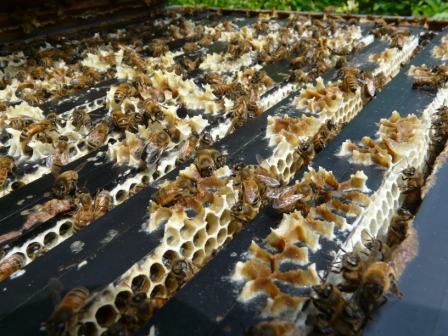
Next, check the top of the existing frames.

Worker bees on the underside of the hive cover-board.

Top of the hive frames -- the bees have built up the wax foundation and have partly filled the frame with honey.

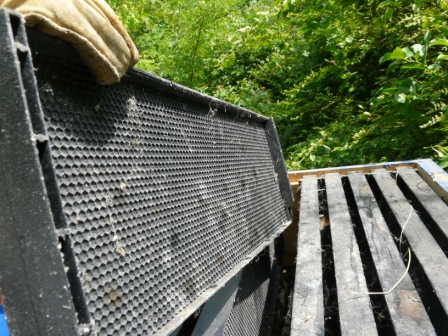
Add the new frames.

New frames. The bees will fill these with honey.

Last, clear some excess vegetation around the hives.

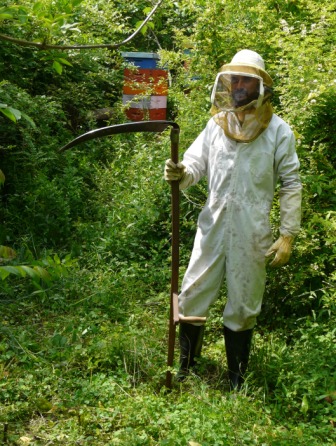
The Reaper, in costume.

Thirteen-year cicadas

Newly emerged cicada in Sewanee, TN. May 12, 2011. Genus Magicicada

The cicadas have been underground for thirteen years, feeding on the sap of roots. Now, the concentrated power of all those years of photosynthesis is unleashed in their songs. Their massed buzzing turns into a roar that penetrates buildings and overpowers conversation.

Around Sewanee, these insects are much more common in the valleys and low mountain slopes than they are in the uplands. Presumably, the cicadas thrive where the soil is deep, rich and full of well-provisioned plant roots.