
Important procedural point: keep your mouth shut when gazing up from below.
Important procedural point: keep your mouth shut when gazing up from below.
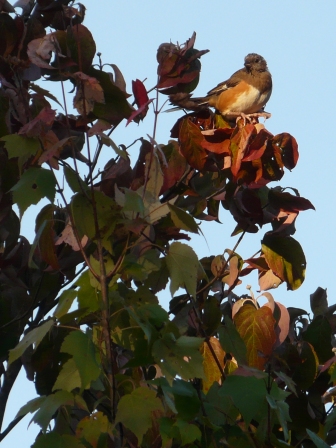
Eastern Towhee feeding on dogwood berries
The last hummingbirds of the season are feeding in the jewelweed patch behind Stirling’s Coffee House.
Jewelweed flowers offer nectar to the hummingbirds from a nectar spur at the end of a cone-shaped flower. The hummingbirds have to insert their beaks all the way in to reach the nectar and in doing so they receive a dab of pollen on their foreheads. Many of the hummingbirds in the patch have heads that are completely coated in pollen.

Jewelweed, Impatiens capensis, with nectar spur visible on the far right

The last thing a hummingbird sees before it sinks its beak into the flower. The pollen dusters are at the top of the flower.
Not all spurs are the same shape. Some are curled, others are straight. It turns out the the more curvy spurs result in better pollen transfer to the hummingbirds, probably because the birds have to reach down further to get the nectar.

Compare this piglet-tailed spur to the one above.
The degree of curvature is heritable, so this is a feature that can evolve through natural selection. Why, then, don’t all flowers have the same degree of curl? No-one knows, but the diversity of pollinators that visit jewelweed may favor a diverse set of nectar spur designs.
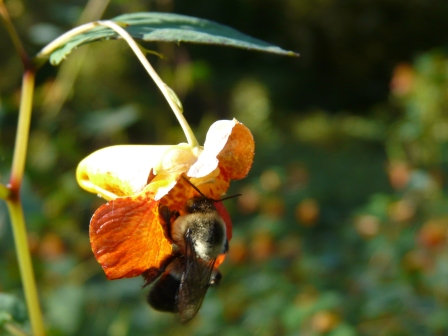
Bumblebee visiting the same jewelweed patch.
Jewelweed is also called-touch-me-not: a gentle pinch to the bottom of the seed capsule will cause the seeds to explode outwards, shooting several feet away. Gram for gram, the energy stored in these seed pods exceeds that of steel in springs.
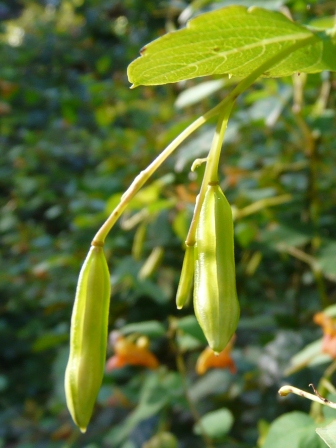
Waiting to explode...
As an extra bonus today, the jewelweed patch also hosted a beautiful red phase screech owl. The scolding wrens gave away its location in the shrubs.
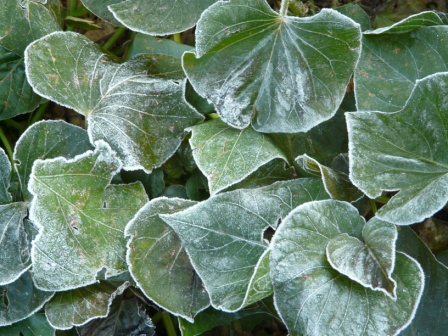
Sweet potato vines: time to dig
And, the steady north wind has brought a pulse of migrant birds: veery, Swainson’s thrush, common yellowthroat, Tennessee warbler, summer tanager, yellow-throated warbler, magnolia warbler, rose-breasted grosbeak, ruby-throated hummingbird, and chimney swift. Every other tree has a couple of warblers flitting through its branches. Even our okra patch has a Tennessee warbler and a common yellowthroat rummaging through its old stems.
Junebug pursued a skunk with her usual vigor and head-long enthusiasm, and was rewarded with a face full of spray. Ah!, that familiar smell of burning tires.
We washed her with peroxide and baking soda but she, not satisfied with the result, ran into the mulch under our maple trees and dug herself a massive wallow in which she thrashed and rolled for quarter of an hour. The result: a skunky dog, wet with peroxide tonic, covered in soil. We’ll be branding the resulting fragrance under our new Cudzoo label soon. No doubt this cologne will smell slightly better than some other innovative fragrances.


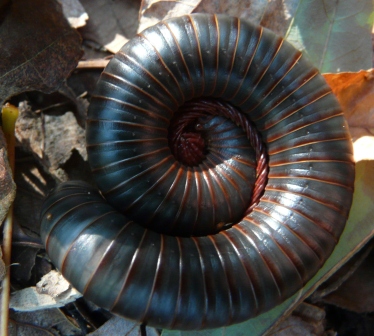 Look closely at this Narceus millipede and you’ll see two small hitch-hikers (one near the center of the coil and one at opposite end of the millipede). These mites have a very close relationship with their millipede host.
Narceus millipedes live on and in dead logs. At this time of year, they gather together in writhing mating tangles. Because the adult mites never wander away from their millipede, this is their only chance to meet other mites, so they also breed now, having synchronized their life-cycle to that of their host. Both millipede and mite will then overwinter buried in logs or the soil. In spring, both species lay eggs in millipede frass (dung) in logs; the eggs hatch out together.
The millipedes and mites live for several years. Millipedes feed on fungi and dead wood. Adult mites feed on exudations from the millipedes’ bodies. Young mites wait for millipedes to hide from the sun inside a log, then wander off the host to feed on small invertebrates.
This whole family of mites, the Heterozerconidae, live exclusively on millipedes.
For more info, see: Gerdeman and Garcia (2010). Heterozerconidae: A comparison between a temperate and a tropical species. Trends in Arachology.
My Field Investigations in Biology class ventured into the old growth forest in Dick Cove (aka Thumping Dick Hollow, apparently named for a former inhabitant who built an ingenious corn-pounding device). In addition to measuring trees to quantify how the forest community is changing, we found some interesting creatures in the undergrowth.
First question, thanks to Ruffin: can you spot the animal?
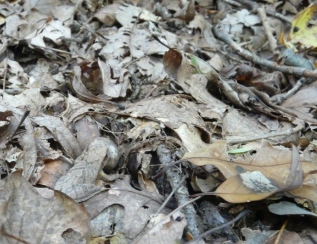
Camouflage on leaves
How about now, when it sits on a rock?
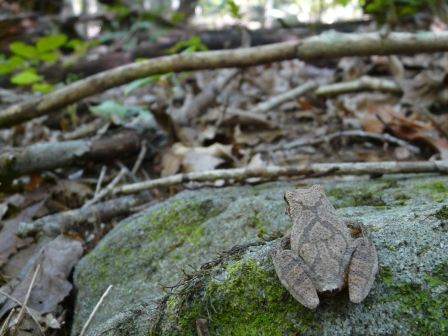
Spring peeper, Pseudacris crucifer. The scientific name derives from the cross on the animal's back.
Another cryptic creature, this time an unknown Hemipteran bug:

...and Mary demonstrates how to "picture-bomb."
Allie found an archaeological artifact (or, trash, depending on your perspective). After some debate, we left it in place. The mini-terrarium inside was remarkable — soil had accumulated over the years, then moss spores somehow found their way in.
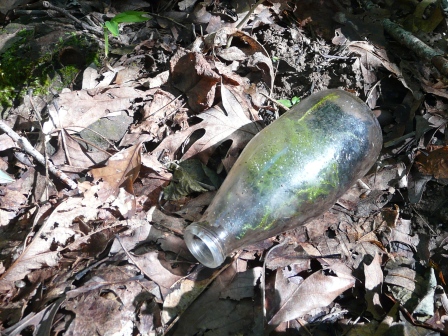
Bryophytes in a bottle
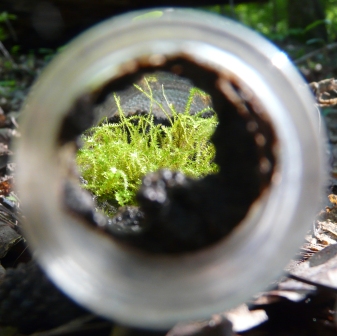
Another world inside; like the Sewanee Bubble.
Last, Jeff found a spectacular Philomycus under some bark of a downed log. These native gastropods are “mantleslugs” and they are as big as cigars.
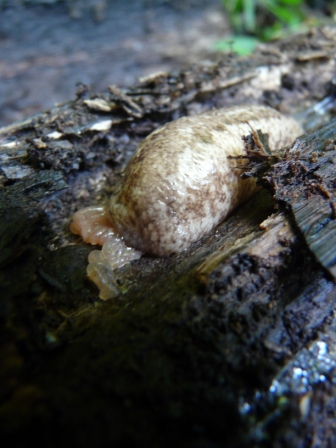
Philomycus with the fecal remains of its fungus dinner.
…EEeep! EEeep! Rose-breasted Grosbeaks are in town, en route to Central American and the northern part of South America.
When I asked Google Maps for directions, it responded: “We could not calculate directions between Sewanee, TN and Bogotá, Colombia.”
Each cluster of purple berries is about as big as a lemon. And each beautyberry shrub has dozens of clusters: a fruit-eating bird’s dream.

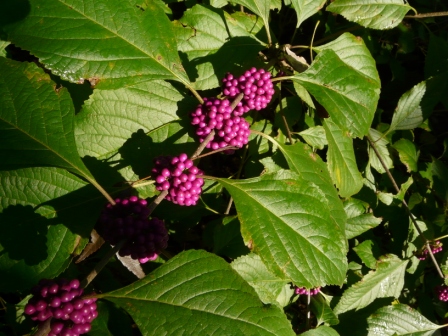 In addition to providing food for birds (our resident mockingbird has occupied the bush and gorges herself several times each day), the bruised leaves of this shrub produce mosquito-deterring chemicals, making it a good shrub to turn to when under mossie assault in the woods
These photos are from our garden. In the wild, this species prefers the lower elevation limestone slopes over the sandstone uplands.
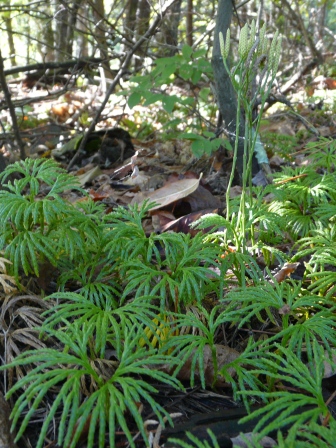
Clubmoss with its spore-bearing "clubs" and branching, green stems
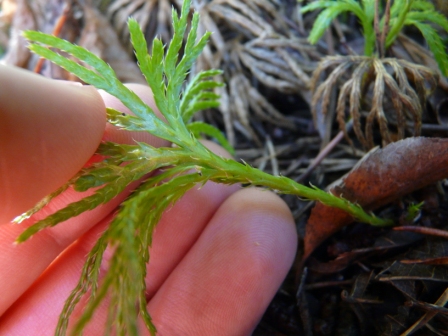
Like other Lycopods, this species has small, scale-like leaves that emerge from the stem. Unlike the leaves of flowering plants, these "mircophyll" leaves are supplied by a simple, unbranched vein.
This Lycopodium is a diminished shadow of its ancestors. Three hundred million years ago, another Lycopsid, Lepidodendron, grew in vast forests all across our region (and well beyond, where-ever the Carboniferous coal forests grew). Lepidodendron also had scale-like leaves, restricted to the tips of it long bifurcating branches. These plants grew up to 30m high and their remains form part of the coal deposits that we now use to power our economy. Unless you’re on green power, the light coming from the image of the tiny clubmoss on this post is likely fueled, in part, by these ancient relatives: their stored photosynthetic energy flickers one more time.
 David George Haskell