Author Archives: David George Haskell

Pipevines

This humble vine is at the center of a evolutionary tangle of butterflies:
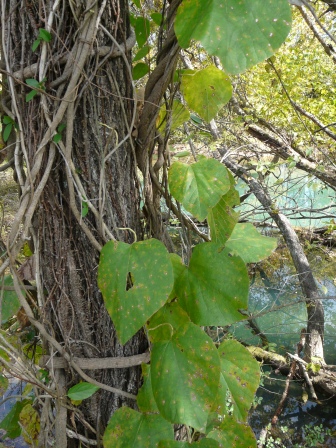
Woolly Pipevine, aka Dutchman's Pipe, Aristolochia tomentosa.

The vine makes poisonous defensive compounds which keep away most chewing insects. But pipevine swallowtails have evolved the ability to not only eat the pipevine, but to sequester its nasty chemicals, taking on a protective mantle. The poisons are stored by caterpillars when they feed on the vine and the chemicals are retained in the bodies of adult butterflies. The butterflies advertise their distastefulness with distinctive blue and black colors. Few birds or other predators are interested in attacking this species.
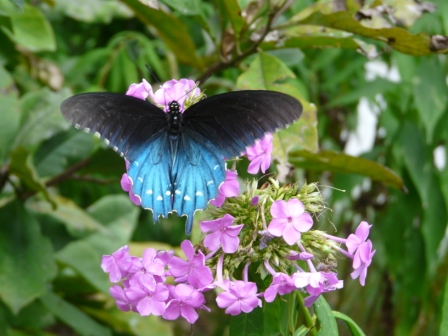
Pipevine swallowtail (photographed earlier this summer, as were all the butterflies that follow)

This bad-tasting butterfly carries a gaggle of other species in its wake. These others lack the defensive chemicals, but mimic the blue and black colors, gaining protection through false advertising.  This kind of mimicry is called Batesian mimicry, after Henry Walter Bates, a Victorian naturalist who first described the phenomenon in the rainforests of South America.

Mimic 1: Spicebush swallowtail

Mimic 2: Red-spotted purple

Mimic 3: Female tiger swallowtail (males are yellow and black). The females can also be yellow and black; the proportion of mimetic forms increases in areas with more pipevine swallowtails.

Humans also use the chemicals in pipevine as a herbal medicine, but the severe toxicity of the aristolochic acids in the plant make this risky medicine, at best.
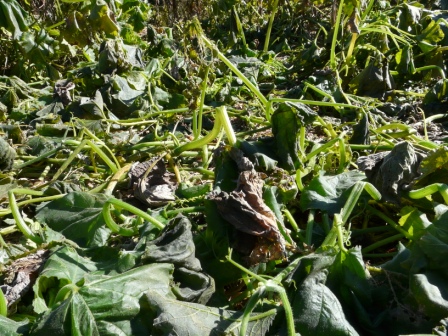
Autumn, part 2, begins

A vigorous killing frost laid waste to the last of the tender summer plants in the vegetable garden.

RIP squash vines

I harvested the last of the peppers before they could get zapped,

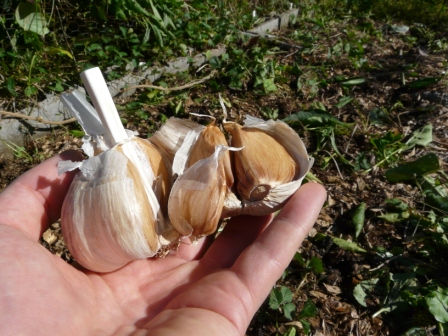
then planted garlic bulbs in the empty pepper beds.

New birds in the garden today, all refugees from the north that will stay with us for the winter: dark-eyed junco, yellow-bellied sapsucker, and white-throated sparrow.

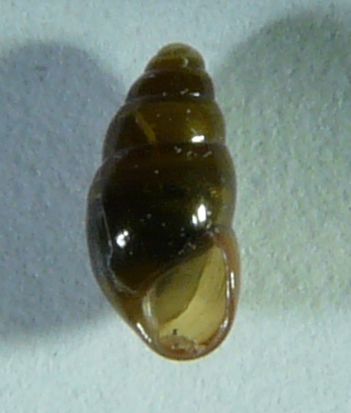
Cionella snail

This tiny snail is about the size of a grain of rice (5mm long). Chris Waldrup brought it to me after finding it under a log. The snail belongs to the genus Cionella, probably Cionella morseana (the genus also goes by the name Cochlicopa). Reproduction in this genus of snails is mostly through self-fertilization, confusing the taxonomy of the group by creating a star-burst of mini-groups. Studies of European members of the genus have found that some named “species” are collections of multiple lineages.

This snail is the intermediate host of Dicrocoelium dendriticum, a parasitic liver fluke that infects sheep, goats, and cattle. After infecting a snail, the fluke moves on to ants, then finally infects mammals. The following diagram from the CDC summarizes this complex life cycle, although they have drawn the wrong species of snail. Humans can get infected, but only when we eat infested ants, an event that is apparently rather rare.

Yucca drill

Downy woodpeckers love the dried flower stems of yucca plants. The stems stand for months after the flowers have died and woodpeckers visit them every few days. Presumably, woodpeckers are after the overwintering larvae of insects.

Head-banging. Seedpods rattle as the woodpecker works.

Pileated woodpecker feasting on magnolia fruits

The sun was rising directly behind the magnolia tree

Southern magnolia (Magnolia grandiflora) fruits are dyed bright red by lycopene pigment, the same colorant that gives tomatoes their glow. They are buried in the brown husk at the bird’s feet. Like other colored autumn fruits, the magnolia is advertising its wares to passing seed-dispersers.

Across the road, the male’s mate was pecking at a dead tree trunk. After a minute or two, she flew down to join him at the fruit bar.

Note her black mustache and black forehead (the male has red in both places).

Counting back

Sewanee’s campus lost two of its oldest living residents last week. No fanfare ensued, although these were remarkable members of our community. They were born before 1800, one or two human generations before the founding of the University. They were likely seedlings when Tennessee first became a state.

The growth revealed by the tree rings on these oak trees showed no sign of slowing until last summer when the construction company working on the University Archives dug up their roots and routed their heavy machinery directly across most of the root zone. The trees could not recover and were cut down.

Migrant thrush

Despite the best efforts of our resident mockingbird, the beautyberry shrubs are still loaded with fruit. Today, two Swainson’s thrushes (Catharus ustulatus) found the bounty and have been feasting ever since. They can swallow a dozen fruits per minute.

Swainson's thrush -- note the smudged spots on the chest and the buffy eyering

Swainson’s thrushes nest in the spruce-fir boreal forests of Canada and the coniferous woods of the western U.S. The ones in our garden are on their way to South America, where they will spend the winter. Interestingly, many birds in western North America fly due east for thousands of miles before heading south. This seemingly wasteful route (why not fly directly south?) appears to be a consequence of their history: the western birds are descended from easterners and they retrace the migratory route of their ancestors.

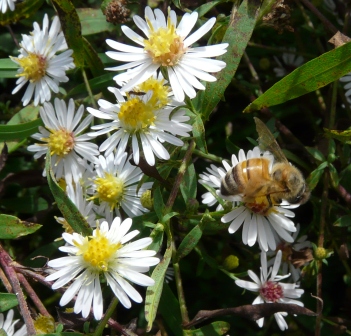
White heath aster

White heath aster, Aster pilosus, is now in full bloom. Each plant stands about four feet tall and has hundreds of small blooms. The plant grows from a perennial root.

Honeybees adore this species. Most other flowers have gone to seed or died back completely, so the abundant nectar and pollen draws dozens of bees to each cluster of flowers.

Pollen basket, the "corbicula", of a honeybee, packed full of aster pollen. The basket consists of a flattened area on the hind leg surrounded by long stiff hairs. The pollen will be used to feed young bees in the hive.