Author Archives: David George Haskell

Ginkgo

The golden leaves of Ginkgo trees are just spectacular this week.

I have a special fondness for this species: its kin date back to the Permian (>250 million years ago), so the Paleozoic lives on right here on our campus lawns. The Ginkgo is also remarkably robust and is able to live in even the most polluted cities. Ginkgo trees were among the few living creatures to survive the horrors of the atomic bombs that were dropped onto Japan. Survivors, indeed.

In addition, the species refuses to conform to our narrow notions of botanical beauty. It is dioecious (female and males are separate individuals) and female trees are currently scattering their extremely pungent seeds all over tidy lawns (the smell is butyric acid — rancid butter). The philosophical underpinning of a lawn denies the realities of biology: death and sex are nowhere in evidence on a “nice” lawn. The Ginkgo violates these standards with great flair. I can smell the trees from at least fifty meters away.
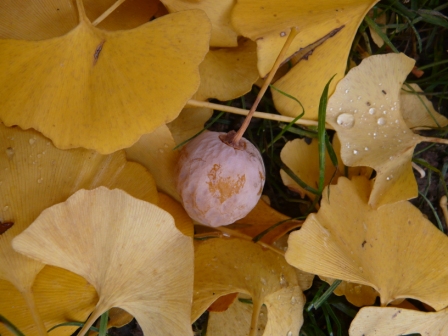
Squirrels can smell them too. When I took my Field Investigations class to see the Ginkgos, we counted ten gray squirrels under one tree, gathering the seeds. The squirrels were as fat as bear cubs. A great harvest. Humans also like the cleaned centers of the seeds, but be warned, the fleshy outer layer is highly allergenic to some people.

Ginkgos are gymnosperms, so they technically don’t make true “fruits.” The fleshy outer layer is actually just the soft husk of the seed, not formed from an ovary wall as with true fruits. (Botany, it turns out, is mostly about sexual organs, an obsession that got Linnaeus into trouble — a colleague reportedly called his focus on sexuality “loathsome harlotry.”)
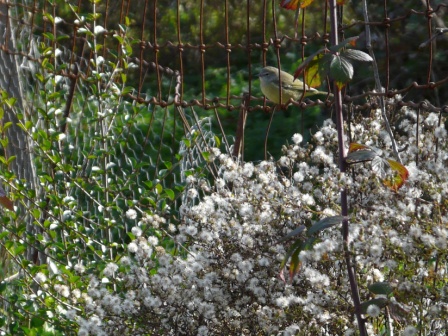
Late migrant: orange-crowned warbler

The bird was feeding in the dead seed heads of asters and goldenrod this morning, chipping gently to itself.

Compared to other warblers, this species is scarce here. It breeds in the far north of Canada, then winters in the southern U.S., along the Gulf Coast and into Mexico.

I pulled its occurence data from ebird‘s new graphing tool. The graph below shows how the number of sightings in Tennessee varies through the year. I also included magnolia warbler to give a comparison to a more common migrant species. The orange-crowned warbler generally migrates later in the year and is much less abundant. Even by orange-crowned warbler standards, mid-November seems a bit late.

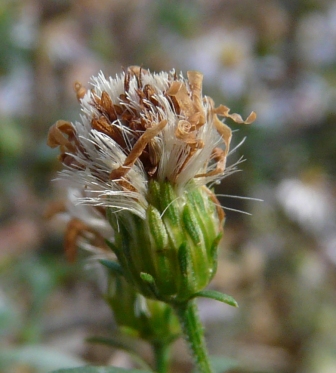
The seed heads of white heath aster seemed particularly popular choices for the bird’s attention. What tiny spiders, flies, and grubs hide inside these pea-sized flower heads?


Hermit thrush

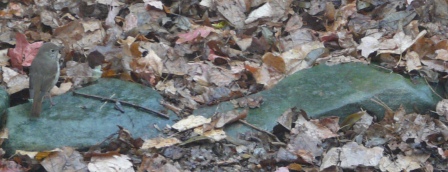
Appropriately enough for a day in which plans to despoil boreal forests were dealt a blow, the first hermit thrush of the winter showed up yesterday. These thrushes breed in the boreal and mixed forests of Canada and the western U.S., then move south for the winter. They are well-camouflaged against fallen leaves; even their rusty tail looks like a fallen autumn leaf. Once spotted, though, they are easy to identify: unlike other thrush species, the hermit thrush bobs its tail up and down, giving away its identify even when all other field marks are unclear.

Pine siskin

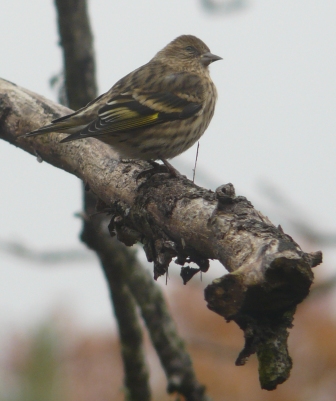
On the heels (or, more precisely, the hallux) of the purple finch, comes another bird from the north, the pine siskin (Spinus pinus — a scientific name with some poetic potential). This species also arrives in Sewanee in waves that vary considerably in strength from year to year. Perhaps last week’s major snowstorm up north has pushed these birds south?

Pine siskin: characterized by a sharp little beak, plus yellow streaks in the wings and tail.


First purple finch of the winter

Note the very distinctive stripes on the head and the slightly forked tail. The size of the overwintering population here varies considerably. The food supply available in the northern coniferous forests seems to determine how many we get. In hard years, we're swamped with them; in other years, we have none. This one is a female. Males have a purple wash over their head.

Amorous ticks

Halloween brought the blood-feeding ghouls and vampires out onto the streets last night. None were more fearsome that the black-legged ticks (Ixodes scapularis) that Neptune the Tick-Gathering Cat brought in. I tweaked an engorged tick off his neck, only to find that I had interrupted an acarine love-fest.

The female feeds and swells with blood, while the male wanders over her adoringly and finally inserts a small sperm packet into a pore. For their libidinous sins, they burned in the fires of hell: not wanting dozens of baby ticks in a few months, I tossed them in the wood-stove.

Does this blood meal make my butt look big?

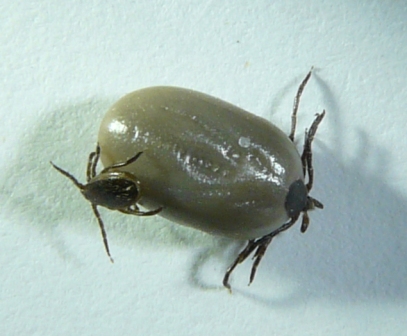
Later, Junebug the Hound brought in a female of the same species that had not yet fed. The difference is fearsome; these ticks actually grow new skin to accommodate their meals.

Adult female black-legged tick, before feeding on high-fructose corn syrup

Catharsis

A few days ago, a deer died just beyond the fence at the bottom of the garden. A dozen vultures came to the wake.

Turkey vulture and Black vultures in walnut branches

Turkey vultures arrive first, guided by their excellent sense of smell. Black vultures follow, guided by their excellent sense of entitlement. Black vultures travel in groups, watching for the turkey vultures, then flop down and drive away their keen-nosed cousins.

All vultures have powerfully acidic guts with potent digestive enzymes. In this way, they cleanse carrion of disease. Anthrax and other microbes are killed by passage through a vulture; not much else in nature will kill them. The scientific name of the turkey vulture is therefore apt: Cathartes aura, the purifier.

Marbled salamander guarding eggs

My Field Investigations in Biology class stopped by the Brakefield Road salamander pond today. This pond is a large ephemeral wetland in the upland forest near Sewanee. It is home to dozens of animals that are found in no other habitats here. These animals thrive because the intermittent drying of the pond keeps out predatory fish, allowing salamanders, frogs, crustaceans, and others to thrive.

Today, we found a female marbled salamander (Ambystoma opacum) guarding her eggs. This species lives under the ground or under logs for most of the year, then comes to the dry pond beds in autumn to breed. The females make nests in depressions on the pond floor, usually under logs. They stay to guard their eggs until rain fills the ponds and the young hatch out.