Author Archives: David George Haskell

Quite possibly the most overused image of North American bird life

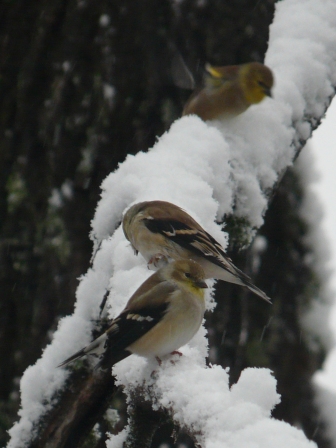
Wet encrustations of snow forced dozens of birds to the sunflower seed feeder. All their usual feeding places, the nooks and crannies in bark, are plugged with frozen flakes.
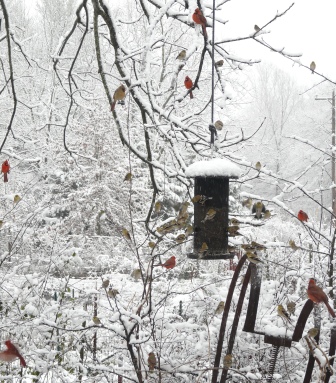
Hard times for birds create interesting viewing opportunities for humans and other mammals with keen ornithological interests. We stay inside and watch through the windows.

Of course, we also have the old standby, “cardinals in snow,” an image found on so many greeting cards, mailbox paintings, Christmas shopping flyers, nature magazines, and, yes, blogs, that the weight of accumulated cultural exposure squashes the actual experience.

My thought on seeing them was, Oh how cliché, an absurd response to the sight of birds that were minding their own business as they fed on my sunflowery largess. Once I got over my overly puffed up horror at participation in such a tawdry aesthetic experience, I saw them with new eyes. They were stunning.

So, what is it about red-on-white? Our eyes are easily beguiled: cardinals in snow, STOP signs, Texaco, the Red Cross, Marilyn Monroe’s lips, Coca-Cola, candy canes, and flags, endless flags (USA, Japan, Canada, England, Poland, Turkey, Singapore, it goes on…). None of these are particularly subtle signals. The recurring theme is, “gimme your attention.”

So, why does it work? The contrast of hue and saturation obviously helps. But so does our heritage as primates. We’re unusual among mammals in being able to “see red.” In fact, most mammals lack the right type of receptor cell in their eyes and so miss out on the cardinals’ display. Only in one lineage of primates did this receptor evolve, probably to see red fruits (our monkey cousins still eat actual fruit, we use the receptor to find candy and sodas, then to define national boundaries — that’s evolutionary progress for you). So thank you, mutant ancestors, for my experience of the cardinals’ winter glory.

The cardinals themselves have an even richer experience. Not only do birds see red, but their receptors open the UV-range of light to them. We can’t begin to imagine the experience of these extra colors. What does snow look like in UV?
Precip

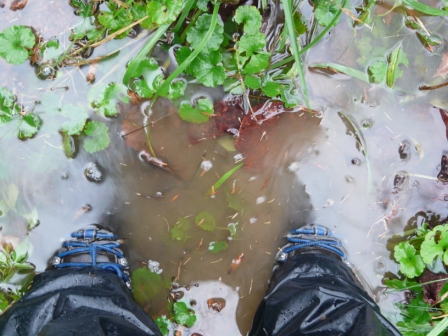
The four or five inches of rain that have fallen in the last day have me thinking that the garden is ready for conversion to rice paddies.

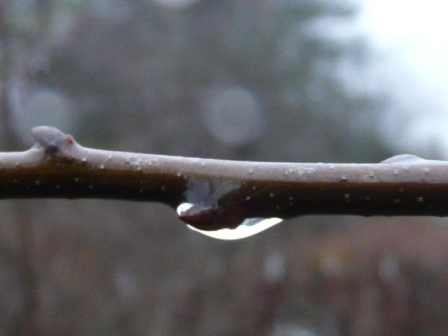
You would think that with all this rain, wild animals would have their fill of water. But goldfinches perched in the rain and carefully caught water drops from the underside of twigs. The birds would reach their heads down, below their feet, then twist to the side and scoop pendulous drops of water from under tree buds. The contrast between the elegance of the birds’ water-gathering and the disorganized squalling of the rain was striking.

Last night the rain turned to snow. Barely enough to dust a goldfinch’s knee, but wet enough to weigh down tree limbs.

Lynn Margulis: an appreciation

Our experience of the world is mediated through stories. Stories (also called theories by those who need a patina of scientific respectability) tell us how the world came to be, how it works, and what its fundamental rules are. Once is a while, someone comes along who so fundamentally changes the nature of our guiding stories that our life experience is transformed. Lynn Margulis, who died two days ago, is such a person.

Margulis taught us the importance of symbiosis in biology — the union of two or more different species into a new form. Her views were dismissed, ridiculed, and ignored for years. Finally, some of her ideas prevailed, although she continued to receive sniper fire for her penchant for questioning dogma.

Now, thanks largely to her, we understand that every living species is, at some level, the result of symbiotic fusion and union: all animal, plant and fungal cells have ancient bacterial cooperators hidden within; trees are united to fungal helpers below-ground; the animals that build coral reefs cannot survival without algal partners; insects are partly nourished by symbiotic gut bacteria; and even DNA itself appears to jump among species, intertwining radically “different” species into new entities. These processes happen in every part of life’s delta, but are particularly powerful among Margulis’ favorite creatures, the so-called “microbes” (the true “99%”).

Our metaphors have to shift. The “tree” of life? No, life has too many cross-connections among distant branches. An unstable, flowing delta is a better image. Evolution as a capitalistic competition among individuals? No, there are as many unions as robber barons; self-interested cooperation is rife.

As a small homage to Margulis, here are some of my DNA sequence data from the mitochondria of land snails. These are the color-coded “letters” of the DNA alphabet found within the ancient bacteria that live inside every cell in a snail’s body. But this description is misleading: the bacterial cells truly don’t “live inside,” instead they have melted their bodies into the other, creating an individuality-destroying symbiosis. Thank you, Lynn Margulis.

Each row is the DNA from one individual. Each column is one position along the DNA stand. The different "letters," A, T, C, and G, are color-coded.

For more on Margulis’ life, see John Horgan’s blog entry at Scientific American. He has some nice insights. The NY Times has a shorter obituary.

Young snail

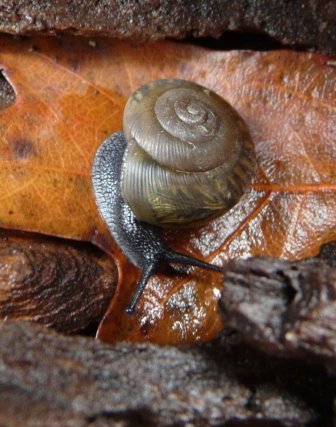
This snail was hiding under the broken edge of a fallen log, posed on an oak leaf. The lung is visible through the shell (the pulmonary vein makes an interesting pattern). This individual is probably a young Triodopsis (dark body rules out Mesodon thyroidus), but it has not yet grown the diagnostic lip on its shell opening, so I’m not 100% sure.

A little jaunt in the early morning…

…down to Bridal Veil Falls, below Morgan’s Steep. Unlike yesterday when the air was warm and the spring peepers were calling, a cold front has pushed some real November chill into the woods. The frogs were silent, but a Winter Wren was singing its heart out. Surely this species is our most vigorous songster, heard only in the winter months (this video and recording from Lang Elliott and Bob McGuire is remarkable — these are not easy birds to approach).

The stream at Bridal Veils comes out of the sandstone scree, hits the limestone layer, then plunges into a pit.

Junebug was fascinated by the pit, but didn’t take the leap. There are some huge toads, snails, and slugs down there. Even in summer, the air at the bottom is moist and cool.

The big waterfall is not the only force sculpting the rock here. Limestone dissolves readily and the rocks have been shaped by years of trickles and oozes.

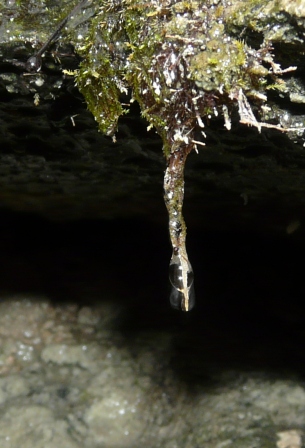
Even a tiny drip over the lip of a rock has cut a U into its path.

A tangle

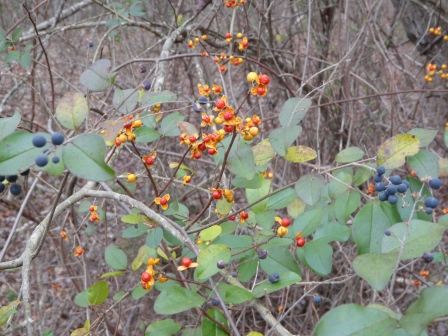
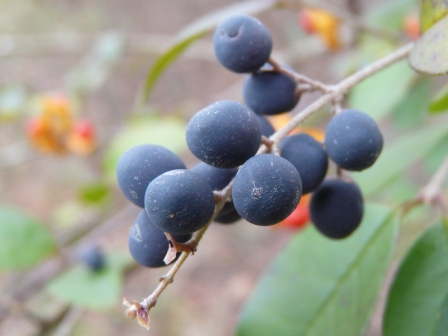
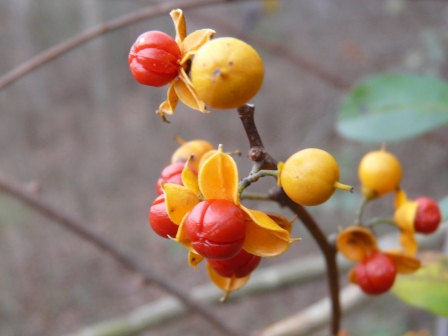
Our two most vigorous invasive plant species, privet and oriental bittersweet, are wrapped into each other at Lake Cheston. A moment’s reflection from the perspective of a hungry bird hints at how these species manage to spread so successfully. Unfortunately, their fruits have no gastronomic value to humans, except when passed through a goat and turned to milk. Bittersweet, despite its appealing red color, is slightly toxic to humans but not to goats.

Their twining reminds me of the Bramble and the Rose.

Proto-holotype

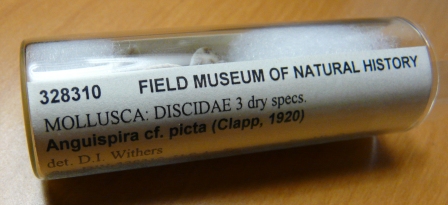
The Field Museum in Chicago has kindly lent me the only known museum collection of the tiger-snail variety that I’m writing up as a new species. Genetic data indicate that this population is distinct and quite different from the other species in our region. One of the shells in this tube will become the “holotype” of the new species, the physical specimen to which the species name is attached. This all depends on the approval of the peer-review process, so the holotype will not be official until (and if) the new species passes muster in review.

Clean-up in the vegetable garden

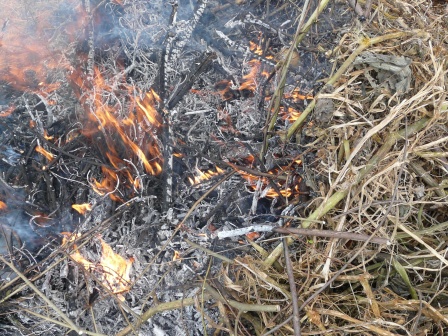
Last year I piled all the old squash vines together in a stack the size of a sofa in an attempt to compost them. They decomposed a bit, but by early summer were still mushy. I think they may have been the source of the powdery mildew that affected my early squash plantings. This year, I’m burning the old vines on a bonfire, hopefully incinerating the mildew spores. And, the burn gives a nice sense of finality and closure to the summer garden. Moving on…

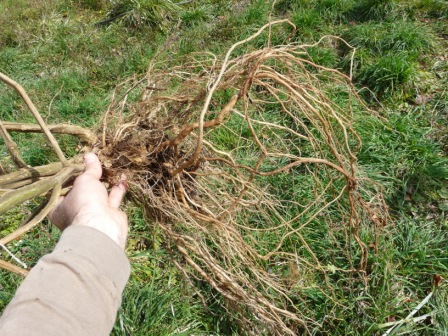
I’ve also pulled the tomato plants. The roots on this one show how large and vigorous individual plants will get if given enough room. I plant them about five feet apart, a distance that seems ridiculous in May, but by August, the tree-like plants are enjoying growth unfettered by competition. In this case, less is more: these vines are more productive than those from my previous practice of crowding plants in staked rows.