Author Archives: David George Haskell

Aristaeus wannabe nearly gets what he deserves

I made a visit to the sisterhood at the end of the garden yesterday to see how they were doing and to add another layer to their stack of hive boxes. Both hives seem vigorous and well-stocked with bees.

The bees in the photo below were standing at the entrance to the hive, holding their bodies up on stilt-like legs, whirring their wings. They are the hive’s air-conditioning crew, keeping a steady draft moving into the entrance, cooling the inside of the hive. When things get really hot, the ventilation crew will bring water into the hive to encourage evaporative cooling.
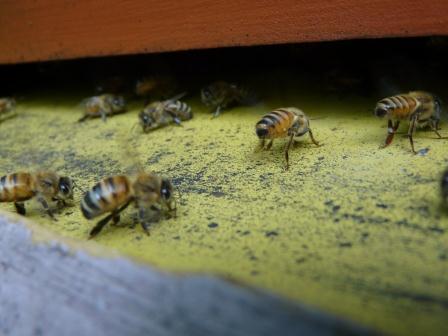
Note below the bees with yellow baskets of pollen on their legs — this is food for the bee larvae inside.

Before opening the hive, I give the bees a puff of smoke. This causes them to gorge on honey and, in theory, to calm down.
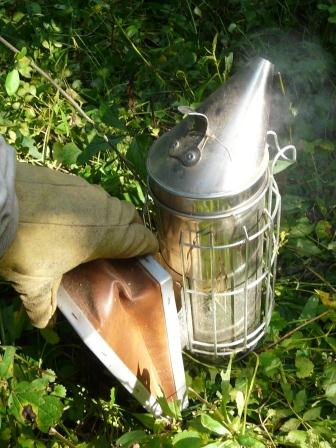
A few did not get the message and tried to sting me through my gloves. One of them left her stinger embedded in the fabric (and thereby sacrificed herself for the hive — the act of stinging kills the bee). In this photo the lance-like part of the stinger is buried and we see the poison sac that continues pumping after the bee has torn herself away.
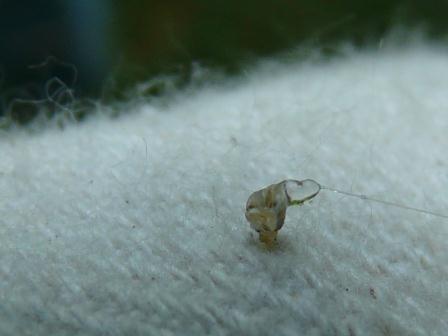
I pulled the stinger out (not easy — the lance is barbed) to get an idea of its length. Answer: not long enough to reach my skin.

For a view of the very tip of a bee sting, as seen under an electron microscope, see here.

Having given the bees the extra boxes that they need for the summer, I’ll now leave them in peace until it is time for me to make my annual bear-like robbery and collect rent.
Reblog: Memorial Day

I’m “reblogging” this thoughtful and moving Memorial Day post from my friend and colleague Chris McDonough. I’ll add that the poppy referred to in the poems of WWI is the European poppy, Papaver rhoeas, a annual plant that specializes on colonizing disturbed soils. It therefore bloomed all over the bombed-out landscape of Northern Europe during the war. The plant is still a successful “weed” in European grain fields; these days, the “war” is against herbicide-resistant varieties of poppy: progress of a kind, surely.

Rachel Carson’s birthday: “No one could write truthfully about the sea and leave out the poetry.”

This week I’ve been reading Rachel Carson in preparation for a short essay that I’m working on. Today is her birthday, so I thought I’d post a few quotes from her work. She is a fabulous writer, channeling her extraordinary passion through thoughtful metaphor and confident but understated prose. The quotes come from her article “Help your child to wonder” which ran in Woman’s Home Companion in 1956. I had not read this article before; it is not widely reprinted, but is full of gems. Thankfully, the U.S. Fish and Wildlife Service Conservation Library has a scanned pdf available of the original.

“Out there, just at the edge of where-we-couldn’t-see, big waves were thundering in, dimly seen white shapes that boomed and shouted and threw great handfuls of froth at us. Together we laughed for pure joy – he a baby meeting for the first time the wild tumult of Oceanus, I with the salt of half a lifetime of sea love in me.”

“If I had influence with the good fairy who is supposed to preside over the christening of all children I should ask that her gift to each child in the world be a sense of wonder so indestructible that it would last throughout life, as an unfailing antidote against the boredom and disenchantments of later years, the sterile preoccupation with things that are artificial, the alienation from the sources of our strength.”

“It is not half so important to know as to feel. If facts are the seeds that later produce knowledge and wisdom, then the emotions and the impressions of the senses are the fertile soil in which the seeds must grow.”

When she received the  National Book Award in 1952, she said: “The winds, the sea, and the moving tides are what they are. If there is wonder and beauty and majesty in them, science will discover these qualities. If they are not there, science cannot create them. If there is poetry in my book about the sea, it is not because I deliberately put it there, but because no one could write truthfully about the sea and leave out the poetry.”

Snake (charmer)

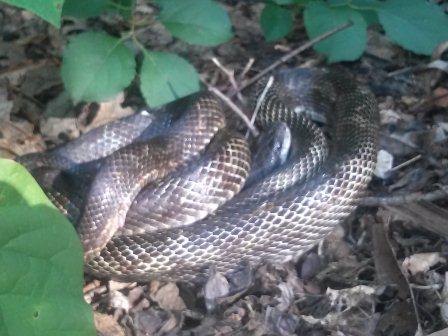
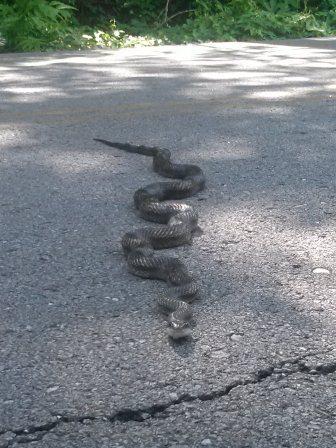
I came across this large (4.5 foot long) snake as I was biking up Roark’s Cove Road near Sewanee (apologies for the haze in the photos — these are phone-camera shots). The snake is a black rat snake (Pantherophis obsoletus) and it showed no desire to move off the toasty road surface. I did not want it to get squashed by the next passing car, so I unclipped from my bike and poked the snake with a stick. It responded by curling into a defensive posture with its head jabbing at the air in my direction (all bluff — these rat snakes are non-venomous and present no danger to humans). It was now even less inclined to slither off the road. At this point a car came up the steep road. No doubt the driver wondered what a sketchy dude in tight shorts and odd shoes was doing waving a stick around in the middle of the road, but this is Sewanee, so peculiarity of behavior is expected if not always welcomed. I used the universal hand signal for “there is a gorgeous snake curled in the road; I am presently attempting to assist the animal; please don’t squash it.” I resorted to scooping the snake onto the stick and shuffling it to the verge. This caused further coiling, with the head withdrawn under the body, nose peeking out. Yes, I was snake-charmed.

Hopefully the snake had the sense to stay off the road after I left. I’ll find out on my next ride. This road is heavily wooded and therefore great for viewing wildlife as I pedal Sisyphus-like up the mountain, but it is regrettably also good for finding road-killed beasts of all kinds.

Spotted Wintergreen

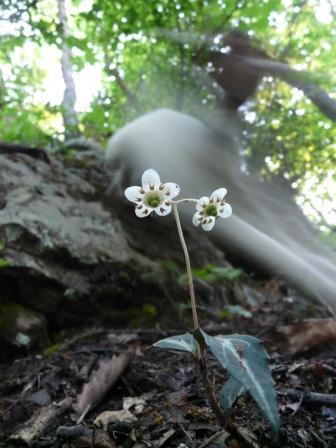
This diminutive wildflower grows in sandy poor soils. It also goes by Pipsissewa, from a Native American name (which of the many languages of Native Americans, I do not know). The leaves taste vaguely medicinal and were once used in root beer.

The flower stands about five inches tall. This one was growing below the cliff at Morgan’s Steep. I angled the camera up to give a bumblebee’s view of the ornate architecture of the flower — these insects are the main pollinators.

Junebug bombed the photoshoot. Stasis and motion:

The plants are growing in deep woodland shade and the white stands out from the gloomy surroundings like a tiny bumblebeacon.

Goslings and caterpillar

Continuing with the theme of cute animals, I was in Chattanooga today and took time out for a bike ride along the Riverwalk. Young animals from two very different parts of the tree of life caught my attention.

This mixed brood of Canada goose goslings was making its way upstream along the Tennessee River. There are at least two families, possibly three, in this “crèche.” Mixing families like this is common in waterfowl, although less so among Canada geese. There is safety in numbers, so these goslings benefit from each other’s presence.

This pipevine swallowtail caterpillar was crossing the concrete path. Although it looks fearsome, it is harmless to handle. But any would-be predator foolish enough to try to eat the caterpillar will soon regret its decision. These caterpillars feed on poisonous pipevine plants and sequester the toxins in their bodies. The toxins then get passed to the adult butterfly. The adult tastes so nasty that half a dozen other species of butterfly mimic the butterfly’s blue and black colors, gaining protection through deception. Predators generally leave these mimics alone for fear of biting into a pipevine swallowtail. The photo below is from last summer — note the remarkable iridescent blue. Although I frequently encounter the adults I have never before seen the caterpillar. So a close encounter with this bristly rubbery beast made my day. I put it back in the vegetation, away from the walkway.

Mammoths

The discovery of the remains of a miniature mammoth on the Mediterranean island of Crete was announced last week. These mammoths stood about waist-high and the reconstruction of the animal in the journal Nature must rank as one of the cutest scientific reports in a long time.

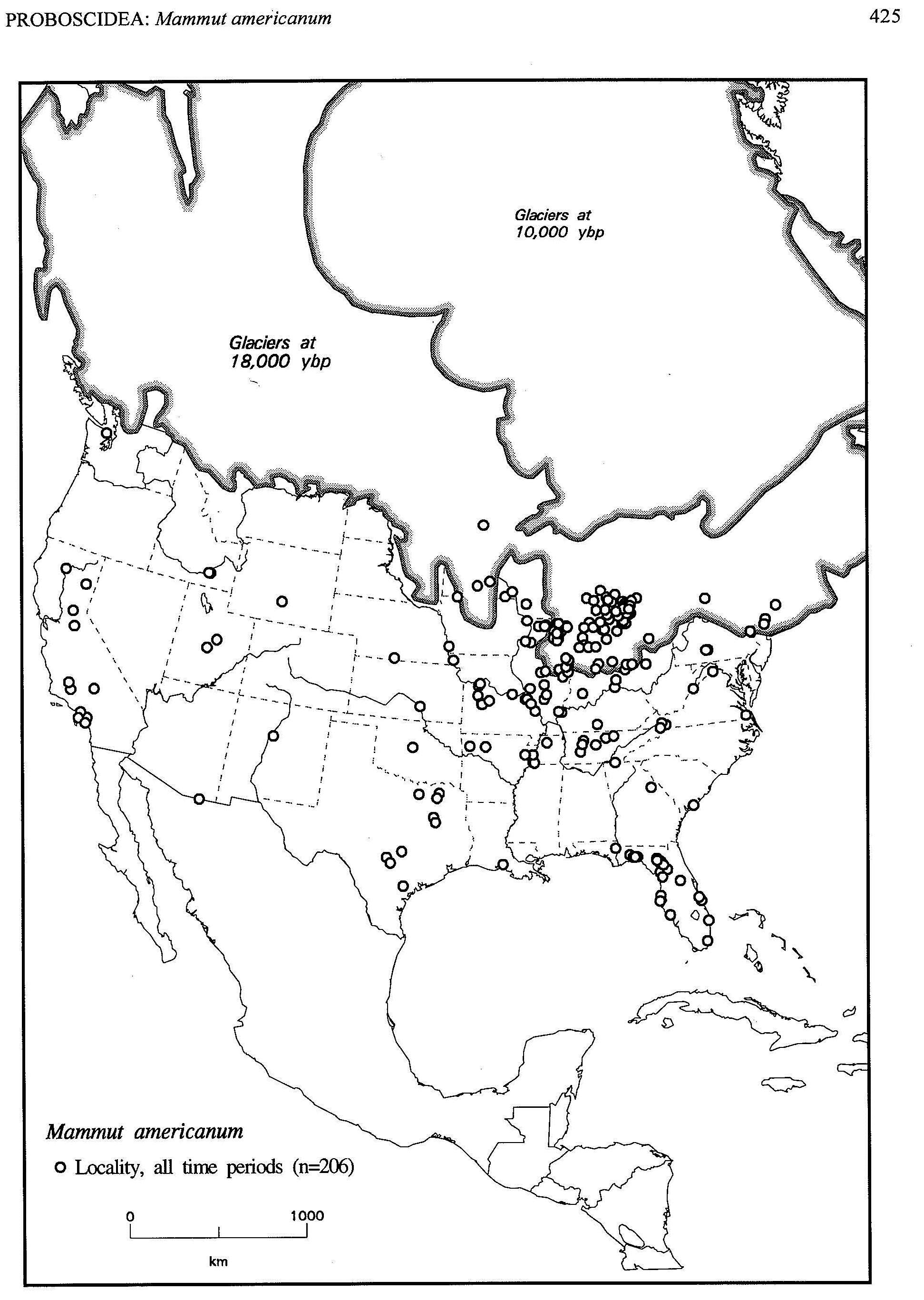
If Crete seems impossibly remote, the map below serves as a reminder that mammoths and mastodons (full-sized: three meters high) roamed North America until very recently. For three million years, this species wandered through forests in small bands, tearing up the vegetation. The “damage” left by the much maligned white-tailed deer is nothing compared to what these giant herbivores wrought. About ten thousand years ago the mammoths and mastodons disappeared. A combination of climate change (the last of many ice ages was ending) and predation (humans had just shown up on the continent) probably did them in.

So, we have to turn to our imaginations to experience what our forests were like for most of their evolution. We sit on a mountain ridge and watch a group of huge elephant-like beings work their way across the valley, twisting at tree trunks with their five meter tusks, ripping and nibbling at branches with their mouths. Their calls? Stirring, no doubt.

Each dot is the location of a fossil. Image from FaunMap: http://www.museum.state.il.us/research/faunmap/ This map is for the American mastodon. The fossils from Crete were mammoths, a different genus.

Trees in Oxford, MS

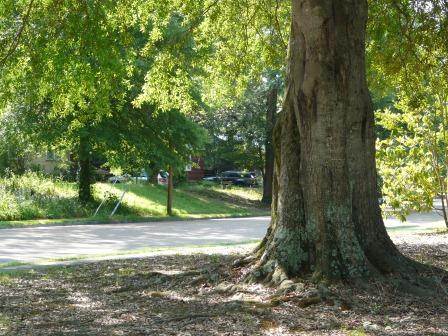
The number and stature of trees in Oxford, MS, is impressive. My stay was quite short, so my ramblings were brief, but it seemed to me that the sylvan nature of town extended well beyond the upscale neighborhoods. Urban trees and other forms of biodiversity are well-known to be associated with the more wealthy parts of towns (e.g., this and this study), so the presence of large trees in less affluent neighborhoods can be thought of as a measure of the “eco-justice” in communities: access to the practical and aesthetic benefits of nature.

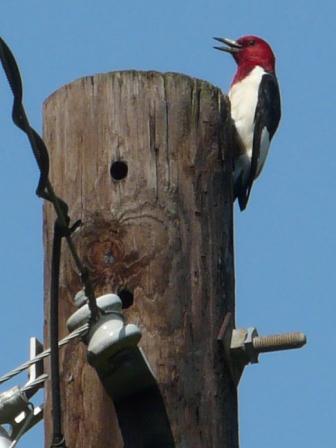
The large trees in the suburbs of Oxford attract a good diversity of bird species, including this red-headed woodpecker that was using the top of the power pole as a place to carry insects or seeds to jab with its beak.

The impressive tress in town contrast with much of the rural land in northern Mississippi where large plantations of loblolly pine dominate. These plantations are planted and cut like crops and, although they have more biodiversity than cotton fields, they generally host fewer species than native forests or residential areas (for my study of these differences on the Cumberland Plateau, see here).

Oxford’s wealth of trees didn’t “just happen.” The town has a tree board and a plan that not only seeks to preserve existing trees but also to expand plantings for the future. So, what lies behind the leafy charm of one of the most beautiful (and consequently one of the more prosperous) southern towns? Proactive urban planning, the work of loving the people and trees of the future.

“Given a choice between grief and nothing, I’d choose grief” — William Faulkner

Rowan Oak, the home of William Faulkner from 1930 until his death in 1962, has the feel of a sarcophagus from which the King has been ghosted away. The ornamented shell is there, the bones have moved on, yet the spirit lingers. I think Faulkner would have liked it that way. I’m no expert on his work, but the interpretation (and preservation) of memory runs through his writing. Memory is now preserved and interpreted at Rowan Oak with care and skill.

A few of his own words about time, memory, and writing:

“The aim of every artist is to arrest motion, which is life, by artificial means and hold it fixed so that a hundred years later, when a stranger looks at it, it moves again since it is life.”

“Clocks slay time… time is dead as long as it is being clicked off by little wheels; only when the clock stops does time come to life.”

“I have found that the greatest help in meeting any problem is to know where you yourself stand. That is, to have in words what you believe and are acting from.”

“The past is never dead. It’s not even past.”

…and most telling of all, “Given a choice between grief and nothing, I’d choose grief.” Memory, indeed.

From the house and grounds:

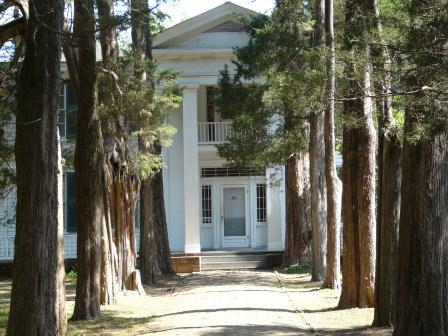
The entrance to the main house. Cedars line the driveway. Although they are not native to this part of Mississippi, they were planted with the hope that they would ward off yellow fever. Now they are grand old trees, filled with woodpecker holes.

Typewriter in his writing room.

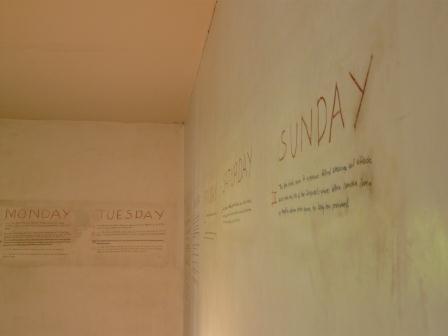
Plot outline for The Fable drawn on the wall of the same room.

His thoughts on tools of the trade.

Punctuation to his writing.

More punctuation.

Estelle Faulkner’s watercolors line the walls.

…and she had this window AC unit installed the day after his funeral. He objected to AC until the end. The timing of the appearance of the unit no doubt is loaded with meaning that we’ll never have access to — did she willingly respect his wishes, or chafe at his strong-headed bullying, or did grief finally make the heat intolerable?

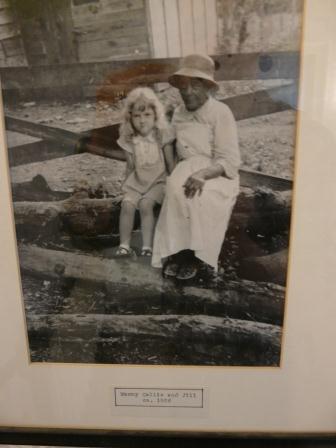
The Faulkner’s servants have a low profile in the house. A form of erasure. “Mammy Callie” is present in the house in this photograph; I did not encounter the other two servants. 

Servants’ quarters in the back of the house. These memories are locked. Hopefully restoration will be coming soon.

The old man’s boots have some miles left in them…

Pricky Pear in bloom

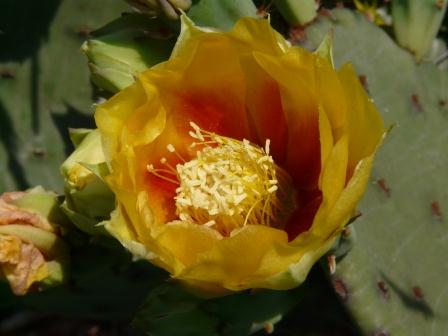
Tennessee’s only native cactus, the prickly pear (Opuntia humifusa) is coming into flower. The flowers stand on top of the fleshy green stems like torches on monuments — an apt comparison in both shape and brilliance of color. The gorgeous intensity of orange and yellow in these flowers is hard to convey. Wow. I feel my wax wings start to melt.

This cactus grows in places that are too hot and dry for most other plants: rocky outcrops, dunes, gravel, and thin rocky soil. I found this cluster of plants on the lichen-encrusted sandstone outcrop behind the Fulford Hall parking lot in Sewanee. There are dozens of cactus plants there, each one bearing several flowers. I’ve never seen such profusion. Perhaps the long warm spring has suited them.

Bumblebees love the flowers. Such is the strength of their desire that several were fighting their way down between the petals of unopened flowers. Later this summer I’ll check the patch again. The pulp of the fat red fruits is edible, although the spines urge caution in this gastronomic quest.