Author Archives: David George Haskell

Horror from within

The rains have brought all kinds of strangeness to the woods. As we wrapped up our surveys of stream salamanders, a cry went up: nematomorph! (Yes, this is an advanced class; in Introductory Biology the cry would have been, OMG-gross…) Lying on the stream bed was half of a Narceus millipede with a long white worm writhing its way out of the broken body. The millipede’s front legs were still grasping feebly at the ground. It had dragged itself several feet to this spot, leaving its other half discarded on the wet rocks.

This individual was not alone. Barely ten minutes later we found another, this time with both halves still encasing the emerging parasite.

I’m fairly confident that the students’ identification of the cause of this distress was correct: a nematomorph worm emerging from its host. However, the light color of the worm makes me a little suspicious that a mermithid nematode might also be the culprit. My search of the scientific literature revealed nothing about either of these worms in this particular host, so we may have stumbled into new corner of the vast wonderland of pain that is animal parasitism. We’ll likely head back down into Shakerag Hollow to see if we can find more worms to bring back to the lab.

Nematomorphs appear in the first chapter of The Forest Unseen as examples of one extreme of the continuum between cooperation and conflict. The worms eat their hosts from the inside out, with no regard for the comfort of the suffering victim. The vital organs are left in place to allow the host to continue feeding (the food goes mostly to the inner pirate, of course). At last the parasite directs its hollowed-out victim to water. There the worm breaks free, discards its dying carrier and squirms away to look for a mate.

After one of my recent public lectures, someone recently asked me for an example of what I meant by the “weight of the world’s pain” (what a blessed life the questioner must have led). This species could surely serve as an answer.

Some visceral fears are tapped when we observe the emergence from within of a life-robbing villain. I think these fears may, in part, be rooted in our species’ long history with parasites, some of which do indeed emerge through our flesh, others merely use existing exit orifices. Either way, we recoil in horror. Movie-makers titillate these deep-seated fears when they show slick-bodied monsters sliding out of our skin. And Freud et al‘s ideas of the unconscious are so successful because of our pre-existing and, ahem, unconscious fear of what might be hidden within us (oh delicious infolding circularity). Psychoanalysis entices because it promises to draw out the appalling inner worm, a cleansing that is surely the deep desire of all animals.
Act I of Autumn

A vigorous belt of chilly rain passed over Sewanee this morning. In its wake, a Canada Warbler feeding on the shrubs in our garden. This is a bird of the boreal forest, found here only during migration. Cool rain, falling temperatures, a forecast for a week of low humidity and clear sunny skies, and the Bird from the North: these all speak of the season’s change.

The plants are ready. Many local species make use of the autumnal surge of birds to complete their pollination and seed dispersal. Cardinal flowers bloom along lake edges, beckoning hummingbirds with their crimson blooms. Dogwood and beautyberry offer brightly colored fruits to the passing thrushes, vireos and warblers. These birds feed on North American insects all summer, then become frugivorous on their tropical wintering grounds. They start the fruity feast right here, gobbling the fruits of our native shrubs and depositing the seeds a few hours later.

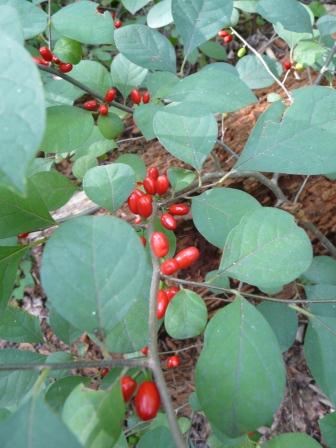
One of the most abundant of these fruiting shrubs is spicebush (Lindera benzoin), a species that is particularly common on the mountain slopes. This has been an incredible year for spicebush. I’ve never seen so many fruits. The warm spring must have suited them.

Like Christmas trees loaded with goodies, the plants will be stripped bare when the party gets going. For now, they sit in a quiet forest, waiting for the rambunctious guests to arrive. But unlike the treats on Christmas tree which make up just a small part of the festive food, these berries are the main meal for migrant birds. Now that dogwoods are nearly gone from our forests, killed by an invading fungus, spicebush is a lifeline for the feathered travelers.

Fall garden emerges

This slideshow requires JavaScript.

The slideshow shows a few snapshots of the emerging fall garden (and a gratuitous picture of a Seminole squash bloom — one plant has put on about 200 ft of vine and is still producing). It is very good to see lettuce again after a too-hot summer. I feel healthier just seeing the gentle green of lettuce. Eating is almost an afterthought.

The benign and drawn out autumn weather here make fall gardening quite easy. The weeds grow just a little slower than in the summer and the cooler temperatures are kinder on the soil. Lettuce, Asian greens, and carrots all thrive. And, with a little protection, fall-grown veggies will be good to eat all the way until February.

Unfortunately, a lot of local stores pull their seed racks or offer only turnip greens. If you want to put in a fall garden and need seeds in a hurry, Johnny’s is a good place to start, as is Southern Exposure Seed Exchange. For readers in colder climes, check out Eliot Coleman’s books on winter gardening — the man eats home-grown lettuce in mid-winter in Maine. I can only imagine how good that must look and taste.

Red eft

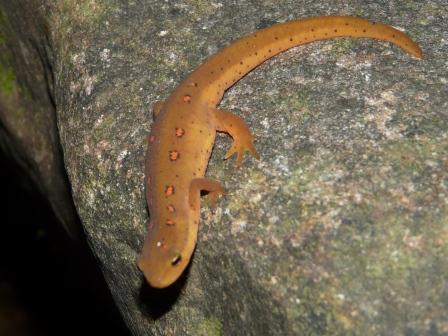
We found this beauty in Shakerag Hollow today during our stream surveys: a red eft, the terrestrial form of a salamander that has no fewer than four life stages. The eggs (stage 1) hatch in lakes, then the larva (stage 2) fattens up in the lake before metamorphosing into an eft (stage 3) that leaves the water and wanders on land for several years before returning to a lake and transforming into an adult red-spotted newt (stage 4).

The eft stage is very unusual; no other salamanders in our region have such a stage. The advantages are clear: the eft can feed on the forest’s abundant small invertebrates and grow to adult size without having to compete with any adults. This is a common strategy among other animals, especially insects whose young specialize on different food sources than the parents (butterflies and caterpillars; maggots and flies; lake-dwelling larvae and flying dragonflies). But why should only the newt adopt such a strategy among salamanders? No-one knows, but I suspect that part of the reason lies in the species’ powerful defensive chemicals. All red-spotted newt life stages have neurotoxins in their skin and are therefore well protected from predators. It was therefore presumably not that hard for evolution to draw the eft out of water onto land. Indeed, unlike all other local salamanders, efts wander the woods in broad daylight. They are seemingly the most fearless of all the woodland creatures, with the possible exception of hornets and yellowjackets. Like these wasps, efts advertise their noxiousness with dramatic colors. This one was about only two or three inches long, but was sighted from several meters away.

“Eft” is from the Old English for “newt” or “small lizard.”

Pelting rain, then mist, more rain, and…salamanders

Intermittent downpours are not ideal weather for outdoor classes, unless your topic for the day is: salamanders!

So a hardy (and uncomplaining — YSR!) group of cyclists headed out in the rain, destination Shakerag Hollow. This is the first of many days of salamandering for my Advanced Ecology and Biodiversity class. We’ll be documenting the local fauna and comparing communities among streams with varying degrees of sedimentation.

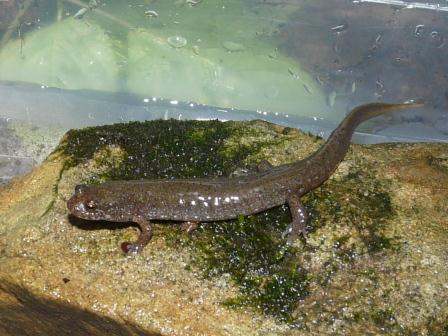
The focal stream for the day yielded many Spotted Dusky Salamanders, Desmognathus conanti. These stocky animals are fast movers: you need quick hands to catch them. They are about five inches long and hide under rocks, emerging at night and in downpours to feed on insects and other small prey.

Spotted Duskies stake out a tiny stretch of stream for their home range, so we made sure to put them back exactly where we found them.

In addition to salamanders, we found several crayfish, including this one, expertly captured and held by my colleague David Johnson, that has two babies attached to the underside of its tail. The females usually carry eggs in this position, but youngsters generally swim off on their own.

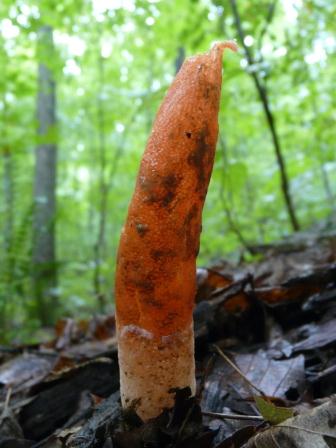
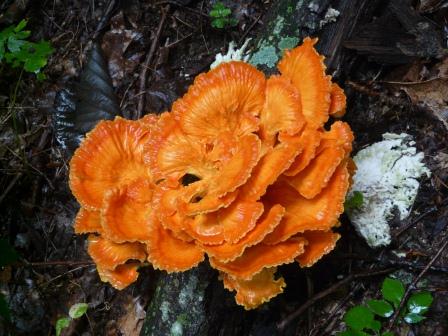
The woods were also full of fungi, including this stinkhorn……and a spectacular growth of what I think is “chicken-of-the-woods,” a species that is edible (to some; for others it causes considerable distress). This fungus was visible from about fifty meters away. It glowed through the mist of the forest. No, it burned. But salamander-like, we survived the fire.

Unusual mating behavior alerts us to an invasion of giant slugs

A pleasant outdoor evening for Cari and Jason Reynolds was interrupted by the antics of some rather large slugs. The slugs had entwined their bodies, then suspended themselves from a stiff strand of mucus. Two large translucent structures emerged from their heads and coiled together. Sex, slug style. More precisely, sex, European slug style; American slugs have more pedestrian ways of completing their unions. For readers with sluggy, salacious turn of mind, the Ever So Strange Animal Almanac has a description (note for the bemused: some British slang involved) and David Attenborough narrates the whole process with some “marvels of nature” music playing along. Bottom line: the translucent structures were penises, exchanging sperm between two hermaphrodites.

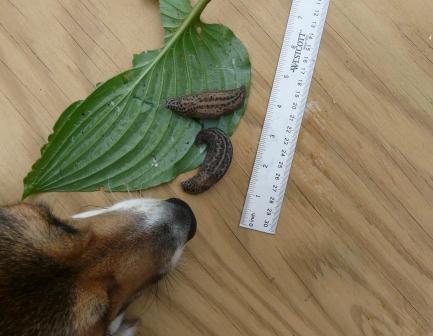
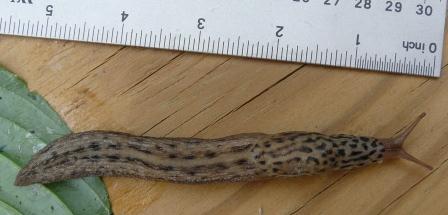
Cari alerted the world through Facebook and I requested a closer look at these creatures. Thanks to a prompt delivery by Jason, I’m now in possession of two specimens of Limax maximus (well named, they grow to eight inches long; photos below). These are the first that I have encountered on the Cumberland Plateau. This worries me a bit, not just because the spotless innocents of Sewanee and surrounding areas are perhaps not ready for regular exposure to giant penis-dangling hermaphrodites, but because these monster slugs may be about to invade our woodlands and out-compete native species. We’re in one of the world’s epicenters of gastropod diversity, so such an invasion would be one more loss in the ongoing worldwide (and local) erosion of biological diversity. In the northeastern U. S., non-native slugs have thoroughly disrupted the local ecology. We have far more native species, so the damage here would be that much more troubling.

The species has been present in the cities of the Northeast since at least the late nineteenth century. Tyron’s Manual of Conchology published in 1885 includes a plate featuring Limax maximus (top two animals in the plate). In these more northerly areas, the slug seems to prefer to live in disturbed habitats and gardens, so it might not invade the forests here. However, our climate is more slug-friendly that that of Boston and Philadelphia; we can’t assume that the species will behave in the same way here as it does elsewhere. Stay tuned for further adventures in the biology of invasive species. Up next: Arion, an exotic slug that is ubiquitous further east, but has not yet been seen in Sewanee (to my knowledge — keep the reports coming!).

Limax maximus. Junebug for scale.

One common name is “leopard slug.”

Five inches. Three more to go. They can live for several years.

“There sleeps Titania sometime of the night, / Lull’d in these flowers”

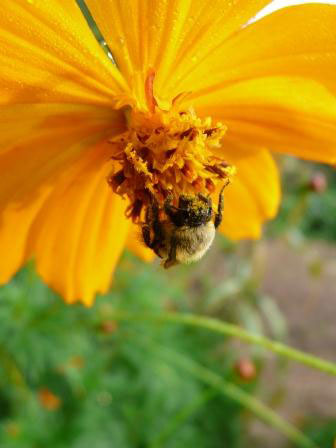
Now that late summer is upon us, bumblebee nests are full of worker bees. These bumble-workers often stay out in the field at night, sleeping in flowers. I found this bee in a dewy Yellow Cosmos bloom. She was completely still, paralyzed by the cool morning temperatures.

Like mammals and birds, bumblebees are endothermic, meaning that they warm themselves from internal heat sources. Bumblebees do this by shivering their flight muscles as they wake in the morning. Until they reach running temperature, they are sluggish and can barely move a leg, let alone fly.

In the arctic, some bumblebees use their bodies’ heat to incubate eggs and young bees, just like a mother bird. Without a boost of maternal muscle-heat, the bees would not have enough time to complete their life cycle during the short arctic summer. This endothermic physiology explains why bumblebees, especially northern bumblebees, are furry: like birds (feathers) and mammals (hair), they have a layer of insulation to retain hard-won heat.

Our local bees’ nightly cold stupor saves energy. But immobility is is a dangerous habit, especially for footloose bees who like to sleep outside of the nest in exposed flowers. Yesterday, I watched a European hornet patrolling the profuse blossoms on a clematis vine. Every time it came across a bee or fly, the hornet lunged, trying to grab the victim.

Look sharp, little bee. An evil Puck is after your life.

Saddleback caterpillar, Acharia stimulea

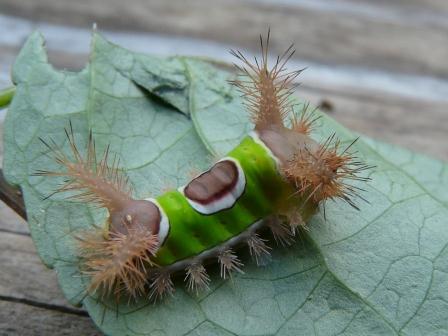
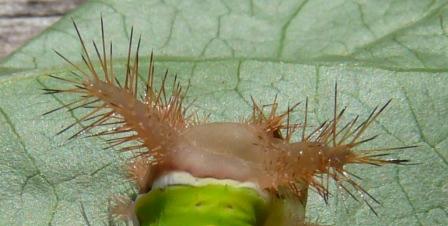
The pain receptors on Marianne Tyndall’s arm found this impressively spiny caterpillar on some garden vegetation yesterday. The caterpillar is about two inches long. Its sting causes pain that feels like a combination of burning skin and tearing muscle. Pretty impressive. The pain is bad enough to cause some people to call a poison center, as reported here. Note that the paper in this link uses the old genus name, Sibine. The paper also relates events in Louisiana where people evidently have different attitudes to caterpillar attacks — in Sewanee, we suck up the pain, then carefully gather the caterpillar to bring it to fellow naturalists.

The stinging hairs deter predatory wasps and assassin bugs. Wasps learn to recognize the caterpillars and after a few inspections, leave them well alone.

The colorful caterpillar turns into a fuzzy brown moth.