Author Archives: David George Haskell

Bee comb, despite the weather

Like a boorish guest, winter is outstaying its welcome. Its hosts wait with forbearance, their energy reserves running low. This week has been dismal for the returning migrant birds (no flying insects on which to feed), the spring wildflowers (no pollinators, no photosynthesis) and the breaking buds of trees (temperatures have dipped low enough to cause some frost damage).

Bees have retreated to their hives. Inside, they turn honey to heat. The hive’s core stays toasty. In very cold spells, the bees ball up, rotating their positions from the exterior to the interior of the ball, kneading warmth into their gathered mass. But on days that are merely chilly, work continues. Brood is tended, the hive is cleaned and wax is lain down.

Two weeks ago, when winter seemed about to get up and leave, I cleaned up the hives that sit at the bottom of our garden. In doing so, I removed some abandoned “wild” comb from an empty hive box. This is comb that bees constructed without the aid of artificial foundations. These foundations make honey extraction easier for humans, but bees don’t need them.

The comb hung down in a foot-long tongue. It was slightly flexible, wobbling a bit as I moved it. The edges of the individual cells were drawn so thin that they powdered away if I handled them without delicacy.

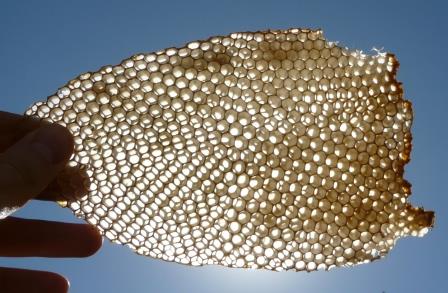
bee comb in the sun

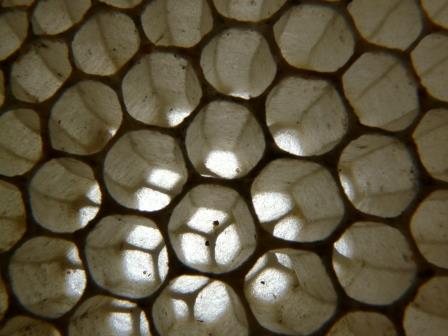
Held to the sun, the wax glowed, revealing the bee’s careful architecture. Cells on opposite sides of the comb are offset. The centers of cells on one side align precisely with the three-way joins among cells on the opposite side. In this way the whole structure is strengthened.

bee combbee comb closeEmpty cells, biding time. When this weather moves on, the bees will be ready.

Reed Environmental Writing Award

This afternoon The Forest Unseen and Jay Leutze’s Stand Up That Mountain were awarded the Reed Environmental Writing Award. This award is given by the Southern Environmental Law Center in recognition of books that address the changing southern environment, especially the relationships between humans and the rest of the community of life. Undoubtedly many readers of this blog will know that SELC has been, for more than twenty five years, an extraordinarily effective voice for the protection of land, air and water in the southeastern U. S. I therefore feel particularly honored and humbled to be recognized by the Reed Award.

It also gives me special pleasure to share the award with Jay Leutze. Jay and I met just a few weeks ago when he gave a reading at Sewanee. (I dragged him out in the rain to look for woodcock displays, to no avail, a cold Sewanee baptism.) Jay’s book describes a years-long struggle to keep a huge open-pit mine away from the Appalachian Trail and a local community. At least, that is what the book is about on the surface. But along with the gripping storyline comes a portrait of the people involved in the case: neighbors who’ve lived on the mountainside for generations, lawyers and judges of all stripes, a motley collection of professional and home-spun conservationists, tireless and sometimes tiresome state officials, and a lively cast of other characters ranging from unsung saints to deluded drunks. Jay uses his considerable talent as a writer to interweave these tales with beautiful descriptions of the history and ecology of the landscape. Let me rephrase that. The tales are not interwoven, but so tightly connected that the strands cannot be teased apart. Stand Up That Mountain is full of memorable images and tells a fascinating story. I highly recommend it. And if you have a chance to hear Jay speak, grab the opportunity. He’s a great speaker and, I now know, a tough act to follow.

The Southern Environmental Law Center’s work is not usually thought of as “art” or “literature,” but it struck me during my visit that theirs is a high form of writing. By integrating love for the land, deep intellectual analysis, massive amounts of hard work, and a long list of creative partnerships, SELC scribes works of lasting beauty on the land, in the air, through the water, and into our communities. Their words are etched deep and form the stories that future generations will read and live by. Noble literature, for all.

Least Trillium lives on…

I’m happy to report that the Least (or Dwarf) Trillium (Trillium pusillum) that I feared had been dug up by the plant poachers (as an incidental effect of bluebell thieving) has escaped the spade for another year.

My Ornithology class looked down from the skies today and admired some of the wildflowers on Bluebell Island. The Least Trillium was in bloom. Hooray! The species is classified as endangered in Tennessee, so every plant matters. There is only one other location known for the species in our county.

Note that the annual land trust hike to the island is this weekend. (I’ll be out of town and will have to miss the event.) Land trust volunteer leaders will be on hand to help people across the log to the island (a fun challenge) and to point out interesting plants.


Thanks to Will Coleman and his iPhone for this shot.

Thanks to Will Coleman and his iPhone for this shot.

Over the winter I had some new signs made for the island. A few weeks ago Sanford McGee, Joseph Bordley, Bran Potter, and Bob Salter joined me in a little expedition to put them up. Hopefully the message is clear and people will leave the plants in place:

BluebellSignComp

Dead wood, ashes.

One of Shakerag Hollow’s giant trees has fallen. An ash that until last week held its arms in the highest reaches of the canopy now sprawls across the forest floor, its body utterly torn. I’ll go back soon and “measure” things (how tall? what weight of wood came slamming down?), but for now: just awe.

I did not see the fall, but came by soon after. The trunk was … indescribable. Some grand words are needed, for barely imaginable violence had been at work. Rent asunder!? The whole wide trunk was twisted and split open, lengthways, in several long gashes. Other trees, themselves no mere saplings, were smashed into the ground. Large boulders were shifted as roots reared and cracked. The air was infused with the odor of fresh-split wood. An overtone of bitterness, like cut oak, but mostly a sweet smell, almost honeyed.

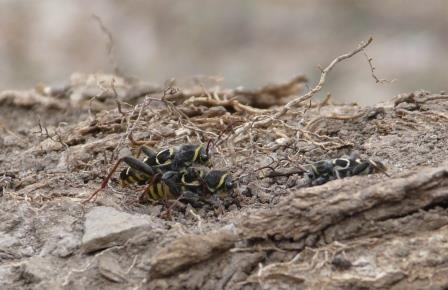
I found the tree in the morning and returned in later in the day for another look. As I stepped closer in the warm afternoon, I hesitated then held back. There were wasp-like creatures, big ones, swarming over one of the thick exposed roots. These insects were scurrying, flickering their wings, crawling over each other. A frenzy.

Black with bold yellow stripes. Buzzing as they flew. Had the tree fall unearthed a buried wasp nest?

Neoclytus caprea

But something was not quite right about these wasps. I moved forward slowly and saw their fat hind legs, too beefy for a wasp. Crickets? No. Then the wing cases, striped in black and yellow: beetles! Wasp-mimicking beetles of some kind. I moved to the side of the tree and saw hundreds of them, racing up and down the bark. They were on no other trees nearby. Half of the beetles were copulating; the other half seemed intent on colliding with the mating pairs. Even though I now knew that they were harmless, their waspy nature made me cautious. Even their short curved antennae were creepily hymenopteran in style (oh yes, those hymenoptera have style).

Who were they? To identify them, I spent some time in the online funhouse known as the Photographic Atlas of the Cerambycidae of the World. This is an amazing site devoted to a single family of beetles, the so-called longhorns (although many of them do not have long antennae). The family contains twenty thousand species, an impressive number when we remember that there are fewer than six thousand mammal species. Some of these cerambid beetles run afoul of humans when they bore into trees and wood that we’d rather they stayed out of. A few of them are “invasive exotics,” killing off native plants. But the beetles in Shakerag were natives: Banded Ash Borers (Neoclytus caprea (Say) 1824). They have an interesting life history, finding recently downed ash and oak trees, then laying their eggs in the bark. The larvae then chew on the wood below the bark, emerging next spring to start the hunt for a newly downed tree.

So I was not the only creature in Shakerag following my nose to the smell of ripped up wood. How many huge ash trees have fallen lately? Not many. Every banded borer within miles must have been at this party. Those flickering antennae are surely tuned to the chemical particularities of newly opened ash wood.

The beetles were one of the very first arrivals in the tree’s new existence. When a large tree falls, its ecological life still stretches out into the future. Perhaps half of the animals (and many more of the fungi) that the tree will nurture during its existence arrive after the tree has fallen. The ecological vitality of a forest can be judged by how may large trees are lying around, feeding beetles, hiding salamanders, growing fungi.

To paraphrase Mr. Faulkner, “Dead wood is never past, it’s not even dead.”

ash

John James Audubon exhibition at New-York Historical Society

It feels like blasphemy to admit it, but I have for some time felt over-Auduboned. In the world of ornithological and environmental studies, reproductions of John James Audubon’s work abound. Coffee mugs, posters, websites: he’s everywhere. Overexposure produces ennui. Surely North American bird art has more to offer than the endless repetition of these 19th century engravings?

A visit to the recently opened exhibition at the New-York Historical Society cracked my armor, snapping my senses out of their laziness.  The exhibition is the first of a three part celebration of the watercolor studies that Audubon painted in preparation for the engravings that in turn produced his famous double-elephant-folio, The Birds of America (1827–38). The paintings have a stunning vivacity and range of feeling. Unlike so many reproductions, these works are alive with Audubon’s hand.

What struck me most was his grand ecological statement: the bird cannot be understood, or felt, or even seen apart from its relationships with other species. Audubon make this case with compelling vigor. As a naturalist, I was also impressed by the sensory truthfulness of his work. The years that he spent tramping the woods and fields shine through.

Of course, Audubon’s style is one of exaggeration: four thrashers defending a nest, one bird swooning into roll-eyed death as the snake slides upward. A spike-crested osprey cries out as it carries away a fish whose mouth echoes the bird’s scream. But though this melodrama sometimes skates on the edge of sentimentality or absurdity, his intimacy with the lives of the birds keeps the paintings grounded in each species’ character, even as his flamboyant emotion takes flight.

The exhibition also has a copy of one of the original double-elephant printings. A magnificent book, the product of meticulous engraving on copper plates, followed by hand-tinting by dozens of colorists. One of the original copper plates is also on display. It was rescued from the melting pot after Lucy Audubon sold it for scrap years after her wandering husband, whom she had propped up financially for years, had died. This copper plate, although it is not centrally displayed, is a significant part of the exhibition. It hints at the costs of Audubon’s obsession.

If you’re in New York, I strongly encourage you to visit this important exhibition. To learn more about the show and its context, I recommend Edward Rothstein’s excellent review in the New York Times. And the exhibition’s catalog is a work of art in its own right.

Addendum: Part II is showing in the summer of 2014. Reviewed in the NYT here. Bring on Part III! (Date not yet announced.)

Upcoming speaking engagements

Next week I’ll travel to New York to give a lecture at the American Museum of Natural History. I’m very honored to speak at such a fabulous center for the study and celebration of the natural world. Please consider attending if you live nearby. Or if you have friends and family in the area, I’d be very grateful if you could spread the word. The talk is at 6:30pm on Wednesday March 13th. Reservations are recommended.

In April I’ll be speaking at Trails and Trilliums, an event organized by the Friends of the South Cumberland. I’ll be giving a lecture and leading a couple of bird walks. The events are in the Monteagle Assembly, April 12-14th, with exact times to be announced on the event’s webpage. The event will also feature a native plant sale (with plants not dug from the wild!), an art show, guided walks and a reception. Please join us, if you can.

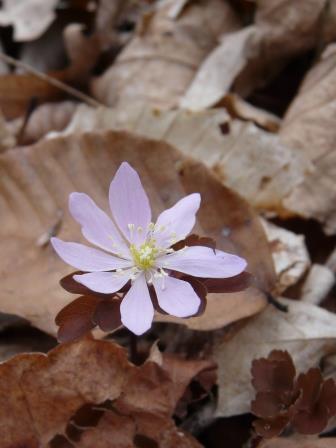
In closing, an early rue anemone, poking up despite the cold:

Rue anemone


Shakerag Hollow snow

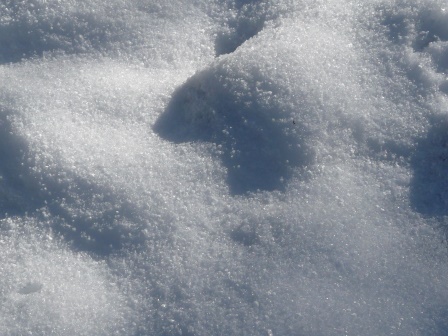
Winter seemed to be slipping quietly out of the door, but evidently it still has business here. The forest floor is transformed.

SnowComp1

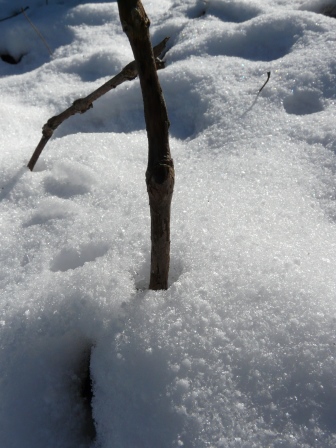
Where-ever dark objects protrude, they soak the sun’s weak heat. Gradually the surrounding snow sublimates, leaving sleeves of empty space around twigs and leaves.

SnowComp7The nascent growth of spring wildflowers is checked. Buds and furled leaves endure, listening for the click of the door.

This slideshow requires JavaScript.

Why so many vultures?

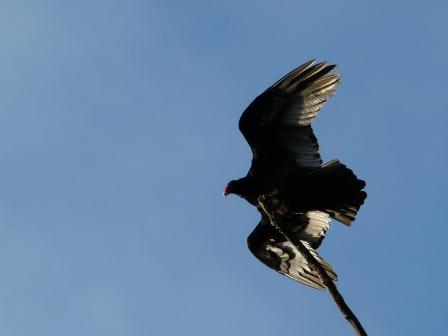
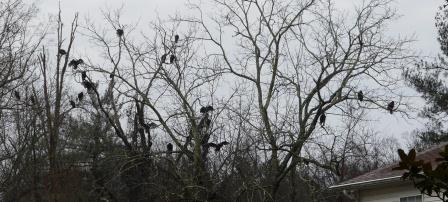
Coasting down the hill on my bike, I turn my head and there it is, a dark angelic form, big as an eagle, soaring just off my left shoulder. We cruise together for a spell, then the bird banks away, the low sun laying a rosy tint on its black feathers. Ahead, hundreds circle low, turning the sky into a swimming confusion of slicing dark lines.

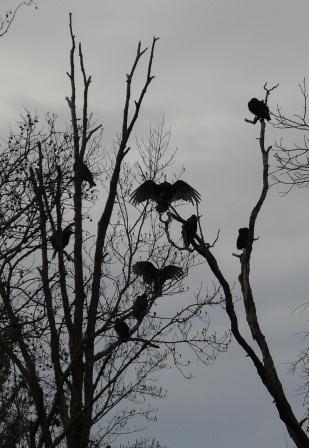
As dusk approaches, the vultures gather in tall pines and oaks around Sewanee’s downtown, clumping by the dozen on high branches. They settle slowly, restlessly hissing at new arrivals and flailing their huge wings at neighbors. With a start, the whole group startles into wheeling flight, then returns to roost with flustering feathers.

vulturesafterwetcoldnight

This roost formed last year in early winter, grew into a gathering of two to three hundred birds, then dissolved as spring wore on. This winter they are back. The talk in town often drifts their way. Why so many? Are they drawn to some hidden bounty of dead animals? Might a leaking gas pipeline be luring them? What danger do they pose?

I suspect that several factors have converged to bring us this spectacular daily display. One of these causes is the regional increase in vulture abundance. DDT’s effects are no longer felt by these birds, fewer people shoot them, and as deer and small mammal populations have increased, the vultures’ food has become more plentiful.

Wintertime abundance of Turkey and Black vultures. I constructed this graph from the Christmas Bird Count data from Alabama, Tennessee, Georgia, and South Carolina.

Wintertime abundance of Turkey and Black vultures. I constructed this graph from Christmas Bird Count data from Alabama, Tennessee, Georgia, and South Carolina. The graph shows populations since 1970.

In addition to this long-term trend, the record-breaking warmth of the last two winters also likely contributes to the recent increase in vultures in our area. Birds that previously would have flown to Florida or Mexico may have curtailed their migration. Why wing to Veracruz when you can dine on ‘possum and venison in a relatively balmy Tennessee or Georgia?

Local changes also play a role. Until last winter, the vultures were roosting here, but mostly out of sight in the valleys and mountain slopes. Why the move? We cannot know for sure, but it may be that these vultures have discovered that no-one harasses or shoots them here in town. It may also be slightly warmer. Like some other native animals, they have found that lingering near human habitation may bring benefits.

The vultures in town are gathering to sleep, not to feed. On all but the most dismal days they disperse every morning, surveying the surrounding countryside for food. They return to sleep in the safety of a group. Certainly any dead animal near the roost gets eaten promptly (a dead deer on the highway near town was snarfed within a couple of days), but feeding is not the purpose of this gathering. Nor can gas leaks explain the behavior. The birds are congregating away from the gas pipeline and show no attraction to any of the gas pumping stations in town.

Do the birds present a danger to humans or pets? My research indicates that dangers are few. If the roosts get larger and persist for many years, their fecal matter might accumulate and start to smell. These droppings are no more threatening than those of other birds; indeed vultures’ powerful guts probably kill more bacteria than the guts of other bird species. Temporary winter roosts present less of a problem in this regard than permanent roosts located further south (where some vultures have, in addition to depositing guano, turned into vandals). Another threat is unlikely, but memorable: vultures defend themselves by vomiting on their assailants, so it is possible that foolhardy hazers of the roost might get an unpleasant (and potentially bacteria-laden) shower. This outcome can be avoided with some common sense. Don’t climb roost trees. And remember the ornithologists’ Golden Rule: keep your mouth shut when you look up.

vulture

Of all the species that I researched for The Forest Unseen, vultures were perhaps the one that most changed my everyday experience. I see them many times each day, yet until I knew just how fabulous they are at purging the land of dead animals, my appreciation for their lives was far too limited. No other animal removes carrion with such unassuming efficacy. A vulture gut will kill anthrax and other bacteria, a feat that no other scavenger can match. The near extinction of vultures in India has underscored their importance. As vultures declined, the populations of other scavengers surged, leading to a plague of feral dogs and rabies (and problems for people who use vultures for funerary purposes).

Being followed on my bike by a death-eating scavenger was, therefore, an unexpected delight. The dark forms that soar overhead or sit hunched in tall oak trees are to be admired. Their easy, loping wingbeats are beautiful memento mori, sky burials for the thousands of animals that live and die on this mountain. Like living prayer flags, their presence delivers a very real ecological blessing on the land below.
vulturerow

Fog happens, and the woods rise into it.

The overlook at Green’s View offered an interesting prospect this morning. The hundred mile view was shortened by the enveloping cloud to less than one hundred feet.

fogThe fog penetrated the forest, hazing and graying views through the trees.

fog2The smell was deliciously tenebrous, seeping into the dim air from the darkness of the soil. Shrews and moles must inhale the same rich earthiness as they burrow.

Although we imagine springtime coming from elsewhere, a warm breeze blowing birds and warmth from the tropics, in reality most of the year’s new life rises from the musty earth, surging through layers of decay.

The first significant signs of this life have now appeared in Shakerag Hollow. Harbinger-of-spring (also called salt-and-pepper plant, Erigenia bulbosa, a carrot relative with an edible tuber) has raised hundreds of tiny blooms over the mountainside, each one standing barely taller than the upper surface of the leaf litter.

harbinger of spring1

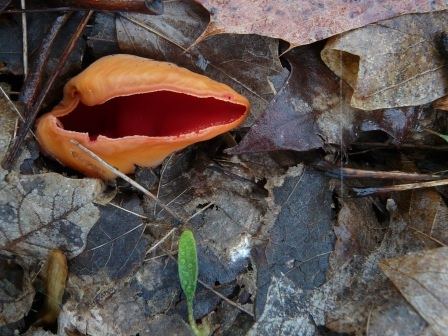
harbinger of springFungi are also poking through, spreading their spores from colored cups.

cup1cuo2And the animal world is alive. Hairy woodpeckers call, perhaps starting their  breeding season. Orange centipedes lumber across the litter, seeking prey into which to sink their poisoned fangs. Spiders, although withdrawn in their hiding places, have their presence revealed by the foggy air. Every web is a bright cloud of droplets. In some places, funnel-web spiders had strewn the forest floor with dozens of newly constructed traps.

funnelLeaves of toothwort, spring beauty, bloodroot and trillium were unfurling, but their flowers were not yet emerged. Soon, though, the smouldering wet soil will blaze.

Quiz: Bird Beaks

Last week my Ornithology class started their bird anatomy studies with dissections of road- or window-killed birds. The project will continue, as in years past, with cleaning of bones and reconstruction of the skeleton, ending with an articulated specimen.

I took the following photographs of beaks before the class started. Can you identify the bird from the beak? Answers with some additional information are listed below. Hovering your mouse over the images will reveal the name (take care when dangling rodents next to birds of prey) or click on any of the images to see a slideshow with answers included.

Answers:

  1. The insect killer. Carolina Wren. Long beak with a downward curve. Great for probing insects out of tangles of vegetation.
  2. Worm slayer. American Robin. “with a start, a bounce, a stab/Overtake the instant and drag out some writhing thing” Also fond of fruit. Hughes didn’t mention that.
  3. Glutton of small mammals and invertebrates. Eastern Screech Owl.
  4. Seed cracker and insect slicer. Northern Cardinal.
  5. Insect gleaner and, especially, fruit fiend. Gray Catbird.
  6. Serious seed cracker and bug crusher. Rose-breasted Grosbeak.
  7. Connoisseur of little insects and dainty fruit. Swainson’s Thrush.
  8. Omnivorous rascal, fond of using its beak to lever into hidden things. Common Grackle.
  9. Bunnies, beware. Red-tailed Hawk.
  10. Everything, beware, including most of the birds on this list. Great-horned Owl.
  11. Bird and rodent destroyer. Note the tomial tooth: a notch in the beak used to pop the neck vertebrae of victims. This notch is shared by all falcons. For the prey, a fast way to go. Merlin.
  12. A mellow forager on plants, algae, and invertebrates. Beaks the muddy edges of lakes, grabbing underwater snails and water bugs. American Coot.
  13. Silencing songbirds. Cooper’s Hawk.